Claim check
Maya Long Count: The 2012 Date Was a Rollover, Not an End
Sherd and Script · Published 13 October 2026 · Revised 1 November 2026
On the Long Count, the 2012 day was day 1,872,000. The inscriptions that name it describe a dedication and a royal visit, and a tablet at Palenque counts on to 4772.
Find card
- Calendar
- Maya Long Count
- Type
- count
- Epoch
13.0.0.0.0 4 Ajaw 8 Kumk'u · documentary(written with 13 bak'tuns, arithmetically day 0) = JD 584283 =11 August 3114 BCE · computed, GMT 584283, proleptic Gregorian(6 September 3114 BCE, proleptic Julian)- Leap rule
- None: a plain count of days. 20 kins = 1 winal; 18 winals = 1 tun (360 days); 20 tuns = 1 k'atun (7,200 days); 20 k'atuns = 1 bak'tun (144,000 days)
- In use
- On stone monuments by
36 BCE · computed, GMT correlation(Chiapa de Corzo, an example cited by Kennett et al.); in wide use in the Classic period,300–900 CE · computed, GMT correlation; out of use before the Spanish arrived in the 16th century - Computed with
- This site's own day count (fixed day numbers in the style of Reingold & Dershowitz), cross-checked with convertdate 2.4.0, mayacal 0.2.6, jdcal 1.4.1 and Fliegel-type JDN formulas; GMT 584283, with 584285 and 584286 shown as
Disputed; proleptic Gregorian and Julian, astronomical years internally (1 BCE = 0)
Find card as CSV maya-long-count-find-card.csv (sources and license, JSON)Data: S. Gronemeyer and B. MacLeod, What Could Happen in 2012, Wayeb Notes 34 (2010), CC BY 3.0 DE, https://hdl.handle.net/20.500.11811/1104 (single readings); S. G. Morley, An Introduction to the Study of the Maya Hieroglyphs, BAE Bulletin 57 (1915), public domain, Project Gutenberg eBook 43491; D. J. Kennett et al., Scientific Reports 3:1597 (2013), https://doi.org/10.1038/srep01597 (single published values); S. Martin and J. Skidmore, The PARI Journal 13(2) (2012), https://www.mesoweb.com/pari/publications/journal/1302/Correlation.pdf (single published values); Cross-checks: convertdate 2.4.0 (MIT), mayacal 0.2.6 (MIT), jdcal 1.4.1 (BSD), Fliegel-type JDN formulas
TL;DR. The Maya Long Count is a running day count, and 13.0.0.0.0 4 Ajaw 3 K'ank'in · documentary was day 1,872,000, when the bak'tun place reached 13. The two inscriptions known by 2012 to name that day, at Tortuguero and La Corona, tie it to a building dedication and a royal visit, and a Palenque tablet counts past it to 21 October 4772 · computed, GMT 584283. Converted, the 2012 day is 21 December 2012 · computed, GMT 584283, though rival constants, still Disputed as of 2026, put it two or three days later.
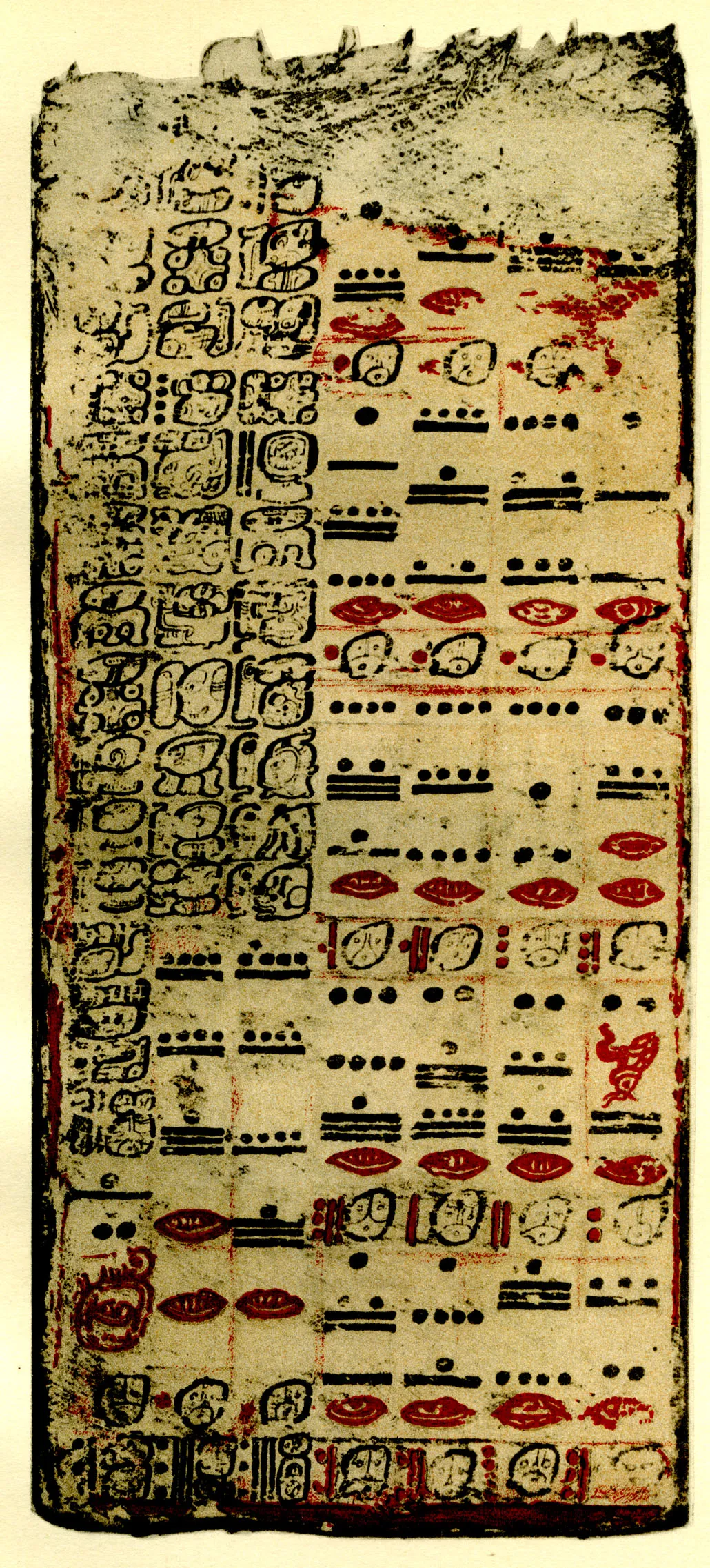
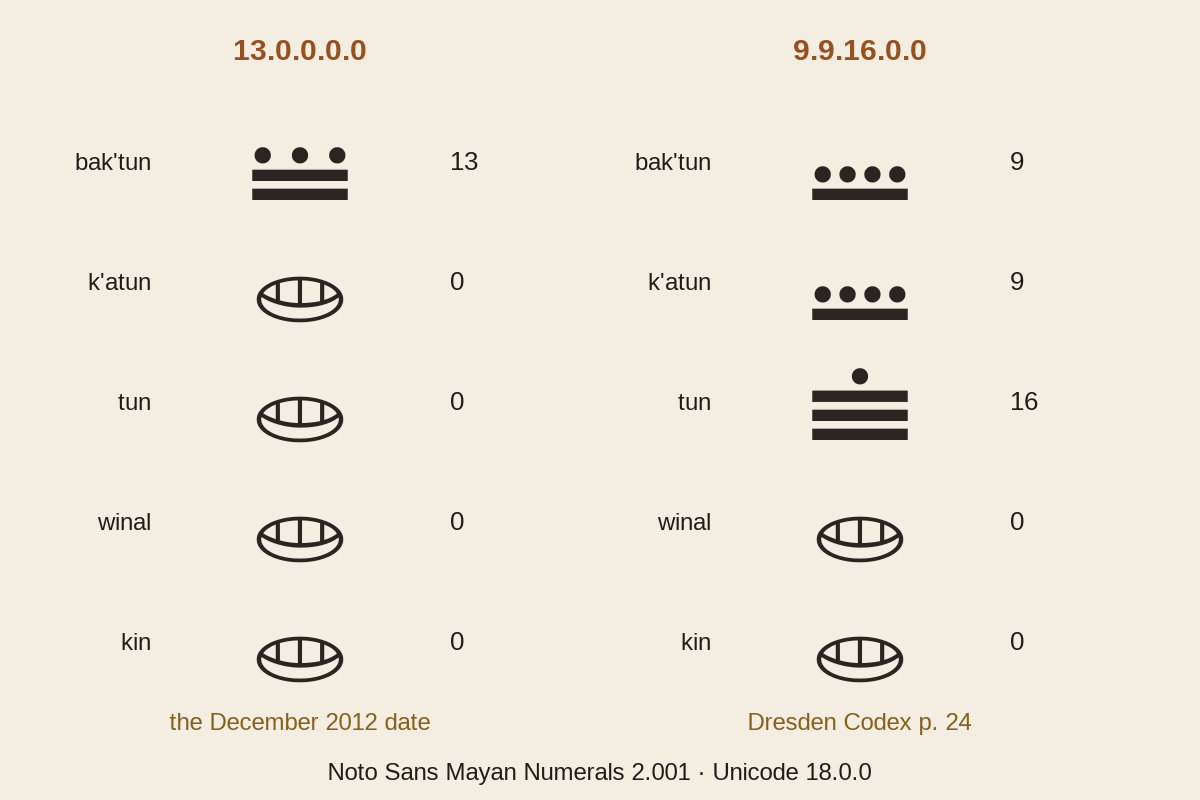
Page 24 of the Dresden Codex in a 1915 plate. Bar-and-dot numbers fill most of the columns, and the red shell-like signs are zeros; Morley read one number near the lower left as 9.9.16.0.0.
Museum no. Mscr.Dresd.R.310 · Findspot: unrecorded
"Page 24 of the Dresden Codex, showing Initial Series" by S. G. Morley, An Introduction to the Study of the Maya Hieroglyphs (1915), plate 31. Public domain.

Full image credit
"Page 24 of the Dresden Codex, showing Initial Series" by S. G. Morley, An Introduction to the Study of the Maya Hieroglyphs (1915), plate 31 — https://commons.wikimedia.org/wiki/File:Maya_Hieroglyphs_Plate_31.jpg — Public domain (Plate 31 of Bureau of American Ethnology Bulletin 57, printed 1915 by the US Government Printing Office without a named plate maker: US, published before 1931; EU, anonymous work published 1915, term ended 1985 (Commons lists the author S. G. Morley, d. 1948, term also ended); a faithful copy of a page of an anonymous pre-Columbian manuscript (Directive (EU) 2019/790, Art. 14))
Two ancient inscriptions were known by mid-2012 to name 13.0.0.0.0, the Long Count day of December 2012. David Stuart counted them that June: Monument 6 from Tortuguero, in Tabasco, Mexico, and a stairway block excavated that spring at La Corona, Guatemala. Neither text says the world will end. Stuart wrote of the new one that "There is no prediction involved."
The popular story turned that day into a deadline. Sven Gronemeyer and Barbara MacLeod opened their 2010 study of Monument 6 by noting that Hollywood had "jumped in" with Roland Emmerich's disaster film 2012, released in 2009. Printed without the constant used to convert it, "21 December 2012" is a bare date, a date given without its basis.
How does the Long Count count days?
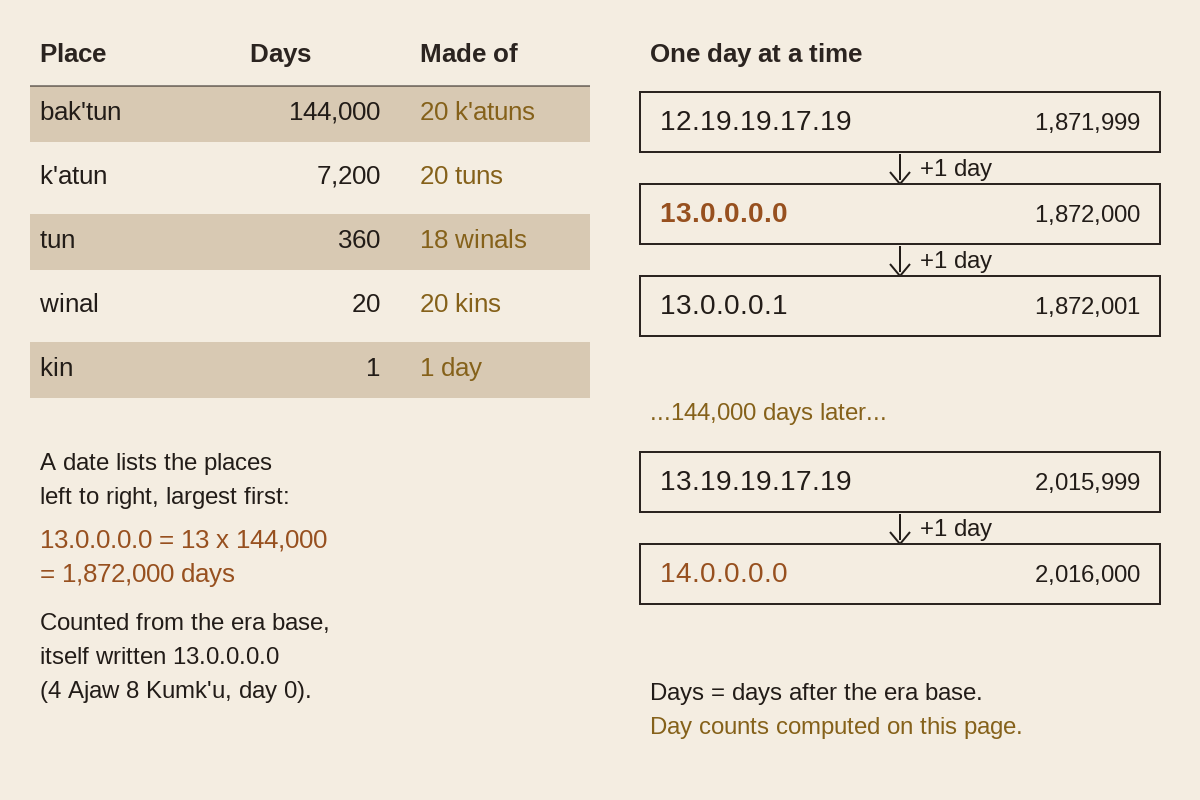
The Long Count is "a continuous reckoning of days from a certain zero point forward," as Gronemeyer and MacLeod put it, citing Sylvanus Morley's 1915 primer. A date lists its places from largest to smallest. A kin is one day, 20 kins make a winal, 18 winals make a tun of 360 days, 20 tuns make a k'atun of 7,200 days, and 20 k'atuns make a bak'tun of 144,000 days.
The only irregular step is the tun, which contains 18 winals rather than 20, and Morley suggested that this departure was probably intended to bring the tun close to the length of the solar year. A written date is therefore an accumulated total. Kennett and colleagues (2013) reduce 9.13.3.7.18 to 1,390,838 days, and this page's script reaches the identical sum.
Scroll sideways to read every label, or open the full drawing.
The five places of a Long Count date, and the count passing 13.0.0.0.0 one day at a time. Day 1,872,000 is followed by day 1,872,001.
"Long Count place values and the 2012 rollover" by Sherd and Script, https://sherdandscript.com/calendars/maya-long-count/, licensed under CC BY 4.0 (https://creativecommons.org/licenses/by/4.0/)Data used under CC BY: S. Gronemeyer and B. MacLeod, What Could Happen in 2012, Wayeb Notes 34 (2010), CC BY 3.0 DE, https://hdl.handle.net/20.500.11811/1104 (single readings)
Data sources for this figure
Data: S. G. Morley, An Introduction to the Study of the Maya Hieroglyphs, BAE Bulletin 57 (1915), public domain, Project Gutenberg eBook 43491; S. Gronemeyer and B. MacLeod, What Could Happen in 2012, Wayeb Notes 34 (2010), CC BY 3.0 DE, https://hdl.handle.net/20.500.11811/1104 (single readings)
The zero point is the day the inscriptions call 4 Ajaw 8 Kumk'u. Arithmetically it is 0.0.0.0.0, but Classic inscriptions consistently wrote it as 13.0.0.0.0, according to Gronemeyer and MacLeod. Morley noted that no contemporary record falls in the more than 3,000 years after it and concluded that it was "a purely hypothetical occurrence," a chosen zero. The Antikythera mechanism raises the same distinction for its dial settings.
Thirteen bak'tuns after that zero comes day 1,872,000, which Monument 6 describes as the completion of the 13th bak'tun, 13.0.0.0.0 4 Ajaw 3 K'ank'in · documentary. The following day is 13.0.0.0.1, 5 Imix 4 K'ank'in, and 144,000 days after the 2012 day comes 14.0.0.0.0, 3 Ajaw 8 Sek, in the calculation of Gronemeyer and MacLeod. A Long Count names a day by how many days have passed, much like the Julian Day numbers used in the Egyptian civil calendar conversion. Simon Martin and Joel Skidmore also draw this parallel.
Scroll sideways to read every label, or open the full drawing.
Standard forms in the Noto Sans Mayan Numerals font, not the hand on any monument or page. Left, 13.0.0.0.0; right, 9.9.16.0.0, the number Morley read on Dresden page 24.
"Two Long Count dates in Mayan numerals (Noto Sans Mayan Numerals)" by Sherd and Script, https://sherdandscript.com/calendars/maya-long-count/, licensed under CC BY 4.0 (https://creativecommons.org/licenses/by/4.0/)
Data sources for this figure
Data: Noto Sans Mayan Numerals 2.001 (SIL Open Font License 1.1), https://github.com/notofonts/mayan-numerals; Unicode Character Database 18.0.0 (UnicodeData.txt, Unicode License v3), https://www.unicode.org/Public/18.0.0/ucd/; S. G. Morley, An Introduction to the Study of the Maya Hieroglyphs, BAE Bulletin 57 (1915), public domain, Project Gutenberg eBook 43491
The Long Count also anchors the shorter cycle that accompanies every Maya date. That cycle, the Calendar Round, combines a 260-day count with a 365-day year and therefore repeats every 18,980 days. On page 24 of the Dresden Codex, Morley demonstrated that 9.9.16.0.0 equals exactly 72 Calendar Rounds, so its day is once again 4 Ajaw 8 Kumk'u. The script confirms both the total and the repetition.
Where did the 2012 end-of-the-world claim come from?
The oldest end-of-the-world reading among the sources read for this page is about a picture, not a date. In 1915 Morley, following Ernst Förstemann, described the last page of the Dresden Codex as "the Destruction of the World," with water pouring from the sky. He tied the scene to the codex's huge numbers, which "have paved the way," not to any day in 2012.
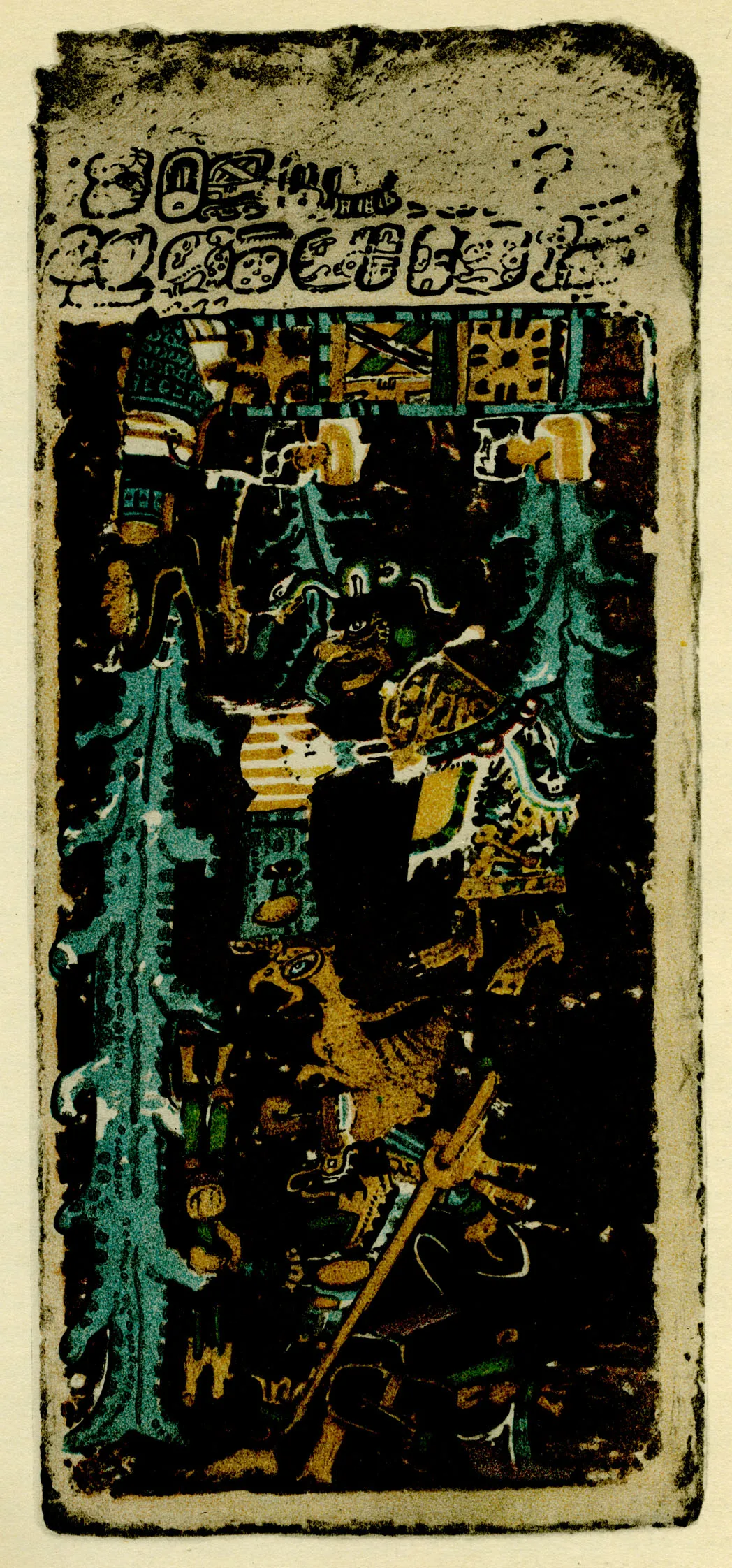
Page 74 of the Dresden Codex in Morley's 1915 plate. He read the water pouring from the sky, following Förstemann, as the destruction of the world.
Museum no. Mscr.Dresd.R.310 · Findspot: unrecorded
"Page 74 of the Dresden Codex, showing the end of the world (according to Förstemann)" by S. G. Morley, An Introduction to the Study of the Maya Hieroglyphs (1915), plate 3. Public domain.

Full image credit
"Page 74 of the Dresden Codex, showing the end of the world (according to Förstemann)" by S. G. Morley, An Introduction to the Study of the Maya Hieroglyphs (1915), plate 3 — https://commons.wikimedia.org/wiki/File:Maya_Hieroglyphs_Plate_03.jpg — Public domain (Plate 3 of Bureau of American Ethnology Bulletin 57, printed 1915 by the US Government Printing Office without a named plate maker: US, published before 1931; EU, anonymous work published 1915, term ended 1985 (Commons lists the author S. G. Morley, d. 1948, term also ended); a faithful copy of a page of an anonymous pre-Columbian manuscript (Directive (EU) 2019/790, Art. 14))
The codex was bought in Vienna in 1739 · documentary for the Dresden court library, as a "Mexican book," and Wikidata lists it in the Saxon State and University Library as Mscr.Dresd.R.310. The World Digital Library's description, transcribed on Wikimedia Commons, says the codex culminates in a "full-page miniature showing a great deluge." The codex's findspot is unrecorded, so nothing ties this copy to the place where it was painted or used.
The 2012 reading of Monument 6 began as a scholarly guess that its authors later withdrew. In 1996 Stephen Houston and David Stuart suggested that a god would "descend" on 13.0.0.0.0, with "some technical problems" admitted. Houston called his 2008 revisit "a mea culpa and a rectification," so the descent reading is now an Outdated claim.
A drawing error fed the darker versions. Gronemeyer and MacLeod report that an early drawing showed one damaged sign as ik', and that readers with "esoteric agendas" saw their "darkest" expectations fulfilled in it. Their own drawing reads the sign as i, the first part of the word they read as "seeing."
Do not stare at the sun, even when it sits low on the horizon. Another version tied the date to the sky. On the winter solstice of 2012, the claim went, the Sun would line up with the center of the galaxy. By this page's calculation, at the solstice on 21 December 2012 the Sun passed about 6.3 degrees north of the galactic center; it came closer a couple of days earlier and enters that part of the sky every year.

Never look straight at the sun. A winter sunrise over flat forest; one version of the 2012 claim tied the date to the Sun on the winter solstice.
Illustration: Sherd and Script. Generated schematic illustration — not a photograph or record of any real object or site. Reuse: CC BY 4.0 (https://creativecommons.org/licenses/by/4.0/), to the extent Sherd and Script holds rights in it.
What does Tortuguero Monument 6 actually say?
Monument 6 survives only in fragments. The 2012 passage is among the damaged parts. Gronemeyer and MacLeod built their 2010 reading on a new drawing made from a photo mosaic of fragments E, F and G; the panel to the left of the main text is lost. One fragment was drawn from the original in Villahermosa in 1974 · documentary.
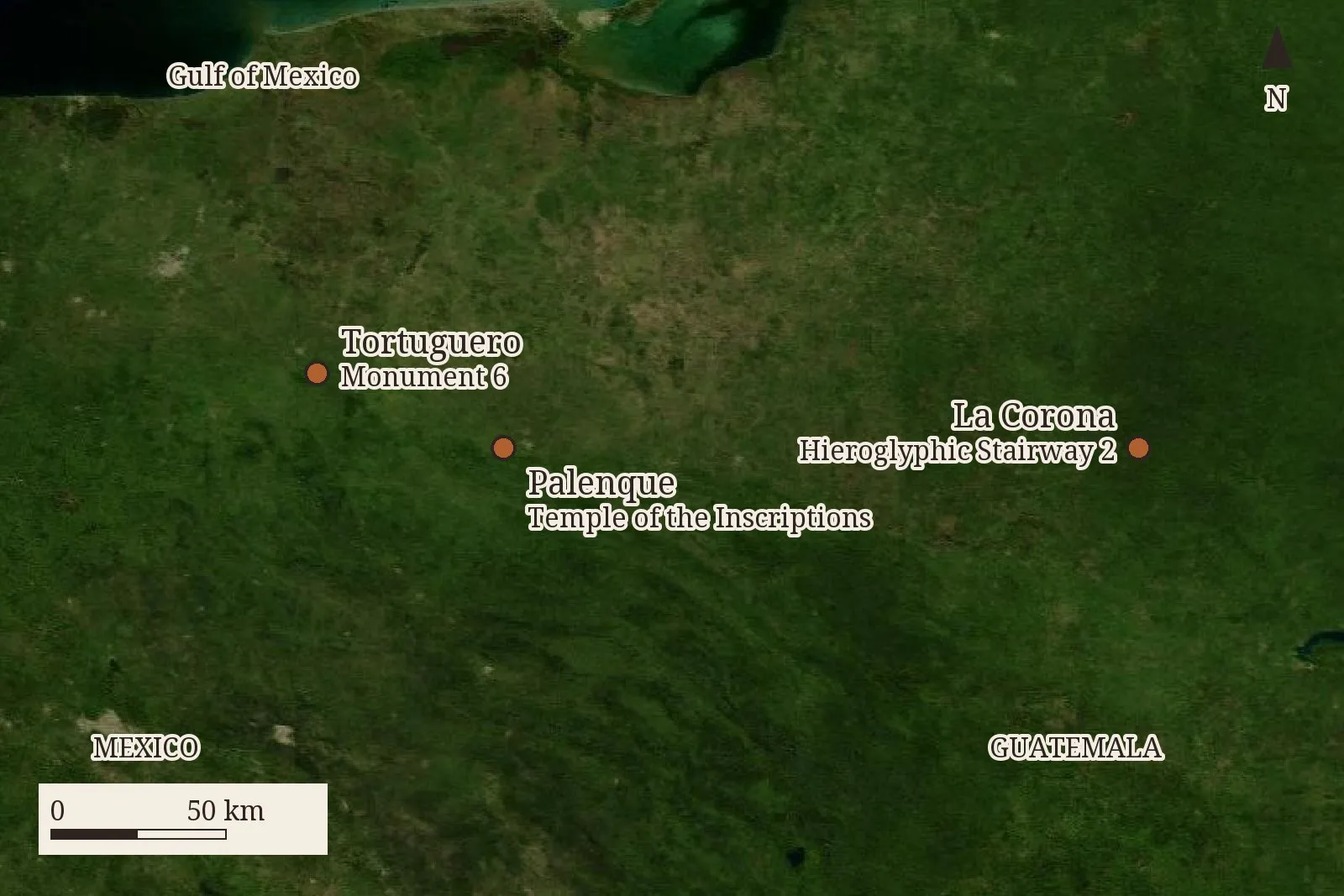
Open the full-size image to read the labels.
Tortuguero, Palenque and La Corona, the three sites whose inscriptions are discussed here, marked at site level only. Monument 6 itself is described here from published readings.
"Tortuguero, Palenque and La Corona: locations at site level" by Sherd and Script, https://sherdandscript.com/calendars/maya-long-count/, licensed under CC BY 4.0 (https://creativecommons.org/licenses/by/4.0/)Data: Base image: NASA Blue Marble Next Generation (layer BlueMarble_NextGeneration), provided by services from NASA's Global Imagery Browse Services (GIBS), part of NASA's Earth Science Data and Information System (ESDIS), https://nasa-gibs.github.io/gibs-api-docs/; Site locations: Wikidata (CC0), rounded to site level
The passage counts forward from a house dedication on the day 9 Etz'nab 6 K'ayab · documentary. The monument does not write that day's Long Count; Gronemeyer and MacLeod deduce it from its Distance Numbers, counts of days separating two dates, as 9.11.16.8.18 · computed, distance number (Gronemeyer and MacLeod 2010). That converts to 14 January 669 · computed, GMT 584283, proleptic Gregorian, a Gregorian date projected back before the calendar existed. A Distance Number of 3.8.3.9.2 then leads from the dedication to 13.0.0.0.0, and the script confirms the arithmetic closes exactly.
In their reading, the text says: "It will be completed the thirteenth Bak'tun. It is 4 Ajaw 3 K'ank'in and it will happen a 'seeing'. It is the display of B'olon-Yokte' in a great 'investiture'." The key block, P4, is "badly eroded and parts of the carving are chipped off," so the "seeing" depends on surviving details and on parallels from other Tortuguero inscriptions.
What Gronemeyer and MacLeod propose is an image of the god, or a person impersonating him, draped with regalia that included a rope. They acknowledge that this deity is associated elsewhere with warfare and destruction. That association, they suggest, may be what doomsayers seized upon.
The verb of completion, tzutz, has the bak'tun as its subject, and Gronemeyer and MacLeod note that dictionary glosses of tzutz as "to end" may have led some authors to think the calendar would end. Think of the doomsday reading as a quotation that keeps the verb and swaps its subject: the thing that "will be completed" is the 13th bak'tun, not the world.
When the display was meant to happen is Disputed. Houston (2008) reads the passage as pointing back to the 7th-century dedication, while Gronemeyer and MacLeod place the investiture in 2012 itself.
What does the La Corona block add?
The second text came out of the ground in 2012 · documentary. Stuart reports that Hieroglyphic Stairway 2 at La Corona had been looted in the mid-1960s · documentary, but that year's excavations found its bottom step, which the looters had missed. Block V, one of the new texts, records a visit by the Calakmul king Yuknoom Yich'aak K'ahk'. Stuart reconstructs its date from the surviving Distance Numbers as 9.13.3.16.17 8 Kaban 10 Kumk'u · computed, distance number (Stuart 2012), or 29 January 696 · computed, GMT 584283, proleptic Julian, the date he gives.
From that visit, a Distance Number of 6.16.1.3 counts forward to 10.0.0.0.0. The inscription then describes the king as a "13 k'atun lord" and names 13.0.0.0.0. Stuart characterizes this as "a literary device used by the scribe to place local political history in a larger cosmological framework." On his interpretation, the people who needed the 2012 date were members of a 7th-century court, situating a royal visit within a cycle of thirteens.
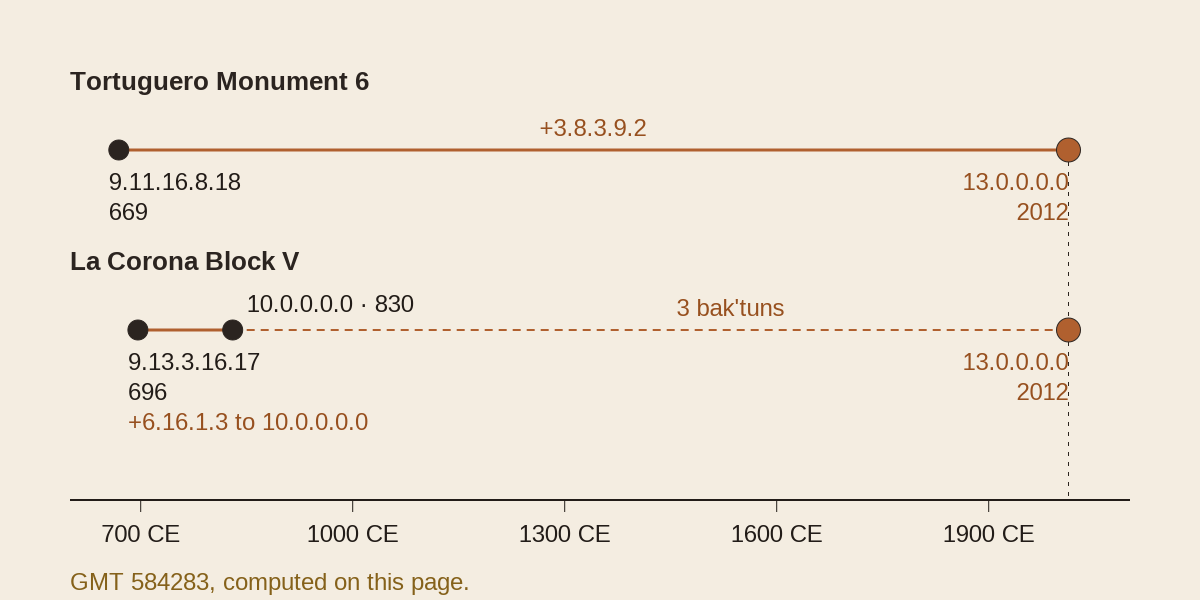
Scroll sideways to read every label, or open the full drawing.
Both inscriptions reach 13.0.0.0.0 from a 7th-century event by Distance Numbers. Positions as read by Gronemeyer and MacLeod and by Stuart; years computed on this page.
"Two inscriptions that count from the 7th century to 13.0.0.0.0" by Sherd and Script, https://sherdandscript.com/calendars/maya-long-count/, licensed under CC BY 4.0 (https://creativecommons.org/licenses/by/4.0/)Data used under CC BY: S. Gronemeyer and B. MacLeod, What Could Happen in 2012, Wayeb Notes 34 (2010), CC BY 3.0 DE, https://hdl.handle.net/20.500.11811/1104 (single readings)
Data sources for this figure
Data: S. Gronemeyer and B. MacLeod, What Could Happen in 2012, Wayeb Notes 34 (2010), CC BY 3.0 DE, https://hdl.handle.net/20.500.11811/1104 (single readings); D. Stuart, Notes on a New Text from La Corona, Maya Decipherment (2012), https://mayadecipherment.com/2012/06/30/notes-on-a-new-text-from-la-corona/ (single readings); Cross-checks: convertdate 2.4.0 (MIT), mayacal 0.2.6 (MIT), jdcal 1.4.1 (BSD), Fliegel-type JDN formulas
Monument 6 was long called the only such text, and Wikipedia's article on Tortuguero, read in October 2026, still says so. Since Stuart's 2012 report that title is an Outdated claim. A brick from Comalcalco had been proposed as another, but Marc Zender argued that its month sign is not K'ank'in, suggested Xul or Suutz' instead, and proposed the position 9.16.18.5.0 (Gronemeyer and MacLeod).
Which day was 13.0.0.0.0?
Converting any Long Count needs a correlation constant, the Julian Day number of the era base. Kennett and colleagues explain why the number is not simply known: the Long Count "fell into disuse" before the Spanish arrived in the 16th century, leaving only a few colonial clues. Proposed constants have placed Maya history nearly a millennium apart.
Among the leading constants, the differences shrink to days. Martin and Skidmore (2012) describe 584285 and 584283 as "the two most widely accepted," trace both to Thompson's publications between 1927 and 1950, and investigate a third candidate, 584286. By this page's calculation, 13.0.0.0.0 is JD 2456283 under 584283, which is 21 December 2012 · computed, GMT 584283, and two or three days later under the others. The script's own day count agrees with convertdate 2.4.0, jdcal 1.4.1 and mayacal 0.2.6 on every conversion here.
| Constant | 13.0.0.0.0 4 Ajaw 3 K'ank'in (Gregorian) | Status as of 2026 |
|---|---|---|
| 584283 (GMT) | 21 December 2012 · computed, GMT 584283 | Default on this site |
| 584285 | 23 December 2012 · computed, 584285 | Disputed |
| 584286 | 24 December 2012 · computed, 584286 | Disputed |
Download: 15 Long Count positions converted under all three constants (CSV) (Data: S. Gronemeyer and B. MacLeod, What Could Happen in 2012, Wayeb Notes 34 (2010), CC BY 3.0 DE, https://hdl.handle.net/20.500.11811/1104 (single readings); S. G. Morley, An Introduction to the Study of the Maya Hieroglyphs, BAE Bulletin 57 (1915), public domain, Project Gutenberg eBook 43491; S. Guenter, The Tomb of K'inich Janaab Pakal, Mesoweb Articles (2007), https://www.mesoweb.com/articles/guenter/TI.pdf (single readings); D. Stuart, Notes on a New Text from La Corona, Maya Decipherment (2012), https://mayadecipherment.com/2012/06/30/notes-on-a-new-text-from-la-corona/ (single readings); S. Houston, What Will Not Happen in 2012, Maya Decipherment (2008), https://mayadecipherment.com/2008/12/20/what-will-not-happen-in-2012/ (single readings); D. J. Kennett et al., Scientific Reports 3:1597 (2013), https://doi.org/10.1038/srep01597 (single published values); S. Martin and J. Skidmore, The PARI Journal 13(2) (2012), https://www.mesoweb.com/pari/publications/journal/1302/Correlation.pdf (single published values); Cross-checks: convertdate 2.4.0 (MIT), mayacal 0.2.6 (MIT), jdcal 1.4.1 (BSD), Fliegel-type JDN formulas) (sources and license, JSON).
Do not gaze at the sun, eclipse or no eclipse. The main evidence for 584286 is a sign on Poco Uinic Stela 3, read as a solar eclipse, that follows the day 5 Kib 14 Ch'en · documentary. Martin and Skidmore fix that day at 9.17.19.13.16. Using the eclipse figure that Thompson cited in 1935, they put the event on JD 2009802, 16 July 790 · computed, proleptic Julian, and the script confirms the subtraction that yields their constant.
Published scholarship mixes the constants as well. Houston's 2008 discussion converted the 2012 day to "Julian Dec. 10," which corresponds to 584285. Stuart's 2012 post gives both "December 23" and "December 21." Each equivalence is correct for its own constant, which is why every conversion on this page identifies the constant it used.
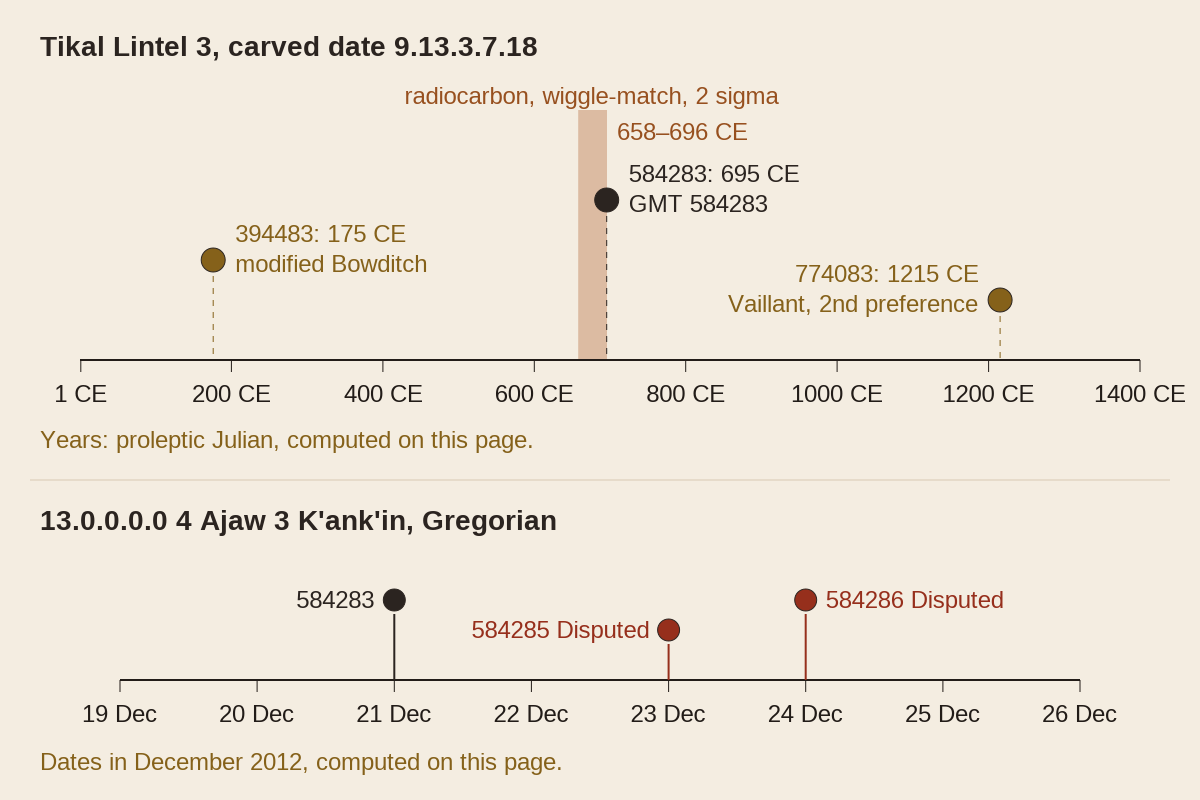
Scroll sideways to read every label, or open the full drawing.
Top: where one carved date lands under three constants, against a radiocarbon estimate. Bottom: the 2012 day under the three leading constants. All conversions computed on this page.
"Correlation constants against radiocarbon, and the 2012 day under three constants" by Sherd and Script, https://sherdandscript.com/calendars/maya-long-count/, licensed under CC BY 4.0 (https://creativecommons.org/licenses/by/4.0/)
Data sources for this figure
Data: D. J. Kennett et al., Scientific Reports 3:1597 (2013), https://doi.org/10.1038/srep01597 (single published values); S. Martin and J. Skidmore, The PARI Journal 13(2) (2012), https://www.mesoweb.com/pari/publications/journal/1302/Correlation.pdf (single published values); Cross-checks: convertdate 2.4.0 (MIT), mayacal 0.2.6 (MIT), jdcal 1.4.1 (BSD), Fliegel-type JDN formulas
Radiocarbon tested the family as a whole. Kennett and colleagues dated a wooden lintel from Temple I at Tikal, whose carved date 9.13.3.7.18 converts to 6 August 695 · computed, GMT 584283, proleptic Gregorian. They fitted a series of samples from the beam, with spacing estimated from seasonal calcium cycles in the wood, to a mix of the IntCal09 and SHCal04 curves. That wiggle-match put the cutting and carving at 658–696 CE · radiocarbon, wiggle-match, 2σ.
Only the GMT correlation fell inside that 95% range. The team concluded that the result supports "the GMT family of correlations." A range 38 years wide cannot choose between constants three days apart, so the 2012 day stays Disputed.
Did Maya scribes count past 13 bak'tuns?
The clearest evidence is carved at Palenque, on the West Tablet of the Temple of the Inscriptions. There a Distance Number of 10.11.10.5.8 counts from the implied birth of the king K'inich Janaab Pakal to the Calendar Round 5 Lamat 1 Mol · documentary (Gronemeyer and MacLeod; Guenter 2007). That day is the 80th Calendar Round anniversary of his accession. The accession, which Gronemeyer and MacLeod equate with 9.9.2.4.8, fell on the same Calendar Round.
Because the scribes recorded only the Calendar Round at the far end, the corresponding Long Count position is a modern reconstruction. Adding the Distance Number to the birth date, 9.8.9.13.0, produces 1.0.0.0.0.8 · computed, distance number (Gronemeyer and MacLeod 2010), equivalent to 21 October 4772 · computed, GMT 584283. Stanley Guenter renders the interval as "4,172 years and 128 days later," a figure expressed in 365-day years, and the script confirms that 4,172 × 365 + 128 equals the Distance Number.
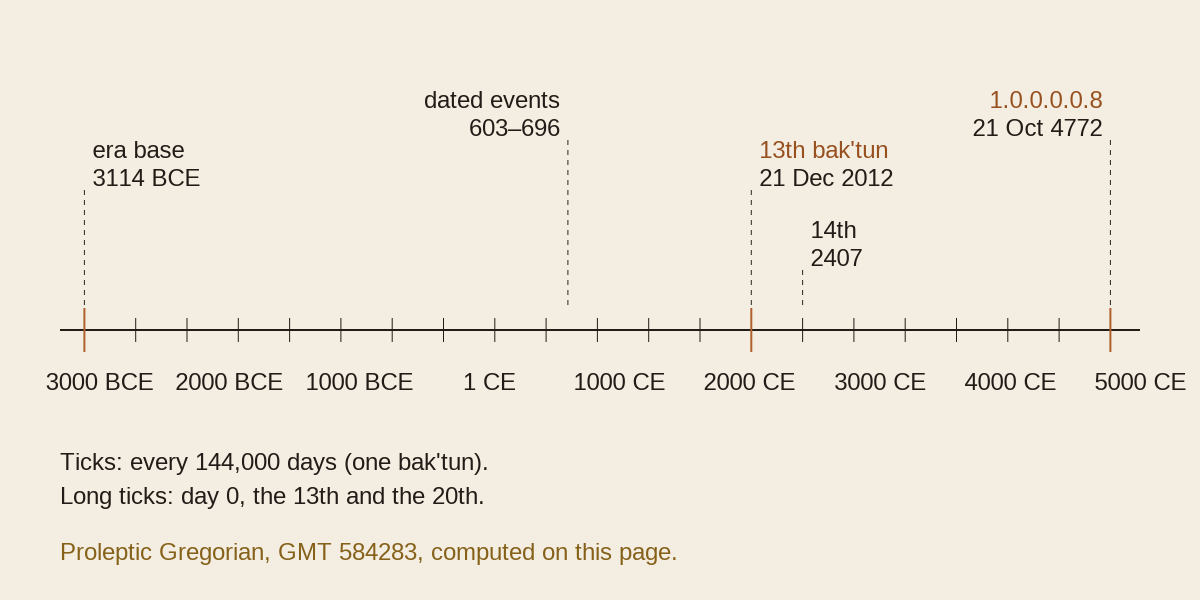
Scroll sideways to read every label, or open the full drawing.
Twenty bak'tuns from the era base to the first piktun, with the dates discussed on this page. The 2012 day is the 13th tick, not the last.
"Twenty bak'tuns from the era base to 4772" by Sherd and Script, https://sherdandscript.com/calendars/maya-long-count/, licensed under CC BY 4.0 (https://creativecommons.org/licenses/by/4.0/)Data used under CC BY: S. Gronemeyer and B. MacLeod, What Could Happen in 2012, Wayeb Notes 34 (2010), CC BY 3.0 DE, https://hdl.handle.net/20.500.11811/1104 (single readings)
Data sources for this figure
Data: S. Gronemeyer and B. MacLeod, What Could Happen in 2012, Wayeb Notes 34 (2010), CC BY 3.0 DE, https://hdl.handle.net/20.500.11811/1104 (single readings); S. Guenter, The Tomb of K'inich Janaab Pakal, Mesoweb Articles (2007), https://www.mesoweb.com/articles/guenter/TI.pdf (single readings); D. Stuart, Notes on a New Text from La Corona, Maya Decipherment (2012), https://mayadecipherment.com/2012/06/30/notes-on-a-new-text-from-la-corona/ (single readings); Cross-checks: convertdate 2.4.0 (MIT), mayacal 0.2.6 (MIT), jdcal 1.4.1 (BSD), Fliegel-type JDN formulas
Eight days before that anniversary falls 1.0.0.0.0.0, the end of the first piktun of 20 bak'tuns. The same tablet records it as 10 Ajaw 13 Yaxk'in · documentary. Guenter wrote that this date alone shows the idea that the Classic Maya predicted an end in 2012 "is nothing but modern fantasy." Coefficients above 13 also occur: a Distance Number on Copan Stela N carries a 17 in the bak'tun place (Gronemeyer and MacLeod, citing Morley).
The Dresden Codex records even larger quantities. On page 62, numbers painted between the coils of two serpents extend to six places, such as 4.6.9.15.12.19, or 12,454,459 days. Morley wrote that a total of nearly 12.5 million days, about 34,000 years, is recorded in them again and again. The script reproduces his additions and the Calendar Round arithmetic for all four numbers on the page.
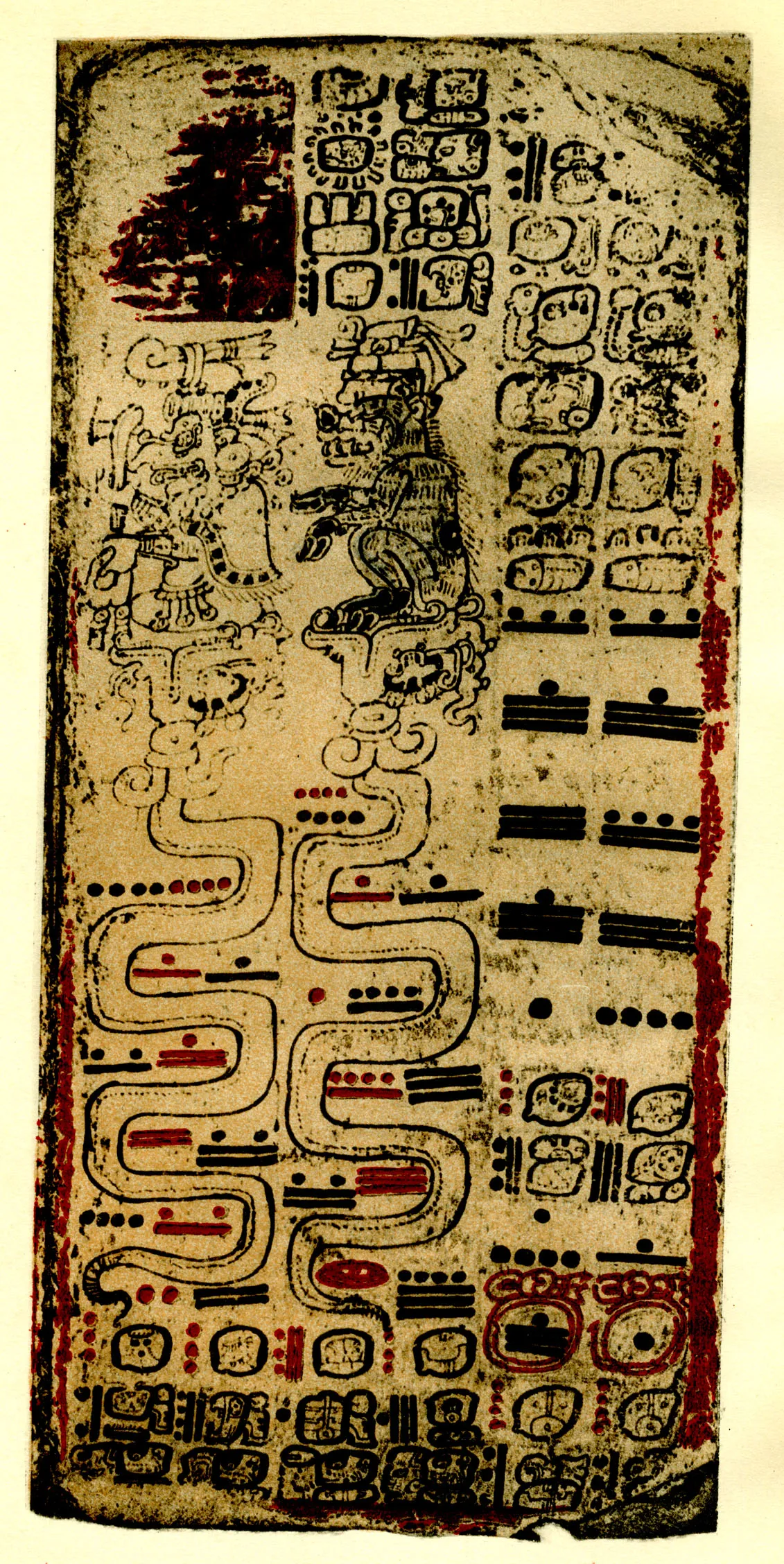
Page 62 of the Dresden Codex in Morley's 1915 plate. Morley called the numbers between the serpents' coils by far the highest in the codices.
Museum no. Mscr.Dresd.R.310 · Findspot: unrecorded
"Page 62 of the Dresden Codex, showing the Serpent Numbers" by S. G. Morley, An Introduction to the Study of the Maya Hieroglyphs (1915), plate 32. Public domain.

Full image credit
"Page 62 of the Dresden Codex, showing the Serpent Numbers" by S. G. Morley, An Introduction to the Study of the Maya Hieroglyphs (1915), plate 32 — https://commons.wikimedia.org/wiki/File:Maya_Hieroglyphs_Plate_32.jpg — Public domain (Plate 32 of Bureau of American Ethnology Bulletin 57, printed 1915 by the US Government Printing Office without a named plate maker: US, published before 1931; EU, anonymous work published 1915, term ended 1985 (Commons lists the author S. G. Morley, d. 1948, term also ended); a faithful copy of a page of an anonymous pre-Columbian manuscript (Directive (EU) 2019/790, Art. 14))
Does Pakal's sarcophagus lid show an astronaut?
The astronaut reading is a modern one with named sources. Wikipedia's summaries of Erich von Däniken's 1968 book Chariots of the Gods? (German Erinnerungen an die Zukunft) say it compared Pakal's pose on the lid to that of astronauts and read the drawings beneath him as rockets. On the television series Ancient Aliens, first aired in 2009, he spoke of the figure working controls, with "a little flame" outside a capsule, as quoted in a 2020 Skeptoid episode.
The lid's own imagery and text point elsewhere. Guenter describes Pakal "ascending out of the maws of the underworld," borne up by a skeletal emblem that seems to represent a flaming offering vessel, with the World Tree rising behind him. Skeptoid identifies the supposed rocket as that tree. A sky band frames the scene, with three figures above it and three below, and each carries a short glyph text that identifies him.
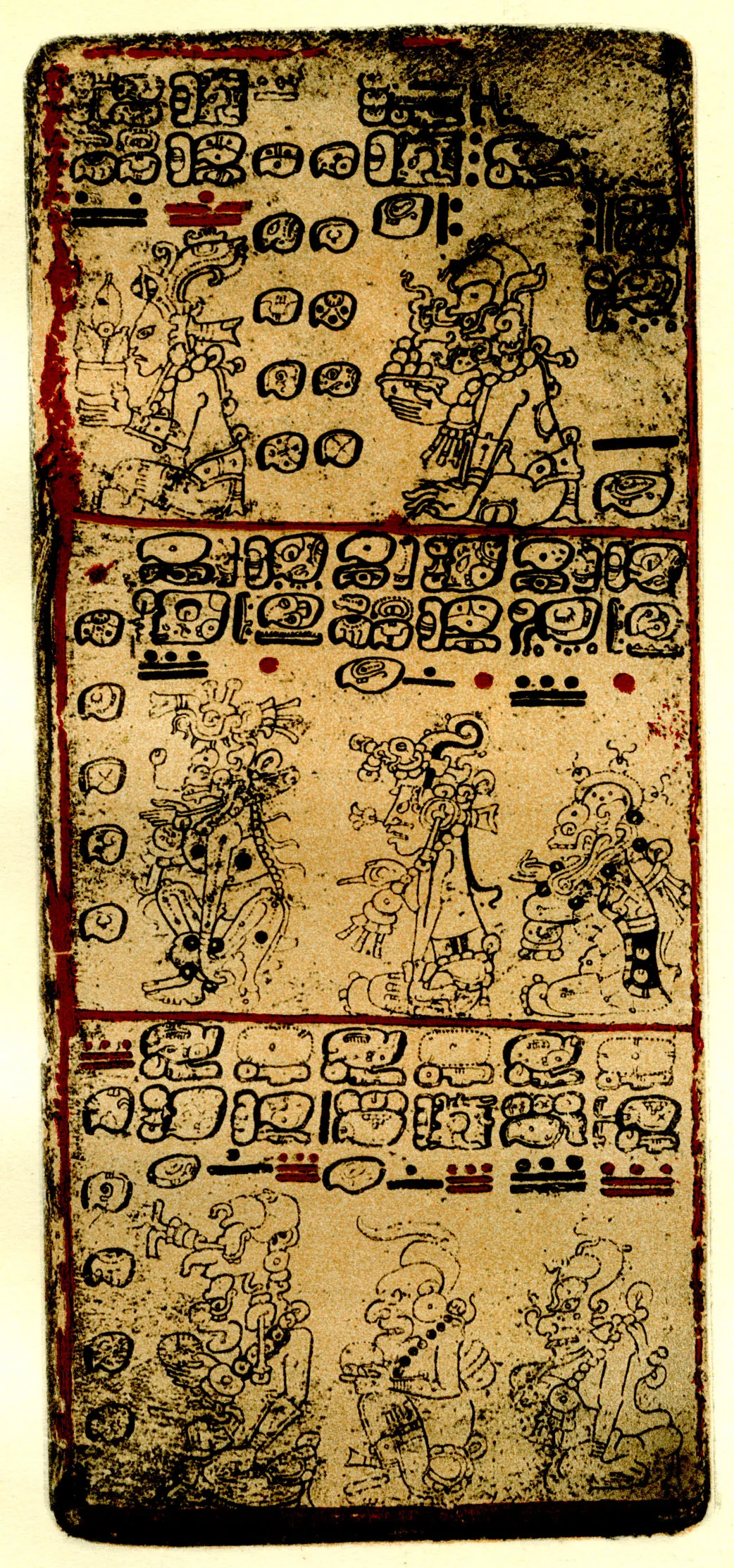
Page 12 of the Dresden Codex in Morley's 1915 plate. Groups of glyphs sit above each figure; Morley noted that they often name the god shown below.
Museum no. Mscr.Dresd.R.310 · Findspot: unrecorded
"Page 12 of the Dresden Codex, showing tonalamatls in all three divisions" by S. G. Morley, An Introduction to the Study of the Maya Hieroglyphs (1915), plate 27. Public domain.

Full image credit
"Page 12 of the Dresden Codex, showing tonalamatls in all three divisions" by S. G. Morley, An Introduction to the Study of the Maya Hieroglyphs (1915), plate 27 — https://commons.wikimedia.org/wiki/File:Maya_Hieroglyphs_Plate_27.jpg — Public domain (Plate 27 of Bureau of American Ethnology Bulletin 57, printed 1915 by the US Government Printing Office without a named plate maker: US, published before 1931; EU, anonymous work published 1915, term ended 1985 (Commons lists the author S. G. Morley, d. 1948, term also ended); a faithful copy of a page of an anonymous pre-Columbian manuscript (Directive (EU) 2019/790, Art. 14))
The codex page shows the same habit in a painted book: figures labeled with glyphs. The text carved around the lid's edges records the deaths of Pakal, his parents and earlier lords of Palenque. Its account of the earlier lords begins with "Ahku'l Mo' Naahb I died on 5 Caban 5 Mac" in Guenter's translation. The sculptors left a royal record of who died when, and the astronaut reading skips it.
One date in Pakal's temple still resists the Long Count. Guenter notes that the event at the center of the West Tablet carries a Calendar Round "that cannot be fit with any certainty into the Long Count." Without the longer count to anchor it, that day could fall in any 52-year round, and in Guenter's 2007 analysis it remains unplaced.
Proof radius
What this box is for: the proof radius.
Proves: The two inscriptions known by 2012 to name 13.0.0.0.0 4 Ajaw 3 K'ank'in count to it from 7th-century events, and Palenque's West Tablet counts past it to the day reconstructed as 1.0.0.0.0.8, so the 13th bak'tun was a digit turning over, not the count's last day.
Doesn't prove: That the day fell on 21 December 2012. That depends on the correlation constant, and 584285 and 584286 put it on the 23rd or 24th.
Read next: Egyptian civil calendar: a 365-day count with no leap day, converted to a Julian date step by step. Piltdown Man: another famous claim that rested on a single date, and the tests that took it apart.
Sources
Primary sources first.
- 1Sylvanus Griswold Morley, An Introduction to the Study of the Maya Hieroglyphs, Bureau of American Ethnology Bulletin 57 (Washington: Government Printing Office, 1915). Project Gutenberg eBook #43491. https://www.gutenberg.org/ebooks/43491 Read: full text (Project Gutenberg) and plates 3, 27, 31, 32 (Commons copies)
- 2Sven Gronemeyer and Barbara MacLeod, "What Could Happen in 2012: A Re-Analysis of the 13-Bak'tun Prophecy on Tortuguero Monument 6," Wayeb Notes 34 (2010), 68 pp. Open-access copy, University and State Library Bonn (CC BY 3.0 DE). https://hdl.handle.net/20.500.11811/1104 Read: full text (PDF)
- 3David Stuart, "Notes on a New Text from La Corona," Maya Decipherment, 30 June 2012. https://mayadecipherment.com/2012/06/30/notes-on-a-new-text-from-la-corona/ Read: full post
- 4Stephen Houston, "What Will Not Happen in 2012," Maya Decipherment, 20 December 2008. https://mayadecipherment.com/2008/12/20/what-will-not-happen-in-2012/ Read: full post
- 5Stanley Guenter, "The Tomb of K'inich Janaab Pakal: The Temple of the Inscriptions at Palenque," Mesoweb Articles, 2007. https://www.mesoweb.com/articles/guenter/TI.pdf Read: full text (PDF)
- 6Douglas J. Kennett, Irka Hajdas, Brendan J. Culleton, Soumaya Belmecheri, Simon Martin, Hector Neff, Jaime Awe, Heather V. Graham, Katherine H. Freeman, Lee Newsom, David L. Lentz, Flavio S. Anselmetti, Mark Robinson, Norbert Marwan, John Southon, David A. Hodell and Gerald H. Haug, "Correlating the Ancient Maya and Modern European Calendars with High-Precision AMS 14C Dating," Scientific Reports 3 (2013): 1597. https://doi.org/10.1038/srep01597 Read: full text (PubMed Central PMC3623374)
- 7Simon Martin and Joel Skidmore, "Exploring the 584286 Correlation between the Maya and European Calendars," The PARI Journal 13, no. 2 (2012): 3-16. https://www.mesoweb.com/pari/publications/journal/1302/Correlation.pdf Read: full text (PDF)
- 8Wikidata, "Dresden Codex" (Q200944): inventory number Mscr.Dresd.R.310, collection Saxon State and University Library, Dresden (Q323270, Germany). https://www.wikidata.org/wiki/Q200944 Read: Wikidata items Q200944 and Q323270 (structured statements)
- 9World Digital Library, description of "The Dresden Codex" (item 11621), as transcribed on Wikimedia Commons, File:The Dresden Codex WDL11621.pdf. https://commons.wikimedia.org/wiki/File:The_Dresden_Codex_WDL11621.pdf Read: file description
- 10Wikidata items for the film 2012 (Q184605, publication date 13 November 2009), the television series Ancient Aliens (Q2501910, start time 8 March 2009) and the book Chariots of the Gods? (Q1354710, publication date 1968). https://www.wikidata.org/wiki/Q184605 Read: three Wikidata items (structured statements)
- 11Brian Dunning, "Debunking Ancient Aliens, Part 3," Skeptoid Podcast #721, 31 March 2020 (transcript). https://skeptoid.com/episodes/4721 Read: full transcript
- 12Wikipedia, "Tortuguero (Maya site)," read 13 October 2026. https://en.wikipedia.org/wiki/Tortuguero_(Maya_site) Read: article text
- 13Wikipedia, "Chariots of the Gods?," read 13 October 2026. https://en.wikipedia.org/wiki/Chariots_of_the_Gods%3F Read: article text
- 14Wikipedia, "K'inich Janaab' Pakal," read 13 October 2026. https://en.wikipedia.org/wiki/K%27inich_Janaab%27_Pakal Read: article text (Pseudoarchaeology section)
Cite this page
Sherd and Script. “Maya Long Count: The 2012 Date Was a Rollover, Not an End.” Sherd and Script. Published 13 October 2026; last substantive revision 1 November 2026. https://sherdandscript.com/calendars/maya-long-count/ (accessed ).
Corrections
- 2026-11-01 — Section "Where did the 2012 end-of-the-world claim come from?": the Sun's distance from the galactic center at the 2012 solstice recalculated and stated as this page's own calculation (was: "… on 21 December 2012 the Sun passed about 6.6 degrees north of the galactic center, came closer a couple of days earlier, and enters that part of the sky every year." → now: "By this page's calculation, at the solstice on 21 December 2012 the Sun passed about 6.3 degrees north of the galactic center; …") — this page's calculation of the Sun's position against the origin of galactic coordinates, at the moment of the solstice; the earlier figure came from a news article that is no longer a source for this page