Case file
Antikythera Mechanism: Neither of Its Two Dates Is When It Was Made
Sherd and Script · Published 13 October 2026 · Revised 14 October 2026
Coins from the wreck put it on the seabed by about 60 BCE, and its dials count from a start computed for 205 or 178 BCE. Neither figure dates the workshop.
Find card
- Object / Site
- Antikythera mechanism: a geared calculating device of chiefly bronze parts in a wooden case, now 82 fragments (seven lettered A to G, 75 numbered 1 to 75); 30 gears survive, 27 of them in Fragment A
- Findspot
- Antikythera shipwreck, off the island of Antikythera between Crete and the Greek mainland; island level only
- Context
- Wreck cargo raised by sponge divers in
1900–1901 · documentaryunder Greek government supervision, with bronze and marble sculpture and glassware; the gear-bearing fragments were noticed in the National Archaeological Museum, Athens, in May1902 · documentary - Dated by
- Associated finds from the wreck: a hoard of 36 silver cistophoric tetradrachms and the ship's ceramics. Nothing dates the device's manufacture directly
- Range
- Sinking:
60 ± 10 BCE · associated finds, coins and pottery, as of 2026. Manufacture: before the sinking; letter forms allowc. 225 BCE to the sinking · art-historical estimate. Dial start settings:205 BCE · computedor178 BCE · computed,Disputed - Dated event
- The sinking of the ship, which gives the latest possible date for manufacture. The 205 and 178 BCE figures date a starting setting of the dials, not manufacture
- Now at
- National Archaeological Museum, Athens, X 15087 (accession number as given in Freeth 2014; the museum's page was not read)
- Primary record
- Open-access technical records: Freeth and Jones 2012 (ISAW Papers 4); Freeth 2014 (PLOS ONE); Jones 2020 (ISAW Papers 17). The museum's own record was not read
Find card as CSV antikythera-mechanism-find-card.csv (sources and license, JSON)Data: Alexander Jones, The Epoch Dates of the Antikythera Mechanism, ISAW Papers 17 (2020), CC BY 4.0, http://hdl.handle.net/2333.1/ffbg7m07; Tony Freeth and Alexander Jones, The Cosmos in the Antikythera Mechanism, ISAW Papers 4 (2012), CC BY 3.0, https://dlib.nyu.edu/awdl/isaw/isaw-papers/4/; Tony Freeth, PLOS ONE 9(7): e103275 (2014), CC BY 4.0, https://doi.org/10.1371/journal.pone.0103275; Wikidata Q182324 (CC0), https://www.wikidata.org/wiki/Q182324
TL;DR. The Antikythera mechanism, a geared bronze calculator raised from a shipwreck off a Greek island, is dated mainly by the coins and pottery found with it, which point to a probable sinking date of 60 ± 10 BCE · associated finds, coins and pottery and show only that the device existed by then. Its dials count from a starting setting computed back from their inscriptions, 205 BCE in studies from 2014 to 2020 and 178 BCE in a 2023 paper, a figure that is Disputed and dates a design choice, not the making. The engraved letters allow any date from c. 225 BCE · art-historical estimate until the sinking, so as of 2026 the year it was built remains open.
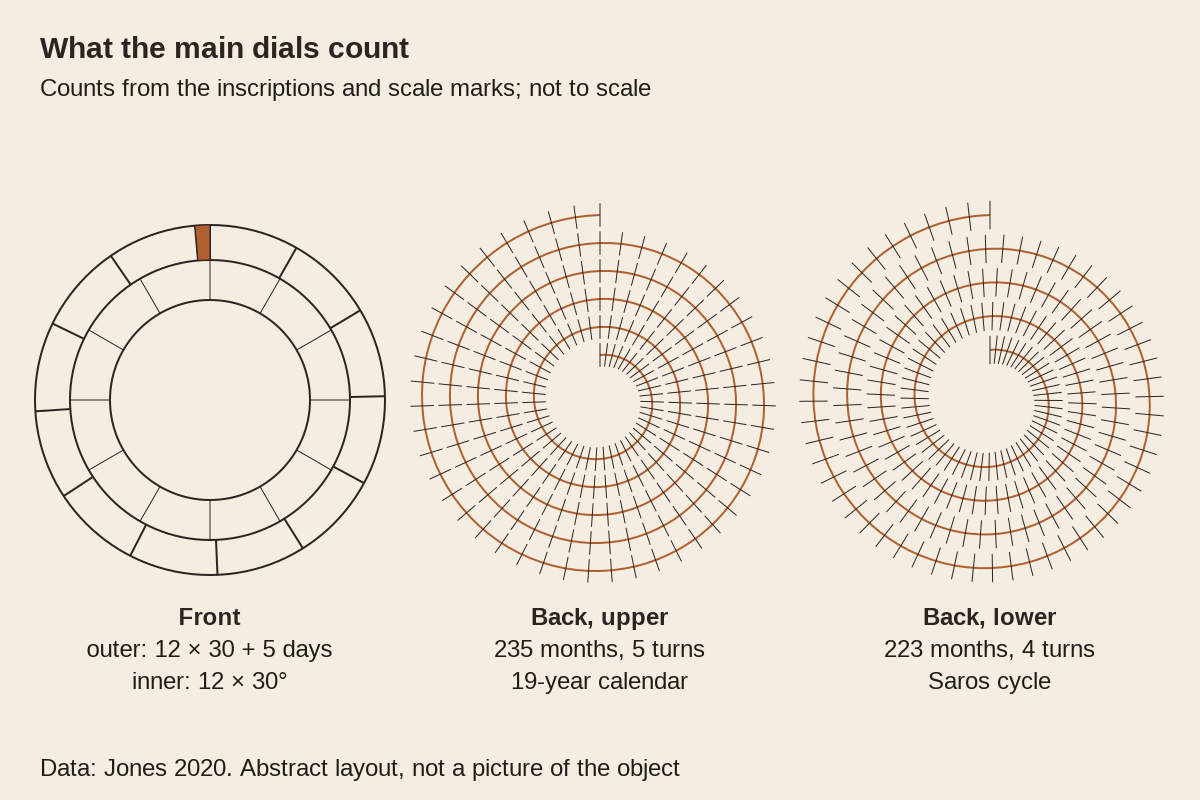
Scroll sideways to read every label, or open the full drawing.
The mechanism's three main scales, laid out from the counts engraved on them rather than from the fragments. The two back spirals count months; the front ring counts days.
Museum no. X 15087 · Findspot: Antikythera shipwreck, off Antikythera, Greece
"Antikythera mechanism: what the main dials count" by Sherd and Script, https://sherdandscript.com/calendars/antikythera-mechanism/, licensed under CC BY 4.0 (https://creativecommons.org/licenses/by/4.0/)Data: Alexander Jones, The Epoch Dates of the Antikythera Mechanism, ISAW Papers 17 (2020), CC BY 4.0, http://hdl.handle.net/2333.1/ffbg7m07
Two dates travel with the Antikythera mechanism, and neither one says when it was made. The first comes from coins and pottery found with it on a wreck, and it dates the sinking of the ship. The second is computed from the inscriptions on its dials, and it dates the moment at which every pointer was meant to stand at zero.
Making the device is a third event. The letter forms and dials leave its date open (Jones 2020). A year quoted without saying which of these events it belongs to is a bare date, a date given without its basis, so this case file keeps the three apart.
What does the Antikythera shipwreck date?
Sponge divers from the island of Symi found the wreck in 1900 · documentary and raised its cargo in 1900–1901 · documentary under Greek government supervision. The ship carried bronze and marble sculpture and glassware. In May 1902 · documentary, corroded fragments with gear wheels were noticed among unsorted bronze pieces from the wreck in the National Archaeological Museum, Athens (Freeth and Jones 2012; Jones 2020).
What survives is 82 fragments: seven lettered A to G and 75 small ones numbered 1 to 75 (Freeth 2014). The museum's accession number, X 15087, is given here as Freeth printed it in 2014. The museum's own record was not read.
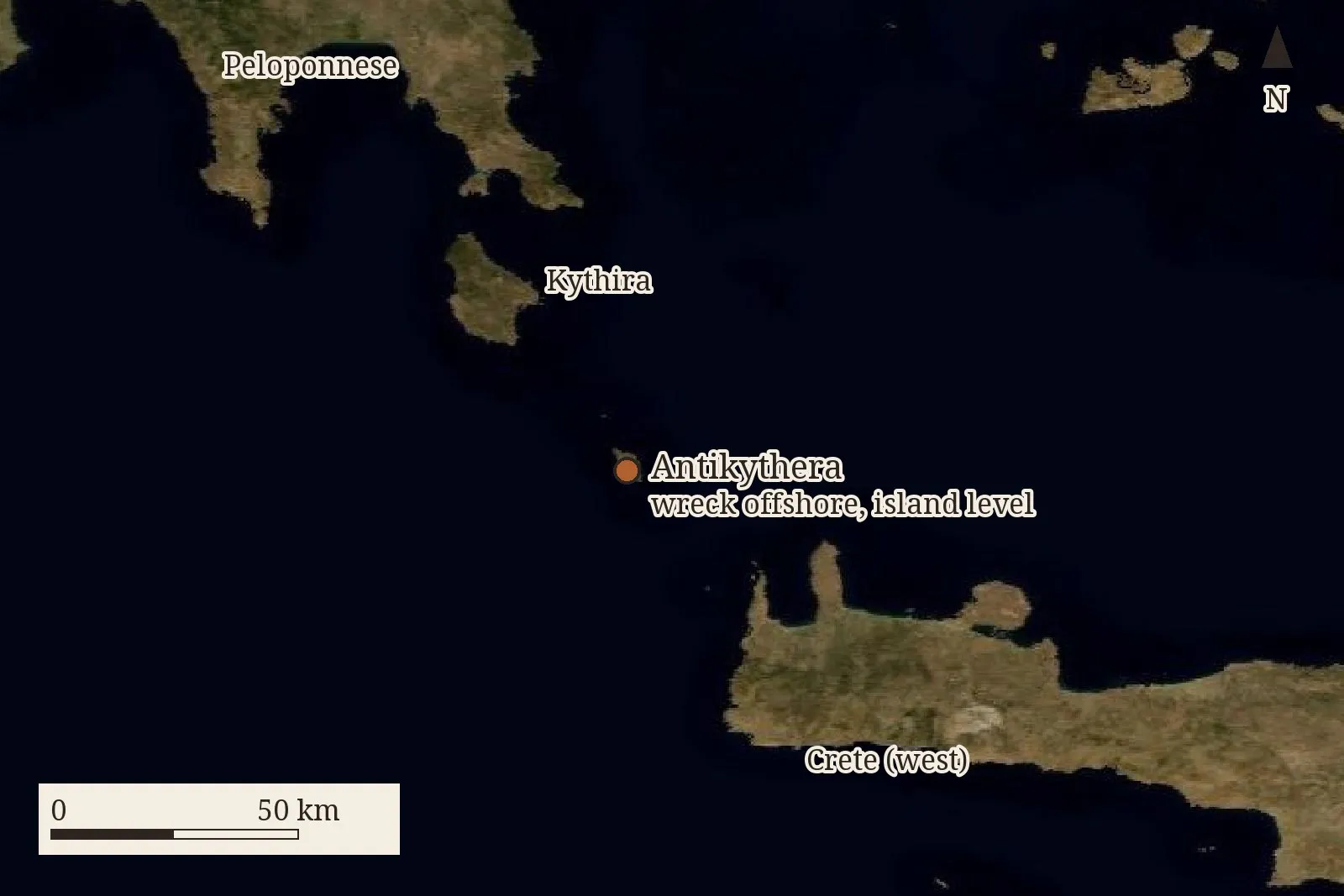
Open the full-size image to read the labels.
The wreck lies off Antikythera, between Kythira and western Crete. The marker sits at island level only.
"Antikythera shipwreck: location at island level" by Sherd and Script, https://sherdandscript.com/calendars/antikythera-mechanism/, licensed under CC BY 4.0 (https://creativecommons.org/licenses/by/4.0/)Data: Base image: NASA Blue Marble Next Generation (layer BlueMarble_NextGeneration), provided by services from NASA's Global Imagery Browse Services (GIBS), part of NASA's Earth Science Data and Information System (ESDIS), https://nasa-gibs.github.io/gibs-api-docs/; Island location: Wikidata (CC0), rounded to island level
The firmest evidence for the sinking is a small hoard of 36 silver cistophoric tetradrachms, coins minted at Pergamon and Ephesos, which Jones (2020) calls "the portable wealth of someone on board." The latest Pergamene issue among them dates to about 76–67 BCE, and none comes from the issues that resumed in 58 BCE. That latest issue is dated by other evidence: it is missing from a large hoard datable to about 76 BCE, and minting of these coins paused in 67 BCE (Jones 2020, note 2).
The pottery points the same way. Transport jars from the cargo and tableware that probably belonged to the crew or passengers suggest the middle of the first century BCE. A 1965 reassessment of the wreck, made before the coins came up in 1976 · documentary, had already reached "the limits 80-50 B.C." (quoted by Jones 2020). Jones combines both into a probable sinking date of 60 ± 10 BCE · associated finds, coins and pottery, and he calls a date more than 20 years either side "rather unlikely."
That range dates one event, the sinking. It is a terminus ante quem, a date before which the mechanism must already have existed, and it says nothing about how long the device was in use before the voyage. Think of the wreck as a sentence cut off in the middle: the coins date where the sentence stops, not when each word in it was first written.
When was the Antikythera mechanism made?
Epigraphers began offering dates for the engraved letters within days of the 1902 find (Jones 2020). The letters stand only about 1.2 to 3 mm high. Jones reports a growing view among epigraphers that, without dated inscriptions from the same place, letter shapes can date a text only to within about a century either way.
Three epigraphers quoted by Jones show the spread. Haralambos Kritzas wrote that "Dates around 150 BC to 100 BC are a plausible range"; Charles Crowther widened it to the late third to early first century BCE; Paul Iversen allowed the late third to the middle of the first. Jones concludes that, on the letters alone, the device "could have been made any time from say 225 BCE to immediately before the shipwreck."
Why did an early date go wrong?
One early date made exactly the mistake this case file is about. Derek de Solla Price examined the fragments in 1958 · documentary, read a short line beside the front calendar ring as the setting the maker had left, and in 1959 suggested that the instrument "was made about 82 B.C." He revised this to about 87 BCE in 1974 (both as quoted by Jones 2020). Both figures are now an Outdated claim, for two reasons Jones gives.
Jones points out that Price assumed the setting had to be made at the time of manufacture, and did not consider a starting date in the past, which was common in astronomical tables. The line itself may not be a mark at all. Allan Bromley wrote in 1990, as Jones quotes him, that it "is certainly now a crack," and Jones calls its genuineness "far from a certainty."
What do the dial start dates measure?
The newer dates come from the back dials. Two studies published in 2014, by Freeth and by Carman and Evans, worked back from the predictions engraved around the lower back dial and dated the sequence they describe to 205–187 BCE · computed (Jones 2020). Freeth placed its first month at the full moon of 12 May 205 BCE · computed (proleptic Julian, astronomical year −204).
Iversen argued in 2017, as Jones summarizes him, that the calendar on the upper dials began with the year starting in 205 BCE. Jones places that year's opening conjunction, or new moon, at 23 August 205 BCE · computed, or a day or two later, 103 days after 12 May by this page's calculation. In a paper published in 2023, Voulgaris, Mouratidis and Vossinakis instead proposed 22/23 December 178 BCE · computed as the initial setting of the pointers. Whether the start date is 205 or 178 BCE is Disputed.
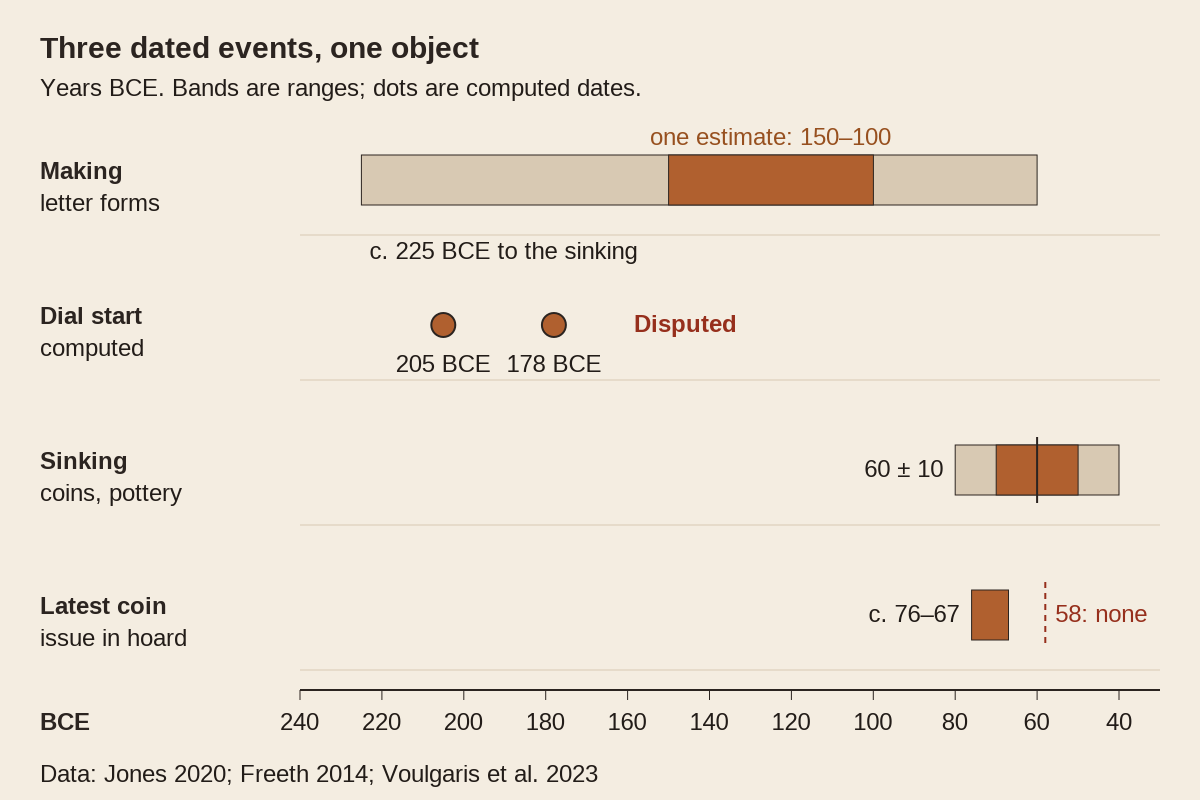
Scroll sideways to read every label, or open the full drawing.
Three events on one axis. The sinking range comes from coins and pottery; the dial starts are computed settings, marked Disputed; the letter forms leave the making open.
"Antikythera mechanism: three dated events" by Sherd and Script, https://sherdandscript.com/calendars/antikythera-mechanism/, licensed under CC BY 4.0 (https://creativecommons.org/licenses/by/4.0/)Data: Alexander Jones, The Epoch Dates of the Antikythera Mechanism, ISAW Papers 17 (2020), CC BY 4.0, http://hdl.handle.net/2333.1/ffbg7m07; Tony Freeth, PLOS ONE 9(7): e103275 (2014), CC BY 4.0, https://doi.org/10.1371/journal.pone.0103275; Aristeidis Voulgaris, Christophoros Mouratidis and Andreas Vossinakis, Almagest 14(1) (2023), arXiv:2203.15045, https://arxiv.org/abs/2203.15045
None of these dates is a manufacturing date. Freeth wrote that his result "should be treated with due caution" and that "The Mechanism could, for example, have been made at a later date." Jones argues that the 205 BCE settings could have been chosen by a designer working as late as the shipwreck of about 60 BCE. The dates and conversions behind the timeline are in a dated-events CSV (Data: Alexander Jones, The Epoch Dates of the Antikythera Mechanism, ISAW Papers 17 (2020), CC BY 4.0, http://hdl.handle.net/2333.1/ffbg7m07; Tony Freeth, PLOS ONE 9(7): e103275 (2014), CC BY 4.0, https://doi.org/10.1371/journal.pone.0103275; Aristeidis Voulgaris, Christophoros Mouratidis and Andreas Vossinakis, Almagest 14(1) (2023), arXiv:2203.15045, https://arxiv.org/abs/2203.15045) (sources and license, JSON).
The start date is unique for a structural reason. By this page's calculation, a 235-month cycle and a 223-month cycle line up again only after 52,405 months, or 4,237 years of the 19-year scheme, the figure Jones gives. So a setting that combines both cycles points to one date within any practical span of time. The same distinction, between a count's chosen zero and the date of the object that carries the count, comes up with the Maya Long Count.
What did the gears and back dials count?
Inside the case, 30 gears survive, 27 of them in Fragment A. Freeth and Jones (2012) report that the functions of 29 are generally agreed. The main drive wheel, b1, turned once per simulated year, and the other pointers were geared to that turn.
The ratios are written in tooth counts. Freeth and Jones describe a gear that turns 254/19 times a year, because 254 sidereal months, the Moon's circuits against the stars, almost equal 19 years. A pin on one 50-tooth gear runs in a slot on another, which makes the Moon's pointer speed up and slow down. Jones notes that any gear train driving a Saros dial from the calendar gearing needs a 223-tooth gear, one of the largest in the device.
The upper back dial is a spiral of 235 cells in five turns, 47 to a turn, one cell for each month of a 19-year calendar. Each cell bore a month name. Skipped day numbers turned 110 of the nominally 30-day months into 29-day months, so the cycle totals 125 × 30 + 110 × 29 = 6,940 days by this page's arithmetic, the total Jones gives.
A small dial counted four of these 19-year cycles, a 76-year period. It is known only from an inscription describing the back face. Its position is not preserved.
Do not look directly at the sun. The lower back dial is a four-turn spiral of 223 cells, the 223 lunar months of the Saros cycle. By inference from the 20 that survive, 49 of its cells carried short inscriptions saying that an eclipse of the Moon or of the Sun was possible that month, with an hour of day or night (Jones 2020).
A smaller dial inside it, the Exeligmos dial, turned once in three Saros cycles. Each cycle averages about 6,585⅓ days. The extra third of a day shifts the times on the dial about 8 hours later every cycle, so this small dial told the user how many hours to add.
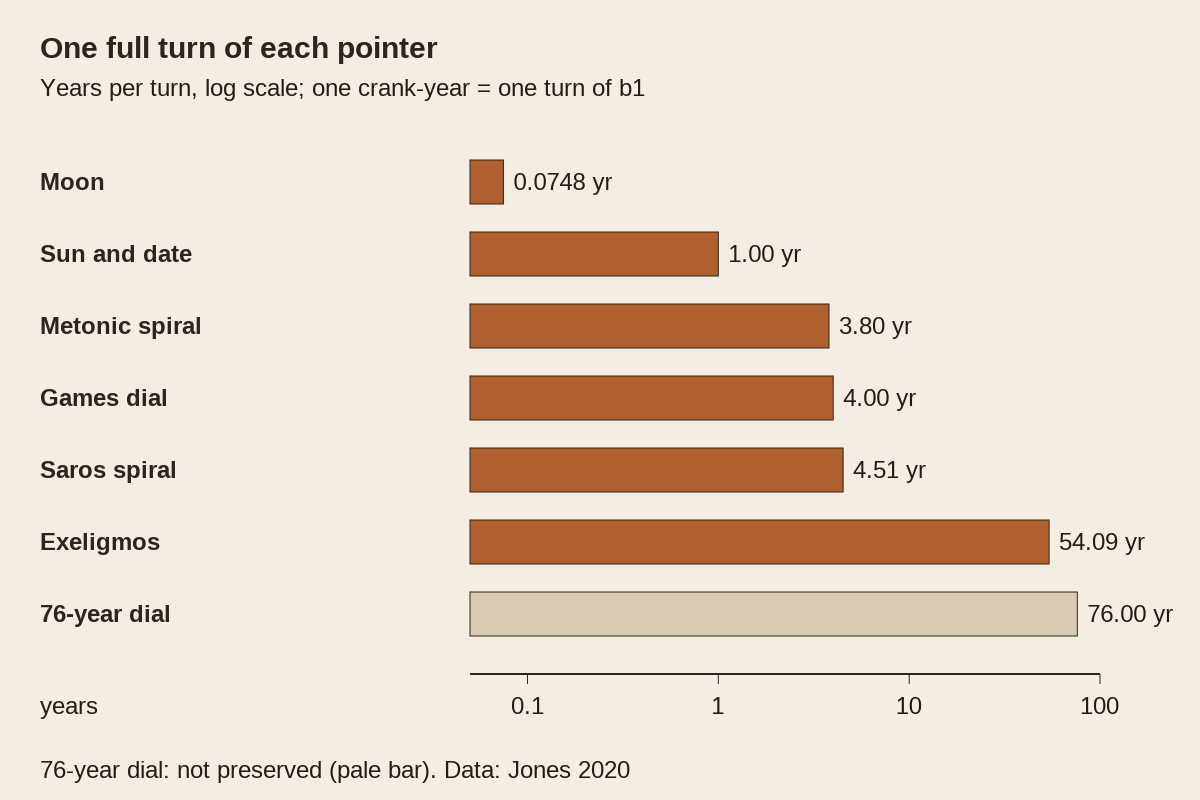
Scroll sideways to read every label, or open the full drawing.
How long each pointer takes to go round once, computed from the published cycle relations with the main drive wheel at one turn per year. Download the table: dial-motion CSV (sources and license, JSON).
"Antikythera mechanism: how long each pointer takes to turn once" by Sherd and Script, https://sherdandscript.com/calendars/antikythera-mechanism/, licensed under CC BY 4.0 (https://creativecommons.org/licenses/by/4.0/)Data: Alexander Jones, The Epoch Dates of the Antikythera Mechanism, ISAW Papers 17 (2020), CC BY 4.0, http://hdl.handle.net/2333.1/ffbg7m07; Tony Freeth and Alexander Jones, The Cosmos in the Antikythera Mechanism, ISAW Papers 4 (2012), CC BY 3.0, https://dlib.nyu.edu/awdl/isaw/isaw-papers/4/
Where did the cycles come from?
Freeth (2014) traces the design of its Sun and Moon gearing in part to "two great arithmetic cycles from ancient Babylon," and Freeth and Jones (2012) note that Babylonian period relations were certainly known to Greek astronomers. They add that astronomers in Babylonia identified the Saros, 223 lunar months between lunar eclipses of almost identical size and duration, from records of dated observations beginning in the 7th century BCE · documentary if not earlier.
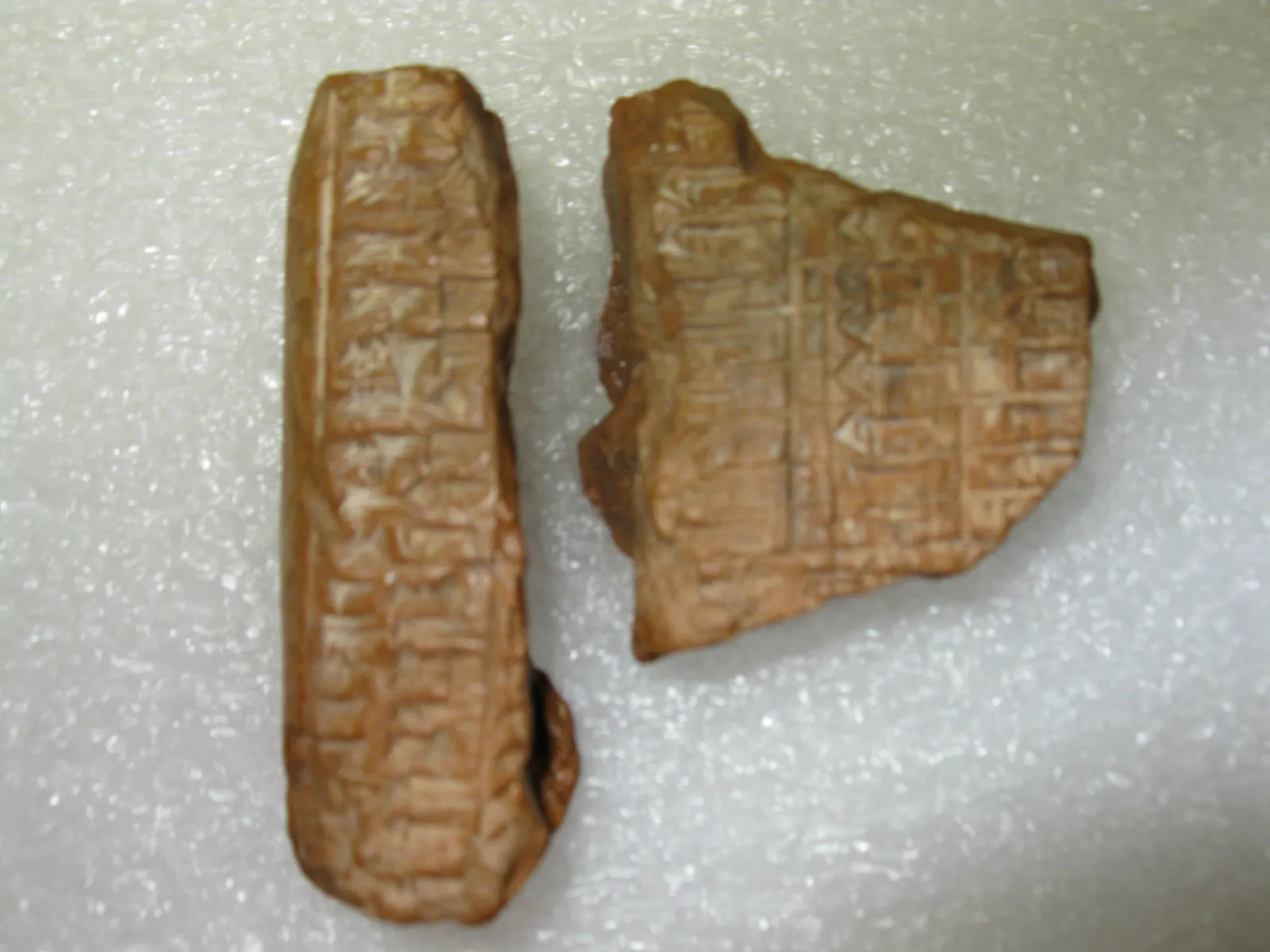
Two clay fragments that the museum catalogs, with a question mark, as part of an astronomical table. On the right fragment, the signs sit in ruled columns.
Museum no. 86.11.374a, b · Findspot: unrecorded
"Cuneiform tablet: fragment of an astronomical table (?)" by The Metropolitan Museum of Art — https://commons.wikimedia.org/wiki/File:Cuneiform_tablet-_fragment_of_an_astronomical_table_(%3F)_MET_86.11.374a,b_new.jpg — CC0 1.0 (https://creativecommons.org/publicdomain/zero/1.0/)

The museum dates the fragments to the late 1st millennium BCE · museum attribution and records a purchase in 1886 but no findspot, so they show what a ruled table looks like, not where or when this one was used. Reading the script itself, sign by sign, is the subject of the cuneiform case file.
The mechanism kept one simplification. Its lower dial assumes the Saros repeats exactly, a belief Jones finds in Ptolemy's account of "still earlier" astronomers and in Geminus, although Babylonian lunar theory and Hipparchus already used more accurate figures.
Who needed a Games dial on a calculator?
Asking who needed these dates gives a clearer answer than asking how the gears worked. A small dial inside the upper spiral is split into four quadrants, one per year, and outside each quadrant are the names of two athletic festivals (Jones 2020).
| Year on the dial | Festivals named | Where held (Jones 2020) |
|---|---|---|
| 1 | Isthmia, Olympia | Isthmia; Olympia |
| 2 | Nemea, Naa | Nemea; Dodona |
| 3 | Isthmia, Pythia | Isthmia; Delphi |
| 4 | Nemea, Halieia | Nemea; Rhodes |

Runners and spectators at an athletic festival, seen from far off. The dial gives each of its four years the names of two athletic festivals.
Illustration: Sherd and Script. Generated schematic illustration — not a photograph or record of any real object or site. Reuse: CC BY 4.0 (https://creativecommons.org/licenses/by/4.0/), to the extent Sherd and Script holds rights in it.
This is not the usual Olympiad cycle. Jones explains that Olympiad years began after the summer solstice, while the dial's years did not split the summer festival season. He reads the dial's years as years of the Corinthian calendar, which began in mid to late summer. The month names on the upper spiral belong to the same Corinthian family of calendars.
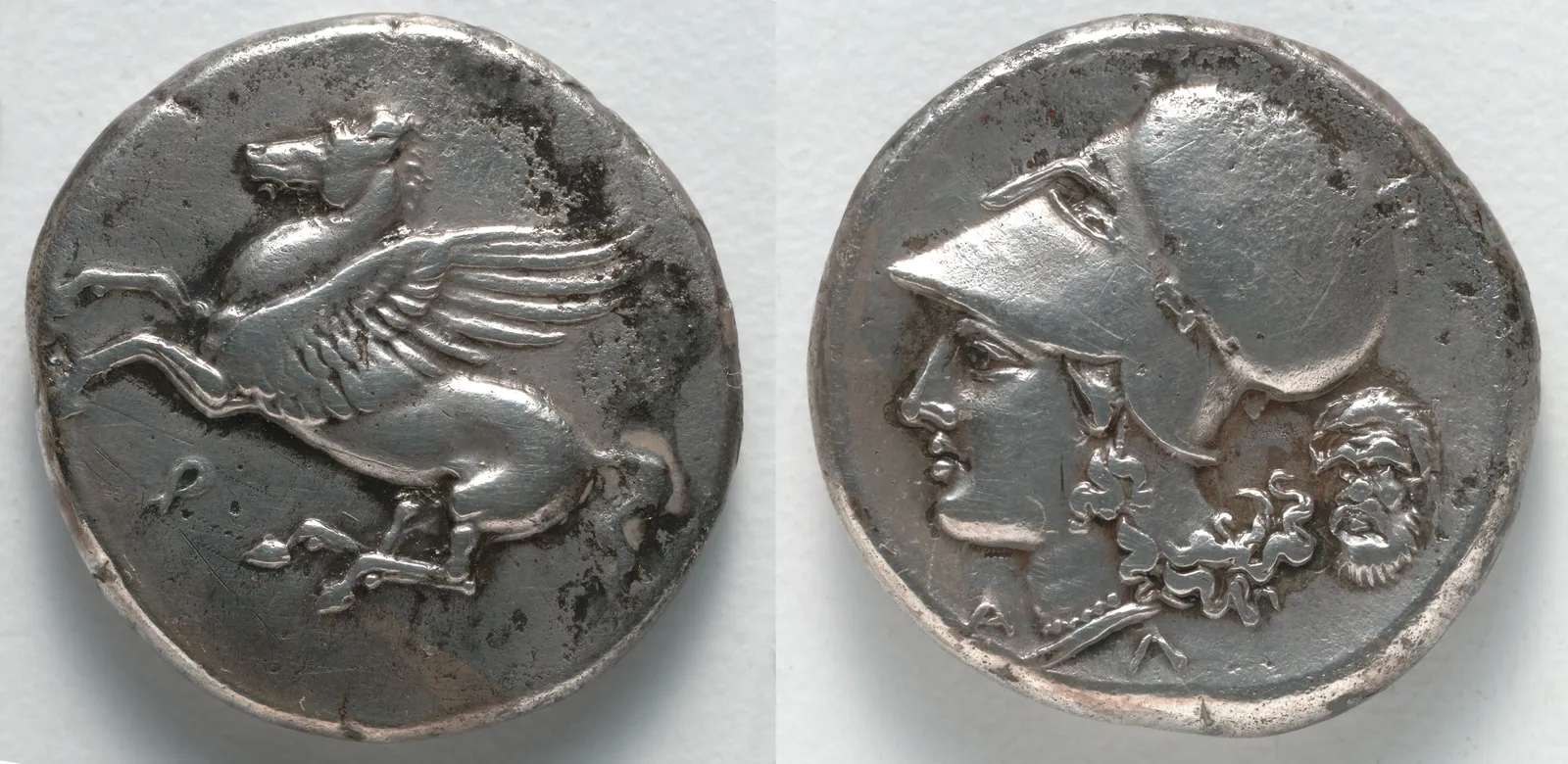
A silver stater minted at Corinth, c. 350–338 BCE · museum attribution. The Corinthian family of calendars supplies the month names on the mechanism's upper spiral.
Museum no. 1916.984 · Findspot: unrecorded
"Stater: Pegasos (obverse); Head of Athena (reverse)" by The Cleveland Museum of Art — https://clevelandart.org/art/1916.984 — CC0 1.0 (https://creativecommons.org/publicdomain/zero/1.0/)
The coin's findspot is unrecorded, so it shows what Corinth struck but not where this piece circulated. The two local festivals on the dial carry more weight. The Halieia belonged to Rhodes and the Naa to Dodona. Jones argues that this copy's calendar was probably adapted for an owner living where the Corinthian calendar was used, and he finds Iversen's proposal of a Rhodian calendar on the original design "highly plausible."
The most economical reading is a device built for someone who needed civic and festival dates as well as the sky. That fits this site's habit of asking first who needed a date: a month name and a festival year are dates for a city, not for an astronomer.
Was the Antikythera mechanism the first computer?
A label that is often repeated calls it a computer. Price used the word in the title of his 1959 Scientific American article, "An Ancient Greek Computer" (listed by Jones 2020). Wikipedia's article, read in October 2026, calls the device "the oldest known example of an analogue computer." The word that matters there is "known."
Cicero describes two comparable devices. In On the Republic, written between 54 and 51 BCE (Freeth 2014), a speaker recalls a sphere by Archimedes that Marcellus took from Syracuse. In it, "una conversio" (a single turning, in this page's translation) kept the unequal courses of the Sun, the Moon and the five planets (book 1, sections 21 and 22).
In On the Nature of the Gods (2.88), published in 45 BCE but set in the 70s BCE (Jones 2020), a speaker mentions, in the 1933 Loeb translation, "the orrery recently constructed by our friend Posidonius." So "oldest known" is a title held by survival, as of 2026, not evidence that nothing came before. Jones (2020) cites "numerous explicit references to such devices in Greco-Roman literature starting in the first century BCE," and Freeth and Jones (2012) call the mechanism "the product of a sophisticated and mature engineering tradition."
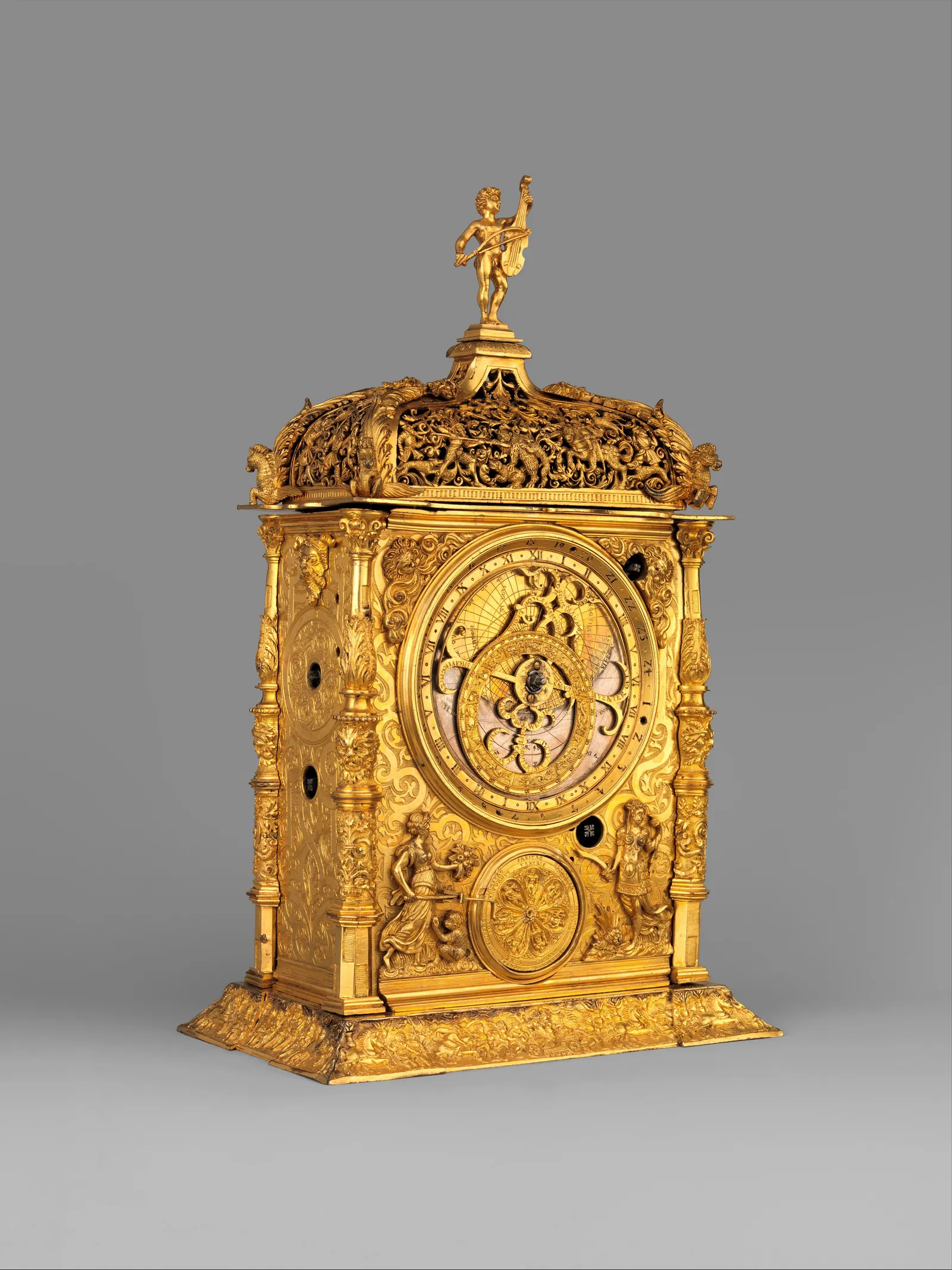
An astronomical table clock made in Augsburg, 1568 · museum attribution: gilded brass case and dials, movement in an iron-posted frame. It belongs to the century one modern-origin claim proposes.
Museum no. 17.190.634a–d · Findspot: unrecorded
"Astronomical table clock" by The Metropolitan Museum of Art — https://commons.wikimedia.org/wiki/File:Astronomical_table_clock_MET_DP353268.jpg — CC0 1.0 (https://creativecommons.org/publicdomain/zero/1.0/)

An occasional claim says the device is not ancient at all. After Price announced his first results in December 1958 · documentary, the Baltimore Sun and Kathimerini reported in January 1959 · documentary the view that it was a modern schoolroom planetarium dropped from a passing ship (Jones 2020).
Nimal and Tranier (2012) argued for a 17th-century curiosity, and Lequèvre (2017) placed it in the second half of the 16th century or later (all as summarized by Jones 2020). Jones notes that, so far as he knows, none of these arguments has appeared in a peer-reviewed or otherwise scholarly venue.
The answers sit in the object and its paperwork. Photographs and descriptions place the fragments in the Athens museum from May 1902. The uneven spacing of some gear teeth suggests, in Freeth and Jones's reading, hand cutting with a file rather than a dividing machine. The clock above has no findspot either; its 1568 date comes from the museum's record of the object.
The inscriptions give the firmest answer. The Naa of Dodona, named on the Games dial, seems to have reached modern print only in 1774, Jones notes. His main argument is that the makers knew details of the upper spiral's calendar that were unavailable to anyone from the early modern period until the late 20th century, some of them found only from 2008 onward through study of the mechanism itself. On that argument, a maker in the 1500s would have needed facts that nobody in that century could look up.
Who could have built the Antikythera mechanism?
No maker of the Antikythera mechanism is known by name; none of the studies read for this page reports a signature or a workshop name among its inscriptions, as of 2026. Its calendar points to users rather than makers: as noted above, Jones reads the month names as an adaptation for one owner and thinks the original design likely used the calendar of Rhodes.
Cicero names two builders of comparable devices, and Freeth and Jones (2012) weigh them differently. They place Posidonius's sphere in Rhodes, probably in the 80s–70s BCE · documentary, and suggest it was more plausibly built "at the commission of" Posidonius than by him. For Archimedes' sphere, of the late 3rd century BCE · documentary, they doubt that Cicero saw it and are "wary" of using his account to date such devices back to Archimedes.
No source read for this page assigns the Antikythera fragments to either man. Freeth raised the Posidonius question in the title of a 2002 paper, "Is it Posidonius' Orrery?", listed in the 2012 bibliography and not read here. In 2012 he and Jones wrote that many aspects of its design suggest a mathematician's instrument, a description of the design that names no maker.
How many days did the front calendar ring count?
The front dial has two rings. The inner one is the zodiac, 12 signs of 30 degrees. The outer one is a movable ring marked for the Egyptian calendar, twelve 30-day months and five extra days, and its surviving part in Fragment C includes the sectors for the months Pachon and Payni (Jones 2020).
That 365-day year had no leap day, so it slipped against the seasons by one day every four years, and the ring could be turned to follow it. The Egyptian civil calendar has its own page here. Jones notes that in 205 BCE the Egyptian New Year, 1 Thoth, fell on 13 October, and this page's calculation from the standard Egyptian epoch, JD 1448638, gives the same day: 13 October 205 BCE · computed, proleptic Julian.
What is Disputed is the count of small holes drilled beneath the ring, which held it in position. Jones (2020) describes the ring as settable in any of 365 orientations, on peg holes spaced close to 1 degree apart. In a December 2020 paper, Budiselic and colleagues measured hole positions on the surviving arc from X-ray images and gave a 99 percent confidence interval of 346.8 to 367.2 holes for the full ring (as reported by Woan and Bayley 2024).
In 2024, Woan and Bayley of the University of Glasgow reanalyzed those measurements, 81 measured hole positions, with Bayesian methods. Their 68 percent credible estimate is 355.24 holes (+1.39/−1.36). With holes beside fractures left out, it is 354.08 (+1.47/−1.41). They found a 360-hole ring "strongly disfavoured," and one of 365 holes "is not plausible, given our model assumptions."
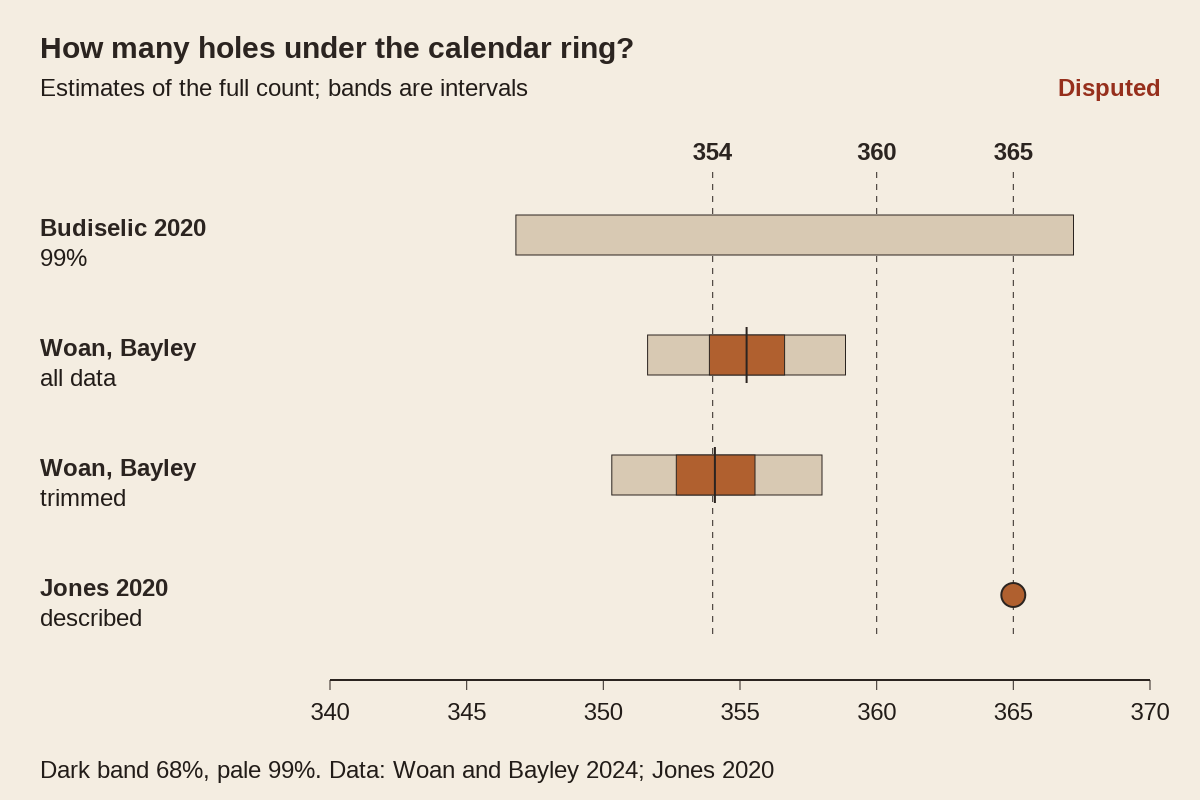
Scroll sideways to read every label, or open the full drawing.
Estimates of the full hole count, with reference lines at 354, 360 and 365. Dark bands are 68 percent intervals, pale bands 99 percent. Download: hole-count CSV (sources and license, JSON).
"Antikythera mechanism: estimates of the calendar ring hole count" by Sherd and Script, https://sherdandscript.com/calendars/antikythera-mechanism/, licensed under CC BY 4.0 (https://creativecommons.org/licenses/by/4.0/)Data: Graham Woan and Joseph Bayley, An improved calendar ring hole-count for the Antikythera mechanism, arXiv:2403.00040 (2024), https://arxiv.org/abs/2403.00040; Alexander Jones, The Epoch Dates of the Antikythera Mechanism, ISAW Papers 17 (2020), CC BY 4.0, http://hdl.handle.net/2333.1/ffbg7m07
A ring of 354 holes would fit a 354-day lunar year, not the Egyptian year whose month names are engraved on the scale above it. The Glasgow authors also state that they could not show the count is a whole number. As of 2026, which calendar those holes served is still open.
Proof radius
What this box is for: the proof radius.
Proves: The wreck's coins and pottery show that the Antikythera mechanism existed by
60 ± 10 BCE · associated finds, coins and pottery, and its dials show that it counted a 19-year Corinthian-type calendar, the 223-month Saros cycle and a four-year festival cycle.Doesn't prove: That it was made in 205 or 178 BCE. Those are computed starting settings of its dials, and the year of its making is still unknown.
Read next: Egyptian civil calendar: the 365-day year named on the front ring, converted step by step. Sutton Hoo: another find whose date leans on the coins buried with it.
Sources
Primary sources first.
- 1Cicero, De re publica 1.21–22, Latin text, The Latin Library. https://www.thelatinlibrary.com/cicero/repub1.shtml Read: full text of book 1 (Latin)
- 2Cicero, De natura deorum 2.88, Latin text, The Latin Library. https://www.thelatinlibrary.com/cicero/nd2.shtml Read: full text of book 2 (Latin)
- 3Cicero, De Natura Deorum 2.88, Loeb Classical Library translation (1933), LacusCurtius transcription. https://penelope.uchicago.edu/Thayer/E/Roman/Texts/Cicero/de_Natura_Deorum/2B*.html Read: full text of 2.73–end (English); page states the text is in the public domain
- 4Cleveland Museum of Art, "Stater: Pegasos (obverse); Head of Athena (reverse)," 1916.984, collection record (Open Access data, CC0). https://www.clevelandart.org/art/1916.984 Read: full record (CC0)
- 5Metropolitan Museum of Art, "Astronomical table clock," 17.190.634a–d, collection record as mirrored on Wikimedia Commons (the museum's page was not read). https://commons.wikimedia.org/wiki/File:Astronomical_table_clock_MET_DP353268.jpg Read: Commons file page and metadata mirroring the museum record
- 6Metropolitan Museum of Art, "Cuneiform tablet: fragment of an astronomical table (?)," 86.11.374a, b, collection record as mirrored on Wikimedia Commons (the museum's page was not read). https://commons.wikimedia.org/wiki/File:Cuneiform_tablet-_fragment_of_an_astronomical_table_(%3F)_MET_86.11.374a,b_new.jpg Read: Commons file page and metadata mirroring the museum record
- 7Alexander Jones, "The Epoch Dates of the Antikythera Mechanism (With an Appendix on its Authenticity)," ISAW Papers 17 (2020). https://archive.nyu.edu/bitstream/2451/61000/3/Jones%202020%20Epoch%20dates%20of%20the%20Antikythera%20Mechanism%20ISAW%20Papers%2017.xhtml Read: full text (XHTML, CC BY 4.0)
- 8Tony Freeth and Alexander Jones, "The Cosmos in the Antikythera Mechanism," ISAW Papers 4 (2012). https://dlib.nyu.edu/awdl/isaw/isaw-papers/4/ Read: full text (HTML, CC BY 3.0)
- 9Tony Freeth, "Eclipse Prediction on the Ancient Greek Astronomical Calculating Machine Known as the Antikythera Mechanism," PLOS ONE 9(7): e103275 (2014). https://journals.plos.org/plosone/article?id=10.1371/journal.pone.0103275 Read: full text (HTML, CC BY 4.0)
- 10Graham Woan and Joseph Bayley, "An improved calendar ring hole-count for the Antikythera mechanism," arXiv:2403.00040 (2024); published in the Horological Journal, 2024. https://arxiv.org/abs/2403.00040 Read: full text (arXiv v1 PDF)
- 11University of Glasgow, "Gravitational wave researchers cast new light on Antikythera mechanism mystery," news release, 27 June 2024. https://www.gla.ac.uk/news/headline_1086643_en.html Read: full text
- 12Aristeidis Voulgaris, Christophoros Mouratidis and Andreas Vossinakis, "The Initial Calibration Date of the Antikythera Mechanism after the Saros spiral mechanical Apokatastasis," Almagest 14(1) (2023): 4–39; arXiv:2203.15045. https://arxiv.org/abs/2203.15045 Read: abstract and journal reference (arXiv)
- 13Wikidata, "Antikythera mechanism" (Q182324) and "Antikythera" (Q213730): collection, location of discovery, island coordinates. https://www.wikidata.org/wiki/Q182324 Read: Wikidata items (structured statements, CC0)
- 14Wikipedia, "Antikythera mechanism" (revision 1379527330, read 2026-10-13; used for the popular label and as an entry point). https://en.wikipedia.org/wiki/Antikythera_mechanism Read: full article and reference list
Cite this page
Sherd and Script. “Antikythera Mechanism: Neither of Its Two Dates Is When It Was Made.” Sherd and Script. Published 13 October 2026; last substantive revision 14 October 2026. https://sherdandscript.com/calendars/antikythera-mechanism/ (accessed ).
Corrections
- 2026-10-14 — Added the section "Who could have built the Antikythera mechanism?" (was: no such section → now: three paragraphs beginning "No maker of the Antikythera mechanism is known by name; none of the studies read for this page reports a signature or a workshop name among its inscriptions, as of 2026.") — A. Jones 2020; T. Freeth and A. Jones 2012