Case file
Cuneiform: The Sign That Starts Ea-nasir's Name Also Means "House"
Sherd and Script · Published 13 October 2026 · Revised 14 October 2026
A clay letter from Ur uses one sign as a sound and as a word, and another as a sound and as a silent label. The excavation record puts the letter, probably, in the house of the man it was written to.
Find card
- Object / Site
- Clay letter from Nanni to Ea-nasir in Akkadian cuneiform (UET 5, 81; excavation no. U.16814a)
- Findspot
- Ur (Tell Muqayyar), southern Iraq; area AH, probably the house called No. 1 Old Street; site-level position only
- Context
- House archive: the field catalog gives "AH House IV", twice glossed "? No. 1 Old Street"; the house held other letters to Ea-nasir and tablets dated to the reign of Rim-Sin; excavated in the 1930–31 season
- Dated by
- Museum attribution on the gallery label; the letter carries no date of its own. Archive context: dated tablets from the same house
- Range
c. 1750 BCE · museum attribution; house archivereign of Rim-Sin · associated finds, dated tablets- Dated event
- Writing of the letter (museum attribution); use of the house archive (dated tablets)
- Now at
- British Museum, London: BM 131236 (as given by CDLI P414985 and Wikidata Q21585351); registration 1953,0411.71 (as given by CDLI P414985); the museum’s page was not read
- Primary record
- CDLI P414985, https://cdli.earth/P414985; text edition UET 5, 81 (Figulla and Martin 1953); excavation record, Ur Excavations VII, pp. 124-125
Find card as CSV cuneiform-find-card.csv (sources and license, JSON)Data: Cuneiform Digital Library Initiative, artifact entry P414985, https://cdli.earth/P414985; Wikidata Q21585351 and Q5699 (CC0), https://www.wikidata.org/
TL;DR. The Ea-nasir tablet, British Museum BM 131236 (number via Wikidata Q21585351 and CDLI P414985; museum page not read), is a letter in Akkadian cuneiform, Mesopotamia's wedge-shaped script, dated c. 1750 BCE · museum attribution on its gallery label. In CDLI's transliteration, the sign E2 is the syllable e in Ea-nasir's name and the word for "house" on the reverse, while AN is the syllable an in Nanni's name and a silent marker before a god's name. The excavation record places it, probably, in Ea-nasir's own house at Ur.
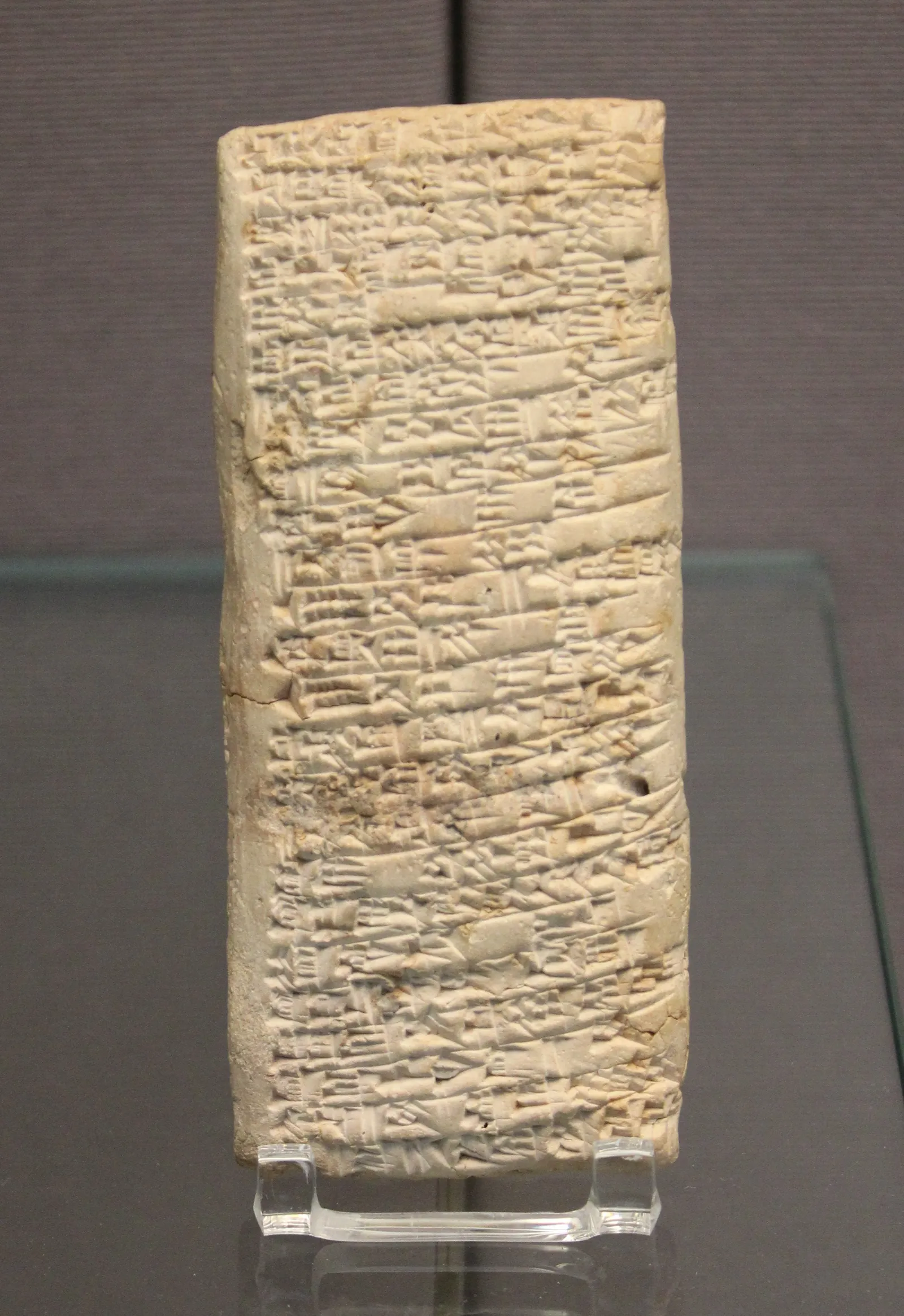
The reverse of the Ea-nasir tablet in its London display case.
Museum no. BM 131236 · Findspot: Ur, area AH, probably house No. 1 Old Street
"Complaint tablet to Ea-Nasir 2020" by Zunkir — https://commons.wikimedia.org/wiki/File:Complaint_tablet_to_Ea-Nasir_2020.jpg — CC BY-SA 4.0 (https://creativecommons.org/licenses/by-sa/4.0/)

The sign that begins Ea-nasir's name on this tablet means "house" on its reverse. Cuneiform, the wedge-shaped script of ancient Mesopotamia, worked that way. In CDLI's transliteration of this letter, one sign is read in one line as a sound and in another as a word, and another is read in one line as a sound and in another not at all. A sign's shape does not say which job it is doing; the signs around it do.
The tablet is also a find with a recorded context. Nanni, a customer, wrote it to Ea-nasir, a copper merchant, and the excavation record from Ur places it, probably, in a house that held other letters to Ea-nasir. The most economical reading of that findspot is that this is mail Ea-nasir received and kept.
What does the Ea-nasir tablet say?
The letter is short and angry. Wikipedia's summary, based on the translations of W. F. Leemans and A. Leo Oppenheim, says Ea-nasir had promised Nanni copper ingots of fine quality, then offered Nanni's servant poor ones on a take-it-or-leave-it basis and turned his messengers away. Nanni demands his money back and says that from now on he will inspect the ingots in his own yard.
Wiktionary's entry for the Akkadian word umma translates the opening this way: "Tell Ea-nāṣir: Nanni sends the following message: When you came, you said to me as follows: 'I will give Gimil-Sin fine quality copper ingots.'" The entry names no translator.
According to Wikipedia's article on the tablet, Oppenheim translated several lines in 1954 · documentary, Leemans published a full English translation in 1960 · documentary, and Oppenheim's complete version followed in 1967 · documentary. Neither man's translation was read for this page. The summary above is Wikipedia's, and the quoted lines are Wiktionary's.
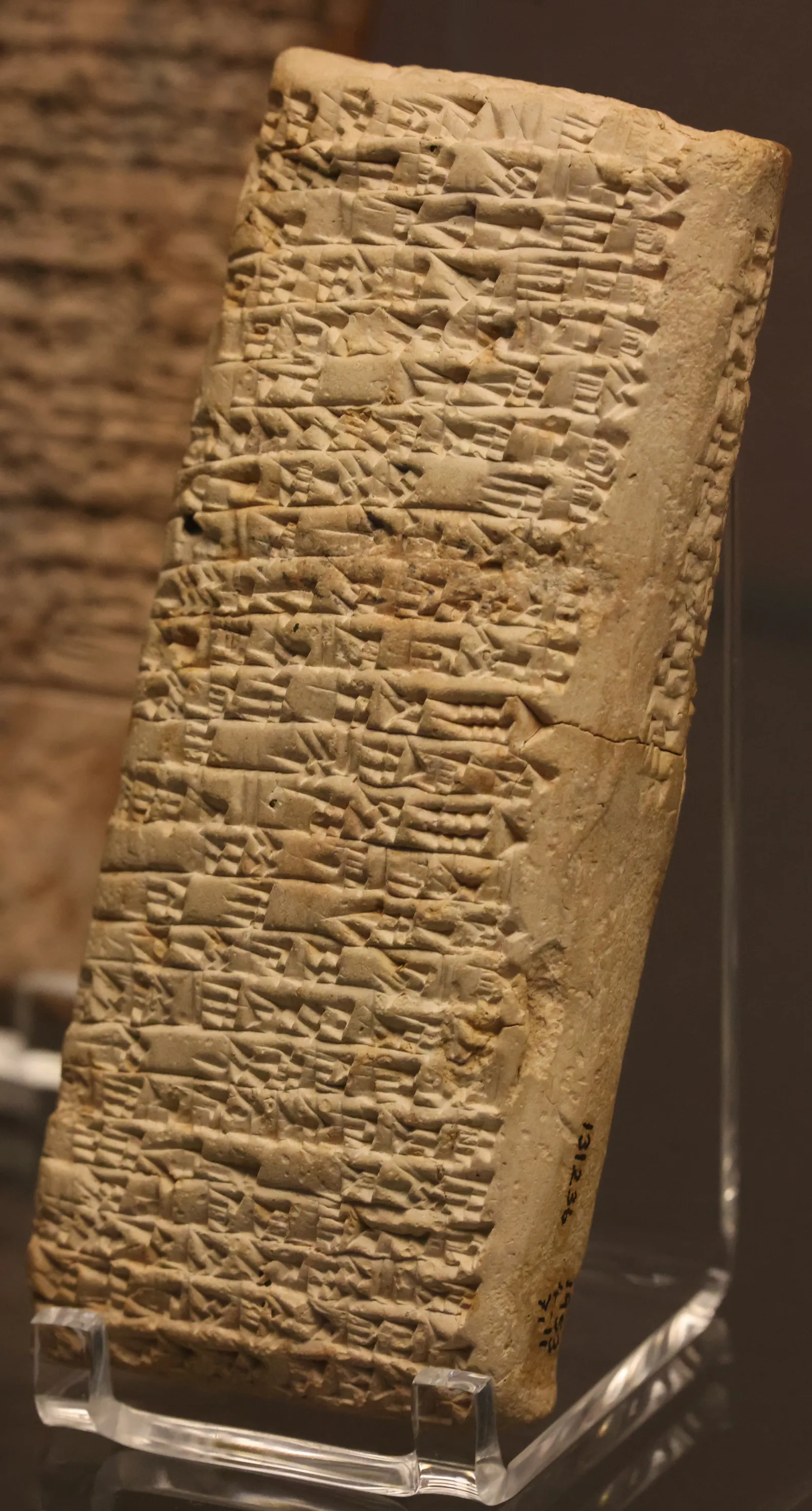
The same tablet at an angle. The wedges fill the face and carry on around the narrow edge.
Museum no. BM 131236 · Findspot: Ur, area AH, probably house No. 1 Old Street
"Complaint tablet to Ea-Nasir three quater view" by Geni — https://commons.wikimedia.org/wiki/File:Complaint_tablet_to_Ea-Nasir_three_quater_view.JPG — CC BY-SA 4.0 (https://creativecommons.org/licenses/by-sa/4.0/)

CDLI's transliteration runs over the obverse, the reverse and the left edge. The record lists no date referenced in the text. The tablet has to be dated from outside it, from a museum label and from the tablets found with it.
How can one cuneiform sign be a word, a syllable or a silent marker?
The Unicode Standard calls Sumero-Akkadian cuneiform "a logographic writing system with a strong syllabic component." A logogram is a sign that stands for a whole word, and a syllabic sign stands for a sound such as an or ma. Wikipedia's article on cuneiform notes that many signs had both kinds of value, and that some also served as determinatives, labels that show what kind of word they go with and are not meant to be pronounced.
The Oracc Sign List, a public-domain catalog of cuneiform signs, shows how far this goes for two signs in Nanni's letter. For CUNEIFORM SIGN AN it lists 38 values, by this page's count, among them the syllable an, the Sumerian word diŋir, "deity," and d, the abbreviation used when the sign marks a god's name. For CUNEIFORM SIGN E2 it lists the syllable e₂ and the Sumerian word e, "house."
Nanni's letter uses both signs both ways. In CDLI's transliteration, E2 is the syllable e₂ at the start of Ea-nasir's name on the first line, and the word É, "house," in "É {d}UTU," the house of the god Utu, on reverse line 15. AN is the syllable an in Nanni's name on obverse line 3, and the silent marker {d} in front of the divine names Utu and Suen.
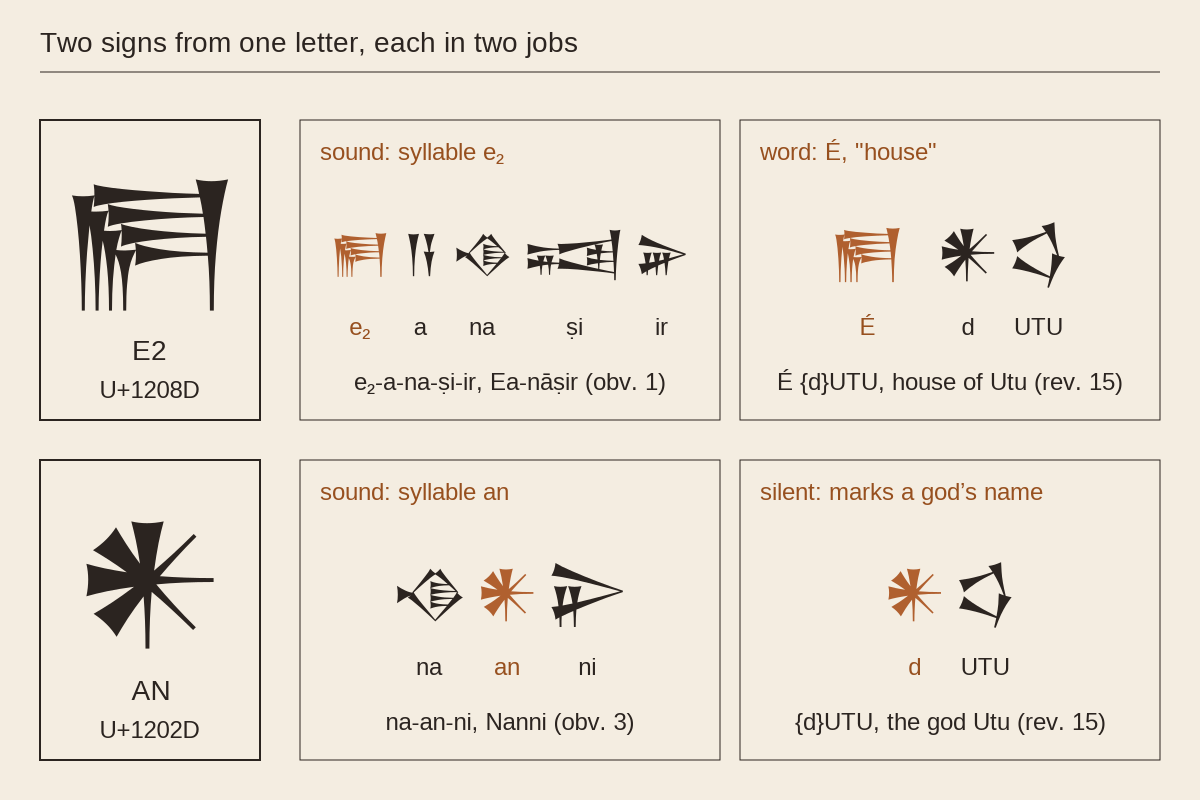
Scroll sideways to read every label, or open the full drawing.
E2 and AN as Nanni's letter uses them, each in two jobs. Standard forms in the Noto Sans Cuneiform font, not the Old Babylonian hand on the tablet.
"Two cuneiform signs from the Ea-nasir letter, each in two jobs" by Sherd and Script, https://sherdandscript.com/scripts/cuneiform/, licensed under CC BY 4.0 (https://creativecommons.org/licenses/by/4.0/)
Data sources for this figure
Data: Glyphs: Noto Sans Cuneiform 2.001 (SIL Open Font License 1.1), https://github.com/notofonts/cuneiform; Transliteration: CDLI P414985 (UET 5, 0081), transliteration by Els Woestenburg (2018), Cuneiform Digital Library Initiative, https://cdli.earth/P414985; Sign values: Oracc Sign List 1.0 (CC0), https://oracc.museum.upenn.edu/osl/signlist/; Character names and code points: Unicode Character Database 18.0.0, © Unicode, Inc., Unicode License v3, https://www.unicode.org/license.txt
Think of such a sign as a word like "present," which can be a noun or a verb: the spelling stays the same, and the sentence around it settles the reading. A transliteration writes that decision down. Wikipedia's article describes the usual conventions: sounds in small letters, signs read as Sumerian words in capitals and the god-marker as a raised d. The Oracc primer on the ATF format, which CDLI uses, puts determinatives in curly brackets.
Where and when did cuneiform begin?
The earliest known cuneiform comes from the city of Uruk in southern Mesopotamia, as of 2026. The Unicode Standard 18.0 says the script is first attested there as a complete writing system in the Uruk IV period, with about 700 signs. Unicode dates that period c. 3500–3200 BCE · archaeological context and the CDLI period list c. 3350–3200 BCE · archaeological context, so its start is Disputed.
Unicode adds that tablets of this early kind, from the late 4th millennium BCE · archaeological context, also come from Susa and other sites in western Iran, from Nineveh, and from Tell Brak and Habuba Kabira in Syria. Much of the early sign list recorded quantities and goods for administration, and many signs were pictures, such as a bull's head for "cattle." Whether the abstract signs grew out of an earlier "token" system of accounting is Disputed; Unicode reports "no general agreement on this point."
The wedges came from the writing tool. Drawing curves in clay with a sharpened reed was slow, so scribes approximated the pictures with short wedge-shaped impressions, and the Latin cuneus, "wedge," gave the script its modern name. Unicode places the first true Sumerian texts in the following Uruk III period and says cuneiform proper was common from c. 2700 BCE · archaeological context.
How do you read the Ea-nasir letter sign by sign?
The first three lines of the obverse are spelled entirely by sound. CDLI transliterates them as "a-na e₂-a-na-ṣi-ir / qi₂-bi₂-ma / um-ma na-an-ni-ma," and Wiktionary normalizes the words as ana Ea-nāṣir qibima umma Nannima. Its entries gloss ana as "to," qibi as the command form of qabûm, "to say," and umma as the word that introduces speech, and the same formula opens another letter quoted under umma.
Each reading points to a particular sign. The small numbers tell apart signs that share a sound. Wikipedia's article on cuneiform describes the convention, and the sign list confirms which sign is meant: qi₂ is a value of the sign KI, bi₂ of NE, and ṣi of ZE2. As with the royal names on the Rosetta Stone, Nanni's and Ea-nasir's names are spelled out by sound, Ea-nasir's in five signs of one syllable each.
One detail shows up only in the transliteration. Wikipedia glosses the name Ea-nāṣir as "Ea (is his) warden," Ea being a god, yet CDLI's text of this letter has no god-marker before it. The scribe wrote {d} before Utu and Suen and left it off Ea.
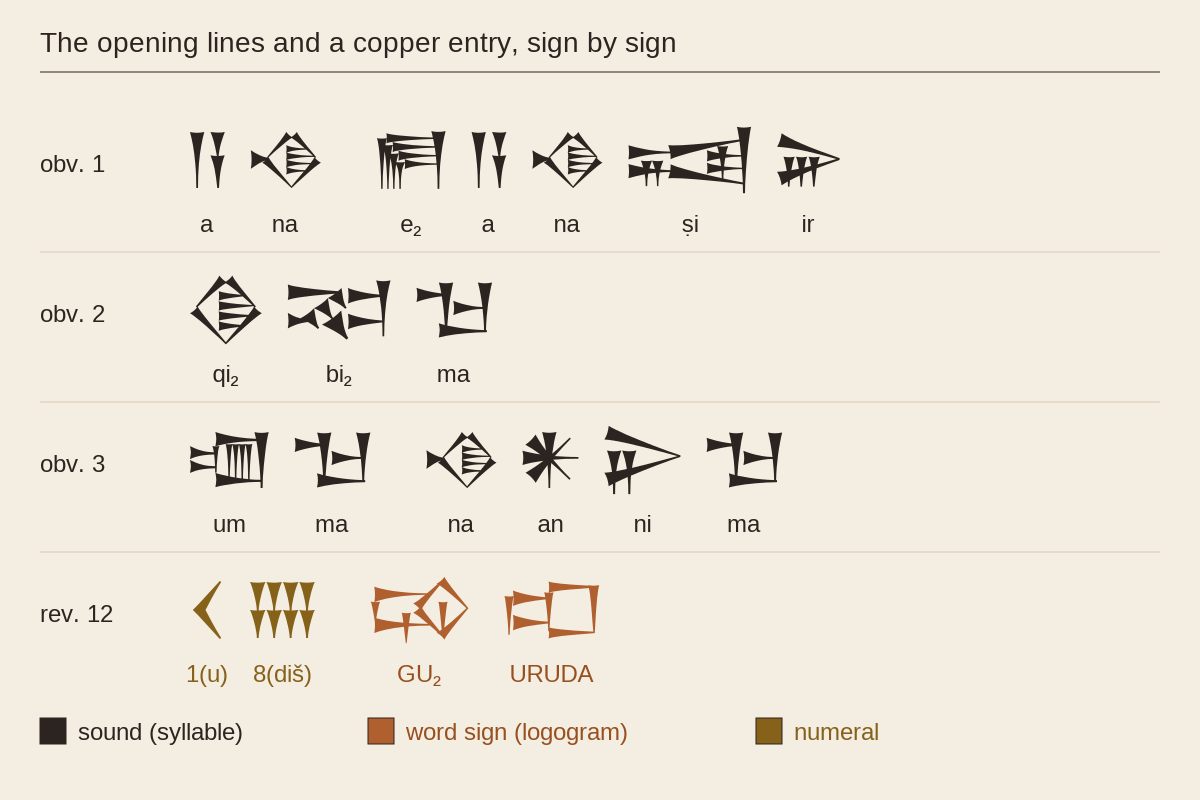
Scroll sideways to read every label, or open the full drawing.
Obverse lines 1 to 3 and the start of reverse line 12, with CDLI's readings. Standard Noto Sans Cuneiform forms, not the Old Babylonian hand on the tablet.
"The opening lines of the Ea-nasir letter and a copper entry, sign by sign" by Sherd and Script, https://sherdandscript.com/scripts/cuneiform/, licensed under CC BY 4.0 (https://creativecommons.org/licenses/by/4.0/)
Data sources for this figure
Data: Glyphs: Noto Sans Cuneiform 2.001 (SIL Open Font License 1.1), https://github.com/notofonts/cuneiform; Transliteration: CDLI P414985 (UET 5, 0081), transliteration by Els Woestenburg (2018), Cuneiform Digital Library Initiative, https://cdli.earth/P414985; Sign values: Oracc Sign List 1.0 (CC0), https://oracc.museum.upenn.edu/osl/signlist/; Character names and code points: Unicode Character Database 18.0.0, © Unicode, Inc., Unicode License v3, https://www.unicode.org/license.txt
Word signs also appear where the letter turns to quantities. Reverse line 12 begins "1(u) 8(diš) GU₂ URUDA." CDLI writes numerals with their counting unit, as the Oracc guide to CDLI's format requires, so one ten-sign and eight unit-signs make 18.
GU₂ is the sign for the talent, which the Unicode Standard describes as a unit of weight of approximately 30 kg, and the sign list gives URUDA the value urud, "copper." By this page's arithmetic, using Unicode's round figure, 18 talents comes to about 540 kg. The line then spells a-na-ku ad-di-in by sound, which Wiktionary's entries parse as anāku, "I," and a form of nadānum, "to give." The readings, signs and code points behind both figures are in a sign-by-sign CSV (Data: Transliteration: CDLI P414985 (UET 5, 0081), transliteration by Els Woestenburg (2018), Cuneiform Digital Library Initiative, https://cdli.earth/P414985; Sign values: Oracc Sign List 1.0 (CC0), https://oracc.museum.upenn.edu/osl/signlist/; Unicode Character Database 18.0.0, © Unicode, Inc., Unicode License v3, https://www.unicode.org/license.txt) (sources and license, JSON).
Who read cuneiform again, and how?
Several scholars read cuneiform again in stages, among them G. F. Grotefend, Henry Rawlinson and E. Hincks, starting with Old Persian royal inscriptions. In his memoir on the Behistun inscription, Rawlinson credits Grotefend with reading the names Hystaspes, Darius and Xerxes in two short inscriptions from Persepolis, using accurate copies by Niebuhr. Rawlinson wrote that he had found the same three names on his own, and he judged that Grotefend's alphabet had 8 of its 30 letters right.
Behistun repeated a Persian text in Babylonian. L. W. King and R. C. Thompson's 1907 edition describes the inscription of Darius the Great there as a Persian text with Susian and Babylonian versions. Rawlinson copied the main Babylonian text in 1847 · documentary as a paper squeeze, or cast, because its position on the rock had kept him from copying it by hand.
The reading was put to a public test in 1857 · documentary. W. H. Fox Talbot sent the Royal Asiatic Society a sealed translation of a newly lithographed cylinder inscription of King Tiglath-Pileser I, and the Society asked Rawlinson, Hincks and Oppert for their own versions under seal. The examiners' report of 29 May 1857 · documentary found "a strong correspondence in the meaning assigned," closest between Rawlinson and Hincks.
Talbot's covering note named the objection the test had to answer: critics doubted a script in which "each Cuneiform group represents a syllable, but not always the same syllable." On this site's reading, that is the same kind of many-valued sign as E2 and AN in Nanni's letter.
Why does Unicode name the cuneiform sign and not the sound?
Unicode encodes cuneiform by sign, not by reading. The character U+1202D is CUNEIFORM SIGN AN whether a scribe meant an, "deity" or the silent {d}, and the standard says that working with cuneiform text needs extra data linking code points to sign lists and to sign values. A run of Unicode cuneiform records which signs were written, not which reading a scholar chose.
The script now fills four blocks, by this page's count of the Unicode 18.0 data files:
| Block | Range | Characters | Added in Unicode version (characters) |
|---|---|---|---|
| Cuneiform | U+12000–U+123FF | 922 | 5.0 (879), 7.0 (42), 8.0 (1) |
| Cuneiform Numbers and Punctuation | U+12400–U+1247F | 128 | 5.0 (103), 7.0 (13), 18.0 (12) |
| Early Dynastic Cuneiform | U+12480–U+1254F | 196 | 8.0 (196) |
| Archaic Cuneiform Numerals | U+12550–U+1268F | 311 | 18.0 (311) |
The main block arrived with Unicode 5.0, released in July 2006 · documentary according to the header of the DerivedAge data file. Download: cuneiform-unicode-blocks.csv (Data: Unicode Character Database 18.0.0, © Unicode, Inc., Unicode License v3, https://www.unicode.org/license.txt) (sources and license, JSON).
Unicode leaves the shape of each sign to the font. Its code charts draw most signs in the style of the Ur III period, and the standard says cuneiform fonts need to be designed for different historic periods. The figures on this page use Noto Sans Cuneiform, so their shapes are standardized and are not copies of the scribe's hand.
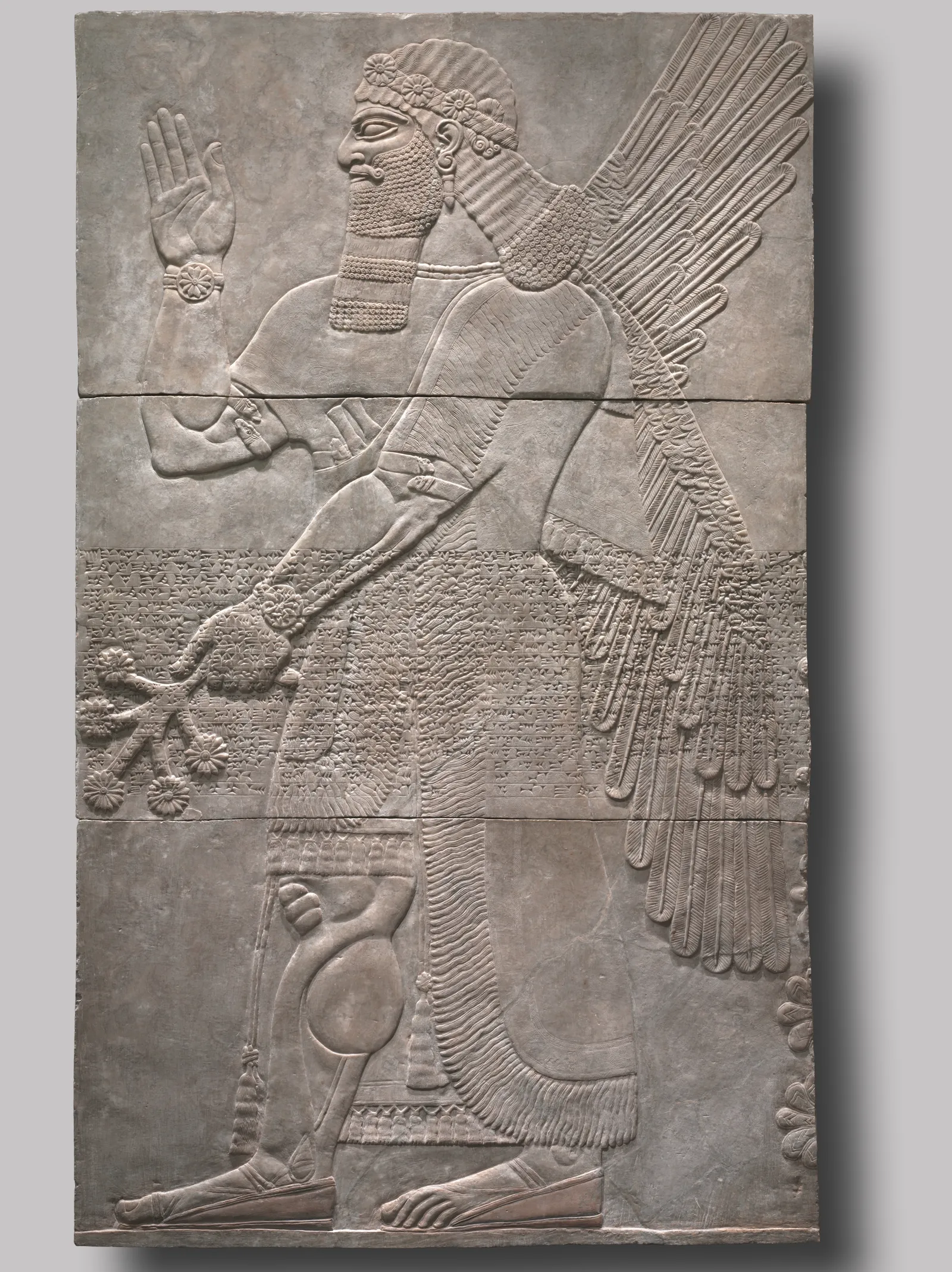
A palace relief from Nimrud in Cleveland, about 2.3 m tall. A band of cuneiform runs across the figure's body.
Museum no. 1943.246 · Findspot: Northwest Palace of Ashurnasirpal II, Nimrud (Calah)
"Saluting Protective Spirit" by The Cleveland Museum of Art — https://clevelandart.org/art/1943.246 — CC0 1.0 (https://creativecommons.org/publicdomain/zero/1.0/)
The same encoding covers inscriptions from much later in the script's history. The Cleveland Museum of Art dates this relief to the reign of Ashurnasirpal II, 883–859 BCE · museum attribution, and its record translates the band as a royal text that begins "(Property of) the palace of Assurnasirpal (II), vice-regent of Assur."
Later still, Freeth and Jones (2012) write, astronomers in Babylonia identified the Saros eclipse cycle from records of dated observations beginning in the 7th century BCE · documentary if not earlier. The Antikythera mechanism counts the same cycle on one of its dials.
Is the Ea-nasir tablet really the world's oldest customer complaint?
The tablet is famous for a title. Wikipedia's article describes it as the "oldest known written complaint" and reports that Guinness World Records lists it as the "oldest written customer complaint."
A claim about a first rests on a date. The letter does not date itself. A visitor's photograph of the gallery label in London shows it reading "About 1750 BC (Old Babylonian period), from Ur," which this page labels c. 1750 BCE · museum attribution, as of 2026. The label does not say how the museum reached that figure.
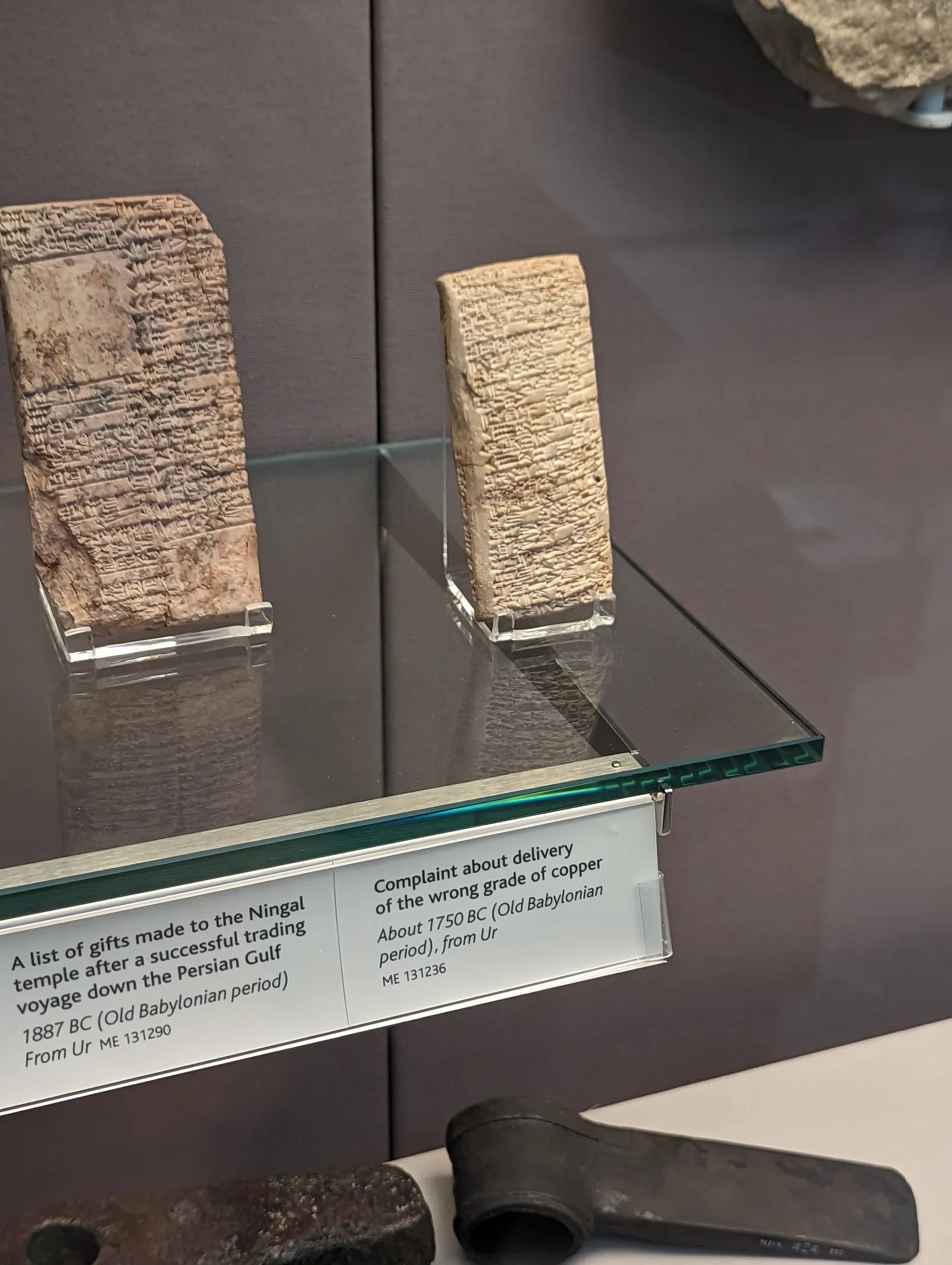
The tablet's gallery label in London: "Complaint about delivery of the wrong grade of copper. About 1750 BC (Old Babylonian period), from Ur."
Museum no. BM 131236 · Findspot: Ur, area AH, probably house No. 1 Old Street
"Complaint tablet to Ea-nasir on display (2023-09-09)" by Avelludo — https://commons.wikimedia.org/wiki/File:Complaint_tablet_to_Ea-nasir_on_display_(2023-09-09).jpg — CC BY-SA 4.0 (https://creativecommons.org/licenses/by-sa/4.0/)

Repeated without that source, the figure turns into a bare date, a date given without its basis. Wikidata stores "c. 1750" for the tablet with no reference, and Wikipedia's infobox prints the same figure without one.
The house gives a second, independent clue. Woolley recorded that tablets in Ea-nasir's house included "some dated to the reign of Rim-Sin," king of Larsa, and Wikipedia, citing a 2021 chapter by Gina Konstantopoulos, places Ea-nasir's dated business in years 11 and 19 of Rim-Sin I · documentary. That gives the archive reign of Rim-Sin · associated finds, dated tablets; Wikipedia's article on the king states his reign "in middle chronology," so any year BCE depends on that choice of chronology.
The record also does not rank Nanni's letter within its own archive. Wikipedia, citing Leemans (1960), names other correspondents who complained to Ea-nasir, among them Arbituram, Appa, Ilsu-ellatsu and Ili-idinnam, and no source read for this page dates Nanni's letter against theirs. As of 2026 the title is provisional: it rests on a museum's round date, and an older complaint could still be unpublished.
Where was the Ea-nasir tablet found?
The tablet came out of Ur, in southern Iraq, during the excavations that the British Museum and the University of Pennsylvania Museum ran jointly in 1922–1934 · documentary, according to the final report's title page and its season table. CDLI records the tablet's excavation number as U.16814a. The table assigns U.16001 to U.17448 to the season of 1930–31 · documentary, so by this page's reading the tablet was found that season.
The house is described in volume VII of Ur Excavations, which Woolley wrote before the Second World War and which appeared, edited by T. C. Mitchell, in 1976 · documentary. In the area Woolley called AH, the house known as No. 1 Old Street had a letter to Ea-nasir lying in a doorway, and "many other tablets, some dated to the reign of Rim-Sin, were scattered over the building." The owner, Woolley concluded, "was a merchant primarily engaged in the copper trade."
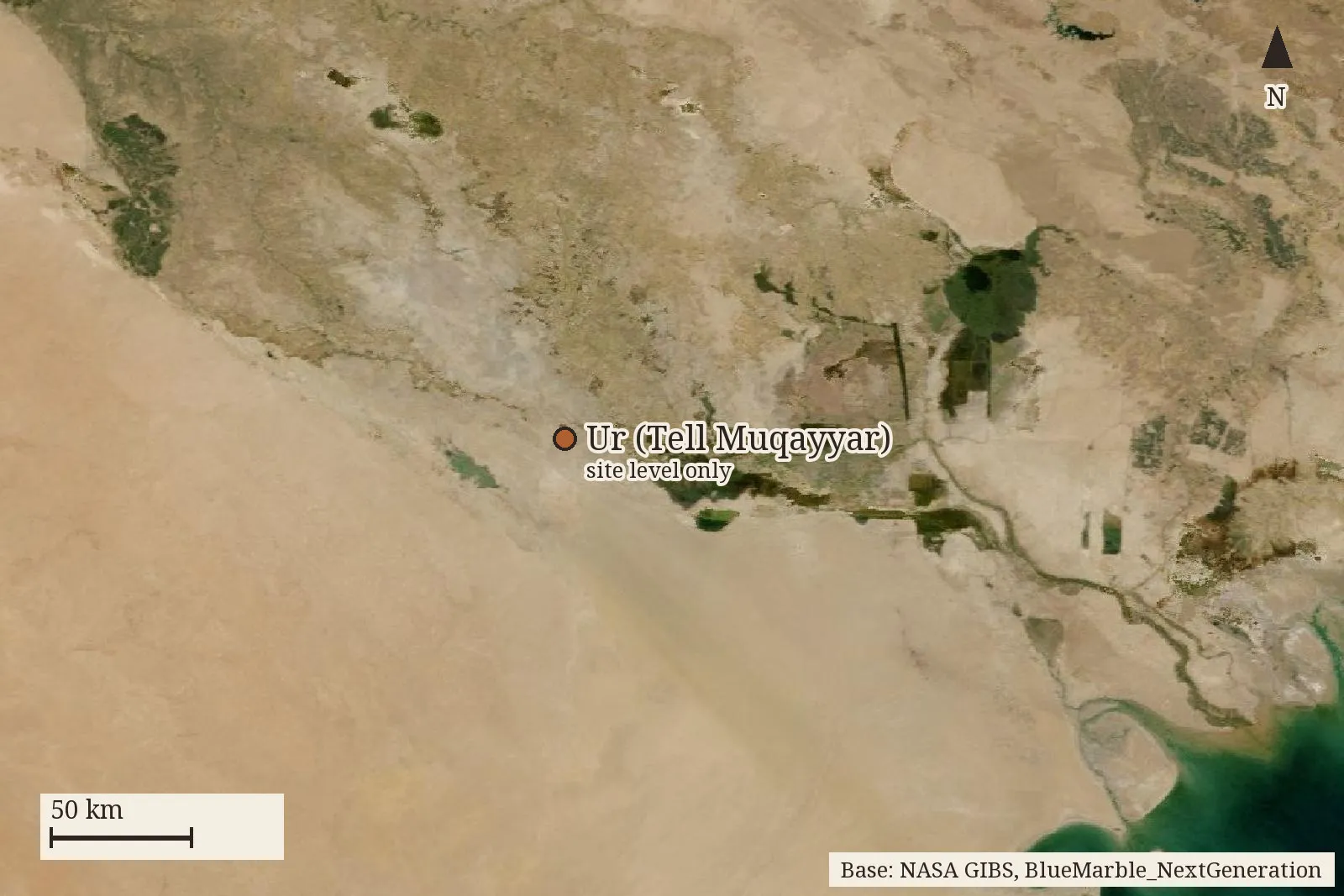
Open the full-size image to read the labels.
Ur in southern Iraq on a NASA Blue Marble image, marked at site level. The house and the excavation area are not plotted.
"Ur in southern Iraq: location at site level" by Sherd and Script, https://sherdandscript.com/scripts/cuneiform/, licensed under CC BY 4.0 (https://creativecommons.org/licenses/by/4.0/)Data: Base image: NASA Blue Marble Next Generation (layer BlueMarble_NextGeneration), provided by services from NASA's Global Imagery Browse Services (GIBS), part of NASA's Earth Science Data and Information System (ESDIS), https://nasa-gibs.github.io/gibs-api-docs/; Site location: Wikidata (CC0), rounded to site level
The link between this tablet and that house rests on a footnote. The editor explains that not every tablet from the house could be traced to its excavation number. The groups numbered U.16814 and several others, the note continues, "are all said in the field catalogue to have come from 'AH House IV' or 'AH IV', which is twice glossed '? No. 1 Old Street'."
Since many of them concern Ea-nasir, and the preliminary report of 1931 · documentary named him as the owner, the editor calls the equation "probable." That note is a small archive dig, a conclusion reached by rereading a field catalog without moving any earth.
How did the tablet reach London?
One popular summary gets the year wrong. Wikipedia's article on Ea-nāṣir says the tablet "was found by Leonard Woolley in Ur in 1953." The season table places its number in 1930–31, and 1953 is the year in its British Museum registration number, 1953,0411.71 (as given by CDLI), and the year Ur Excavations: Texts V, the edition of these letters, was published, 1953 · documentary. Wikidata lists the British Museum as the tablet's collection from that year.
The export itself is recorded only in general terms. Gertrude Bell drafted Iraq's antiquities law of 1924 · documentary, according to Wikipedia citing Magnus Bernhardsson. The Gertrude Bell Archive at Newcastle University says she and Woolley went through the Ur finds together and decided what was to remain in Iraq and what could go to the British Museum.
For the letters, Rients de Boer's 2016 note on the Ur letters says they were "divided over three museums: the British Museum, the Iraq Museum, and the University of Philadelphia Museum." No source read for this page records the division in which this tablet, from 1930–31, was allotted.
Why does it matter that the letter lay in Ea-nasir's house?
A letter found among its addressee's papers carries a second piece of evidence: it arrived. The most economical reading is that Ea-nasir received Nanni's complaint and kept it, together with other letters and dated documents from his business. Think of the house as the sentence and the tablet as one word in it: set there, the word reads as mail received and filed, which the same tablet bought on the market could not show.
Woolley made the point himself. His preliminary report, as quoted in the final volume, says such documents, "not always of any great interest in themselves, gain immensely in value from their association with individual houses." He also recorded a reviewer's complaint that the edition of the texts gave no findspots for its tablets, "so that most of their scientific value was lost."
The weak link was the paperwork. Woolley explains that tablets could not be cataloged until they had been baked and cleaned, so in the field a paper giving the site symbol, house number and room number stayed with each tablet or hoard. The same details, he adds, were scratched on potsherds set beside them in the baking sand. In "only too many cases," he wrote, identification was impossible; for this tablet, the gloss linking its field entry to the house carries a question mark.
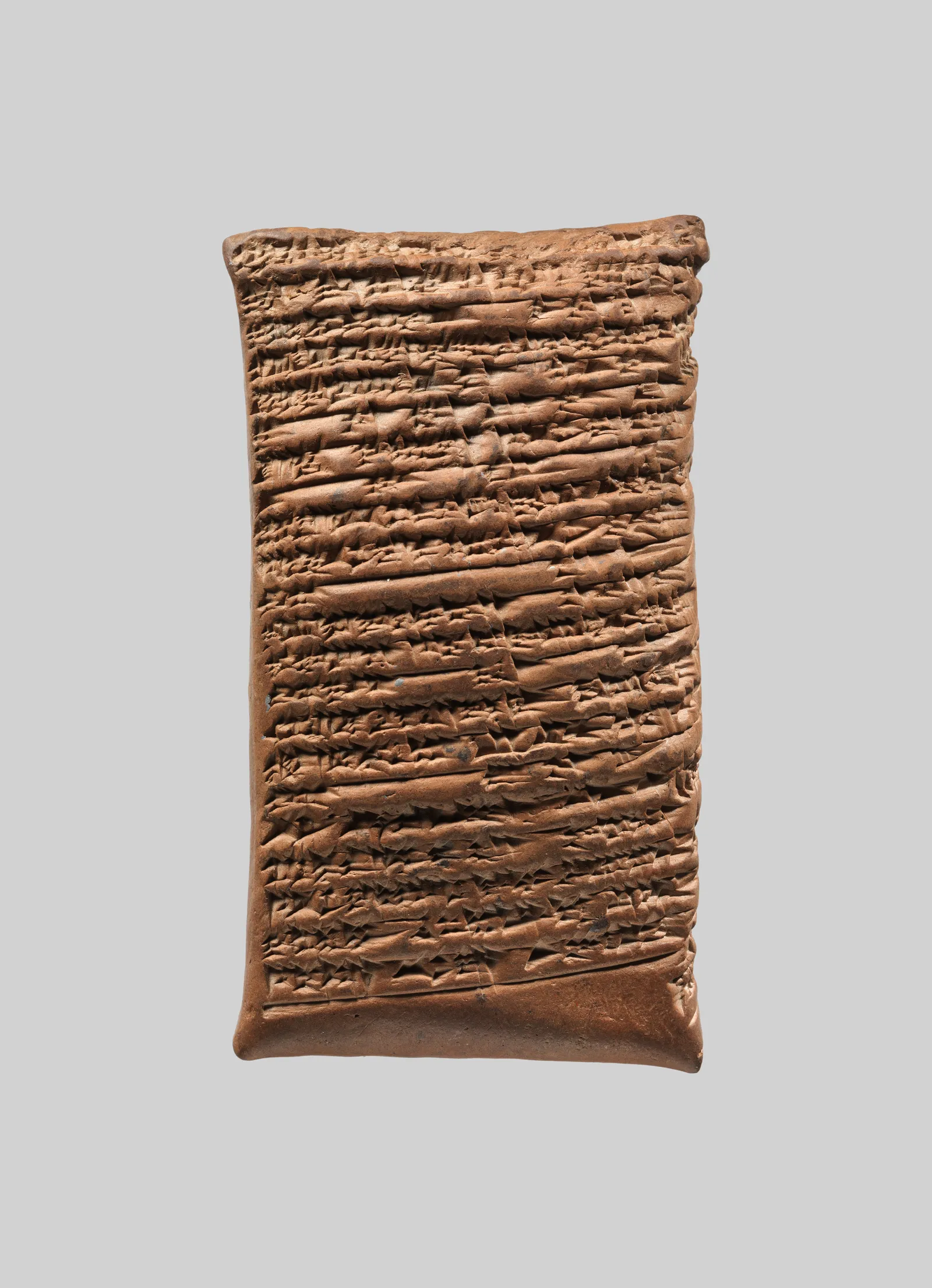
A Babylonian private letter in New York. Its museum record names a probable city but no place of discovery, so nothing ties it to a house or to the person who read it.
Museum no. 86.11.111 · Findspot: unrecorded
"Cuneiform tablet: private letter" by The Metropolitan Museum of Art — https://commons.wikimedia.org/wiki/File:Cuneiform_tablet-_private_letter_MET_DP-12499-014.jpg — CC0 1.0 (https://creativecommons.org/publicdomain/zero/1.0/)

Compare a letter without that record. The Metropolitan Museum of Art dates this private letter to c. 1632 BCE · museum attribution. Its record, as mirrored on Wikimedia Commons, notes a purchase in 1886 · documentary, leaves the place of discovery blank and gives its subregion only as "probably Sippar-Yahrurum (modern Tell Abu Habba)." The tablet shows what such a letter looked like, not who received it or where it was kept.
Even at Ur, the record stops at the house. The editor's note gives the field catalog's provenance for the U.16814 group only as "AH House IV" or "AH IV," with no room, so where in the building Nanni's letter lay is not recorded in any source read for this page.
Proof radius
What this box is for: the proof radius.
Proves: In CDLI's transliteration of one Old Babylonian letter, the sign E2 works as a syllable and as the word "house," and AN as a syllable and as a silent god-marker; the excavation record places the letter, probably, in its addressee's house at Ur.
Doesn't prove: That the Ea-nasir tablet is the oldest customer complaint ever written. Its date is a museum's round figure, and the record does not rank it even against the other complaints found in the same house.
Read next: Linear B: Alice Kober's tables of word endings linked signs that shared a consonant before Ventris read the script as Greek. Antikythera mechanism: a Babylonian eclipse cycle counted on a bronze dial.
Sources
Primary sources first.
- 1Cuneiform Digital Library Initiative, artifact entry P414985, UET 5, 0081 (BM 131236), transliteration by Els Woestenburg (2018), metadata updated 2024-10-22. https://cdli.earth/P414985 Read: full record page: metadata, transliteration, references and revision credits
- 2Sir Leonard Woolley and Sir Max Mallowan, Ur Excavations VII: The Old Babylonian Period, ed. T. C. Mitchell (London: British Museum Publications for the Trustees of the two Museums, 1976). https://archive.org/details/ur-excavations-vii.-the-old-babylonian-period Read: full volume (Internet Archive)
- 3British Museum, gallery label for ME 131236, 'Complaint about delivery of the wrong grade of copper. About 1750 BC (Old Babylonian period), from Ur', as photographed by Avelludo, 9 September 2023 (Wikimedia Commons, CC BY-SA 4.0). https://commons.wikimedia.org/wiki/File:Complaint_tablet_to_Ea-nasir_on_display_(2023-09-09).jpg Read: label text read from the full-size photograph; the museum's own website was not read
- 4The Unicode Consortium, The Unicode Standard, Version 18.0 — Core Specification, chapter 11, section 11.1 Sumero-Akkadian (2026). https://www.unicode.org/versions/Unicode18.0.0/core-spec/chapter-11/ Read: full text of section 11.1 (HTML)
- 5Unicode Character Database 18.0.0: UnicodeData.txt, Blocks.txt and DerivedAge.txt (Unicode, Inc., 2026); code charts U12000 and U12400 (Unicode 18.0). https://www.unicode.org/Public/18.0.0/ucd/ Read: full data files; code charts viewed for glyph checks only
- 6Oracc Sign List (OSL), version 1.0, produced 2025-11-14, Open Richly Annotated Cuneiform Corpus (public domain, CC0). https://oracc.museum.upenn.edu/osl/signlist/ Read: sign pages for A, AN, E₂, GU₂, IR, KI, MA, NA, NE, NI, U, UD, UM, URUDA and ZE₂
- 7Cleveland Museum of Art, Saluting Protective Spirit, 883–859 BCE, Neo-Assyrian, Nimrud, Northwest Palace; gypsum; 1943.246, Purchase from the J. H. Wade Fund (Open Access record, CC0). https://clevelandart.org/art/1943.246 Read: Open Access record (CC0)
- 8The Metropolitan Museum of Art, Cuneiform tablet: private letter, Babylonian, ca. 1632 B.C., 86.11.111, Purchase, 1886 (record as mirrored on Wikimedia Commons, CC0). https://commons.wikimedia.org/wiki/File:Cuneiform_tablet-_private_letter_MET_DP-12499-014.jpg Read: museum record as mirrored on the Wikimedia Commons file page; the museum's website was not read
- 9Wikidata, items Q21585351 (complaint tablet to Ea-nāṣir) and Q5699 (Ur), revisions of 2026-06-01 and later. https://www.wikidata.org/wiki/Q21585351 Read: Wikidata items (structured statements, CC0)
- 10Rients de Boer, "Old Babylonian Letters from UET 5 in the Archibab Database," NABU 2016, no. 1, note 5. http://sepoa.fr/wp/wp-content/uploads/2016/04/NABU-2016-1_DEF.pdf Read: full text of the note (issue PDF)
- 11Oracc, "ATF Primer," "ATF Quick Reference" and "CDLI ATF" help pages (CC BY-SA 3.0). https://oracc.museum.upenn.edu/doc/help/editinginatf/primer/index.html Read: full text of the three help pages
- 12Tony Freeth and Alexander Jones, "The Cosmos in the Antikythera Mechanism," ISAW Papers 4 (2012). https://dlib.nyu.edu/awdl/isaw/isaw-papers/4/ Read: section 3.1 (HTML full text)
- 13Gertrude Bell Archive, Newcastle University, "Gertrude Bell: Archaeologist" (2016). https://research.ncl.ac.uk/gertrudebell/anextraordinarywoman/archaeologist/ Read: full page
- 14Wikipedia, "Complaint tablet to Ea-nāṣir" (read 2026-10-13). https://en.wikipedia.org/wiki/Complaint_tablet_to_Ea-n%C4%81%E1%B9%A3ir Read: article text
- 15Wikipedia, "Ea-nāṣir" (read 2026-10-13). https://en.wikipedia.org/wiki/Ea-n%C4%81%E1%B9%A3ir Read: article text
- 16Wikipedia, "Cuneiform" (read 2026-10-13). https://en.wikipedia.org/wiki/Cuneiform Read: article text (sections on Akkadian writing and transliteration)
- 17Wikipedia, "Gertrude Bell" (read 2026-10-13). https://en.wikipedia.org/wiki/Gertrude_Bell Read: article text (section on the Director of Antiquities)
- 18Wikipedia, "Rim-Sîn I" (read 2026-10-13). https://en.wikipedia.org/wiki/Rim-S%C3%AEn_I Read: article text
- 19Wiktionary, Akkadian entries "umma," "ana," "qabûm," "anāku" and "nadānum" (read 2026-10-13). https://en.wiktionary.org/wiki/umma Read: Akkadian sections of the five entries, including the conjugation table on the nadānum page
- 20Cuneiform Digital Library Initiative, "Periods" and "Uruk IV (ca. 3350-3200 BC)" period pages (CDLI contributors, 2026). https://cdli.earth/periods Read: period list and the Uruk IV period page
- 21Henry C. Rawlinson, "The Persian Cuneiform Inscription at Behistun, Decyphered and Translated; with a Memoir on Persian Cuneiform Inscriptions in General, and on That of Behistun in Particular," Journal of the Royal Asiatic Society of Great Britain and Ireland 10 (1847), pp. 5-6. https://archive.org/details/jstor-25581217 Read: pp. 5-6 with footnotes (scan, Internet Archive)
- 22L. W. King and R. C. Thompson, The Sculptures and Inscription of Darius the Great on the Rock of Behistûn in Persia: A New Collation of the Persian, Susian and Babylonian Texts (London: British Museum, 1907), pp. vii, xvi-xix. https://archive.org/details/sculpturesinscri00brituoft Read: preface (p. vii) and introduction, pp. xvi-xix (scan, Internet Archive)
- 23"Comparative Translations, by W. H. Fox Talbot, Esq., F.R.S., the Reverend E. Hincks, D.D., Dr. Oppert, and Lieut.-Col. Sir Henry C. Rawlinson, K.C.B., of the Inscription of Tiglath Pileser I," with an introductory note by H. H. Wilson, Journal of the Royal Asiatic Society of Great Britain and Ireland 18 (1861), pp. 150-219. https://archive.org/details/jstor-25228700 Read: pp. 150-154: Talbot's note of March 1857, the Council's arrangements and the examiners' report (scan, Internet Archive)
Cite this page
Sherd and Script. “Cuneiform: The Sign That Starts Ea-nasir's Name Also Means "House".” Sherd and Script. Published 13 October 2026; last substantive revision 14 October 2026. https://sherdandscript.com/scripts/cuneiform/ (accessed ).
Corrections
- 2026-10-14 — Added the section "Where and when did cuneiform begin?" (was: no such section → now: three paragraphs beginning "The earliest known cuneiform comes from the city of Uruk in southern Mesopotamia, as of 2026.") — The Unicode Standard 18.0, chapter 11; CDLI period pages
- 2026-10-14 — Added the section "Who read cuneiform again, and how?" (was: no such section → now: four paragraphs beginning "Several scholars read cuneiform again in stages, among them G. F. Grotefend, Henry Rawlinson and E. Hincks, starting with Old Persian royal inscriptions.") — H. C. Rawlinson 1847; L. W. King and R. C. Thompson 1907; "Comparative Translations," Journal of the Royal Asiatic Society 18 (1861)