How we know
Linear B: How a Grid of Signs Led to Greek
Sherd and Script · Published 13 October 2026
Alice Kober and Michael Ventris sorted Linear B's signs before anyone knew a single sound. Then a tablet nobody had read put the sounds to a test.
Find card
- Script
- Linear B, the syllabic script of Mycenaean Greek
- Type
- Syllabary: about 60 phonetic signs, mostly a consonant plus a vowel, with ideograms that count commodities and signs for numbers and measures
- Earliest attestation
- Clay tablets, probably those from the Room of the Chariot Tablets at Knossos, Crete; DAMOS dates the Mycenaean texts to
c. 1450–1150 BCE · archaeological context(end of rangeDisputed); as of 2026 - Deciphered
- Yes for the phonetic signs in regular use: values proposed by Ventris in
1952 · documentaryand checked on tablets read afterward, notably PY Ta 641; 14 signs are still encoded only as numbered symbols (as of 2026) - Unicode block
- Linear B Syllabary U+10000–U+1007F; Linear B Ideograms U+10080–U+100FF; Aegean Numbers U+10100–U+1013F; added in Unicode 4.0 (
2003 · documentary) - Rendered with
- Noto Sans Linear B 2.002 (SIL Open Font License 1.1); names and code points from UnicodeData.txt, Unicode 18.0.0
Find card as CSV linear-b-find-card.csv (sources and license, JSON)Data: Unicode Character Database 18.0.0, © Unicode, Inc., Unicode License v3, https://www.unicode.org/license.txt
TL;DR. Linear B is the syllabic script of Mycenaean Greek, written on clay tablets such as KN Fp 13 from Knossos, British Museum GR 1910.4-23.1 (number as given by DAMOS; the museum's page was not read). Its signs were sorted into a consonant-vowel grid from word endings before any sound was known, and trial values turned the words into Greek in 1952 · documentary. The check came from Pylos tablet PY Ta 641, legible only from 1953 · documentary, where ti-ri-po-de, "tripods," stands beside a drawing of a three-legged cauldron.
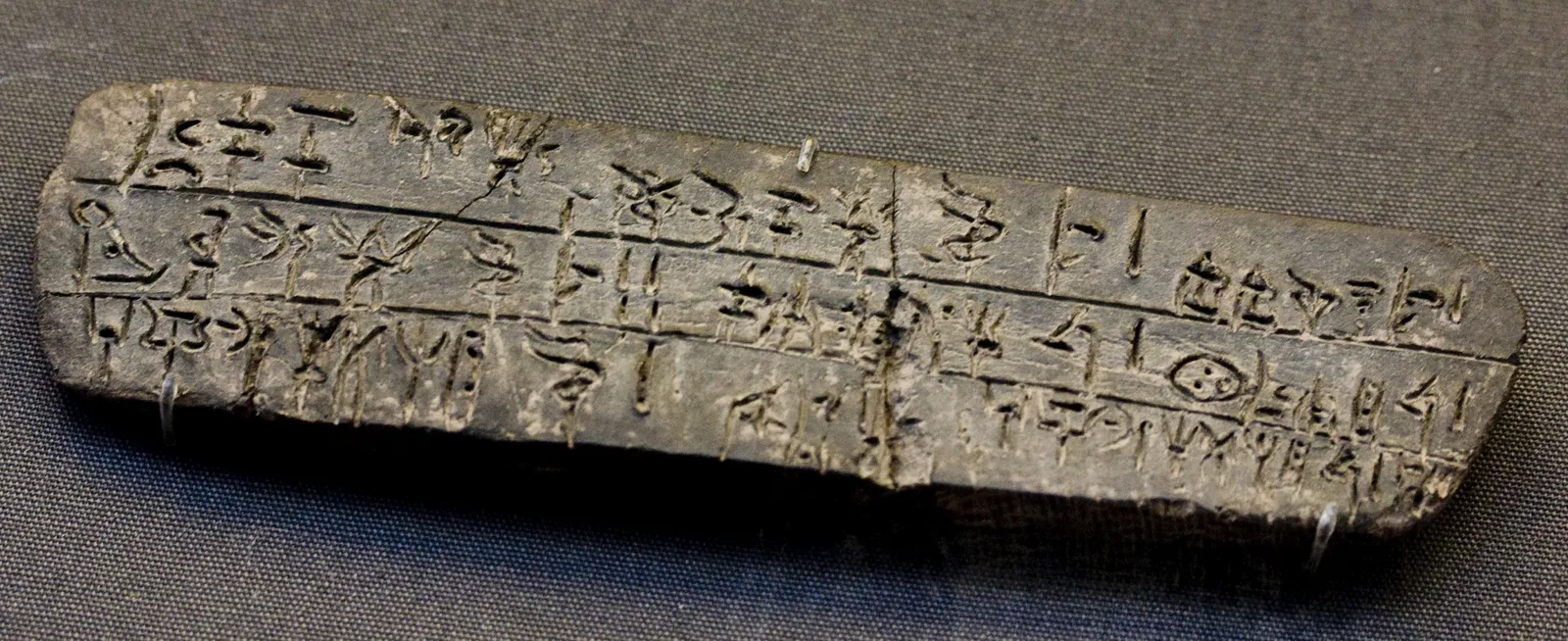
Tablet KN Fp 13 from Knossos, now in London. Its signs run left to right along ruled lines.
Museum no. British Museum GR 1910.4-23.1 · Findspot: Knossos, Crete
"Clay Tablet inscribed with Linear B script" by vintagedept — https://commons.wikimedia.org/wiki/File:Clay_Tablet_inscribed_with_Linear_B_script.jpg — CC BY 2.0 (https://creativecommons.org/licenses/by/2.0/)

Michael Ventris split the decipherment of Linear B into three phases, and only the third could rule out coincidence. In a note in Antiquity in December 1953 · documentary, quoted by Thomas Palaima, he asked first for "an exhaustive analysis of the signs, words and contexts in all the available inscriptions." Next came "an experimental substitution of phonetic values." Last came "a decisive check, preferably with the aid of virgin material, to ensure that the apparent results are not due to fantasy, coincidence or circular reasoning."
Each phase had its own people and its own evidence. Only the last one tested the first two:
| Phase, in Ventris's words | Main evidence | Dates and basis |
|---|---|---|
| "An exhaustive analysis of the signs" | Kober's word endings, Bennett's sign list, Ventris's grids | 1945–1952 · documentary |
| "An experimental substitution of phonetic values" | Cretan place names; Greek words in Ventris's letters | 1952 · documentary |
| "A decisive check" | Pylos tablet PY Ta 641, cleaned after the values were proposed | 1953–1954 · documentary |
What does a Linear B tablet record?
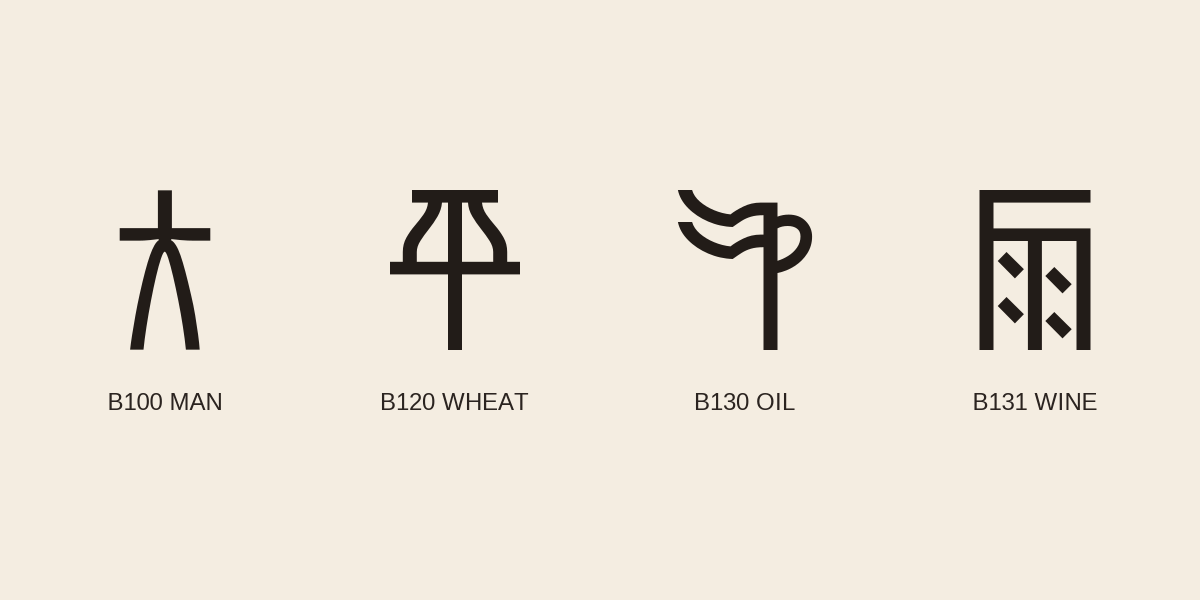
Most Linear B texts are accounts. The Unicode Standard (version 18.0) calls the majority of known inscriptions "inventories of commodities and accounting records." They are written left to right with about 60 phonetic signs, most of them a consonant plus a vowel. Beside those sound signs sit ideograms, used "mainly as counters for commodities."
KN Fp 13, the tablet at the top of this page, is a small example. DAMOS, an online corpus of the Mycenaean texts at the University of Oslo, transcribes three lines on it, each setting sign-groups beside a commodity sign and quantities. DAMOS lists the tablet in the British Museum under GR 1910.4-23.1 and dates it by archaeological phase, "LM IIIA2 or LM IIIB," not by a measurement of the clay.
Scroll sideways to read every label, or open the full drawing.
Four ideograms, signs for things counted rather than for sounds, with their Unicode catalog names. Standard forms in the Noto Sans Linear B font, not the hand on any tablet.
"Four Linear B ideograms: MAN, WHEAT, OIL, WINE" by Sherd and Script, https://sherdandscript.com/scripts/linear-b/, licensed under CC BY 4.0 (https://creativecommons.org/licenses/by/4.0/)Data: Glyphs: Noto Sans Linear B 2.002 (SIL Open Font License 1.1), https://github.com/notofonts/linear-b; Character names and code points: Unicode Character Database 18.0.0, © Unicode, Inc., Unicode License v3
DAMOS counts something under 6,000 documents, many brief or fragmentary and most on clay tablets, and dates the texts to c. 1450–1150 BCE · archaeological context, as of 2026. The oldest group is probably the tablets from the Room of the Chariot Tablets at Knossos, according to Wikipedia's summary of Jan Driessen's 2000 study. The end of the range is Disputed: the Unicode chapter dates the latest tablets to mid- to late 13th century BCE · archaeological context.
How did Alice Kober sort signs she could not read?
The first obstacle was the supply of text. Arthur Evans began finding the Knossos tablets in 1900 · documentary, but Palaima notes that he published a sizable selection only in 1935 · documentary. The first tablets from Pylos, on the Greek mainland, came out of the ground in 1939 · documentary. Cambridge's Mycenaean Epigraphy Group writes that too little had been published for a code-breaker's approach until 1951 · documentary.
Alice Kober, a classicist at Brooklyn College, worked around the gap with method. In papers in the American Journal of Archaeology from 1945–1948 · documentary, she showed that Linear B words change their endings (Wikipedia's article on Kober, citing Margalit Fox's 2013 history). That is how words behave in an inflected language such as Latin or Greek. Palaima describes her "patterns of variation at the ends of sign-groups," which became known as "Kober's triplets."
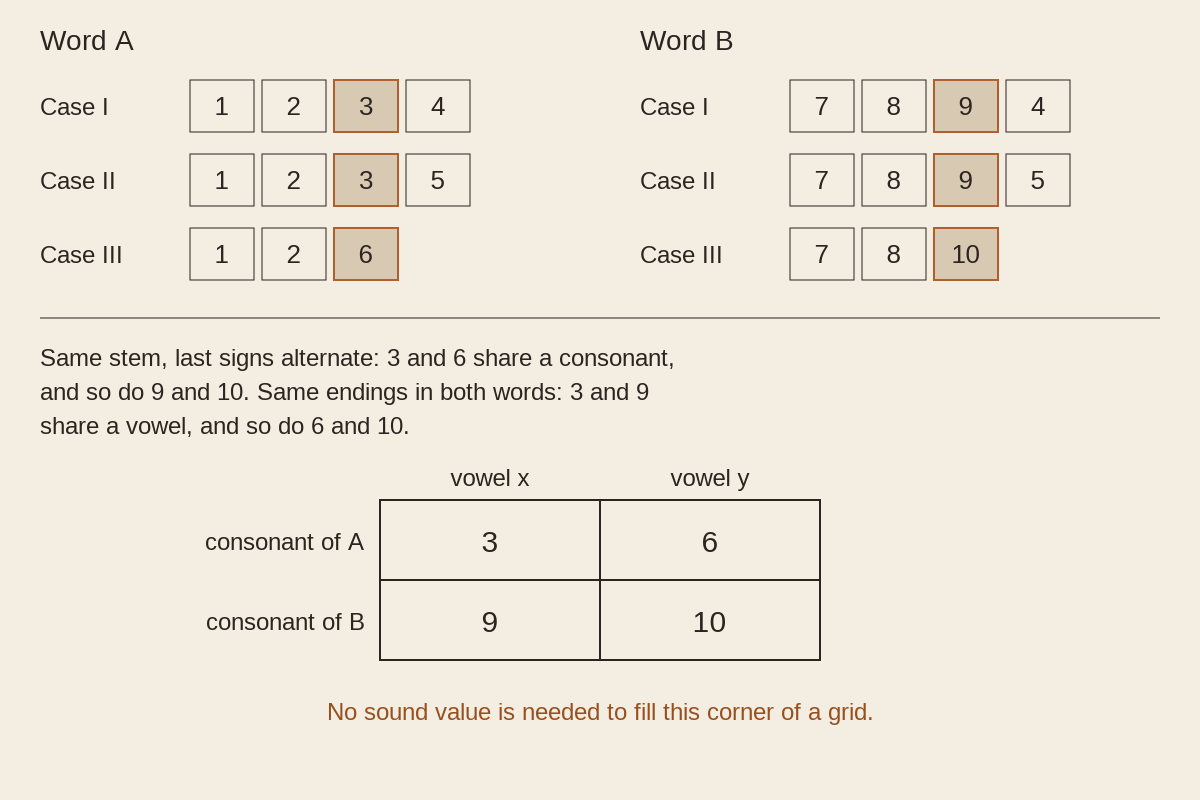
The variation carried information even with no sounds attached. When a stem stays the same and only the end changes, the sign at the join would start with the stem's last consonant and end with the ending's vowel. The same Wikipedia article calls these bridging syllables. Signs that alternate in that slot share a consonant, and words that take the same endings share vowels in the same slots.
Scroll sideways to read every label, or open the full drawing.
A simplified version of the reasoning: two invented words and numbered boxes for unknown signs. The alternating final signs fill a small consonant-vowel grid without any sound values.
"How alternating word endings sort unknown signs into a grid" by Sherd and Script, https://sherdandscript.com/scripts/linear-b/, licensed under CC BY 4.0 (https://creativecommons.org/licenses/by/4.0/)
Think of each triplet as a declension table with the letters blanked out: the pattern of the endings survives even when no ending can be pronounced. Kober's article of 1948 · documentary put ten signs into such a grid, showing which shared a consonant and which shared a vowel (Wikipedia, citing Fox). Palaima writes that she, Emmett L. Bennett Jr. and Ventris all held that the texts had to be analyzed "in abstract, as elements of a code," before anyone gave the signs values.
Blank slips sorted into rows and columns, not Kober's own ten-sign grid. Her grid showed which signs shared a consonant and which shared a vowel, before anyone gave the signs values.
Illustration: Sherd and Script. Generated schematic illustration — not a photograph or record of any real object or site. Reuse: CC BY 4.0 (https://creativecommons.org/licenses/by/4.0/), to the extent Sherd and Script holds rights in it.
Kober died on 16 May 1950 · documentary. By Palaima's account, the decipherment later showed that her triplets were inflected endings of early Greek words. That confirmation "came just over two years too late" for her to see.
What did Michael Ventris's grid add?
Ventris, a British architect, built a larger version of the same grid and sent copies of his work notes to the dozen or so scholars working on the scripts. On 7 March 1950 · documentary he circulated a "Mid-Century Report" with eleven scholars' answers to 21 questions, according to Palaima.
The grid also needed a stable list of signs. That came from Bennett, who was editing the Pylos tablets and setting out a signary, a standard list of the script's signs. On 5 June 1952 · documentary, Palaima reports, Ventris adopted the sign order Bennett had designed for The Pylos Tablets, published in 1951 · documentary.
Bennett's numbers survive in Unicode. Its Linear B character names use catalog numbers documented by Bennett, with a B added in front: the sign for da is LINEAR B SYLLABLE B001 DA.
Ventris set consonants in rows and vowels in columns. He filled the grid before he knew the language. Until a very late stage, the Cambridge group's biography notes, he expected that language to be related to Etruscan. He had argued as much in an article published in 1940 · documentary, when he was 18.
The grid was still unfinished that June. Palaima's caption to the grid in Ventris's letter of 18 June notes two gaps: Ventris had not yet seen that Linear B kept separate signs for d and t, or that it had a series for labiovelar sounds, now written q. The grid below uses today's values. Its cells are listed with code points and Unicode names in a CSV file (Data: Unicode Character Database 18.0.0, © Unicode, Inc., Unicode License v3, https://www.unicode.org/license.txt) (sources and license, JSON).
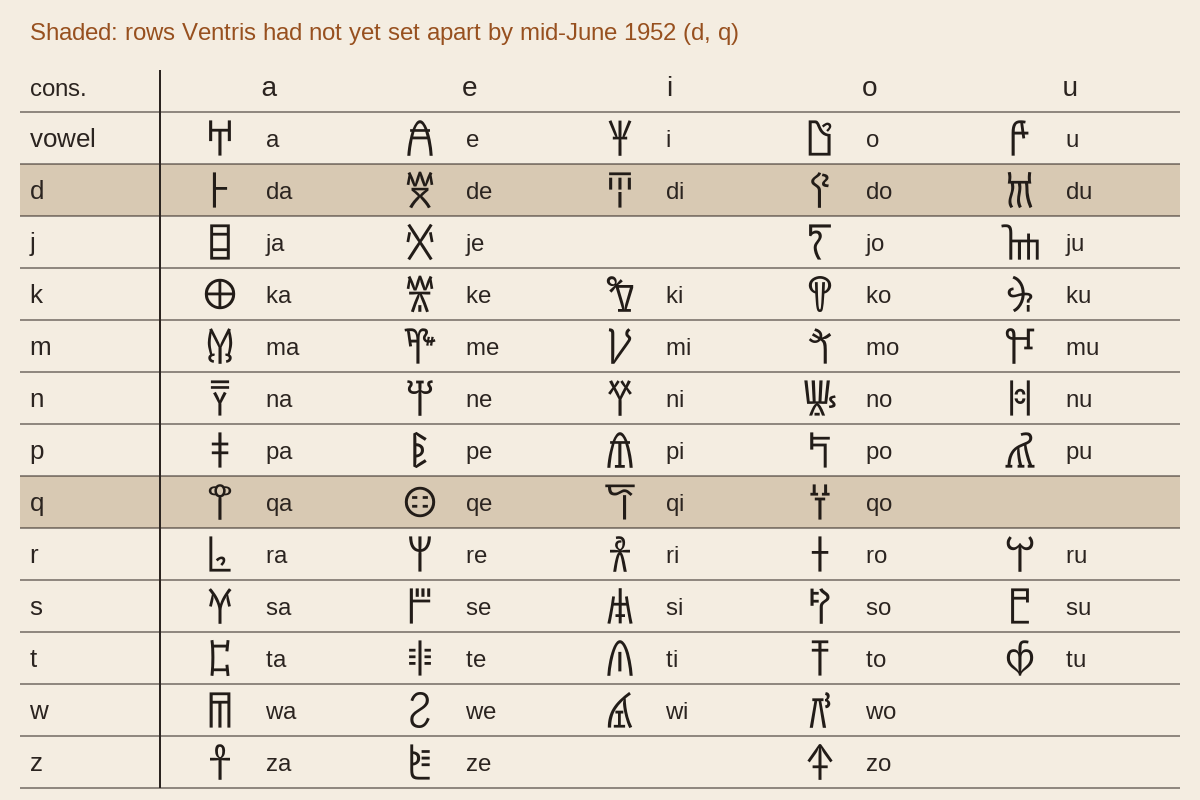
Scroll sideways to read every label, or open the full drawing.
The basic syllable signs as a grid, with today's values from the Unicode names. The shaded d and q rows were not yet set apart in the grid Ventris sent Bennett in June.
"Linear B syllable signs as a consonant-vowel grid" by Sherd and Script, https://sherdandscript.com/scripts/linear-b/, licensed under CC BY 4.0 (https://creativecommons.org/licenses/by/4.0/)Data: Glyphs: Noto Sans Linear B 2.002 (SIL Open Font License 1.1), https://github.com/notofonts/linear-b; Character names and code points: Unicode Character Database 18.0.0, © Unicode, Inc., Unicode License v3
How did trial sound values turn into Greek?
The second phase started from names, as the hieroglyphic decipherment had with the royal names on the Rosetta Stone. Wikipedia's article on Linear B, citing Maurice Pope, says Ventris noticed sign-groups that appeared on the Cretan tablets but not on the mainland ones. He guessed that they were place names on Crete. By February 1952 · documentary, the Cambridge group records, he had written to John Myres in Oxford about a possible reading of place names in the Knossos tablets.
The first tablet Ventris transcribed for Bennett in June was KN Ce 59. His values gave tu-ri-so, read as the Cretan place name Tylissos, and we-ka-ta, read as wergatai, "workers." By Palaima's count, that tablet offered six sign values that made reasonably good sense of two of its seven words.
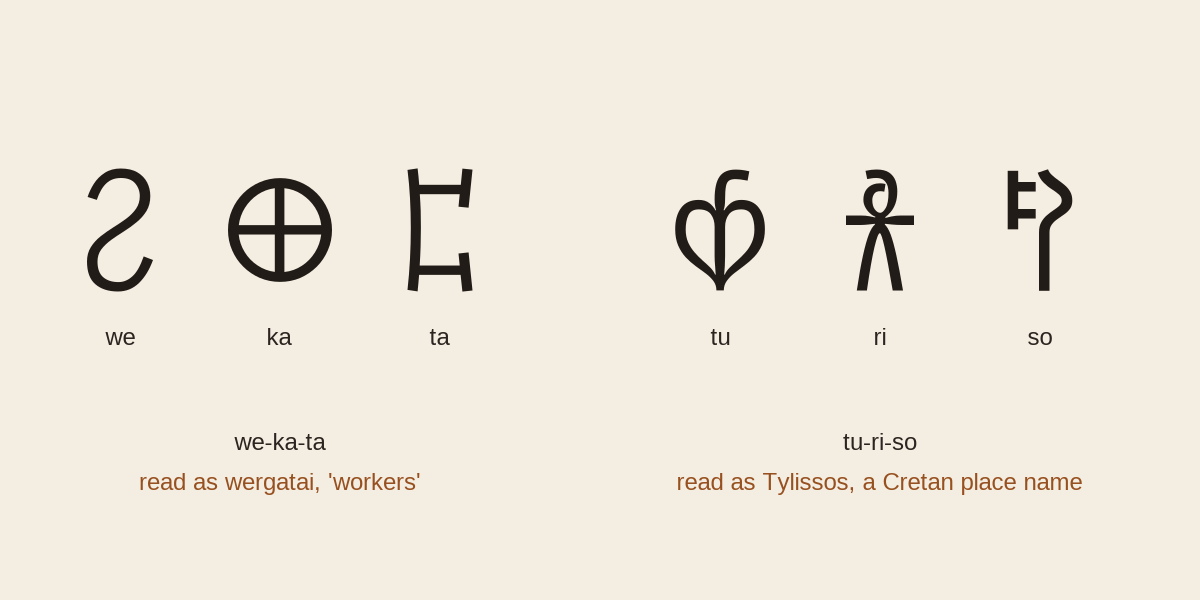
Scroll sideways to read every label, or open the full drawing.
Two words from tablet KN Ce 59, with the readings Ventris gave in his letter of 18 June. Standard forms in the Noto Sans Linear B font, not the hand on the tablet.
"Two Linear B words from tablet KN Ce 59: we-ka-ta and tu-ri-so" by Sherd and Script, https://sherdandscript.com/scripts/linear-b/, licensed under CC BY 4.0 (https://creativecommons.org/licenses/by/4.0/)Data: Glyphs: Noto Sans Linear B 2.002 (SIL Open Font License 1.1), https://github.com/notofonts/linear-b; Character names and code points: Unicode Character Database 18.0.0, © Unicode, Inc., Unicode License v3
Ventris argued in a work note dated 1 June 1952 · documentary that Linear B was used to write Greek (Wikipedia, citing Killen and Morpurgo Davies 2002). On 18 June he wrote to Bennett, "I think I've deciphered Linear B." The same letter set out the spelling rules that had hidden the Greek: "L & R have no separate spelling," and "-L, -N, -R, -S & Diphthongal -I are not written when they close a syllable."
He announced the result on the BBC on 1 July 1952 · documentary. John Chadwick, a Cambridge philologist who heard the broadcast, wrote on 13 July offering help "if there is anything a mere philologist can do." That first letter already proposed a new value, pu, which let him read the name Pylos (Cambridge Mycenaean Epigraphy Group).
The CREWS project at Cambridge noted in 2017 · documentary that this made the tablets some 400 years older than any other known Greek inscriptions. DAMOS adds that Linear B is not related to the later Greek alphabets, the scripts of the age of Athenian black-figure and red-figure pottery.
What did the tripod tablet test?
Values built from a set of texts can fit those texts and still be wrong. Wikipedia's article on the tablet, citing Stephen Tracy's 2018 study, says Bennett worried about exactly that, since Ventris had not tested his values on unseen material. Tablet PY Ta 641 was dug up at Pylos in June 1952 · documentary. It was not legible until it was cleaned the next year (Wikipedia, citing Killen and Morpurgo Davies 2002 and Judson 2017).
Palaima notes that Ventris's 18 June letter, which sampled the readings then possible, had "nothing so probative" to offer. Carl Blegen, the excavator, worked on the 1952 Pylos finds from the end of March to mid-May 1953 · documentary, and he focused on Ta 641 (Palaima 2025, after Tracy). Read with Ventris's values, its first word came out as ti-ri-po-de, "tripods." It stands beside an ideogram of a three-legged cauldron, now catalogued as *201VAS.
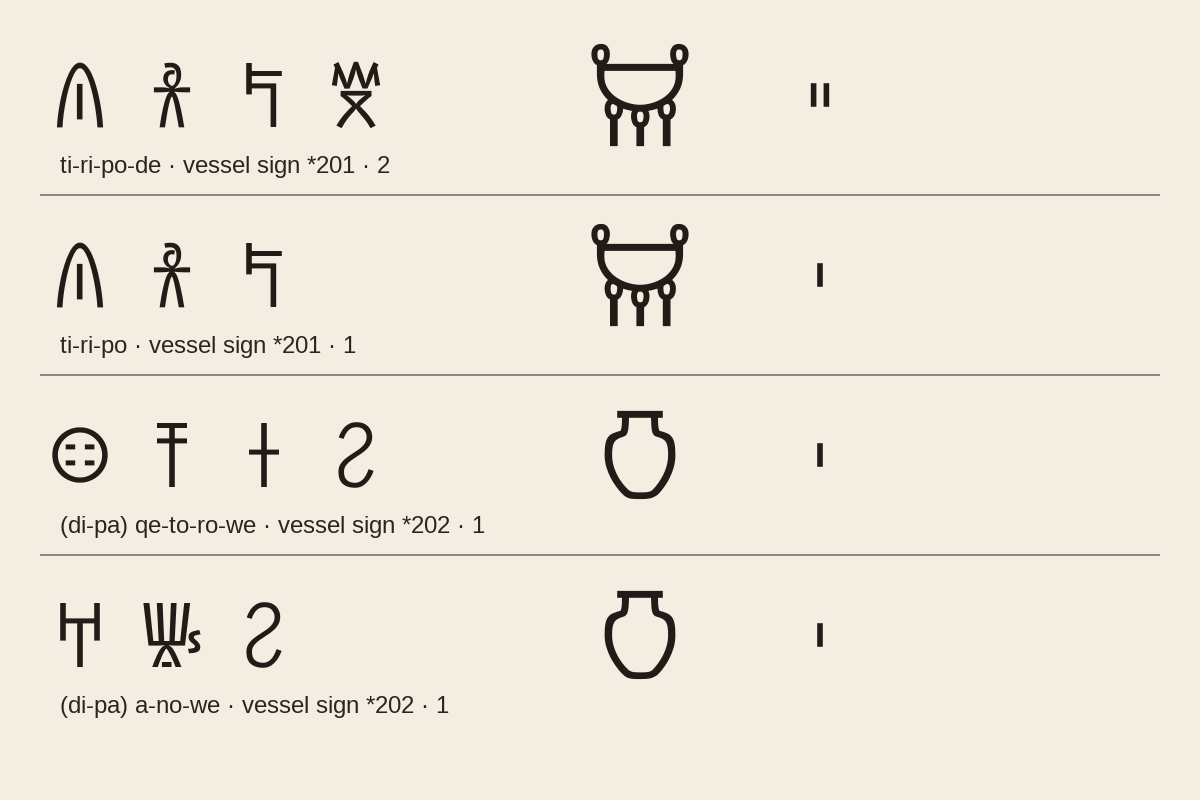
Scroll sideways to read every label, or open the full drawing.
Four entries from PY Ta 641 as transcribed in DAMOS, with vessel signs *201 and *202 and their numbers. Standard Noto Sans Linear B forms; on the tablet the *202 drawings differ in handles.
"Words and vessel signs from Pylos tablet PY Ta 641" by Sherd and Script, https://sherdandscript.com/scripts/linear-b/, licensed under CC BY 4.0 (https://creativecommons.org/licenses/by/4.0/)Data: Glyphs: Noto Sans Linear B 2.002 (SIL Open Font License 1.1), https://github.com/notofonts/linear-b; Character names and code points: Unicode Character Database 18.0.0, © Unicode, Inc., Unicode License v3
On 16 May 1953 · documentary Blegen wrote to Ventris about the match between words and vessel drawings and asked, "Is coincidence excluded?" (quoted in Wikipedia's article on the tablet, from Tracy). The same test recurs several times on the rest of the tablet. Each entry pairs a word with a drawn vessel and a number:
| Entry (DAMOS transcription) | Sign and number | Translation (Ventris and Chadwick) |
|---|---|---|
| ti-ri-po-de, a3-ke-u, ke-re-si-jo, we-ke | *201VAS, 2 | tripods of Cretan workmanship: 2 |
| di-pa, me-zo-e, qe-to-ro-we | *202VAS, 1 | a larger vessel with four handles |
| di-pa-e, me-zo-e, ti-ri-o-we-e | *202VAS, 2 | larger vessels with three handles |
| di-pa, me-wi-jo, a-no-we | *202VAS, 1 | a smaller vessel without handles |
The translations follow Ventris and Chadwick as given in Wikipedia's article on the tablet, which also notes that the drawn vessels carry four, three or no handles to match the words. In the DAMOS text, the forms ti-ri-po-de and di-pa-e stand beside the numeral 2, while ti-ri-po and di-pa stand beside 1.
Blegen made sure the tablet was published quickly, in January 1954 · documentary. Ventris's account in Archaeology that year was titled "King Nestor's four-handled cups" (Palaima 2025).
Did one tablet settle the decipherment?
Not for everyone. Arthur Beattie of Edinburgh argued in the Journal of Hellenic Studies in 1956 · documentary that the match between words and ideograms was "due to chance." He traced it to the several pronunciations Ventris allowed for each sign, and Chadwick replied in the same journal the next year (Wikipedia's article on the tablet, citing both papers).
Other checks accumulated. Chadwick, sorting fragments in the Heraklion museum on Crete, joined a piece to the start of the horse tablet Ca 895, which Evans had found. The new piece carried i-qo, the Mycenaean equivalent of later Greek hippos, "horse" (Cambridge Mycenaean Epigraphy Group). Tracy's 2018 study highlights the roles of Blegen and Sterling Dow of Harvard in the decipherment's early acceptance in North America.
The decipherment did not give every sign a value. By this page's count of the Unicode 18.0 data file, 14 characters in the Linear B Syllabary block have names that carry only a catalog number, such as LINEAR B SYMBOL B018. All 14 were named when the block was added in Unicode 4.0, in 2003 · documentary. The Unicode 18.0 chapter on the script says that Linear B includes "a few unidentified signs," as of 2026.
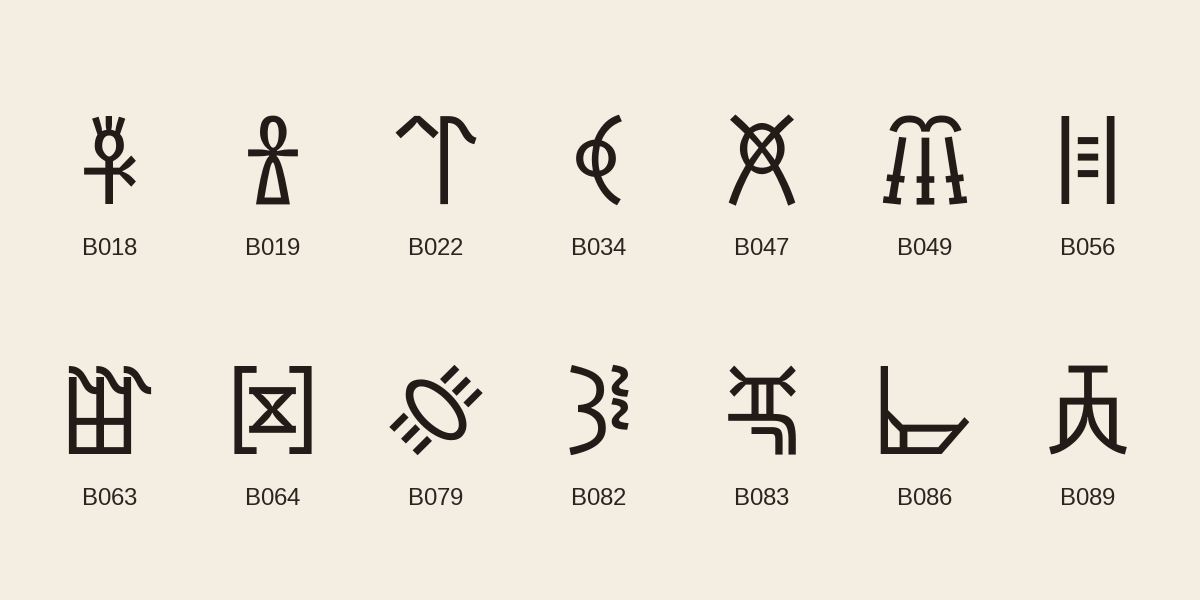
Scroll sideways to read every label, or open the full drawing.
The 14 Linear B characters whose Unicode names give a catalog number but no sound value. Standard forms in the Noto Sans Linear B font, not the hand on any tablet.
"The 14 Linear B signs that Unicode names by number only" by Sherd and Script, https://sherdandscript.com/scripts/linear-b/, licensed under CC BY 4.0 (https://creativecommons.org/licenses/by/4.0/)Data: Glyphs: Noto Sans Linear B 2.002 (SIL Open Font License 1.1), https://github.com/notofonts/linear-b; Character names and code points: Unicode Character Database 18.0.0, © Unicode, Inc., Unicode License v3
Can the same method read Linear A?
Linear A is the older script of Crete, used in c. 1700–1450 BCE · archaeological context, according to the Unicode chapter. Torsten Meißner and Philippa Steele argue that the Mycenaeans took over the whole sign system from the Minoans with very little change. Their paper appeared in the proceedings of a Mycenaean studies colloquium in 2017 · documentary.
The grid half of the method transfers. Meißner and Steele, following earlier scholars, take it that Linear B values can be supplied to read Linear A signs. By their account, Ventris and Chadwick's Documents counted 53 of 89 signs shared by the two scripts, and by 2005 · documentary new finds had raised the count to 64 of 89. Yet the same paper lists the language behind Linear A as unknown, so the sounds can be read aloud with nothing to check them against.
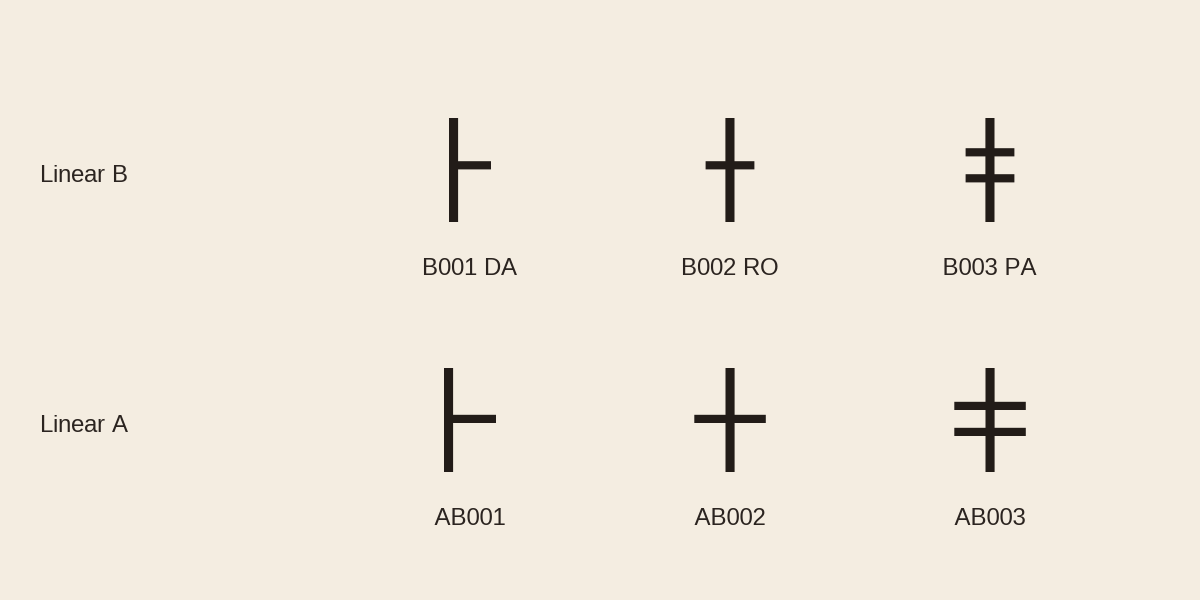
Scroll sideways to read every label, or open the full drawing.
Three Linear B signs above the Linear A signs that share their catalog numbers. Standard forms in the Noto Sans Linear B and Linear A fonts, not the hand on any tablet.
"Linear B and Linear A signs sharing catalog numbers 001 to 003" by Sherd and Script, https://sherdandscript.com/scripts/linear-b/, licensed under CC BY 4.0 (https://creativecommons.org/licenses/by/4.0/)Data: Glyphs: Noto Sans Linear B 2.002 and Noto Sans Linear A 2.002 (SIL Open Font License 1.1), https://github.com/notofonts; Character names and code points: Unicode Character Database 18.0.0, © Unicode, Inc., Unicode License v3
Machine learning has been tried on the already deciphered script. In 2019 · documentary, Jiaming Luo, Yuan Cao and Regina Barzilay reported a neural network that matched Linear B words to their Greek cognates, words with a shared origin. It was right for 84.7 percent of 919 word pairs from a compiled Linear B lexicon, and 67.3 percent in a harder test whose Greek side kept only 455 proper names. Both tests supplied the Greek side and measured matching against a known answer, not the discovery of an unknown language.
On this site's reading, that leaves Linear A without Ventris's third phase. His decisive check needed a known language whose words could agree with the drawings and numbers beside them. As of 2026, the Unicode Standard says the language of Linear A has not yet been identified.
Proof radius
What this box is for: the proof radius.
Proves: Sign values worked out first from a grid of word endings and then from Cretan place names read a tablet cleaned afterward, PY Ta 641, as Greek words that agree with its vessel drawings and numerals.
Doesn't prove: That Ventris cracked Linear B single-handed: his grid rested on Kober's and Bennett's tables, and the decisive check came a year later, on a tablet Blegen read.
Read next: Rosetta Stone: a royal name tested against a second name before anyone read the language. Cuneiform: a script in which one sign can be a word, a syllable or a silent marker.
Sources
Primary sources first.
- 1DAMOS (Database of Mycenaean at Oslo), record PY Ta(-) 641 (Chasm; hand 2), ed. Federico Aurora, University of Oslo. https://damos.hf.uio.no/4972 Read: record data (transcription, metadata, bibliography); content CC BY-NC-SA 4.0, used as a verification entry for single facts only
- 2DAMOS (Database of Mycenaean at Oslo), record KN Fp(1) 13, ed. Federico Aurora, University of Oslo. https://damos.hf.uio.no/13 Read: record data; content CC BY-NC-SA 4.0, single facts only
- 3Unicode Character Database 18.0.0: UnicodeData.txt, Blocks.txt and DerivedAge.txt (Unicode, Inc., 2026). https://www.unicode.org/Public/18.0.0/ucd/ Read: full data files UnicodeData.txt, Blocks.txt and DerivedAge.txt (18.0.0); code charts U10000, U10080, U10100 and U10600 (18.0.0) viewed for glyph checks only
- 4The Unicode Consortium, The Unicode Standard, Version 18.0 — Core Specification, chapter 8, sections 8.1 Linear A and 8.2 Linear B (2026). https://www.unicode.org/versions/Unicode18.0.0/core-spec/chapter-8/ Read: full text of the chapter (HTML)
- 5Thomas G. Palaima, "Michael Ventris's Blueprint: Letters reveal how a British architect and two American scholars worked to decipher a Bronze Age script and read the earliest writings in western civilization," Discovery: Research and Scholarship at the University of Texas at Austin (1993), 20-26. https://sites.utexas.edu/scripts/wp-content/uploads/sites/3428/2020/05/1993-TGP-MichaelVentrisBlueprint.pdf Read: full text PDF (Program in Aegean Scripts and Prehistory site), including the facsimile of Ventris's letter to Bennett of 18 June 1952
- 6Thomas G. Palaima, "Historical reflections on the Pylos Ta series: putting te-ke in its place," in J. Bennet, A. Karnava and T. Meißner (eds.), KO-RO-NO-WE-SA: Proceedings of the 15th International Colloquium on Mycenaean Studies, Ariadne Supplement Series 5 (Rethymno, 2024; online 2025), 449-466. https://doi.org/10.26248/ariadne.vi.1867 Read: full text PDF (ejournals.lib.uoc.gr; CC BY-NC-SA 4.0, single facts cited)
- 7Torsten Meißner and Philippa M. Steele, "Linear A and Linear B: structural and contextual concerns," in M.-L. Nosch and H. Landenius Enegren (eds.), Aegean Scripts: Proceedings of the 14th International Colloquium on Mycenaean Studies, Copenhagen, 2-5 September 2015 (Rome: CNR, 2017), 99ff. https://crewsproject.wordpress.com/wp-content/uploads/2019/12/meissner-steele.pdf Read: full text of the authors' posted offprint (CREWS project site)
- 8Jiaming Luo, Yuan Cao and Regina Barzilay, "Neural Decipherment via Minimum-Cost Flow: from Ugaritic to Linear B," Proceedings of the 57th Annual Meeting of the Association for Computational Linguistics (2019); arXiv:1906.06718. https://arxiv.org/abs/1906.06718 Read: abstract page and full text PDF (arXiv v1)
- 9Stephen V. Tracy, "The Acceptance of the Greek Solution for Linear B," Hesperia 87.1 (2018), 1-16. https://ascsa.edu.gr/publications/hesperia/article/87/1/1-16 Read: abstract only (ASCSA page); full text on JSTOR not read
- 10Mycenaean Epigraphy Group, Faculty of Classics, University of Cambridge, "Michael Ventris, 1922-1956: Architect and Decipherer of Linear B." https://www.classics.cam.ac.uk/research/projects/mycep/decipherment/ventris Read: full page
- 11Mycenaean Epigraphy Group, Faculty of Classics, University of Cambridge, "John Chadwick, 1920-1998: Classical Philologist, Lexicographer and Linear B Scholar." https://www.classics.cam.ac.uk/research/projects/mycep/decipherment/chadwick Read: full page
- 12Mycenaean Epigraphy Group, Faculty of Classics, University of Cambridge, "The Ventris-Chadwick Correspondence." https://www.classics.cam.ac.uk/research/projects/mycep/archive/correspondence Read: full page
- 13DAMOS (Database of Mycenaean at Oslo), "About the content"; F. Aurora, "DAMOS (Database of Mycenaean at Oslo). Annotating a fragmentarily attested language," Procedia - Social and Behavioral Sciences 198 (2015), 21-31. https://damos.hf.uio.no/about/content/ Read: full page
- 14CREWS Project (Contexts of and Relations between Early Writing Systems), Faculty of Classics, Cambridge, "Happy Linear B Day!" (1 July 2017). https://crewsproject.wordpress.com/2017/07/01/happy-linear-b-day/ Read: full post
- 15Wikipedia, "PY Ta 641" (read 2026-10-13; used for the scholarship it cites, as attributed in the body). https://en.wikipedia.org/wiki/PY_Ta_641 Read: article text
- 16Wikipedia, "Alice Kober" (read 2026-10-13; summarizing Margalit Fox, The Riddle of the Labyrinth, 2013). https://en.wikipedia.org/wiki/Alice_Kober Read: article text
- 17Wikipedia, "Michael Ventris" (read 2026-10-13). https://en.wikipedia.org/wiki/Michael_Ventris Read: article text
- 18Wikipedia, "Linear B" (read 2026-10-13; used for the scholarship it cites, as attributed in the body). https://en.wikipedia.org/wiki/Linear_B Read: article text
- 19Wikipedia, "Emmett L. Bennett Jr." (read 2026-10-13). https://en.wikipedia.org/wiki/Emmett_L._Bennett_Jr. Read: article text
Cite this page
Sherd and Script. “Linear B: How a Grid of Signs Led to Greek.” Sherd and Script. Published 13 October 2026. https://sherdandscript.com/scripts/linear-b/ (accessed ).
Corrections
None yet.