Side by side
Black-Figure vs Red-Figure: Reading the Technique from a Single Sherd
Sherd and Script · Published 13 October 2026 · Revised 14 October 2026
Two fragments that entered the Cleveland Museum of Art together in 1915 show the two techniques side by side. One has black figures on bare clay, the other a bare-clay figure on black.
Find card
- Object / Site
- Fragment from a red-figure cup (kylix): a woman; Greek, Attic
- Findspot
- Orvieto, as painted on the fragment's back
- Context
- Unrecorded: the record names no tomb or layer; sold to the museum through Harold Woodbury Parsons, New York, in 1915
- Dated by
- Museum attribution: the record cites no laboratory measurement; painter attribution by style, near the Telephos Painter (Beazley, ARV2 p. 820 no. 4, as cited in the record)
- Range
c. 470–460 BCE · museum attribution- Dated event
- Making and painting of the cup
- Now at
- Cleveland Museum of Art, 1915.533.b
- Primary record
- Cleveland Museum of Art collection record 1915.533.b, https://clevelandart.org/art/1915.533.b (CC0)
Find card as CSV black-figure-vs-red-figure-find-card.csv (sources and license, JSON)Data: Cleveland Museum of Art Open Access data (CC0), record 1915.533.b, https://clevelandart.org/art/1915.533.b
TL;DR. On the red-figure cup fragment Cleveland 1915.533.b, dated c. 470–460 BCE · museum attribution, the woman is unpainted clay, black gloss was brushed around her, and raised relief lines draw her profile. Black-figure reverses this: on the amphora fragment 1915.533.c, the figures are gloss and their details are scratched through to the clay. In both, the black is fired clay slip rather than pigment, and neither fragment has a recorded tomb or layer.
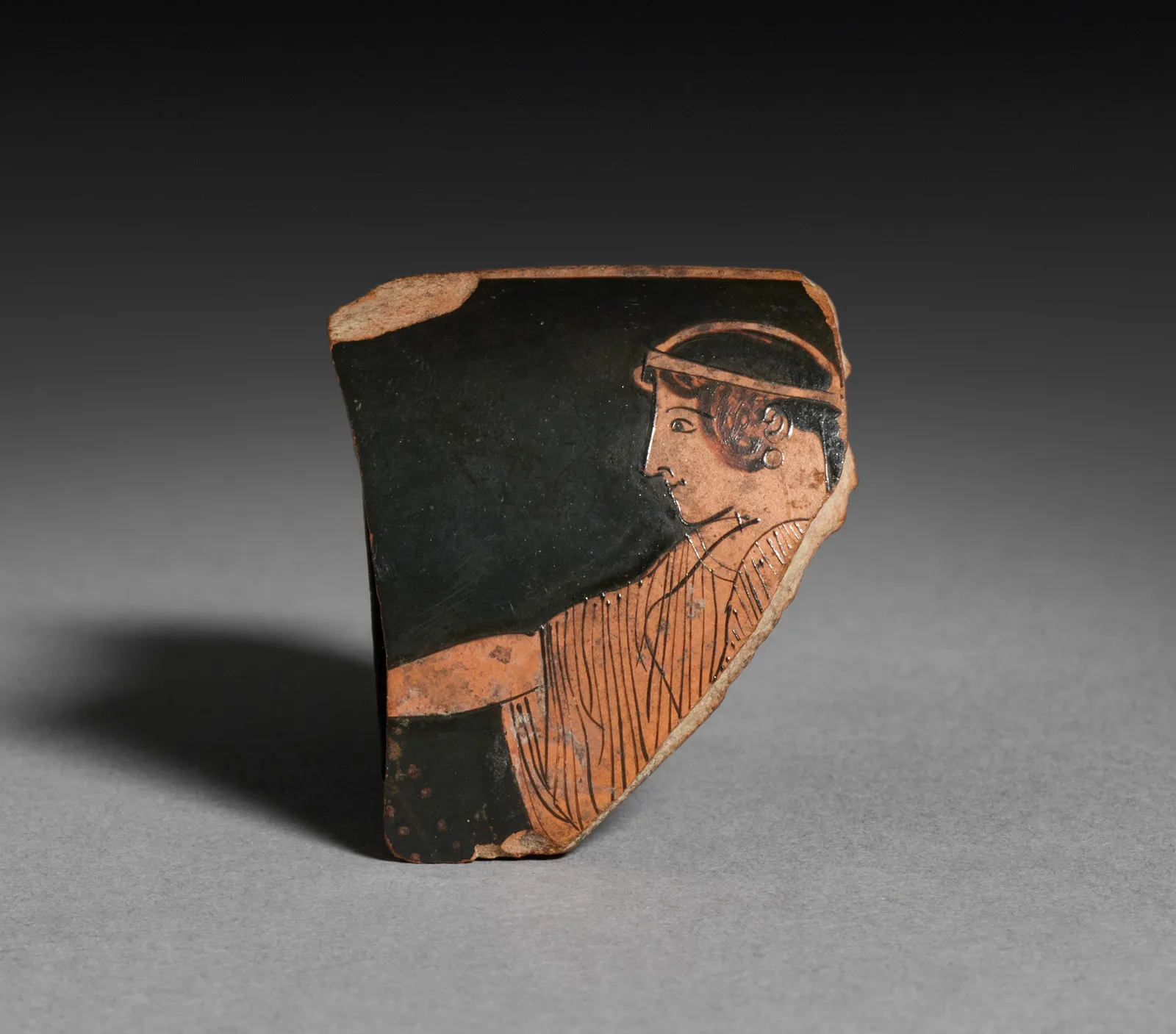
The red-figure fragment 1915.533.b. The woman is the unpainted clay and the black around her is gloss; the museum record notes raised relief lines on her face and arm.
Museum no. 1915.533.b · Findspot: Orvieto, as painted on the fragment's back
"Fragment from Red-Figure Cup: Woman" by The Cleveland Museum of Art, Gift of the John Huntington Art and Polytechnic Trust — https://clevelandart.org/art/1915.533.b — CC0 1.0 (https://creativecommons.org/publicdomain/zero/1.0/)
On this cup fragment in Cleveland, the woman is bare clay and the black around her was brushed on. Leaving the figure unpainted is what makes it red-figure, and the museum record adds a second clue: "Relief lines standing above the surface outline the face, neck, arm, and other details." Black-figure works the other way round, and a fragment from the same 1915 purchase shows how.
Both pieces belong to a group of five fragments from four vases that were sold to the museum through Harold Woodbury Parsons of New York in 1915 · documentary. Neither record names a tomb or a layer, so the evidence they carry is the painted and fired surface itself.
What separates the two fragments at first glance?
Look at the black-figure fragment first. Its figures are painted in black on the orange clay: a satyr guiding a muzzled horse, and a charioteer's hands holding reins and a goad. The clay itself is the background. The museum dates the fragment c. 520–510 BCE · museum attribution and identifies it as part of a neck-amphora, a storage vessel.
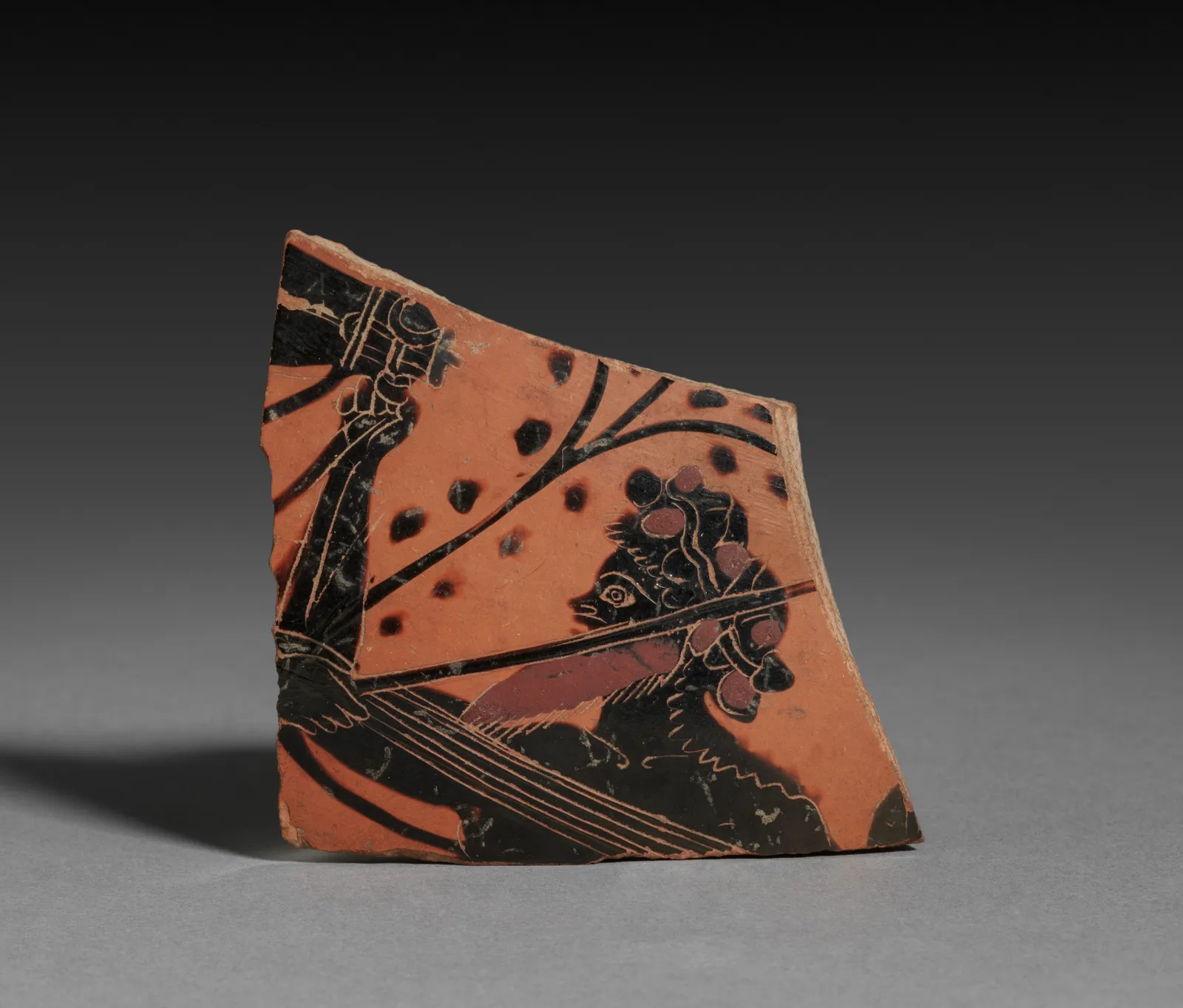
The black-figure fragment 1915.533.c: a red-bearded satyr guides a horse while a charioteer's hands hold the reins. The figures are black gloss on bare clay.
Museum no. 1915.533.c · Findspot: Necropolis of Ferentum (Viterbo)
"Fragment from Black-Figure Neck-Amphora (Storage Vessel): Satyr and Horse" by The Cleveland Museum of Art, Gift of the John Huntington Art and Polytechnic Trust — https://clevelandart.org/art/1915.533.c — CC0 1.0 (https://creativecommons.org/publicdomain/zero/1.0/)
The red-figure fragment puts the black in the other place. Gloss covers the background, and the woman is reserved, the term for a part left unpainted so that it fires to the color of the clay (McKeown and Sneed, University of Colorado Boulder classics department, 2018). Her record identifies the shape from "a bit of preserved lip": a kylix, or drinking cup.
| Field | Red-figure fragment | Black-figure fragment |
|---|---|---|
| Object | Fragment from a red-figure cup (kylix): a woman; Greek, Attic | Fragment from a black-figure neck-amphora (storage vessel): a satyr and a horse; Greek, Attic |
| Findspot | Orvieto, as painted on the fragment's back | Necropolis of Ferentum (Viterbo) |
| Context | Unrecorded: the record names no tomb or layer; sold to the museum through Harold Woodbury Parsons, New York, in 1915 | Unrecorded: the record names no tomb or layer; sold to the museum through Harold Woodbury Parsons, New York, in 1915 |
| Dated by | Museum attribution: the record cites no laboratory measurement; painter attribution by style, near the Telephos Painter (Beazley, ARV2 p. 820 no. 4, as cited in the record) | Museum attribution: the record cites no laboratory measurement and names no painter |
| Range | c. 470–460 BCE · museum attribution | c. 520–510 BCE · museum attribution |
| Dated event | Making and painting of the cup | Making and painting of the amphora |
| Now at | Cleveland Museum of Art, 1915.533.b | Cleveland Museum of Art, 1915.533.c |
| Primary record | Cleveland Museum of Art collection record 1915.533.b | Cleveland Museum of Art collection record 1915.533.c |
Download the comparison: black-figure-vs-red-figure-fragments.csv (Data: Cleveland Museum of Art Open Access data (CC0), records 1915.533.b and 1915.533.c, https://clevelandart.org/art/1915.533.b and https://clevelandart.org/art/1915.533.c) (sources and license, JSON).
The two ranges rest on the same kind of evidence. Each record gives its range without saying how it was reached and cites no laboratory measurement, so these are not dates of the kind discussed in radiocarbon dating. Labeled as museum attributions, they are not bare dates. How a museum's date can differ from a date written on the object is the problem Ming vase takes up.
Neither record lists an inscription. The painter name attached to the cup fragment, "near the Telephos Painter," is a judgment of drawing style, not a signature; the record cites J. D. Beazley's 1963 catalog of Attic red-figure painters for it. Some Athenian vases do carry inscriptions, such as a Cleveland fragment whose faint inscription names Aglauros (1992.369). Centuries earlier, the Greek language had been written in a syllabary, Linear B.
What do incised lines and relief lines show?
The two techniques part most clearly in the details. A black-figure painter filled each figure with gloss and then used a sharp tool to scratch details through it, so the lines show as bare clay (McKeown and Sneed 2018; Wikipedia, "Black-figure pottery"). On 1915.533.c, pale scratched lines mark the satyr's eye, the locks of his hair and the reins.
In red-figure the figure was already bare clay, so the painter drew its details in gloss, and on 1915.533.b the strongest of these are the relief lines named in the record, ridges of gloss that stand up from the surface. Side by side, the two techniques reverse each other except in the black itself:
| Feature | Black-figure | Red-figure |
|---|---|---|
| Figures | Painted in black gloss | Left as bare clay, or reserved |
| Background | Bare clay | Brushed with black gloss |
| Details | Scratched through the gloss to the clay | Drawn in gloss, including raised relief lines |
| The black | Fired clay slip, not pigment | Fired clay slip, not pigment |
How such lines were laid is Disputed. Beth Cohen's 2006 Getty catalog The Colors of Clay stays sympathetic to Joseph Veach Noble's suggestion of a syringe-like tool, according to J. Michael Padgett's 2007 review of the catalog. Padgett calls that unlikely, since skilled forgers make the same lines with a very thin brush.
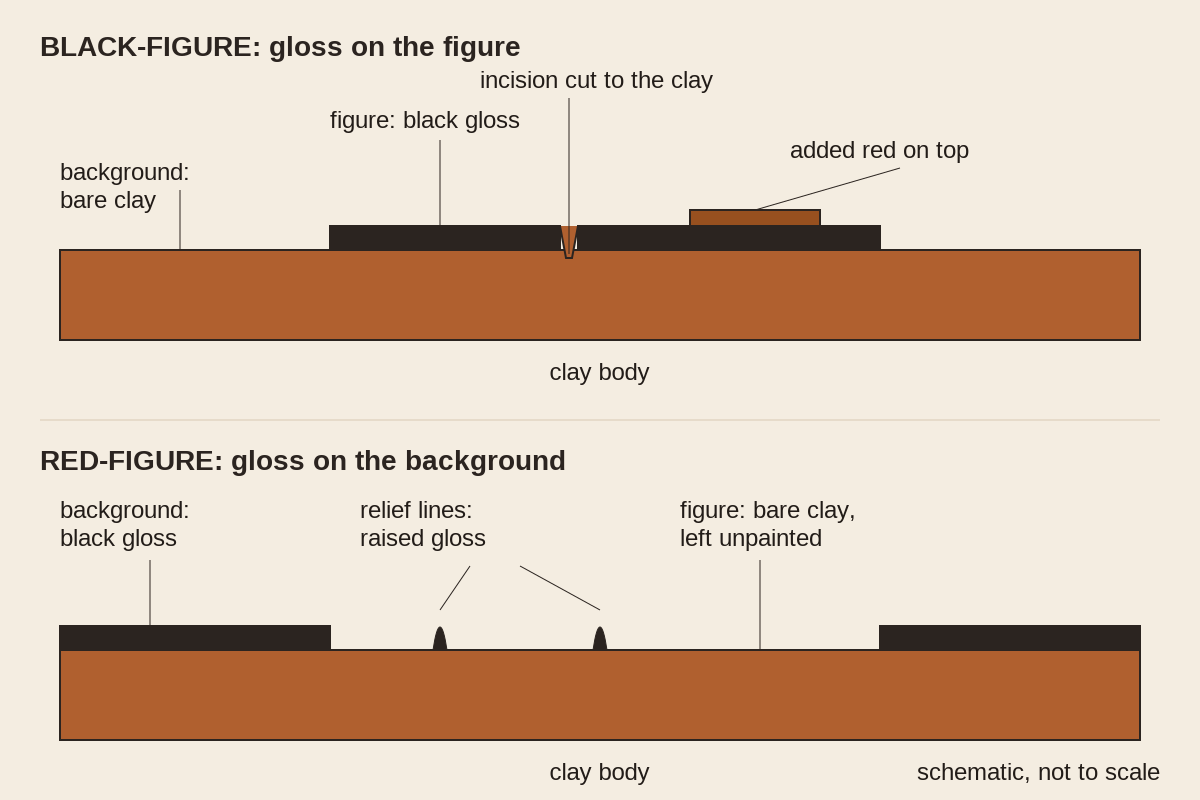
Scroll sideways to read every label, or open the full drawing.
Schematic cross-sections, not to scale. In black-figure the gloss lies on the figure and incision cuts through it; in red-figure it lies on the background, and relief lines stand up from the bare clay.
"Black-figure and red-figure: where the gloss sits (schematic cross-sections)" by Sherd and Script, https://sherdandscript.com/ceramics/black-figure-vs-red-figure/, licensed under CC BY 4.0 (https://creativecommons.org/licenses/by/4.0/)Data: Cleveland Museum of Art Open Access data (CC0), records 1915.533.b and 1915.533.c, https://clevelandart.org/art/1915.533.b
Both techniques could add other colors. The satyr's beard is a dull red, and the woman's right hand, now lost, once held a wreath "in added red paint," according to her record. Black-figure painters often used white for women's skin, and a Cleveland record for another vase calls Athena's skin "typically painted white on black-figure vases."
A scratched line is not always ancient, either. Cleveland's record for a Corinthian black-figure cup, 1923.221, reports "modern repainting and re-incising, or re-scratching, of the internal details," so incision shows the technique, not the age of every line.
Why does the same kiln give both black and red?
The black on both fragments is not paint in the usual sense. Cleveland's record for a black-gloss mug says that finish "derives from fired clay slip, not black pigment," from "the same firing technology used for black-figure and red-figure decoration." The gloss is a slip, a liquid clay, and its particles were much finer than those of the pot's body (De Guire 2013, summarizing Walton et al. 2013).
The standard account fits both techniques into one firing with three stages. In the first, with the kiln's vents open, body and gloss both fire red. In the second, the vents are closed to starve the kiln of oxygen; the iron in the clay is reduced to black oxides, magnetite and hercynite, and the fine gloss sinters, fusing into a dense layer (McKeown and Sneed 2018; De Guire 2013).

A kiln with its stoke-hole sealed. In the second stage of the standard account, closing the vents starves the kiln of oxygen and the iron in the clay turns black.
Illustration: Sherd and Script. Generated schematic illustration — not a photograph or record of any real object or site. Reuse: CC BY 4.0 (https://creativecommons.org/licenses/by/4.0/), to the extent Sherd and Script holds rights in it.
In the third stage, air returns. The porous body takes up oxygen and turns red again, while the dense gloss cannot and stays black, so the colors of a finished vase follow where the painter put the gloss. Padgett's 2007 review describes coral red and black gloss as taking their colors "during the same three-stage firing."
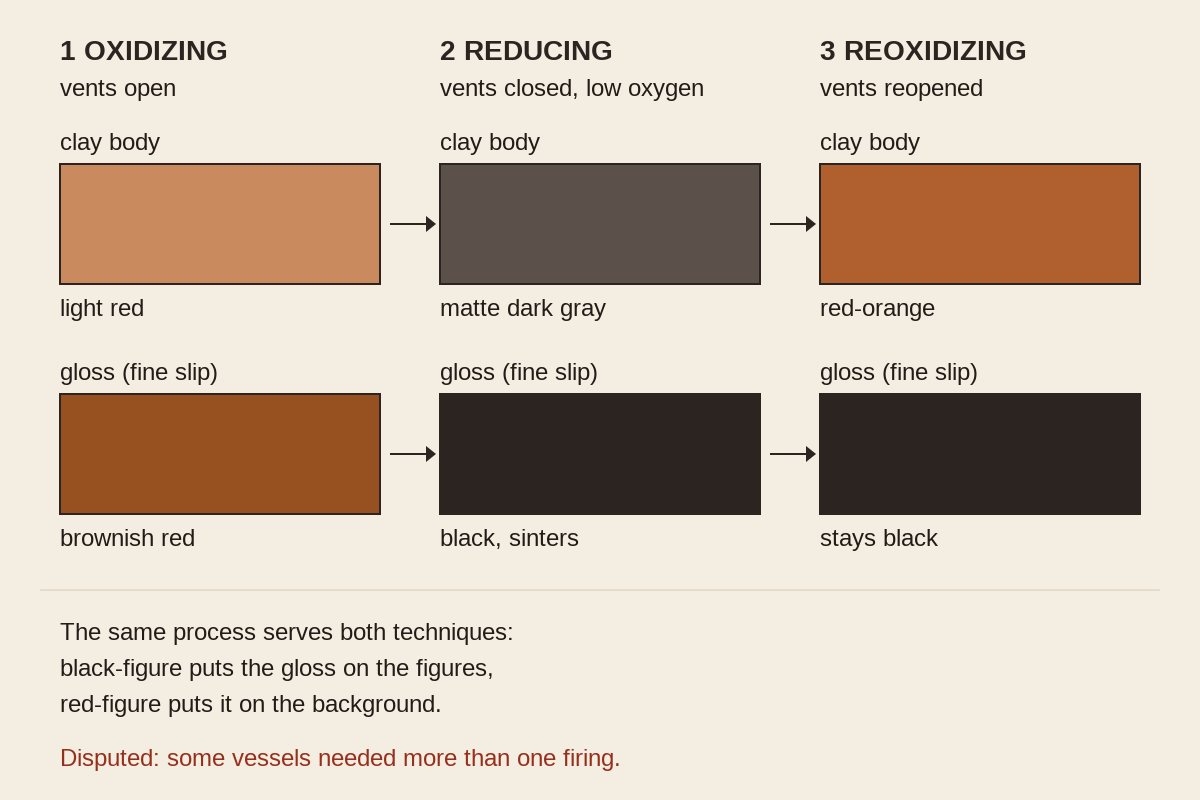
Scroll sideways to read every label, or open the full drawing.
The three stages of the standard account: the clay body goes red, dark gray, then red; the gloss goes black and stays black. Stages as CSV (sources and license, JSON).
"One firing, three kiln atmospheres: why the gloss ends black and the clay ends red" by Sherd and Script, https://sherdandscript.com/ceramics/black-figure-vs-red-figure/, licensed under CC BY 4.0 (https://creativecommons.org/licenses/by/4.0/)
Data sources for this figure and its CSV
Data: Stage facts after H. McKeown and D. Sneed, Black-Figure Vase Painting (University of Colorado Boulder, Department of Classics, 2018), https://www.colorado.edu/classics/2018/06/14/black-figure-vase-painting; Iron phases after E. De Guire, Ceramic Tech Today (American Ceramic Society, 2013), https://ceramics.org/ceramic-tech-today/nanostructure-in-bc-era-athenian-pottery-reveals-decorating-and-firing-innovations/
Whether every vase had a single firing is Disputed as of 2026. A 2013 study, as summarized by the American Ceramic Society, found a different degree of melting in the relief line of a red-figure sherd and read it as a sign of a hotter firing, and so of more than one; its authors allowed that other pots may have had a single firing.
A 2015 study of one vessel by the Berlin Painter in the J. Paul Getty Museum concluded in its abstract that it required "multiple firings and painting applications." The most economical reading is that both studies keep the oxidizing and reducing chemistry and question only whether all of it happened in one firing.
What does the back of a fragment add?
The backs give a second reading. The back of the black-figure fragment is bare clay crossed by fine ridges, and its record reads that "unfinished interior" as the sign of a closed vessel, likely a neck-amphora. The back of the cup fragment is black, like the background on its front.
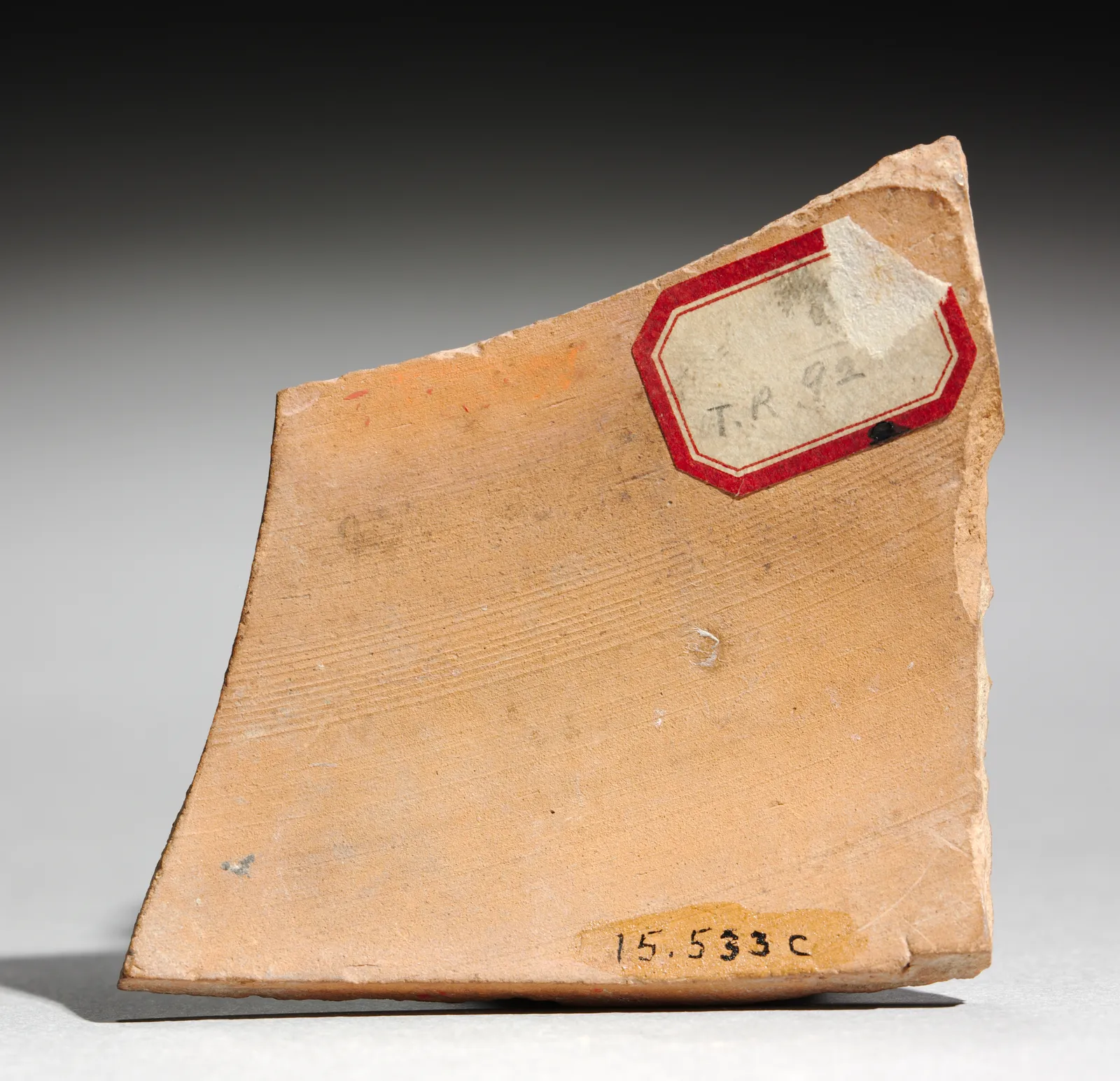
The back of the black-figure fragment 1915.533.c: bare clay with fine ridges, a paper label and the museum number. The record reads the unfinished interior as part of a closed vessel.
Museum no. 1915.533.c · Findspot: Necropolis of Ferentum (Viterbo)
"Fragment from Black-Figure Neck-Amphora (Storage Vessel): Satyr and Horse (back)" by The Cleveland Museum of Art, Gift of the John Huntington Art and Polytechnic Trust — https://clevelandart.org/art/1915.533.c — CC0 1.0 (https://creativecommons.org/publicdomain/zero/1.0/)
Neither shape identification depends on the figures. The museum names the cup from a scrap of its lip and the amphora from its bare inside, so technique and shape are two separate readings of the same sherd.
When did painters switch from black-figure to red-figure?
Black-figure is the older technique. It was developed in Corinth in the 7th century BCE · art-historical estimate and taken up in Athens soon afterwards (McKeown and Sneed 2018; Wikipedia, "Red-figure pottery").
The start of red-figure is also an estimate. As of 2026, the sources read here put it at c. 530–520 BCE · art-historical estimate. Wikipedia's article gives "around 520 BC" in its opening and "around 530 BC" for the first vases, and Padgett's 2007 review has red-figure painters adding raised clay detail "by 530."
For a time, some vases used both. A bilingual amphora in Munich, Staatliche Antikensammlungen 2301, shows Herakles reclining with Athena in red-figure on one side and in black-figure on the other (Wikipedia, "Bilingual vase painting"; Wikimedia Commons file description). Openly licensed photographs of it include a photographer's note that the museum permits photography only for non-commercial purposes. So none is shown here.
Whether one painter did both sides is Disputed. Cohen argues that the black-figure side is by the Lysippides Painter and the red-figure side by the Andokides Painter, two different hands, and Padgett judges her "probably" right while expecting the debate to continue. Wikipedia's article on bilingual painting also records the view that the two may be one painter.
Cleveland's group of five holds both techniques from one purchase: the museum dates the three black-figure pieces to c. 520 BCE · museum attribution or c. 520–510 BCE · museum attribution, and the two red-figure pieces to c. 470–460 BCE · museum attribution and c. 425–420 BCE · museum attribution.
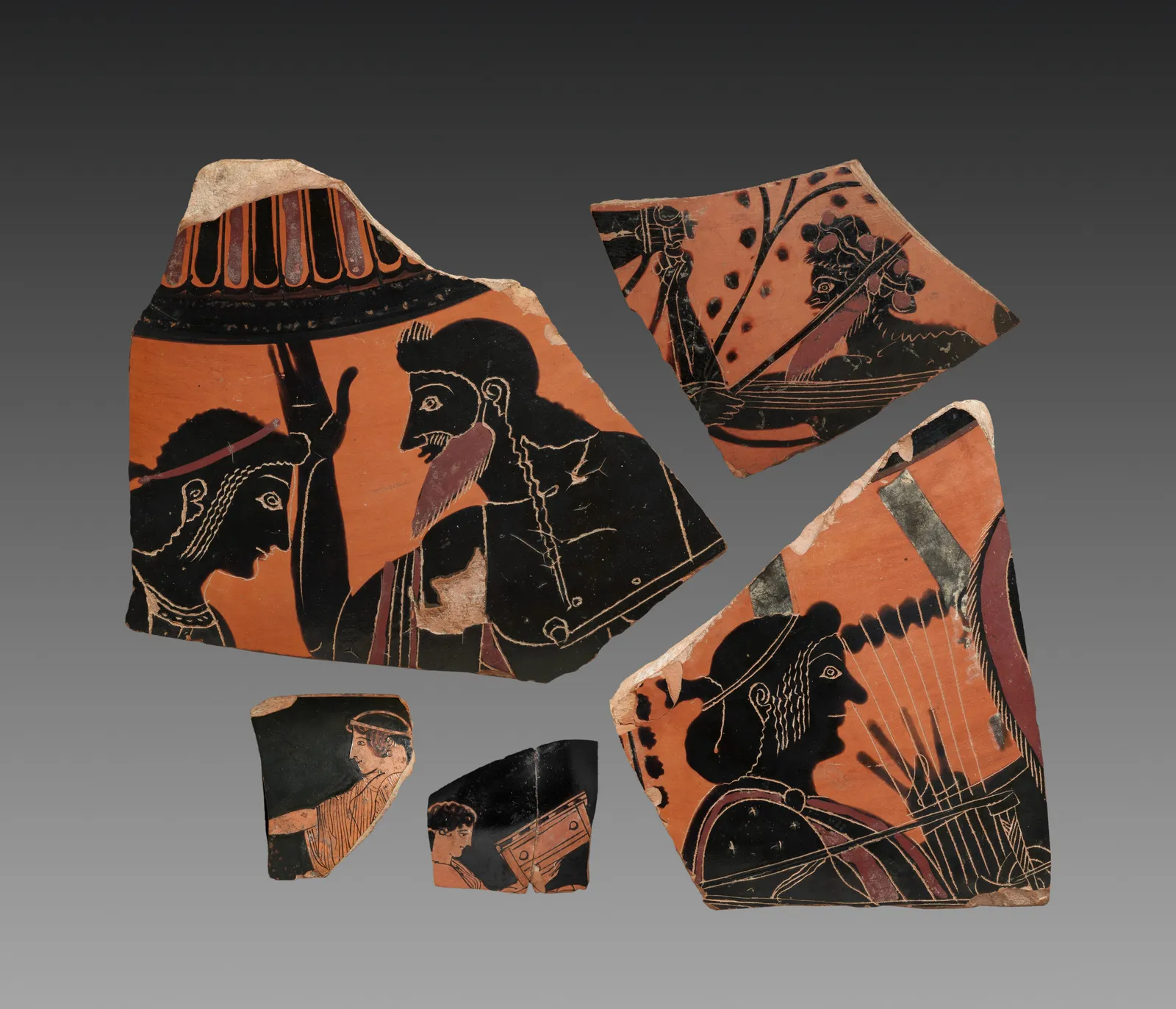
Five fragments from four vases, sold to Cleveland together in 1915. Three are black-figure; the two small pieces at lower left are red-figure.
Museum no. 1915.533 · Findspot: Orvieto and Necropolis of Ferentum (Viterbo), per fragment
"Five Fragments from Four Painted Vases" by The Cleveland Museum of Art, Gift of the John Huntington Art and Polytechnic Trust — https://clevelandart.org/art/1915.533 — CC0 1.0 (https://creativecommons.org/publicdomain/zero/1.0/)
The prize jars at Athens' Panathenaic Games were black-figure: a Cleveland record describes them as "the large black-figure amphorae awarded to athletic and equestrian victors." Why the prize jars used that technique is the question in Panathenaic amphora.
Who painted the first red-figure vases?
The Metropolitan Museum credits the start of red-figure to a workshop. Its record for amphora 63.11.6, as mirrored on Wikimedia Commons, says "the introduction of the red-figure technique is attributed to the workshop of Andokides," the potter who signed the jar, dated c. 530 BCE · museum attribution. It ties the technique to a potter because preparing the glazed and unglazed surfaces "was probably the responsibility of the potter," and gives the jar's red-figure side to the Andokides Painter and its black-figure side to the Lysippides Painter.
Like "near the Telephos Painter" above, the two painters' names are attributions by drawing style in the line of J. D. Beazley's catalogs, not signatures. The Commons description of the Munich amphora 2301 names the Andokides Painter with Beazley's 1963 catalog, page 4, no. 9, as its reference. Cleveland's record for a red-figure eye cup of c. 520 BCE · museum attribution names another early hand, Psiax, "who worked in both black-figure and red-figure." As of 2026, no source read for this page names the first red-figure painter.
What does "Orvieto" on the back prove?
The findspot of the cup fragment is a word painted on its back. Cleveland's record says ORVIETO is painted there and calls it the fragment's "likely findspot more than a century ago," and the photograph below shows the letters in white beside the museum number in red.
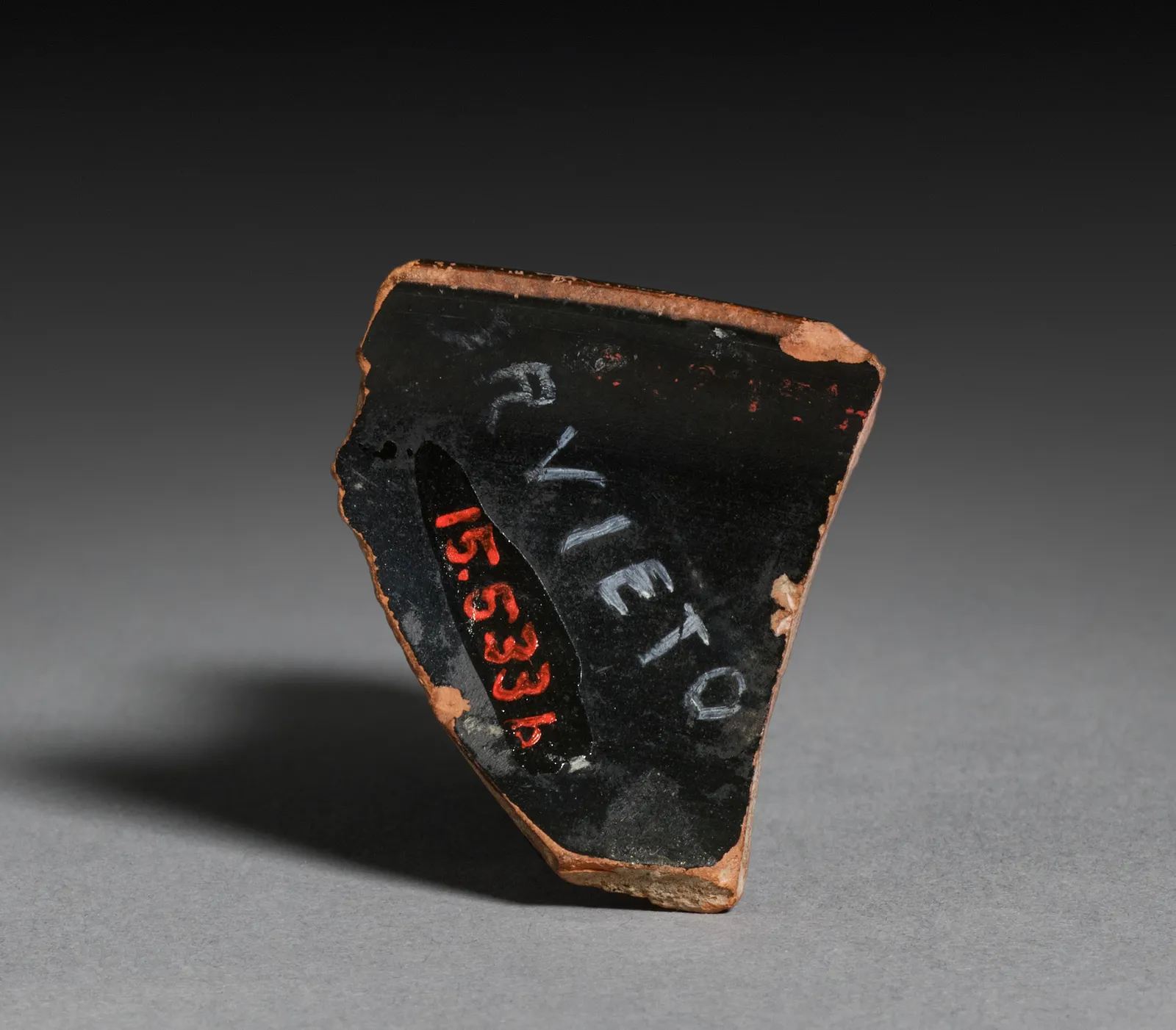
The back of the red-figure fragment 1915.533.b: a black surface, ORVIETO painted in white and the museum number in red. The museum calls Orvieto the fragment's likely findspot.
Museum no. 1915.533.b · Findspot: Orvieto, as painted on the fragment's back
"Fragment from Red-Figure Cup: Woman (back)" by The Cleveland Museum of Art, Gift of the John Huntington Art and Polytechnic Trust — https://clevelandart.org/art/1915.533.b — CC0 1.0 (https://creativecommons.org/publicdomain/zero/1.0/)
That word gives a place name, not a tomb or a layer. Nor does it say who painted it or when. The provenance record begins with the 1915 sale through Parsons, so nothing earlier is recorded except the word itself. The black-figure fragment is listed from the "Necropolis of Ferentum (Viterbo)," a cemetery, and again no tomb is named.
On this site's reading, a findspot without its context limits what a sherd can prove, and here it limits these two to their surfaces. Think of the painted surface as the spelling of a word and the tomb as the sentence it stood in: the spelling survives, so the technique can be read, but the sentence that would show who used these vessels, and how, did not come with them.
One mark on the black-figure fragment is still unexplained. Its back carries a paper label with a handwritten code that reads T.R 92 in the museum's photograph of that side, and as of 2026 the online record does not mention it. If that code ever leads back to a dealer's list or an excavation register, the result would be an archive dig in miniature, and the fragment's proof radius could reach past its technique.
Proof radius
What this box is for: the proof radius.
Proves: Each fragment shows its technique on its own surface: black-figure as gloss figures with details scratched through to the clay, red-figure as bare-clay figures with gloss brushed around them and raised relief lines.
Doesn't prove: That either vase was buried, or even found, where its record says. The cup's record lists plain "Orvieto" as its findspot, while its own note calls Orvieto only the likely findspot, and neither record names a tomb or a layer.
Read next: Panathenaic amphora: the Athenian prize jar that was painted in black-figure. Linear B: an older script for the language Athenian painters wrote on their vases.
Sources
Primary sources first.
- 1Cleveland Museum of Art, "Fragment from Red-Figure Cup: Woman," c. 470–460 BCE, near the Telephos Painter, accession no. 1915.533.b, collection record (Open Access data, CC0). https://clevelandart.org/art/1915.533.b Read: full record (Open Access record 94975)
- 2Cleveland Museum of Art, "Fragment from Black-Figure Neck-Amphora (Storage Vessel): Satyr and Horse," c. 520–510 BCE, accession no. 1915.533.c, collection record (Open Access data, CC0). https://clevelandart.org/art/1915.533.c Read: full record (Open Access record 94976)
- 3Cleveland Museum of Art, "Five Fragments from Four Painted Vases," accession no. 1915.533, collection record (Open Access data, CC0). https://clevelandart.org/art/1915.533 Read: full record (Open Access record 94973)
- 4Cleveland Museum of Art, "Fragment from Black-Figure Neck-Amphora of Panathenaic Shape (Storage Vessel): Apollo and Zeus," c. 520 BCE, accession no. 1915.533.a, collection record (Open Access data, CC0). https://clevelandart.org/art/1915.533.a Read: full record (Open Access record 94974)
- 5Cleveland Museum of Art, "Fragment from Red-Figure Oinochoe (Wine Jug) or Hydria (Water Jar): Woman Holding Box," c. 425–420 BCE, attributed to the Shuvalov Painter, accession no. 1915.533.d, collection record (Open Access data, CC0). https://clevelandart.org/art/1915.533.d Read: full record (Open Access record 94977)
- 6Cleveland Museum of Art, "Fragment from Black-Figure Neck-Amphora of Panathenaic Shape (Storage Vessel): Apollo with Lyre," c. 520 BCE, accession no. 1915.533.f, collection record (Open Access data, CC0). https://clevelandart.org/art/1915.533.f Read: full record (Open Access record 94978)
- 7Cleveland Museum of Art, "Black-Figure Kotyle (Drinking Cup): Chain of Women," c. 590–560 BCE, with modern repainting and reincising, accession no. 1923.221, collection record (Open Access data, CC0). https://clevelandart.org/art/1923.221 Read: full record (Open Access record 104992)
- 8Cleveland Museum of Art, "Black-Gloss Mug," late 400s–300s BCE, accession no. 1991.167, collection record (Open Access data, CC0). https://clevelandart.org/art/1991.167 Read: full record (Open Access record 155864)
- 9Cleveland Museum of Art, "Fragment of a Red-Figure Bell-Krater or Calyx-Krater (Mixing Vessel): Female Head (Aglauros)," c. 460–450 BCE, accession no. 1992.369, collection record (Open Access data, CC0). https://clevelandart.org/art/1992.369 Read: full record (Open Access record 156774)
- 10Cleveland Museum of Art, "Black-Figure White-Ground Lekythos (Oil Vessel): Athena between Cocks and Hieropoioi (Officials)," 500–485 BCE, accession no. 2022.42, collection record (Open Access data, CC0). https://clevelandart.org/art/2022.42 Read: full record (Open Access record 457392)
- 11The Unicode Consortium, The Unicode Standard, Version 18.0.0, Core Specification, chapter 8, section 8.2 "Linear B". https://www.unicode.org/versions/Unicode18.0.0/core-spec/chapter-8/ Read: section 8.2.1 Linear B Syllabary (HTML)
- 12I. Cianchetta, K. Trentelman, J. Maish, D. Saunders, B. Foran, M. Walton and others, "Evidence for an unorthodox firing sequence employed by the Berlin Painter: deciphering ancient ceramic firing conditions through high-resolution material characterization and replication," Journal of Analytical Atomic Spectrometry 30 (2015): 666–676 (abstract). https://research-portal.uu.nl/en/publications/evidence-for-an-unorthodox-firing-sequence-employed-by-the-berlin/ Read: abstract and bibliographic record on the Utrecht University research portal; full text not read
- 13J. Michael Padgett, review of Beth Cohen, The Colors of Clay: Special Techniques in Athenian Vases (Los Angeles: J. Paul Getty Museum, 2006), Bryn Mawr Classical Review 2007.03.09. https://bmcr.brynmawr.edu/2007/2007.03.09/ Read: full text of the review (the reviewed catalog itself was not read)
- 14Eileen De Guire, "Nanostructure in BC-era Athenian pottery reveals decorating and firing innovations," Ceramic Tech Today, American Ceramic Society, 28 June 2013 (summarizing M. Walton et al., "Material evidence for multiple firings of ancient Athenian red-figure pottery," Journal of the American Ceramic Society, 2013). https://ceramics.org/ceramic-tech-today/nanostructure-in-bc-era-athenian-pottery-reveals-decorating-and-firing-innovations/ Read: full text of the article (the Walton et al. paper itself was not read)
- 15Heather McKeown and Debby Sneed, "Black-Figure Vase Painting," University of Colorado Boulder, Department of Classics, 14 June 2018. https://www.colorado.edu/classics/2018/06/14/black-figure-vase-painting Read: full text of the page
- 16Wikipedia, "Red-figure pottery" (revision 1354349526, read 2026-10-13; used only alongside other sources). https://en.wikipedia.org/wiki/Red-figure_pottery Read: article text
- 17Wikipedia, "Black-figure pottery" (revision 1376003847, read 2026-10-13; used only alongside other sources). https://en.wikipedia.org/wiki/Black-figure_pottery Read: article text
- 18Wikipedia, "Bilingual vase painting" (revision 1223234269, read 2026-10-13; used only alongside other sources). https://en.wikipedia.org/wiki/Bilingual_vase_painting Read: article text
- 19Wikimedia Commons, "Andokides Painter ARV 4 9 Herakles reclining with Athena (01).jpg," file description by ArchaiOptix (CC BY-SA 4.0), read 2026-10-13; used only alongside other sources. https://commons.wikimedia.org/wiki/File:Andokides_Painter_ARV_4_9_Herakles_reclining_with_Athena_(01).jpg Read: file description
- 20The Metropolitan Museum of Art, "Terracotta amphora (jar)," signed by Andokides as potter, attributed to the Andokides Painter and the Lysippides Painter, ca. 530 B.C., 63.11.6, collection record as mirrored on Wikimedia Commons (CC0); the museum's own page was not read. https://commons.wikimedia.org/wiki/File:Terracotta_amphora_(jar)_MET_DP116936.jpg Read: Commons file page mirroring the museum record (notes, artist, inscription and date fields)
- 21Cleveland Museum of Art, "Red-Figure Eye Cup: Warriors (A), Musician and Youths (B)," c. 520 BCE, attributed to Psiax and the Group of Leipzig T 3599, accession no. 1976.89, collection record (Open Access data, CC0). https://clevelandart.org/art/1976.89 Read: full record (Open Access record 148849)


Cite this page
Sherd and Script. “Black-Figure vs Red-Figure: Reading the Technique from a Single Sherd.” Sherd and Script. Published 13 October 2026; last substantive revision 14 October 2026. https://sherdandscript.com/ceramics/black-figure-vs-red-figure/ (accessed ).
Corrections
- 2026-10-14 — Added the section "Who painted the first red-figure vases?" (was: no such section → now: two paragraphs beginning "The Metropolitan Museum credits the start of red-figure to a workshop.") — Metropolitan Museum of Art record for 63.11.6, as mirrored on Wikimedia Commons; Wikimedia Commons description of Munich 2301; Cleveland Museum of Art record for 1976.89