Case file
Panathenaic Amphora: The Archon's Name Dates the Oil, Not the Victory
Sherd and Script · Published 13 October 2026 · Revised 23 October 2026
Athens kept its prize jars in the old black-figure technique long after its painters had moved on to red-figure. Later jars also carry the name of the year's archon, and that name dates the oil inside, not the race.
Find card
- Object / Site
- Black-figure Panathenaic prize amphora, Attic: Athena between columns (side A); boxers and Nike (side B)
- Findspot
- Cerveteri (ancient Caere), Italy; town level only
- Context
- Unrecorded: the copied museum data names no tomb or layer; purchased from Alessandro Castellani
- Dated by
- Documentary: the archon's name painted on the jar, Pythodelos archon; year computed from the archon list in Diodorus 16.91 and its Loeb editor's note (Loeb Classical Library, 1963)
- Range
336/5 BCE · computed, archon list (Loeb Diodorus)(archon's term July 336 to June 335 BCE)- Dated event
- The archon's year of office; on the standard reading, the year the prize oil was collected, not the painting of the jar or the Games at which it was awarded
- Now at
- British Museum, London, 1873,0820.371 (catalogue B 607); number as given on Wikimedia Commons, the museum's page was not read
- Primary record
- https://www.britishmuseum.org/collection/object/G_1873-0820-371 (record URL as given on Wikimedia Commons; not read)
Find card as CSV panathenaic-amphora-find-card.csv (sources and license, JSON)Data: British Museum data for 1873,0820.371 as copied on Wikimedia Commons (single factual values); Diodorus Siculus 16.91 and Loeb note 101 (archon term); J. D. Beazley, The Development of Attic Black-Figure, rev. ed. 1986
TL;DR. The British Museum prize jar 1873,0820.371 is dated by its painted words Pythodelos, archon · documentary, and the archon list in Diodorus, with its modern editor's note, puts his year of office at 336/5 BCE · computed, archon list (Loeb Diodorus), from July to June. On the standard reading, that is the year the prize oil was collected, so it dates neither the painting of the jar nor the boxing match on its back. The jar is still black-figure, although red-figure had begun c. 530–520 BCE · art-historical estimate (as of 2026).
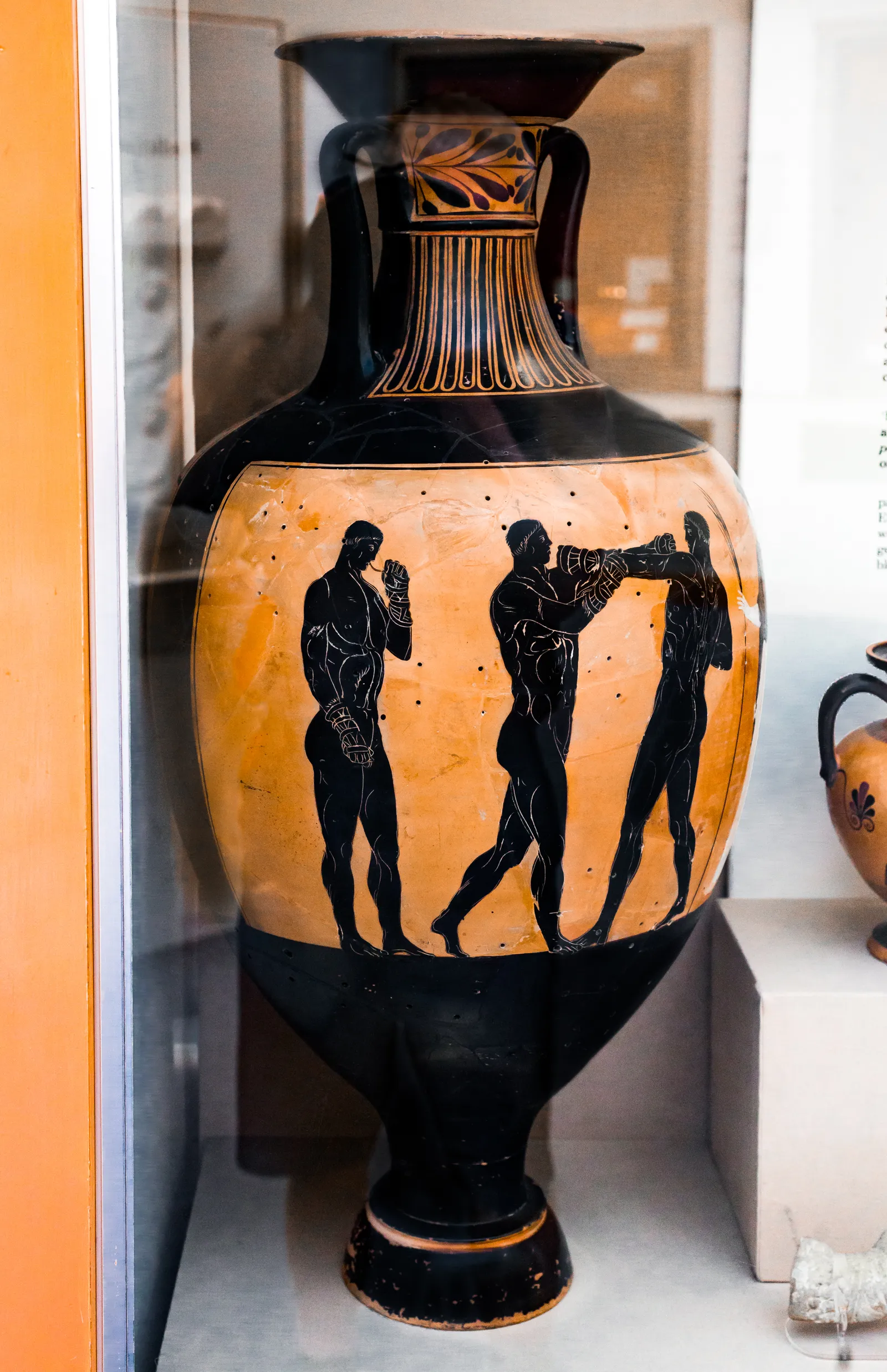
The prize jar British Museum 1873,0820.371, boxing side. The archon's name is painted on the other side, next to the figure of Athena.
Museum no. 1873,0820.371 · Findspot: Cerveteri (ancient Caere), Italy
"Hobble Group - ABV 415 4 - Athena Promachos - boxers - London BM 1873-0820-371 - 01" by ArchaiOptix — https://commons.wikimedia.org/wiki/File:Hobble_Group_-_ABV_415_4_-_Athena_Promachos_-_boxers_-_London_BM_1873-0820-371_-_01.jpg — CC BY-SA 4.0 (https://creativecommons.org/licenses/by-sa/4.0/)

A British Museum prize jar names its year in paint: beside Athena run the words "Pythodelos, archon." An archon was one of Athens' yearly officials, and one of them gave his name to the year. The inscription, recorded in the museum's data as copied on Wikimedia Commons, gives this Panathenaic amphora, a prize jar from the games at Athens, a written date.
The date is real, but it belongs to one particular event. Finding out which event takes three kinds of evidence: the jar itself, an ancient list of archons and an Athenian rule about olive oil. The jar is also out of step with its time, since it is painted in black-figure, black figures on bare clay. How that technique works is explained in black-figure vs red-figure; this case file asks what the jar can date and what it cannot.
What did a Panathenaic victor take home?
The Panathenaia was Athens' festival for Athena, and every fourth year it was held on a grander scale as the Great Panathenaia (Wikipedia, "Attic calendar"). J. D. Beazley's lectures on black-figure, first printed with a 1951 preface and revised in 1986, describe the prizes at the Great Panathenaic games, "held once every four years," as "amphorae of the famous Attic oil." An amphora is a two-handled storage jar.
The Athenian Constitution, a treatise from the school of Aristotle, explains where the oil came from. In F. G. Kenyon's 1921 translation, ten Commissioners of Games, chosen by lot for four years, ran the procession and the contests and provided "the vases" together with the Council. The oil came from sacred olive trees. The archon collected it from the owners of the farms where the trees grew.

An olive grove on a low hill. In the Athenian Constitution, the prize oil came from sacred olive trees, and the archon collected it from the owners of the farms where they grew.
Illustration: Sherd and Script. Generated schematic illustration — not a photograph or record of any real object or site. Reuse: CC BY 4.0 (https://creativecommons.org/licenses/by/4.0/), to the extent Sherd and Script holds rights in it.
Not every winner got oil. The same passage lists silver and gold for the musical contests, shields for the contest of "manly vigour," and oil for the athletic events and the horse race. In the standard design that Beazley describes, the jar's front shows Athena between two columns, and its back shows the kind of event the prize was for.
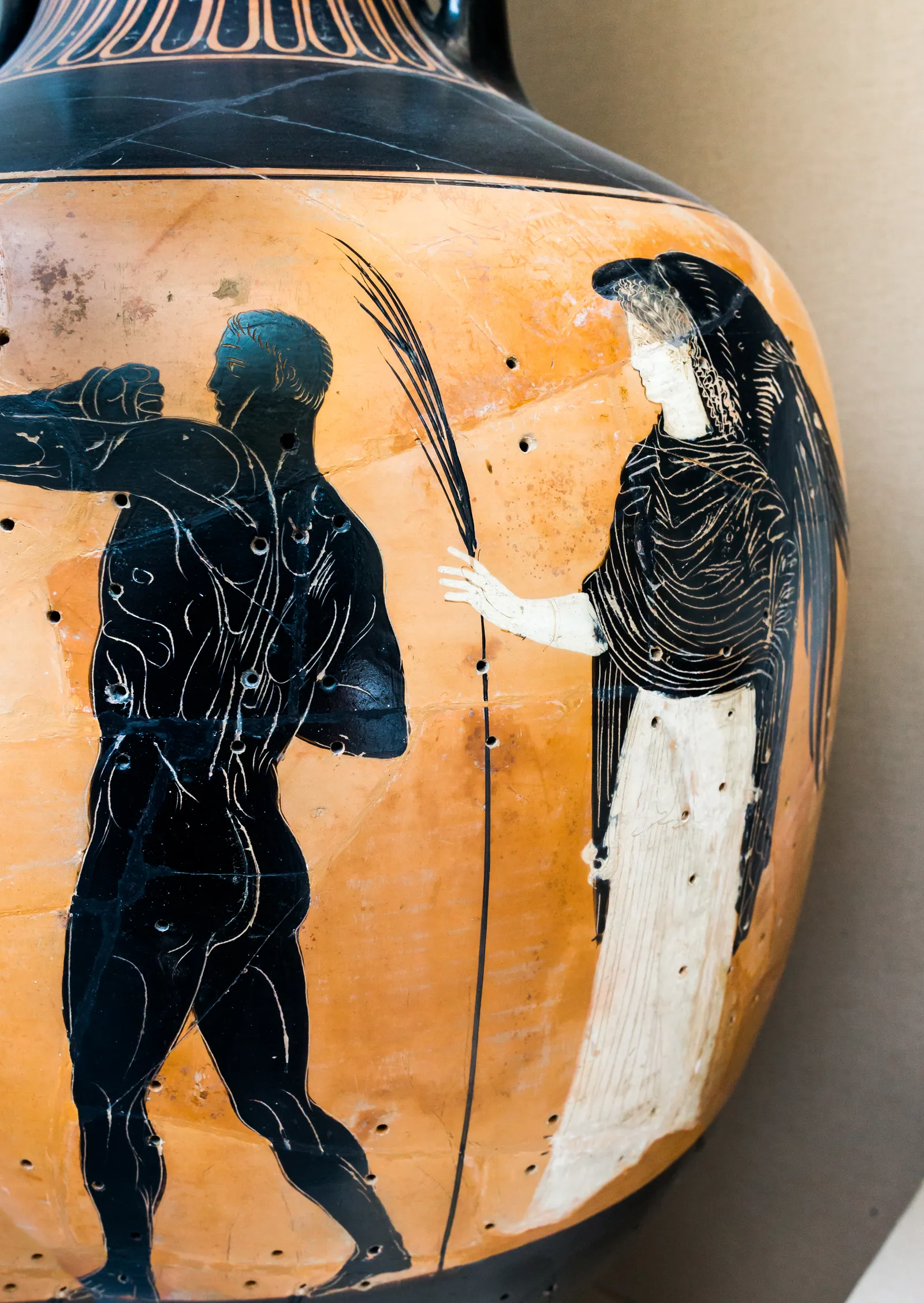
Nike, the goddess of victory, holds a palm branch beside a boxer on the same jar. The picture shows the kind of contest, not who won it.
Museum no. 1873,0820.371 · Findspot: Cerveteri (ancient Caere), Italy
"Hobble Group - ABV 415 4 - Athena Promachos - boxers - London BM 1873-0820-371 - 04" by ArchaiOptix — https://commons.wikimedia.org/wiki/File:Hobble_Group_-_ABV_415_4_-_Athena_Promachos_-_boxers_-_London_BM_1873-0820-371_-_04.jpg — CC BY-SA 4.0 (https://creativecommons.org/licenses/by-sa/4.0/)

The Games dial of the Antikythera mechanism counts a four-year festival cycle too, with festivals such as the Olympia and the Halieia of Rhodes. At Athens, the same cycle may also bear on when the prize oil was collected, as Bentz argues from the archons' names further down.
How many jars of oil went to one victor?
In E. Norman Gardiner's 1910 table of an Athenian prize list, which he places in the 4th century BCE · art-historical estimate, the surviving first prizes in oil run from 4 to 140 amphorae, depending on the event and the age class. The winner of the youths' stade-race received 60 and the runner-up 12, and the winner of the chariot race for full-grown horses 140, against 40 for second place. The lines for the men's athletic events are lost.
Gardiner's 1910 reading is the only edition of the list read here, as of 2026, and his bracketed figures, such as the boys' stade-race prize of 50, are restorations. He reads the figures as "so many amphorae of oil" and thought it probable that only one painted vase went with each victory. Richard Hamilton's 1999 review notes that Martin Bentz's 1998 explanations of the jars' volumes all assume the oil was stored in the prize jars themselves, so how many painted jars a victor took home is Disputed.
Why were the prize jars still black-figure?
Black-figure was nearly gone from Athenian workshops by the mid-5th century BCE · art-historical estimate, according to Beazley. Then he adds: "With one great exception." For the prize jars, "the old technique was retained," and the series runs on well past the time when red-figure itself had stopped being made.
The painters were not old-fashioned specialists. Beazley shows that the fifth-century prize jars were, as a rule, painted by red-figure artists, among them the Kleophrades Painter, the Berlin Painter and the Eucharides Painter. The Met attributes the jar below to the Eucharides Painter and dates it c. 490 BCE · museum attribution, according to its data copied on Commons.
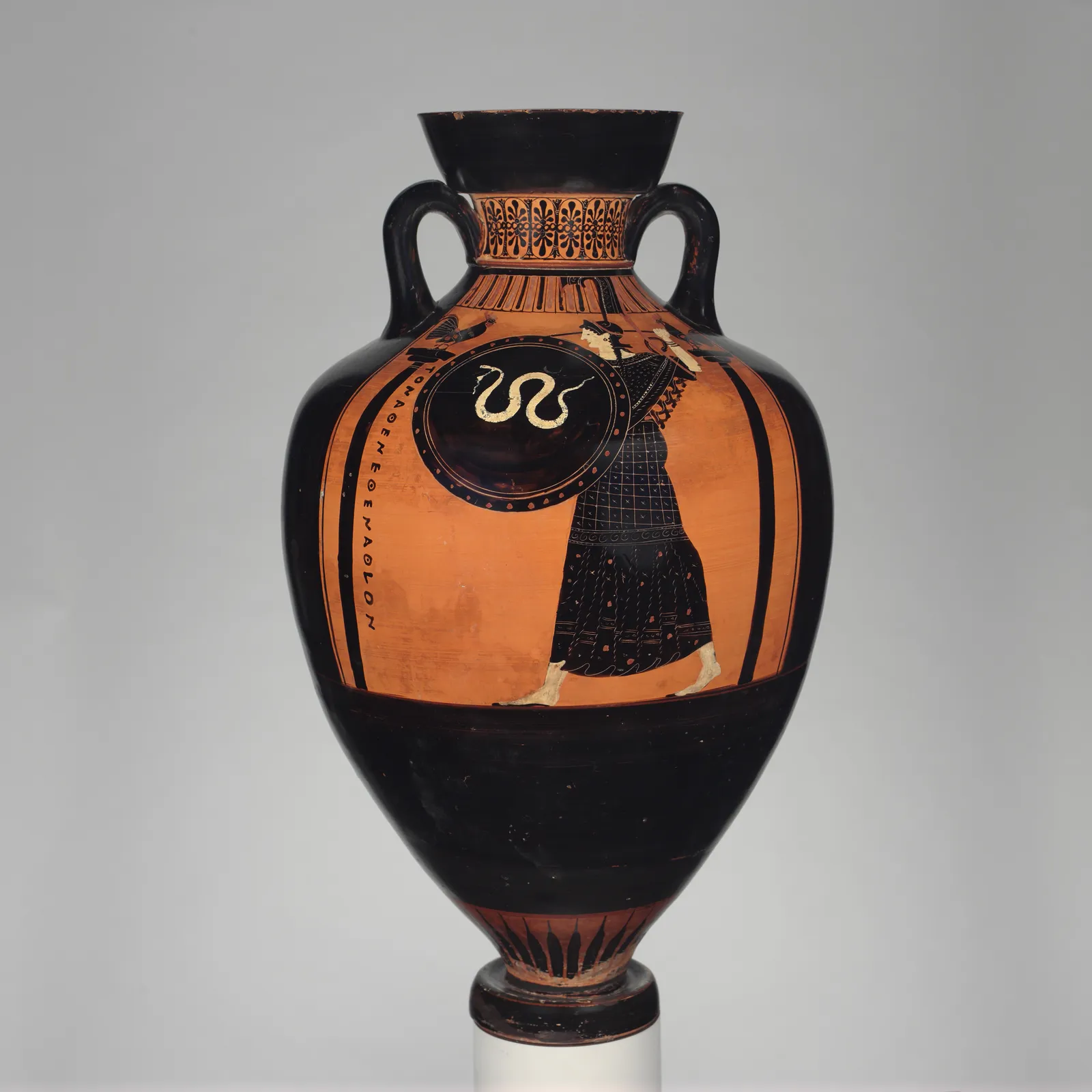
A prize jar the Met attributes to the Eucharides Painter, a red-figure artist. The prize formula runs down the column at left, in black letters on the clay.
Museum no. 56.171.3 · Findspot: unrecorded
"Terracotta Panathenaic prize amphora (jar) MET DP104351" by The Metropolitan Museum of Art, New York (Open Access) — https://commons.wikimedia.org/wiki/File:Terracotta_Panathenaic_prize_amphora_(jar)_MET_DP104351.jpg — CC0 1.0 (https://creativecommons.org/publicdomain/zero/1.0/)

Beazley also saw a split within each jar. The back was drawn in the current style of its day. The Athena on the front, after the archaic period, "remains traditional and 'archaic,'" in his words, "not, of course, true archaic, but a mannered mixture of old and new."
Why Athens kept the old technique is a matter of interpretation, since none of the sources read for this page reports an ancient statement of the reason. Ross Brendle's 2019 chapter on these jars, as summarized in Tim Rood's review of the volume, "relates the archaism of the visual depictions to religious conservatism while allowing for some changes over time." That is one scholar's argument, not a recorded decision.
What does the writing beside Athena say?
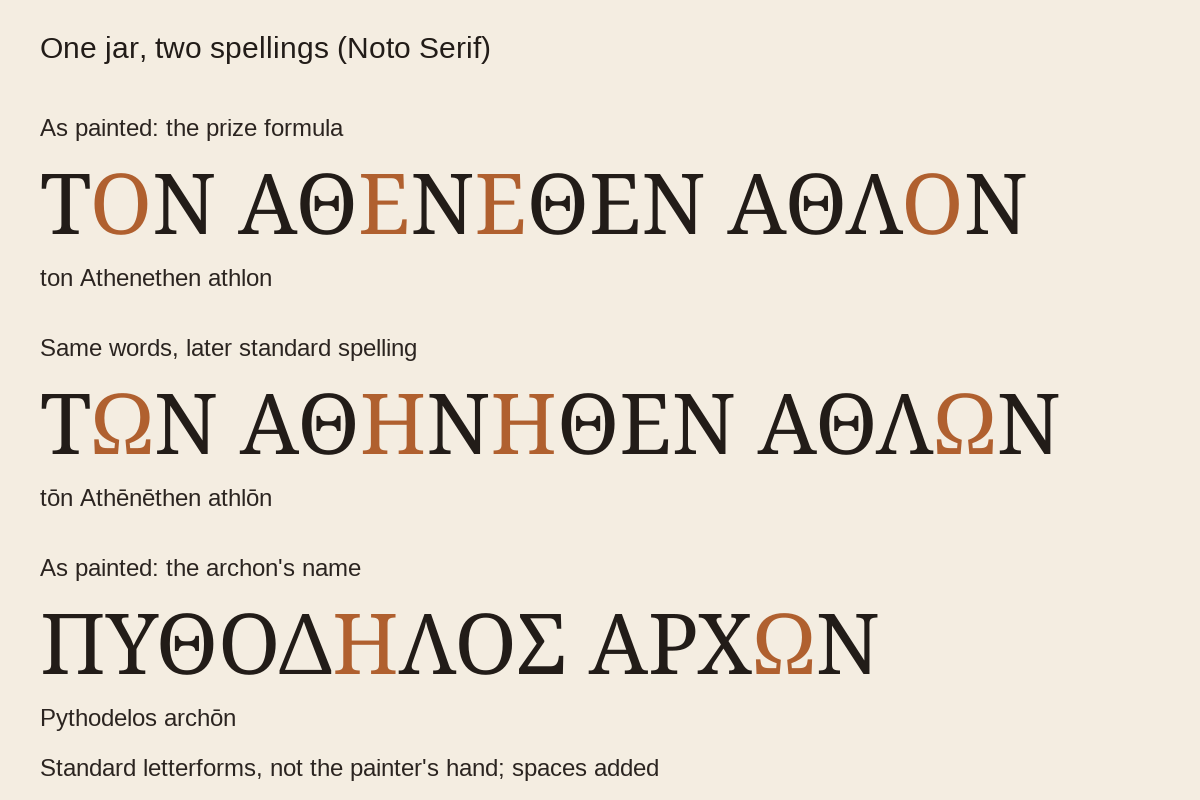
The standard inscription is tōn Athēnēthen athlōn, "(one) of the prizes from Athens," as Richard Hamilton renders it in a 1999 review. On the London jar the museum's inscription data, as copied on Commons, spells it ton Athenethen athlon, with epsilon and omicron where later Greek writes eta and omega.
The archon's name on the same jar is spelled with eta and omega, as Pythodelos archōn. Athens adopted the Ionic alphabet, which has those two letters, for official use under the archon Eukleides (Wikipedia, "Eucleides," citing D'Angour 1999). Kenyon's notes to the Athenian Constitution place Eukleides' year in 403/2 BCE · computed, archon list (Kenyon 1921). Rood's review notes that "some amphorae have letters from both the pre- and the post-Euclidean alphabets."
Scroll sideways to read every label, or open the full drawing.
The prize formula and archon's name from the London jar, with the formula's later spelling between them, in standard Noto Serif letterforms, not the painter's hand. Highlights mark the letters that changed.
"The prize formula and the archon's name, in Noto Serif" by Sherd and Script, https://sherdandscript.com/ceramics/panathenaic-amphora/, licensed under CC BY 4.0 (https://creativecommons.org/licenses/by/4.0/)Data: Noto Serif 2.015 (SIL Open Font License 1.1); Unicode Character Database 18.0.0 (Unicode License v3); Inscription reading: British Museum data for 1873,0820.371 as copied on Wikimedia Commons
In the Met photograph above, the earlier jar spells the formula with the same epsilon and omicron, as it would before the change. For the London jar, the most economical reading is that the formula was copied as a set text in its old spelling, while the name, new every year, was written the way Athenians then wrote.
How does an archon's name become a year?
Athenians named each year after its archon instead of numbering it, as a note in E. J. Chinnock's 1884 translation of Arrian and Wikipedia's "Attic calendar" both explain. A name becomes a year only through a list. Diodorus of Sicily's Library of History opens each year with a line such as "When Pythodorus was archon at Athens," linked to the Roman consuls and, in some years, the Olympic Games.
Here the spelling matters. Diodorus's text, in the Loeb edition of 1963, reads Pythodorus, and the editor's note corrects it: "The archon's name was Pythodelus, and his term ran from July 336 to June 335 B.C." Chinnock's translation of Arrian dates the death of Philip II of Macedon to the year "when Pythodemus was archon." The jar's own spelling, Pythodelos, matches the editor's correction.
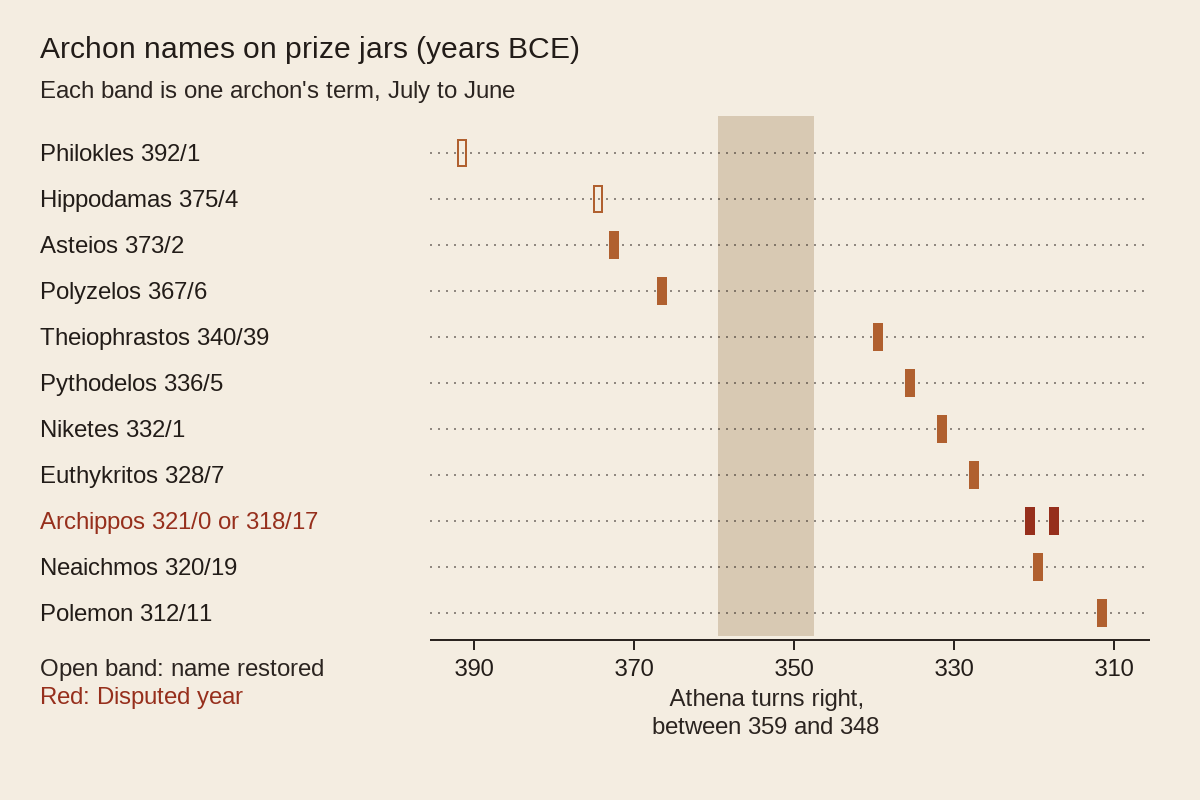
The term crossed a modern New Year because the Athenian year began in midsummer. A note in Kenyon's Athenian Constitution puts the first month of the Attic year in July and says the archons took office at its start. So the jar's date is written 336/5 BCE · computed, archon list (Loeb Diodorus), not plain "336 BC." The name on the jar is the documentary part; the BCE year is a conversion through the list.
Scroll sideways to read every label, or open the full drawing.
Archon years named on prize jars, from Beazley, with the Louvre's Archippos jar added. Each term runs July to June; open bands are restored names, red a disputed year. Timeline CSV (sources and license, JSON).
"Archon names on Panathenaic prize amphorae, 392/1 to 312/11 BCE" by Sherd and Script, https://sherdandscript.com/ceramics/panathenaic-amphora/, licensed under CC BY 4.0 (https://creativecommons.org/licenses/by/4.0/)
Data sources for this figure
Data: Archon years: J. D. Beazley, The Development of Attic Black-Figure, rev. ed. (University of California Press, 1986), chapter 8; Archon terms: Diodorus Siculus, Library of History, Loeb Classical Library vols. VII-X (1947-1963), editors' notes, as transcribed on LacusCurtius; Archippos year: R. Hamilton, review of M. Bentz, Panathenäische Preisamphoren, Bryn Mawr Classical Review 1999.11.15; Musée du Louvre, collections record for MN 705 (Etalab Open Licence), last updated 8 April 2026
Data sources for the CSV
Data: J. D. Beazley, The Development of Attic Black-Figure, rev. ed. 1986, chapter 8; Diodorus Siculus, Library of History, Loeb Classical Library, editors' notes via LacusCurtius; R. Hamilton, Bryn Mawr Classical Review 1999.11.15; Musée du Louvre, collections record for MN 705 (Etalab Open Licence), last updated 8 April 2026; Wikimedia Commons file description of Louvre MN 705
The museum data on Commons gives the London jar a production date of "336BC (or earlier)." Written that way, the date loses half its span and the reason behind it. A date given without its basis is what this site calls a bare date; with the archon's name and the list attached, it is no longer bare.
Can one archon's name point to two years?
It can, because Athenians reused names. The Loeb Diodorus has a Theophrastus as archon in 340/39 BCE · computed, archon list (Loeb Diodorus) and another in 313/12 BCE · computed, archon list (Loeb Diodorus). Beazley places a prize jar at Harvard naming "Theiophrastos" in the earlier year.
The Louvre jar MN 705 shows the problem at its sharpest. Its name, "Archippos, archon," is painted clearly beside Athena, and the Louvre's record, last updated 8 April 2026, dates it 321–320 BCE · museum attribution. Hamilton's review of Martin Bentz's 1998 catalogue, which the Louvre record cites, says it is "not clear why the Archippos Panathenaic is assigned to 321 not 318 BC." The review names no museum number, so the match to this jar rests on that citation.
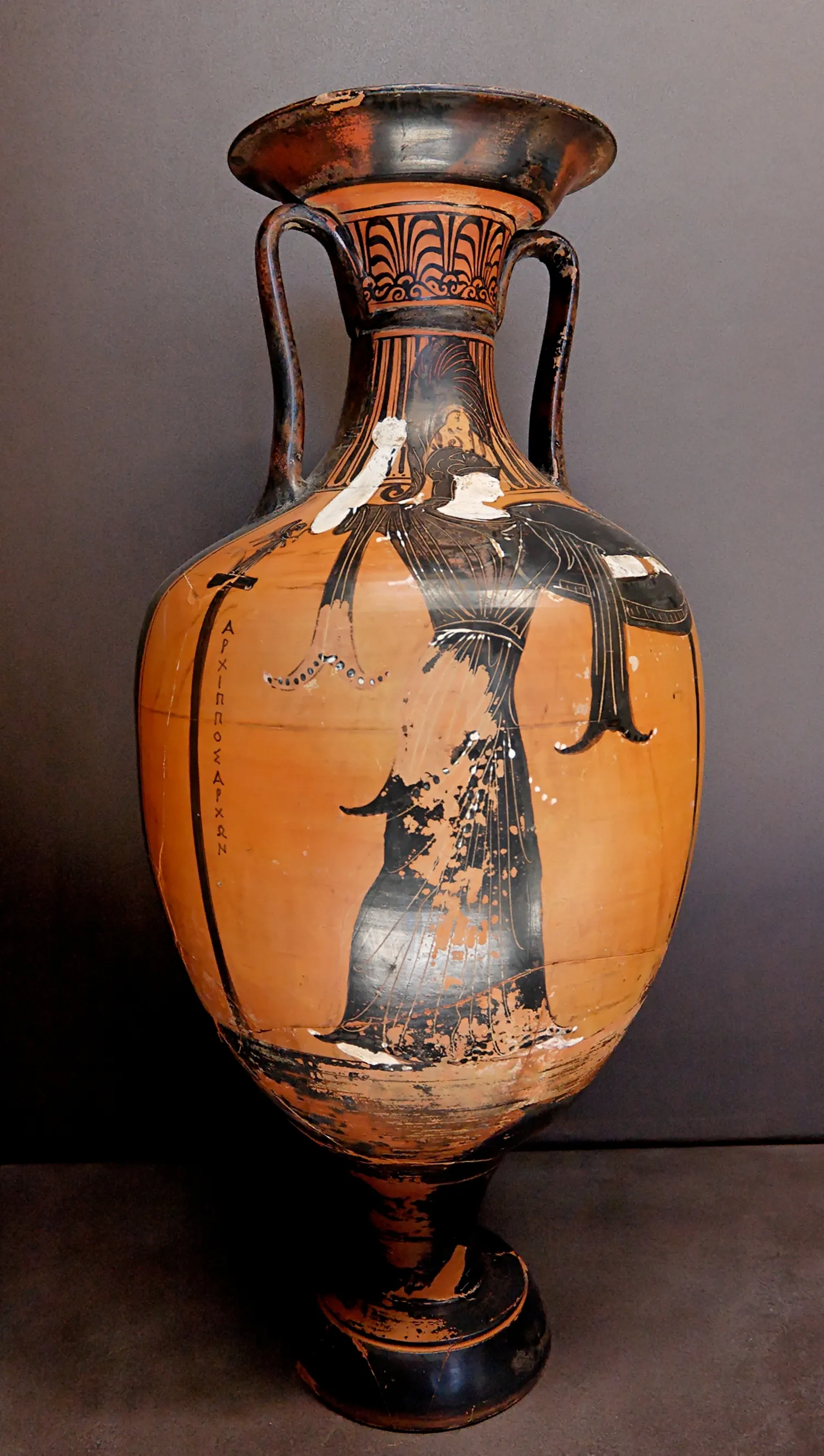
The Louvre's Archippos jar. The name runs down beside the left-hand column; which Archippos it names, and so its year, is Disputed.
Museum no. MN 705 · Findspot: Benghazi (ancient Berenike), Libya
"Panathenaic amphora Louvre MN705" by Jastrow (2006), Wikimedia Commons — https://commons.wikimedia.org/wiki/File:Panathenaic_amphora_Louvre_MN705.jpg — Public domain (the photographer's own public-domain release on Wikimedia Commons (PD-self: worldwide release, with a fallback grant to use the work for any purpose without conditions))

The archon list does not settle it. The Loeb Diodorus names an Archippus as archon in 318/17 BCE · computed, archon list (Loeb Diodorus), and its editor's note on Book 18 lists the four archon years the book uses; the year Bentz's date needs is not among them. As of 2026, on the sources read here, the jar's year stays Disputed: 321–320 BCE · museum attribution or 318/17 BCE · computed, archon list (Loeb Diodorus).
Which event does the archon's year date?
The obvious guess is the year of the games, and Beazley rejects it: "the date is that of the collection of the oil." The Athenian Constitution explains why the archon had to be named. When he had collected the oil for his year, he handed it to the Treasurers on the Acropolis, and he could not join the Areopagus council until the full amount was paid.
The Treasurers stored the oil until the festival. Then they measured it out to the Commissioners, who gave it to the winners. Hamilton reports that Bentz holds "the common view" that the name proved the archon had done this task. In Bentz's count, the surviving names fall mostly in the second year of the four-year cycle and never in the fourth, which he reads as the time the oil was collected.
Think of the archon's name as a tense marker on a verb: it places the action in a year without saying which action it marks. On this site's reading, the name dates the oil, while the painting of the jar and the contest on its back sit outside its proof radius. A reign mark on a Ming vase raises a similar question. The mark names a period of rule rather than the day the pot was made.
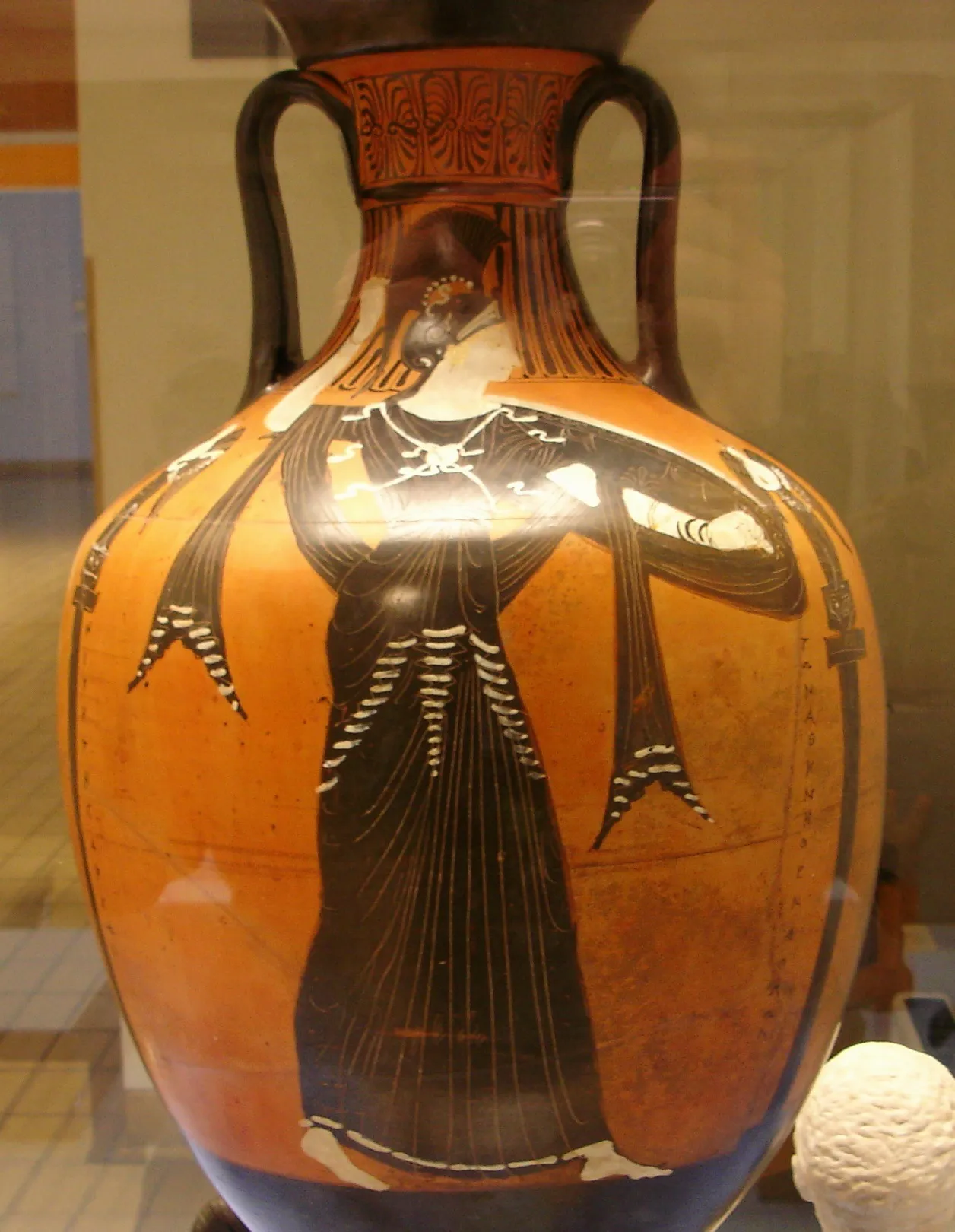
Athena on the London jar from the archonship of Niketes, seen through display glass. Inscriptions run down beside both columns, faint in this photograph.
Museum no. 1873,0820.370 · Findspot: Capua, Italy
"Panathenaic amphora BM B610" by Bibi Saint-Pol (2006), Wikimedia Commons — https://commons.wikimedia.org/wiki/File:Panathenaic_amphora_BM_B610.jpg — Public domain (the photographer's own public-domain release on Wikimedia Commons (PD-self: worldwide release, with a fallback grant to use the work for any purpose without conditions))

Beazley names three prize jars from Pythodelos's year: the London boxing jar, a second London jar, and one in Munich, whose Commons description lists a horse race on the back. So the oil of one archon's year went to at least two different contests.
How much oil did a prize jar hold?
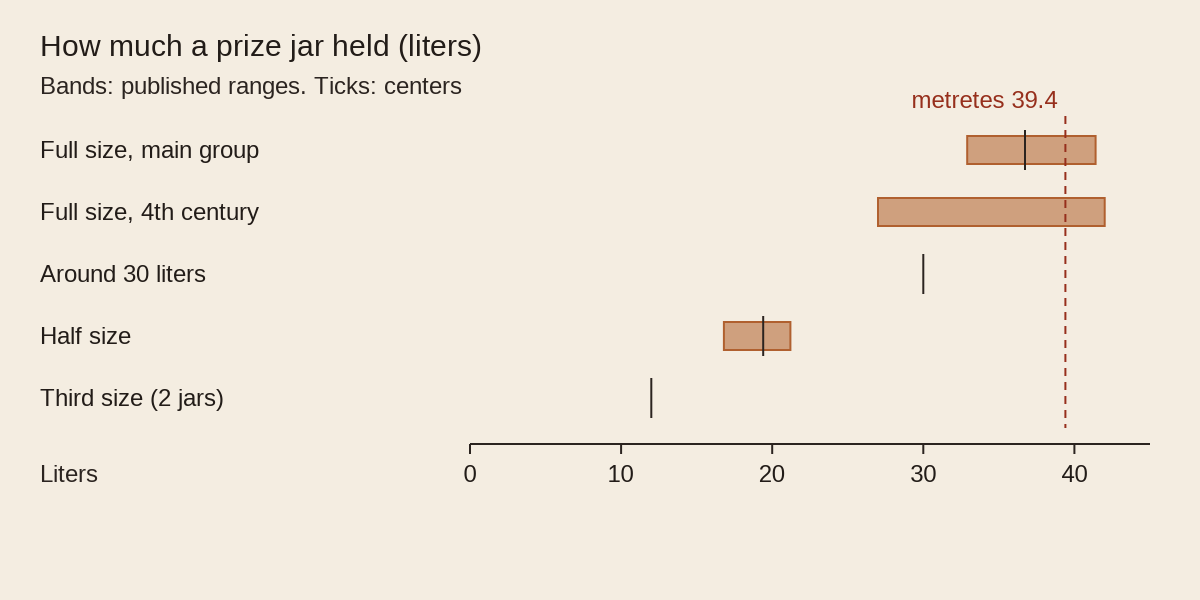
Martin Bentz's 1998 catalogue gives measured volumes for 71 prize jars, up from "a dozen or so" before, according to Hamilton's review. Most of the jars he measured cluster around a midpoint of 36.73 liters, within a range of 32.9 to 41.4 liters. Hamilton also warns that a jar's height is "a poor predictor of volume."
The unit behind the prize is in dispute. A metretes, in Hamilton's words "a standard amphora's worth of oil," is usually taken as 39.4 liters, and graffiti on some prize jars record less than a metretes, he notes. Catherine Pratt's 2018 report for Harvard's Center for Hellenic Studies says the typical capacity "is also 1 metretes." As of 2026, whether a full jar held one metretes stays Disputed on the sources read here.
Scroll sideways to read every label, or open the full drawing.
Volumes Bentz published for prize jars, as Hamilton reports them. Bands are ranges; ticks are centers; the dashed line is the metretes as usually understood. Capacity CSV (Data: M. Bentz, Panathenäische Preisamphoren (1998), as reported in R. Hamilton, Bryn Mawr Classical Review 1999.11.15) (sources and license, JSON).
"Measured volumes of Panathenaic prize amphorae" by Sherd and Script, https://sherdandscript.com/ceramics/panathenaic-amphora/, licensed under CC BY 4.0 (https://creativecommons.org/licenses/by/4.0/)Data: Volumes: M. Bentz, Panathenäische Preisamphoren (1998), as reported in R. Hamilton, Bryn Mawr Classical Review 1999.11.15
There were smaller jars too. Bentz sorts some into a half-volume class centered on 19.4 liters and a third-volume class at 12 liters. But Hamilton finds that the fourth-century volumes in Bentz's appendix form one spaced-out group from 27 to 42 liters, apart from four jars near 20. The chart shows the published ranges only, not individual jars, so it cannot show how many jars sit at each volume.
Was every jar of this shape a prize?
No, and the inscription is what separates them. Hamilton notes that "virtually all scholars" use the prize formula, with the archon's name added later, to tell prize jars from "pseudo-Panathenaics," often of the same size and design. Bentz promised a separate study of more than 300 of those.
Cleveland's jar below has the shape and no figures at all. Its record dates it 525–500 BCE · museum attribution and says the shape "mimics those of larger, figured prize vases." It adds that similar jars with Athena on the front were filled with Athenian olive oil and given as prizes.
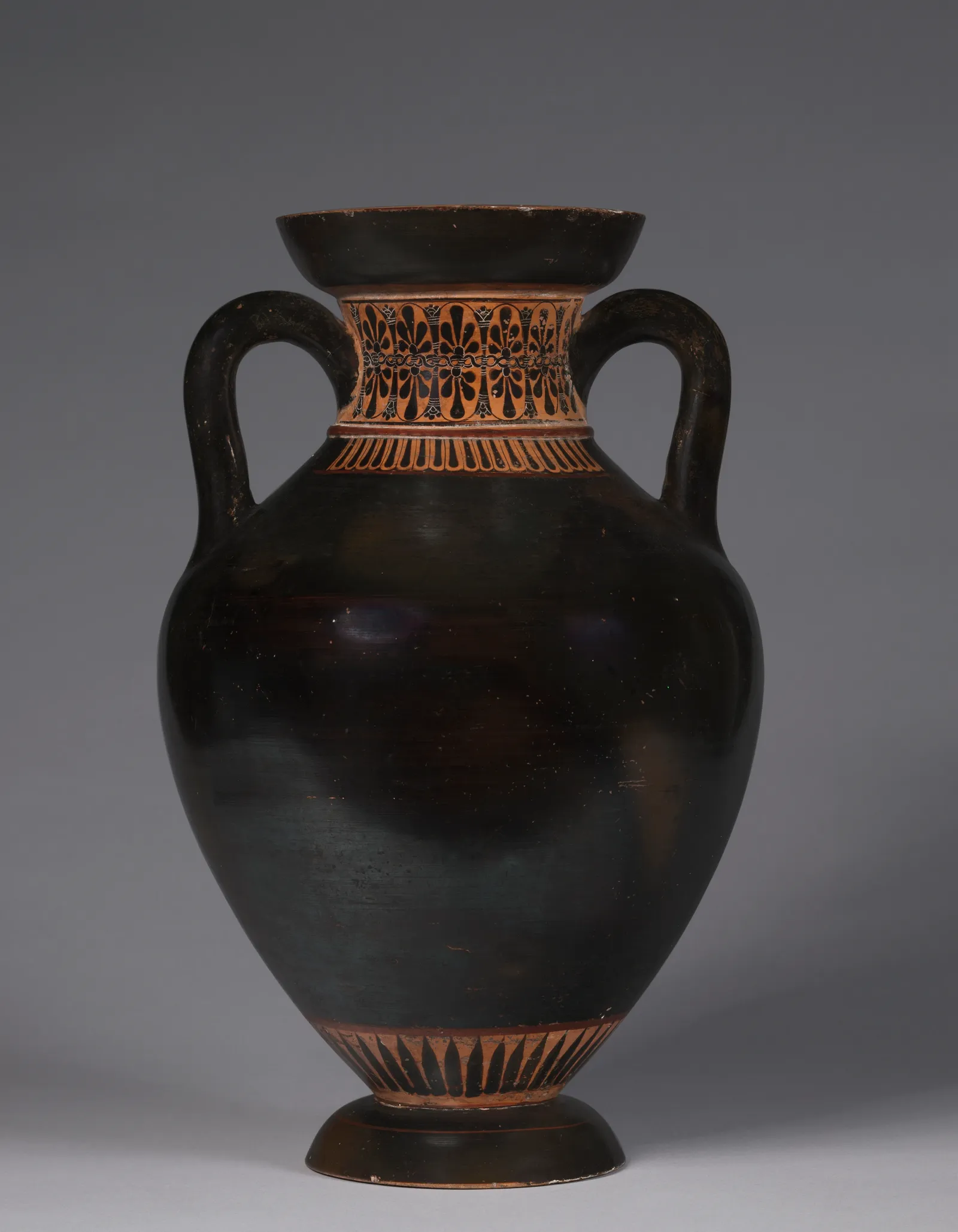
A Cleveland jar of Panathenaic shape, decorated only with patterns. Without Athena or the prize formula, nothing on it ties it to the games.
Museum no. 1923.644 · Findspot: unrecorded
"Black-Figure Neck-Amphora of Panathenaic Shape (Storage Vessel)" by Cleveland Museum of Art, Gift of J. H. Wade (1923.644) — https://clevelandart.org/art/1923.644 — CC0 1.0 (https://creativecommons.org/publicdomain/zero/1.0/)
Cleveland also holds two fragments of a neck-amphora "of Panathenaic Shape," 1915.533.a and .f, dated c. 520 BCE · museum attribution. They show Apollo, with Zeus on one of them, not Athena, and their records list no inscription. Even archon names were not universal at first: Hamilton counts 8 of 37 complete fourth-century prize jars without one, all from early in the series.
Where were the prize jars found?
The museum data copied on Commons gives the London jar from Pythodelos's year a findspot of Cerveteri, an Etruscan town, and records its purchase from Alessandro Castellani, but it names no tomb and no layer. The Niketes jar below, London 1873,0820.370, came from Capua by the same route.
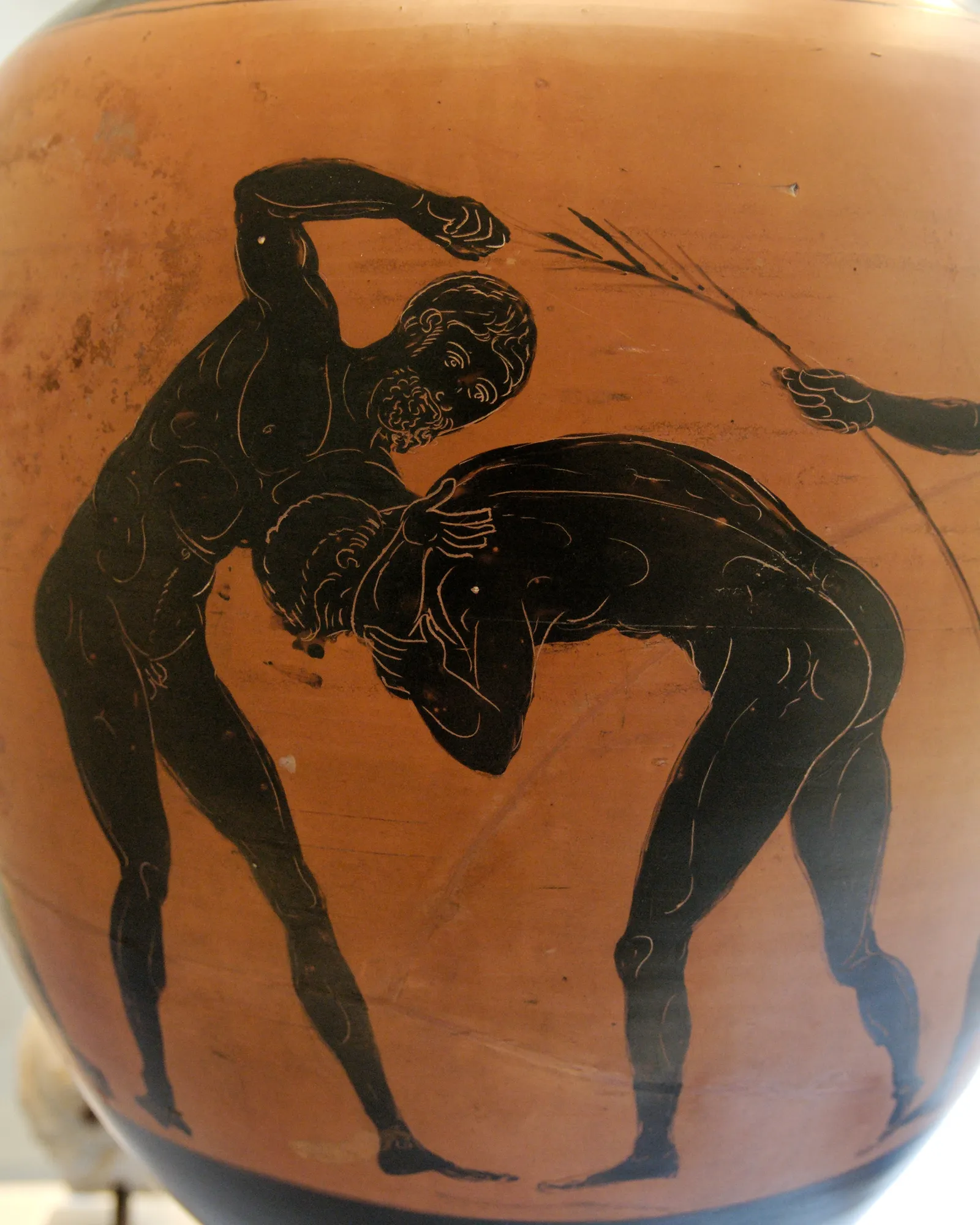
Pankration, a mix of wrestling and boxing, on a London prize jar from the year of the archon Niketes, 332/1 BCE · computed, archon list (Loeb Diodorus).
Museum no. 1873,0820.370 · Findspot: Capua, Italy
"Pankration panathenaic amphora BM VaseB610" by Marie-Lan Nguyen / Wikimedia Commons — https://commons.wikimedia.org/wiki/File:Pankration_panathenaic_amphora_BM_VaseB610.jpg — CC BY 2.5 (https://creativecommons.org/licenses/by/2.5/)

Bentz mapped where prize jars turn up, as Hamilton summarizes. Half were found in Athens, a tenth elsewhere in Attica and a quarter in the rest of Greece, while finds in South Italy decrease over time and those in Cyrenaica increase. Forty percent were placed in sanctuaries and 36 percent in public places: "They were hardly ever simply trophies."
Pratt's report adds that, from the start of the series to the beginning of the Classical era, Panathenaic jars cluster in a few "hot-spots," such as Etruria and Samos, rather than spreading evenly like the ordinary transport jars of the time. On this site's reading, a findspot outside Athens cannot by itself show where a victor lived.
For the London jar, the record supports a town and a sale, not a tomb, a buyer or a winner. The Met and Cleveland jars on this page have no findspot at all in the records read here, so they add nothing to Bentz's distribution.
What about these jars is still unexplained?
Beazley found a change on the front of the jars: "Sometime between 359 and 348 B.C., a change was made in the Panathenaic Athena, it is not known why, and a new series begins." The goddess turned from facing left to facing right. The shield now showed its inside, so its emblem disappeared.
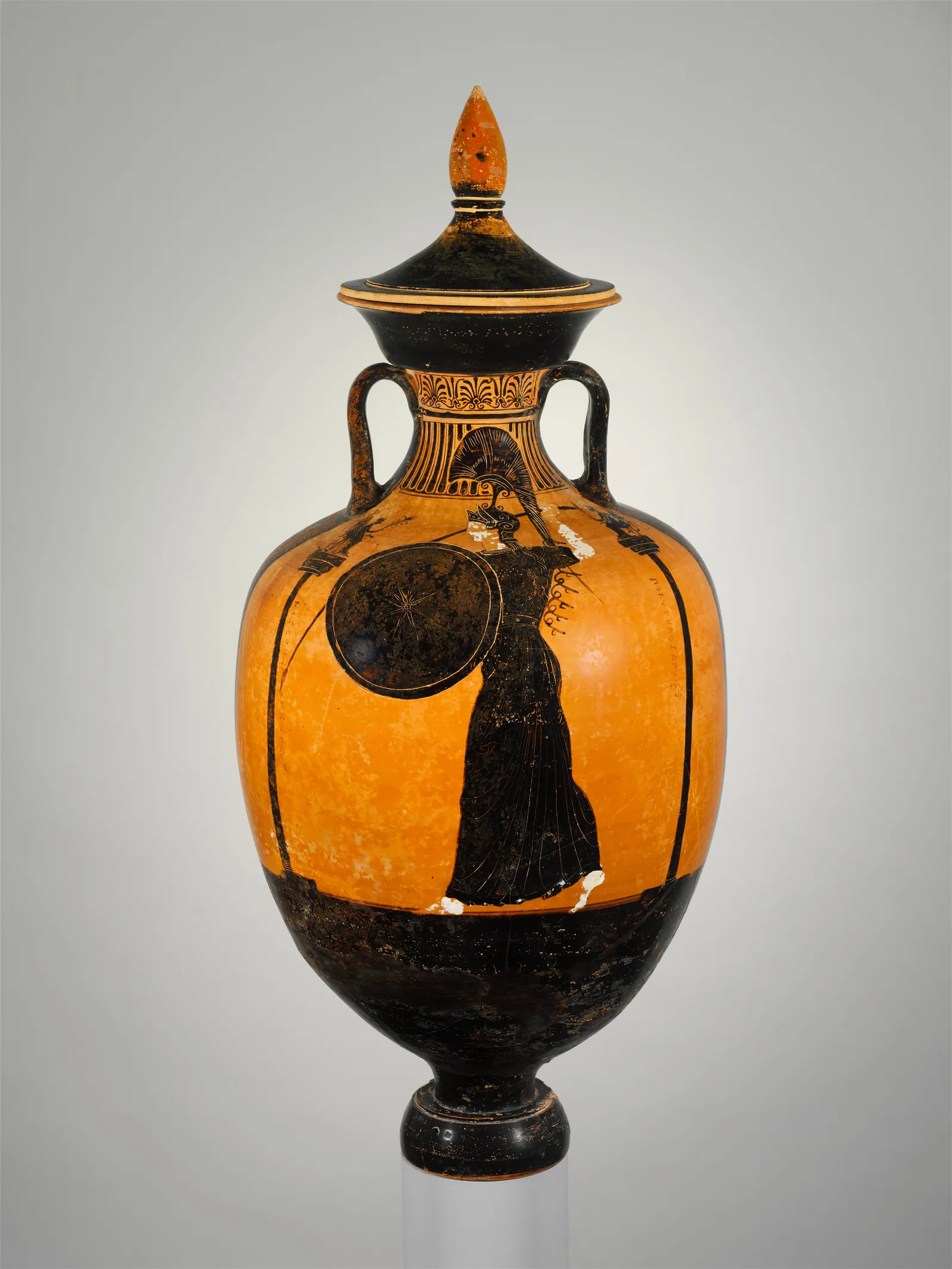
A lidded prize jar the Met dates c. 366/365 BCE · museum attribution. Athena still strides left here; on the later London and Louvre jars she faces right.
Museum no. 56.171.6a, b · Findspot: unrecorded
"Terracotta Panathenaic prize amphora MET DP233575" by The Metropolitan Museum of Art, New York (Open Access) — https://commons.wikimedia.org/wiki/File:Terracotta_Panathenaic_prize_amphora_MET_DP233575.jpg — CC0 1.0 (https://creativecommons.org/publicdomain/zero/1.0/)

The change has only a window in Beazley's account, 359–348 BCE · art-historical estimate, and he refers readers to a 1943 article in the American Journal of Archaeology for the details. Bentz, in Hamilton's summary, rejects a political motive for the small figures that replaced the cocks on the columns. No source read for this page, as of 2026, explains why Athena turned.
Proof radius
What this box is for: the proof radius.
Proves: The painted archon's name ties the London jar to Pythodelos's year of office,
336/5 BCE · computed, archon list (Loeb Diodorus), which on the standard reading is the year its prize oil was collected.Doesn't prove: The year the jar was painted, or the year of the games at which its boxer won it.
Read next: Black-figure vs red-figure: how the technique the prize jars kept works on the clay. Antikythera mechanism: a Games dial that counts a four-year festival cycle.
Sources
Primary sources first.
- 1British Museum, Panathenaic prize amphora, registration number 1873,0820.371 (catalogue B 607): museum data as copied on the Wikimedia Commons category page "Panathenaic amphora, British Museum, Reg.Nr. 1873,0820.371" (revision of 1 November 2025) and in ArchaiOptix's Commons file descriptions (2018); the museum's own record, https://www.britishmuseum.org/collection/object/G_1873-0820-371, was not read https://commons.wikimedia.org/wiki/Category:Panathenaic_amphora,_British_Museum,_Reg.Nr._1873,0820.371 Read: Commons category page and five file descriptions
- 2British Museum 1873,0820.370 (catalogue B 610), Panathenaic amphora of the archonship of Niketes, from Capua: Wikimedia Commons file descriptions of "Pankration panathenaic amphora BM VaseB610.jpg" (photograph by Marie-Lan Nguyen, 2007) and "Panathenaic amphora BM B610.jpg" (photograph by Bibi Saint-Pol, 2006), and the museum data copied on the Commons category page "British Museum Vases B610" (revision of 9 December 2025); the museum's page was not read https://commons.wikimedia.org/wiki/File:Pankration_panathenaic_amphora_BM_VaseB610.jpg Read: Two Commons file descriptions and the category page
- 3Musée du Louvre, Département des Antiquités grecques, étrusques et romaines, amphore panathénaïque MN 705 (N 3164; M 3), séries de Nicomachos, collections record https://collections.louvre.fr/ark:/53355/cl010279836 (source: Musée du Louvre; Etalab Open Licence; last updated 8 April 2026) https://collections.louvre.fr/en/ark:/53355/cl010279836 Read: Full text record; images not accessed
- 4Musée du Louvre MN 705, black-figure Panathenaic amphora with the inscription "Archippos, archon", from Benghazi: Wikimedia Commons file description of "Panathenaic amphora Louvre MN705.jpg" (Jastrow, 2006); the Louvre's own record is listed separately https://commons.wikimedia.org/wiki/File:Panathenaic_amphora_Louvre_MN705.jpg Read: Commons file description
- 5Staatliche Antikensammlungen, Munich, N.I. 7767, Panathenaic prize amphora of the archon Pythodelos: Wikimedia Commons file descriptions by ArchaiOptix (2018) https://commons.wikimedia.org/wiki/File:Hobble_Group_-_ABV_417_2_-_Athena_Promachos_-_horse_race_-_M%C3%BCnchen_AS_7767_-_04.jpg Read: Commons file descriptions
- 6The Metropolitan Museum of Art 56.171.3, Panathenaic prize amphora attributed to the Eucharides Painter, ca. 490 B.C.: Met Open Access data mirrored on Wikimedia Commons ("Terracotta Panathenaic prize amphora (jar) MET DP104351.jpg"); metmuseum.org was not read https://commons.wikimedia.org/wiki/File:Terracotta_Panathenaic_prize_amphora_(jar)_MET_DP104351.jpg Read: Commons file description with the mirrored Met data
- 7The Metropolitan Museum of Art 56.171.6a, b, Panathenaic prize amphora attributed to a painter of the Kittos Group, ca. 366/365 B.C.: Met Open Access data mirrored on Wikimedia Commons ("Terracotta Panathenaic prize amphora MET DP233575.jpg"); metmuseum.org was not read https://commons.wikimedia.org/wiki/File:Terracotta_Panathenaic_prize_amphora_MET_DP233575.jpg Read: Commons file description with the mirrored Met data
- 8Cleveland Museum of Art, Black-Figure Neck-Amphora of Panathenaic Shape (Storage Vessel), 1923.644, collection record (Open Access record 105540, CC0) https://clevelandart.org/art/1923.644 Read: Open Access record
- 9Cleveland Museum of Art, Fragment from Black-Figure Neck-Amphora of Panathenaic Shape (Storage Vessel): Apollo and Zeus, 1915.533.a, collection record (Open Access record 94974, CC0) https://clevelandart.org/art/1915.533.a Read: Open Access record
- 10Cleveland Museum of Art, Fragment from Black-Figure Neck-Amphora of Panathenaic Shape (Storage Vessel): Apollo with Lyre, 1915.533.f, collection record (Open Access record 94978, CC0) https://clevelandart.org/art/1915.533.f Read: Open Access record
- 11Diodorus Siculus, Library of History, Books 15-19, in the Loeb Classical Library, vols. VII (1952), VIII (1963), IX (1947) and X (1954), with the Loeb editors' notes, as transcribed on LacusCurtius https://penelope.uchicago.edu/Thayer/E/Roman/Texts/Diodorus_Siculus/16D*.html Read: Full text of Books 15.20-76, 16.66-95, 17.40-83, 18.1-75 and 19.73-101 with notes
- 12The School of Aristotle, Athenian Constitution, translated by Frederic G. Kenyon (1921), chapter 60 and note 122, Wikisource https://en.wikisource.org/wiki/Athenian_Constitution Read: Full text of the Wikisource transcription (chapter 60 and notes 95, 105, 122, 171, 172 checked)
- 13Arrian, The Anabasis of Alexander, translated by E. J. Chinnock (1884), Book I, chapter 1, with the translator's notes, Wikisource https://en.wikisource.org/wiki/The_Anabasis_of_Alexander/Book_I/Chapter_I Read: Full text of the chapter and its notes
- 14J. D. Beazley, The Development of Attic Black-Figure, revised edition (Berkeley: University of California Press, 1986; first printed with a 1951 preface), chapter 8, "Panathenaic Amphorae," and notes, UC Press E-Books Collection https://publishing.cdlib.org/ucpressebooks/public/book/development-of-the-attic-black-figure-revised-edition.html Read: Full text of chapter 8 (pp. 81-92) and its notes (public title)
- 15Richard Hamilton, review of Martin Bentz, Panathenäische Preisamphoren: Eine athenische Vasengattung und ihre Funktion vom 6.-4. Jahrhundert v. Chr. (Antike Kunst Beiheft 18; Basel, 1998), Bryn Mawr Classical Review 1999.11.15 https://bmcr.brynmawr.edu/1999/1999.11.15/ Read: Full text of the review (Bentz 1998 itself not read)
- 16Tim Rood, review of A. Junghanß, B. Kaiser and D. Pausch (eds.), Zeitmontagen: Formen und Funktionen gezielter Anachronismen (Stuttgart, 2019), Histos 13 (2019) lxxi-lxxii https://histos.org/index.php/histos/article/download/438/432/441 Read: Full text of the review (PDF); Brendle's chapter itself not read
- 17Catherine Pratt, "Gift of Athena: Olive Oil and the Making of Athens," Center for Hellenic Studies Research Bulletin (2018) https://research-bulletin.chs.harvard.edu/2018/04/27/report-olive-oil/ Read: Full text of the report
- 18J. Michael Padgett, review of Beth Cohen, The Colors of Clay: Special Techniques in Athenian Vases (Los Angeles: J. Paul Getty Museum, 2006), Bryn Mawr Classical Review 2007.03.09 https://bmcr.brynmawr.edu/2007/2007.03.09/ Read: Full text of the review (the catalog itself not read)
- 19Wikipedia, "Panathenaic amphora" (read 13 October 2026) https://en.wikipedia.org/wiki/Panathenaic_amphora Read: HTML page (auxiliary only)
- 20Wikipedia, "Eucleides" (read 13 October 2026), citing D'Angour 1999 and Guarducci 1967 https://en.wikipedia.org/wiki/Eucleides Read: HTML page (auxiliary only)
- 21Wikipedia, "Attic calendar" (read 13 October 2026) https://en.wikipedia.org/wiki/Attic_calendar Read: HTML page (auxiliary only)
- 22Wikipedia, "Red-figure pottery" (read 13 October 2026; used only alongside other sources) https://en.wikipedia.org/wiki/Red-figure_pottery Read: HTML page (auxiliary only)
- 23Unicode Consortium, Unicode Character Database 18.0.0 (UnicodeData.txt) and code chart "Greek and Coptic" (U0370.pdf, Unicode 18.0) https://www.unicode.org/Public/18.0.0/ucd/UnicodeData.txt Read: UnicodeData.txt in full; code chart viewed for the glyph check only
- 24E. Norman Gardiner, Greek Athletic Sports and Festivals (London: Macmillan, 1910), pp. 75-76 and 231-236. https://archive.org/details/greekathleticspo00garduoft Read: pp. 75-76 and 231-241 (scan, Internet Archive)

Cite this page
Sherd and Script. “Panathenaic Amphora: The Archon's Name Dates the Oil, Not the Victory.” Sherd and Script. Published 13 October 2026; last substantive revision 23 October 2026. https://sherdandscript.com/ceramics/panathenaic-amphora/ (accessed ).
Corrections
- 2026-10-23 — Sources, entry 4 (the Wikimedia Commons description of Louvre MN 705): a note that contradicted entry 3 removed (was: "… (Jastrow, 2006); collections.louvre.fr was not read" → now: "… (Jastrow, 2006); the Louvre's own record is listed separately") — the Louvre's collections record for MN 705, entry 3, was read in text on 13 October 2026, without its images, and the page's museum date for the jar comes from it
- 2026-10-14 — Added the section "How many jars of oil went to one victor?" (was: no such section → now: two paragraphs beginning "In E. Norman Gardiner's 1910 table of an Athenian prize list, which he places in the
4th century BCE · art-historical estimate, the surviving first prizes in oil run from 4 to 140 amphorae, depending on the event and the age class.") — E. N. Gardiner 1910; R. Hamilton 1999