Side by side
Ming Vase: One Reign Mark, Two Museum Dates
Sherd and Script · Published 13 October 2026
Six characters on a small Cleveland vase name a Ming reign, and the museum's date agrees. The same six characters on a bowl meet a museum date at least 96 years later.
Find card
- Object / Site
- Square double-gourd vase: porcelain with underglaze blue decoration and overglaze enamel; China, Jiangxi Province, Jingdezhen kilns, Ming dynasty (museum attribution)
- Findspot
- Unrecorded: the record gives no findspot
- Context
- Unrecorded: no excavation context. Collection history begins with Mr. and Mrs. Maurice Solvay, Paris,
by 1937 · documentary; in the museum since1964 · documentary - Dated by
- Documentary: the six-character reign mark, Da Ming Jiajing nian zhi, names the Jiajing reign. Museum attribution: the record dates the making to the same reign and states no other basis
- Range
- Mark: Jiajing reign,
1522–66 · documentary(reign years as given in the record). Museum:1522–66 · museum attribution - Dated event
- Making of the vase (the mark reads 'made in' the reign; the museum date is the record's creation date)
- Now at
- Cleveland Museum of Art, 1964.172
- Primary record
- Cleveland Museum of Art collection record 1964.172, https://clevelandart.org/art/1964.172 (CC0)
Find card as CSV ming-vase-find-card.csv (sources and license, JSON)Data: Cleveland Museum of Art Open Access data (CC0), record 1964.172, https://clevelandart.org/art/1964.172
TL;DR. The mark on the Ming vase 1964.172 in the Cleveland Museum of Art names the Jiajing reign, and the museum dates it to that reign, 1522–66 · museum attribution. The same six characters on the bowl 1940.962 are called "apocryphal" in its record, which dates it to the Kangxi reign of the Qing, 1662–1722 · museum attribution, as of 2026. In one 2026 query, by this page's count, 5 of 34 Cleveland ceramics whose records transcribe a full Ming reign mark are dated outside their mark's reign.
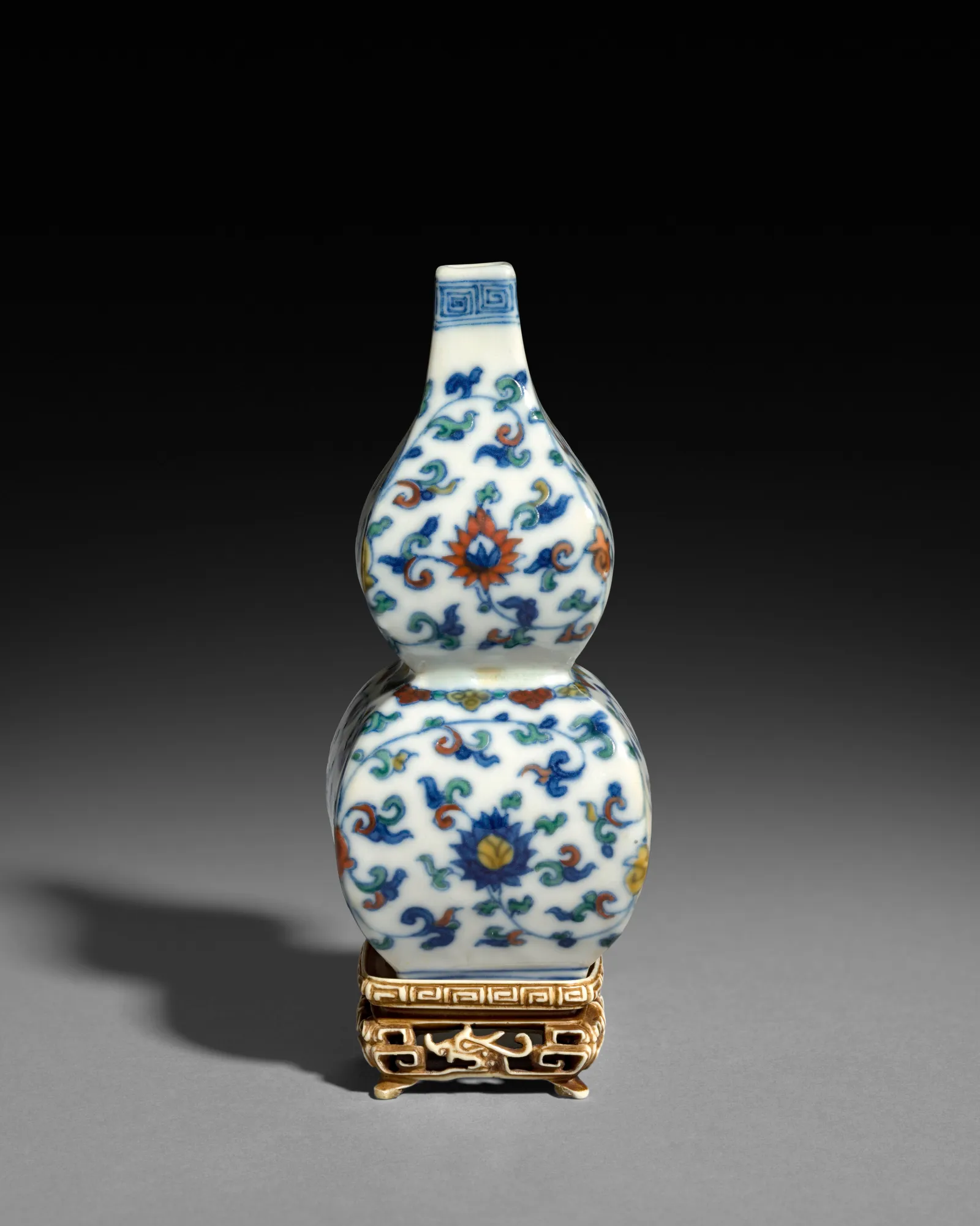
The double-gourd vase 1964.172, shown on a stand. The museum dates it to the Jiajing reign, the reign named by the mark on its base.
Museum no. 1964.172 · Findspot: unrecorded
"Square Double-Gourd Vase with Floral Scrolls" by The Cleveland Museum of Art, Severance and Greta Millikin Collection — https://clevelandart.org/art/1964.172 — CC0 1.0 (https://creativecommons.org/publicdomain/zero/1.0/)
Six characters on the base of a small Cleveland vase name the Jiajing reign of the Ming dynasty. The museum agrees: its record for this Ming vase, 1964.172, dates the making to the reign that the mark names. The same six characters, transcribed the same way, appear in the record of a bowl, 1940.962, that the museum dates to the Kangxi reign of the Qing dynasty.
This page reads the mark as a documentary date, a claim written on the pot about when it was made, and the museum's date as a separate judgment. Both come from the museum's own records, so what follows is a reading of how one museum labels its pieces, not a method for judging any other piece.
What does the mark on this Ming vase say?
Cleveland's records transcribe the mark as six characters and give the reading Da Ming Jiajing nian zhi, rendered "Made in the Ming dynasty, Jiajing period." Another Cleveland record renders Da Ming as "Great Ming," the name of the dynasty. Jiajing, the third and fourth characters, names the reign.
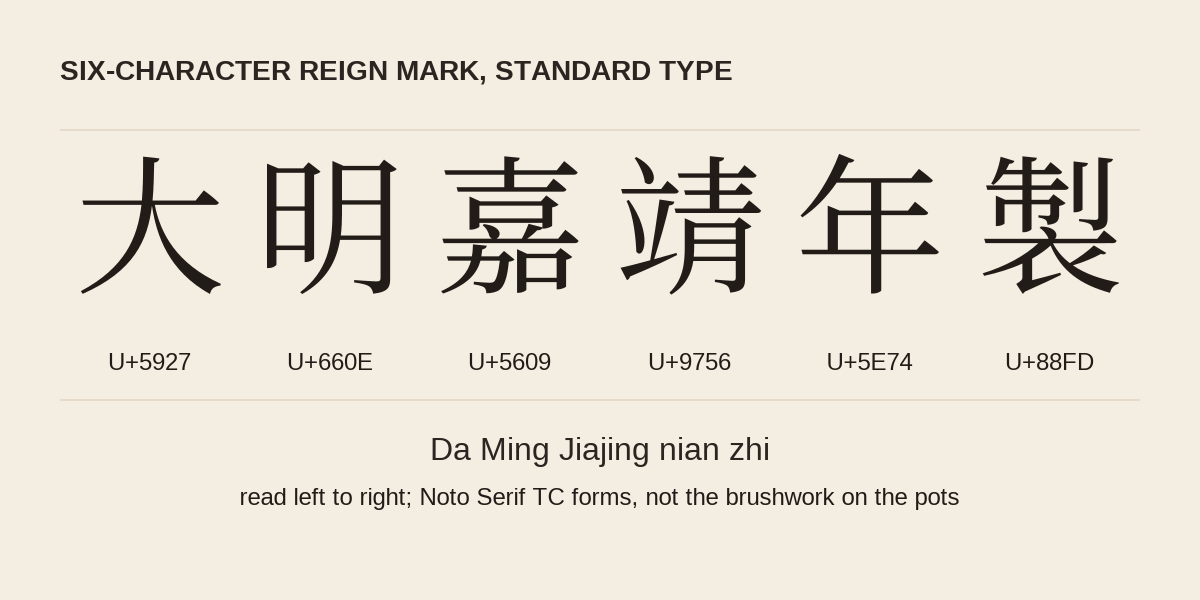
Scroll sideways to read every label, or open the full drawing.
The mark's six characters in standard Noto Serif TC type, not the brushwork on either pot: U+5927, U+660E, U+5609, U+9756, U+5E74, U+88FD.
"Reign mark Da Ming Jiajing nian zhi in standard type (Noto Serif TC)" by Sherd and Script, https://sherdandscript.com/ceramics/ming-vase/, licensed under CC BY 4.0 (https://creativecommons.org/licenses/by/4.0/)
Data sources for this figure
Data: Noto Serif TC 2.003, copyright 2017-2024 Adobe (SIL Open Font License 1.1), https://github.com/notofonts/noto-cjk; Unicode Character Database 18.0.0 (Unicode License v3), https://www.unicode.org/Public/18.0.0/ucd/; Mark text from Cleveland Museum of Art Open Access data (CC0), records 1964.172 and 1940.962
| Position | Code point | Unicode name (Unicode 18.0) | Syllable in the museum's reading |
|---|---|---|---|
| 1 | U+5927 | CJK UNIFIED IDEOGRAPH-5927 | Da |
| 2 | U+660E | CJK UNIFIED IDEOGRAPH-660E | Ming |
| 3 | U+5609 | CJK UNIFIED IDEOGRAPH-5609 | Jia |
| 4 | U+9756 | CJK UNIFIED IDEOGRAPH-9756 | jing |
| 5 | U+5E74 | CJK UNIFIED IDEOGRAPH-5E74 | nian |
| 6 | U+88FD | CJK UNIFIED IDEOGRAPH-88FD | zhi |
A reign mark names a reign, not a year. The years come from the museum, whose records give the Jiajing reign as 1522–66, so the mark's claim, written as a date, is 1522–66 · documentary. With its basis stated, that is not a bare date, a date given without its basis, but it is still a claim written on the vase rather than a test of it.
Some of Cleveland's records describe the format. A Zhengde bowl, 1989.290, has a "six-character mark in underglaze blue within a double circle on the base," that is, painted in blue before the glaze went on. On a Xuande dice bowl, 1989.287, the mark is "in the interior." A Jiajing jar, 1989.291, bears "a six-character nianhao in the form of a vertical mark," and a Zhengde bowl, 1957.359, carries a four-character version without Da Ming.
Dates counted from a ruler turn up elsewhere on this site: the Egyptian civil calendar page turns an Egyptian king's regnal year into a modern date by calculation. Here the step from a reign name to years is the museum's.
Which dates does the museum give the vase and the bowl?
The vase is a square double gourd, a shape of two stacked bulbs, 8.8 cm overall, in porcelain with underglaze blue decoration and overglaze enamel, colors painted on top of the glaze. Its record places it at the Jingdezhen kilns in Jiangxi Province and dates it 1522–66 · museum attribution, the same years it gives for the reign in the mark.
The bowl carries the same mark "in a double circle on the base," in the words of its record. That record dates it 1662–1722 · museum attribution, in the reign of the Qing emperor Kangxi, and names no kiln or province.
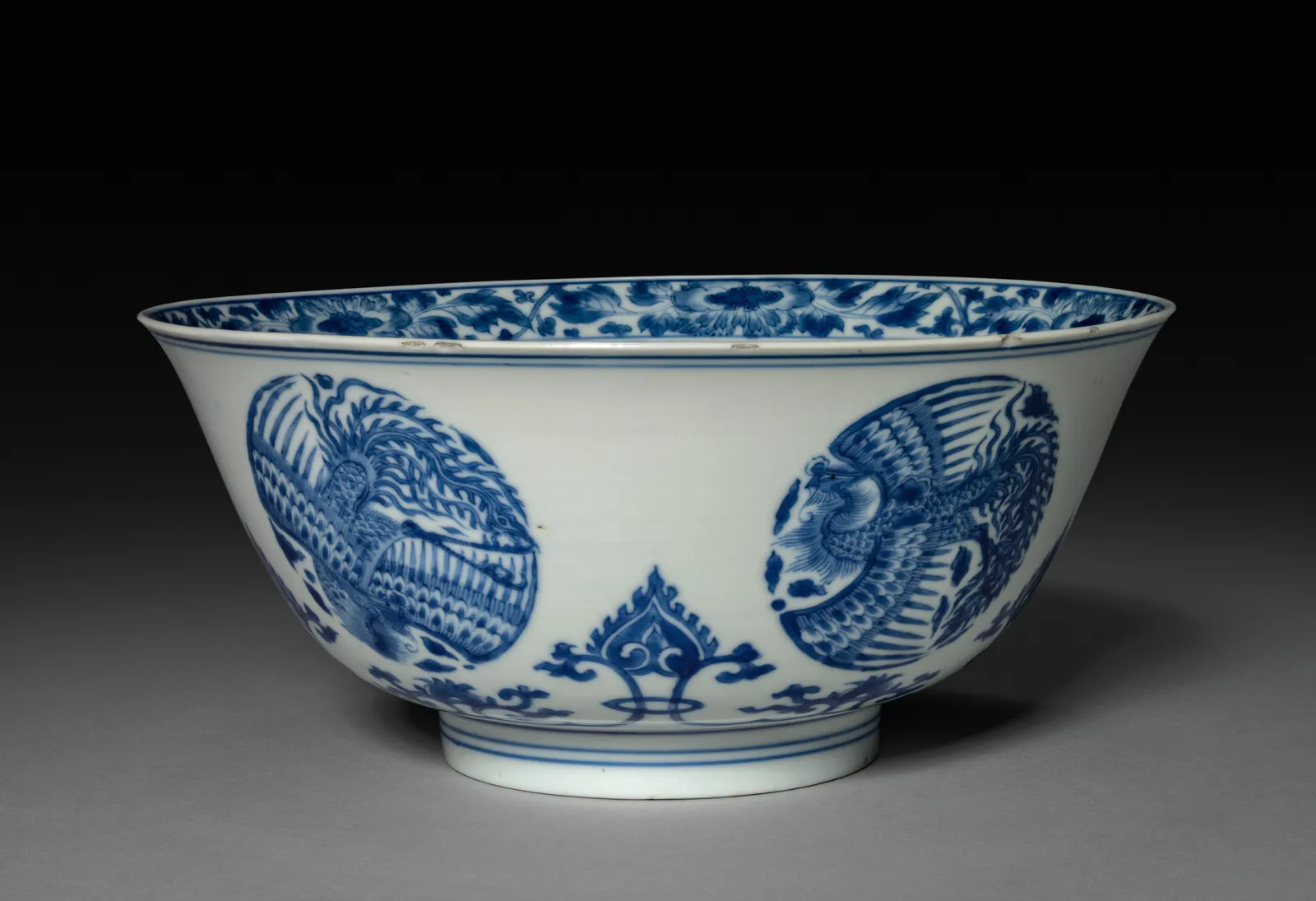
The bowl 1940.962. Its mark names the Jiajing reign of the Ming, but its record dates the bowl to the Kangxi reign of the Qing.
Museum no. 1940.962 · Findspot: unrecorded
"Bowl" by The Cleveland Museum of Art, Bequest of James Parmelee — https://clevelandart.org/art/1940.962 — CC0 1.0 (https://creativecommons.org/publicdomain/zero/1.0/)
| Field | Vase 1964.172 | Bowl 1940.962 |
|---|---|---|
| Object | Square double-gourd vase; porcelain, underglaze blue and overglaze enamel | Bowl; porcelain |
| Place in the record | China, Jiangxi Province, Jingdezhen kilns | China; no kiln named |
| Findspot | Unrecorded | Unrecorded |
| Context | No excavation context; collection history begins in Paris, by 1937 · documentary | No excavation context; a bequest, in the museum since 1940 · documentary |
| Mark as transcribed | Da Ming Jiajing nian zhi | Da Ming Jiajing nian zhi, called "apocryphal" |
| Dated by | Mark (documentary) and museum attribution, in agreement | Mark (documentary) and museum attribution, in conflict |
| Range | Mark 1522–66 · documentary; museum 1522–66 · museum attribution | Mark 1522–66 · documentary; museum 1662–1722 · museum attribution |
| Dated event | Making of the vase | Making of the bowl |
| Now at | Cleveland Museum of Art, 1964.172 | Cleveland Museum of Art, 1940.962 |
Download the comparison: ming-vase-pair.csv (Data: Cleveland Museum of Art Open Access data (CC0), records 1964.172 and 1940.962, https://clevelandart.org/art/1964.172 and https://clevelandart.org/art/1940.962) (sources and license, JSON).
By this page's calculation, the earliest year the museum allows for the bowl, 1662, comes 96 years after the last year it gives for the Jiajing reign, 1566. Even the reign years are given rather than measured. The bowl's date field begins in 1662, while the culture line of the same record gives the Kangxi reign as 1661–1722, and the record does not say which to prefer.
What does the bowl's record say about its mark?
The record calls the bowl's inscription "apocryphal," and its description is one sentence: "The apocryphal inscription in a double circle on the base reads 'made in the Ming dynasty, Jiajing period,' but the bowl was made during the reign of the Qing emperor Kangxi."
Look for the reason and the record is silent. It lists no publication and describes no comparison or test, so the Kangxi date is the museum's judgment as published, with its basis unstated.
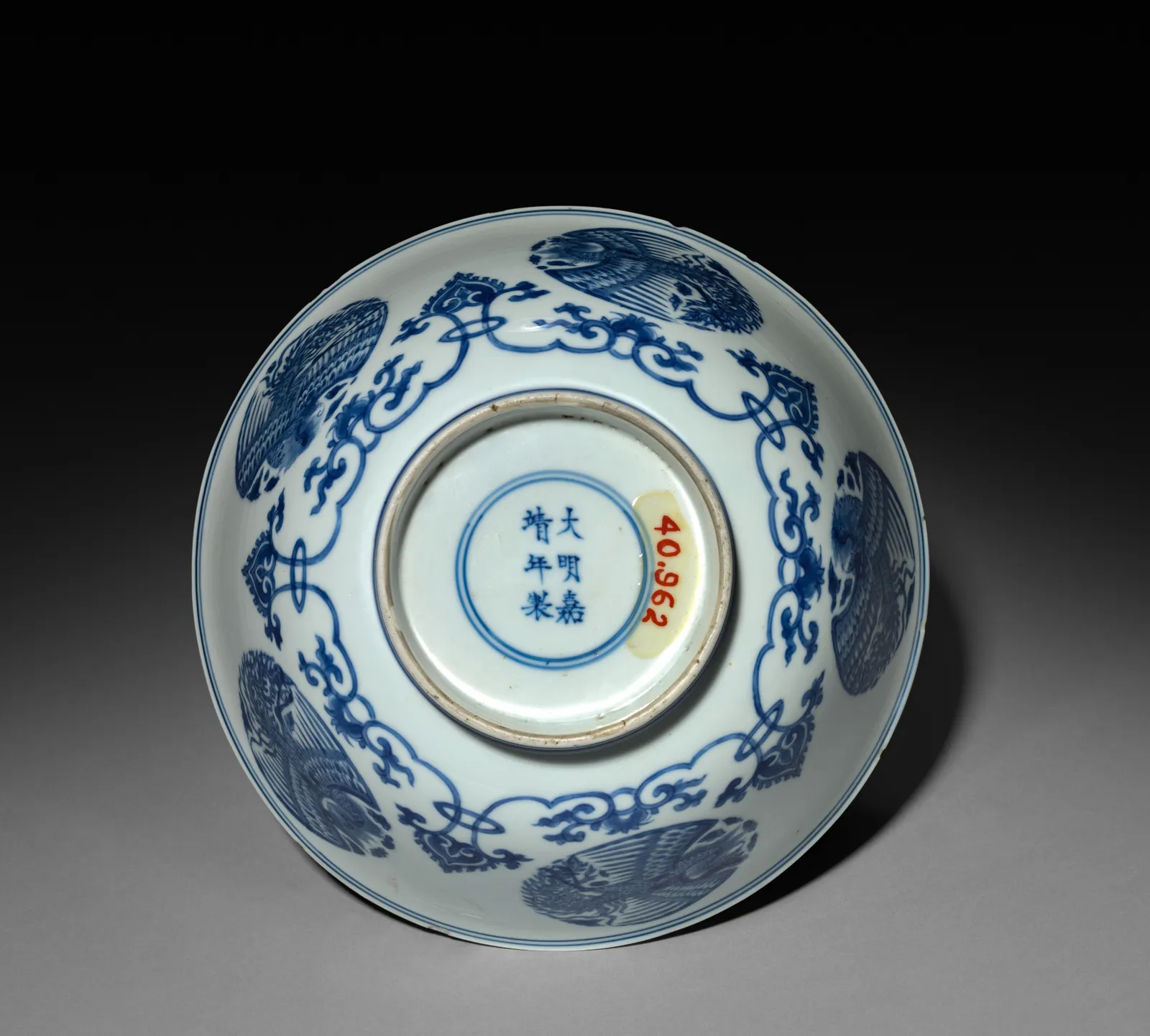
The base of the bowl 1940.962: six characters in two columns inside a double circle, and the museum number on a label; its record calls this mark apocryphal.
Museum no. 1940.962 · Findspot: unrecorded
"Bowl (base)" by The Cleveland Museum of Art, Bequest of James Parmelee — https://clevelandart.org/art/1940.962 — CC0 1.0 (https://creativecommons.org/publicdomain/zero/1.0/)
Other records let the mark decide. For a yellow-glazed bowl, 1989.289, Cleveland's record states that "the six-character inscription on the base reveals this deep bowl was made during the reign of the Hongzhi emperor," and it dates the bowl 1488–1505 · museum attribution.
The vase's own record is terser. Its culture line reads "Jiajing mark and reign (1522–66)," which sets the mark and the date side by side without saying that one rests on the other.
In this site's terms all of these are museum attributions, the label also used for the Athenian fragments in Black-figure vs red-figure. The mark's role changes from record to record: it is given as the basis, overruled, or left unmentioned.
How often do Cleveland's records date a Ming mark later?
A query of Cleveland's Open Access data on 13 October 2026, for CC0 ceramics in the museum's Chinese Art department, returned 690 records. In 34 of them, counting each set of parts once, the inscription field transcribes a complete Ming reign mark of six or four characters.
By this page's calculation, the museum dates 29 of the 34 within the reign the mark names. The other five are dated between 62 and 236 years after the last year the records give for the reign their mark names. Three carry the Jiajing mark and two the Chenghua mark. The word "apocryphal" appears in exactly those five records.
The two Chenghua pieces are a pair of bowls, 1964.218, whose culture line reads "Kangxi reign (1662-1722), but Chenghua mark (1465-87)," and a dish, 1989.315, dated 1723–35 · museum attribution in the Yongzheng reign. Besides the bowl above, the Jiajing pieces are a dish, 2019.176, dated to the Kangxi period, and a green-glazed bowl that the last section of this page takes up.
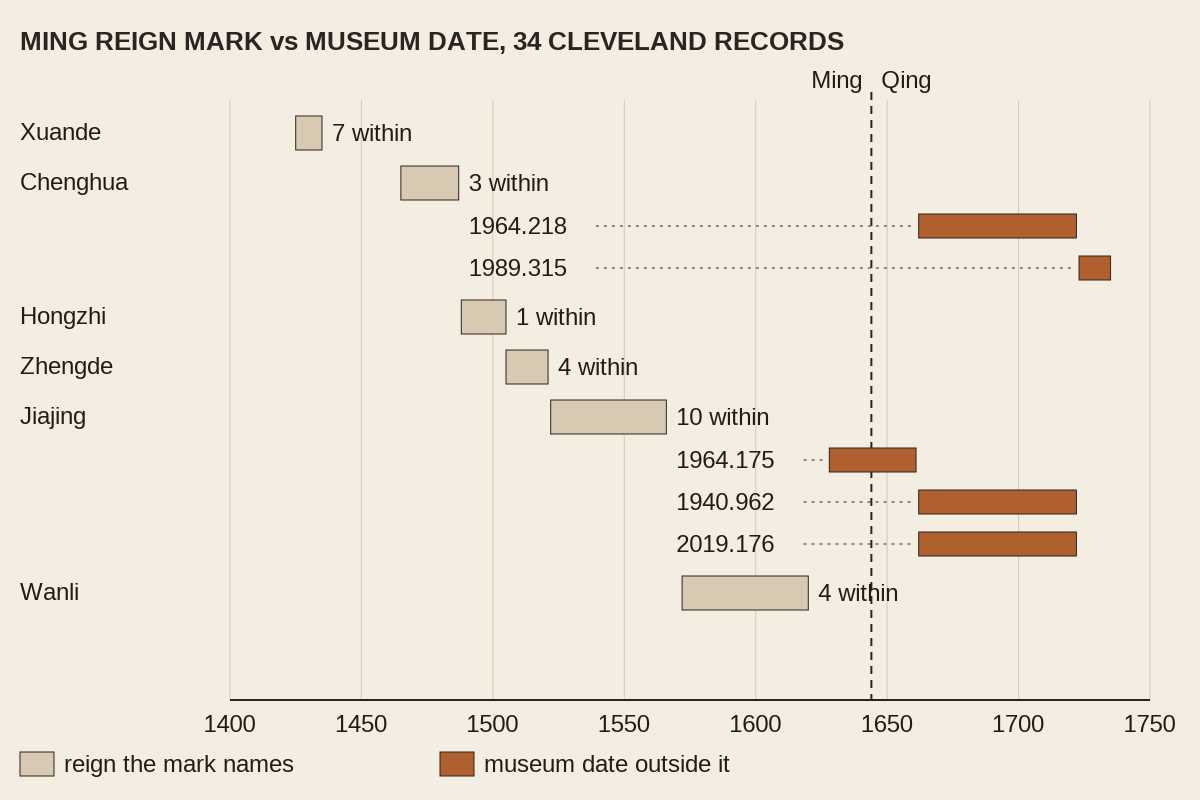
Scroll sideways to read every label, or open the full drawing.
Each pale band is a reign named by a mark, spanning the years Cleveland's records give; each clay bar is a museum date outside that reign, counted by this page's calculation.
"Ming reign mark versus museum date in 34 Cleveland Museum of Art ceramics" by Sherd and Script, https://sherdandscript.com/ceramics/ming-vase/, licensed under CC BY 4.0 (https://creativecommons.org/licenses/by/4.0/)Data: Cleveland Museum of Art Open Access data (CC0), 34 collection records listed in ming-vase-marks.csv, https://www.clevelandart.org/open-access
Download the 34 records: ming-vase-marks.csv (Data: Cleveland Museum of Art Open Access data (CC0), 34 collection records listed in the file, https://www.clevelandart.org/open-access) (sources and license, JSON).
The count describes one museum's catalog and one query, not Ming porcelain as a whole. It leaves out records whose inscription field omits the mark or transcribes only part of it.
The records also differ among themselves by a year at some reign edges. The Xuande reign starts in 1425 in some records and in 1426 in others, the Zhengde reign in 1505 or 1506, and the Wanli reign runs from 1572 or 1573 to 1619 or 1620. So the chart's bands span every version given.
Where were these pieces found?
None of the 34 records in the count gives a findspot. The histories of the pieces pictured here begin with a collector or a dealer, the vase's in Paris by 1937 · documentary, so no layer, tomb or kiln site can test either the mark or the museum's date.
The vase's paper trail reaches back to Paris, and it still stops short of the ground. Its record cites Georges Salles's catalog Arts de la Chine ancienne (Paris: Musée de l'Orangerie, 1937 · documentary), p. 233, no. 833, and lists an exhibition of that name in Paris the same year, which dates the vase's presence in a Paris collection, not its making.
Without a findspot, the evidence for when a piece was made is the piece itself and whatever the museum compares it with. Think of a reign mark as a word that names the sentence it belongs to; only a findspot could show the sentence it was actually found in.
The one excavation in these records belongs to a different piece. Cleveland's record for a large blue-and-white plate, 1953.127, dated 1403–24 · museum attribution in the Yongle period, notes that "a similar example bearing the Xuande reign mark has also been excavated from the Ming imperial kilns at Jingdezhen."
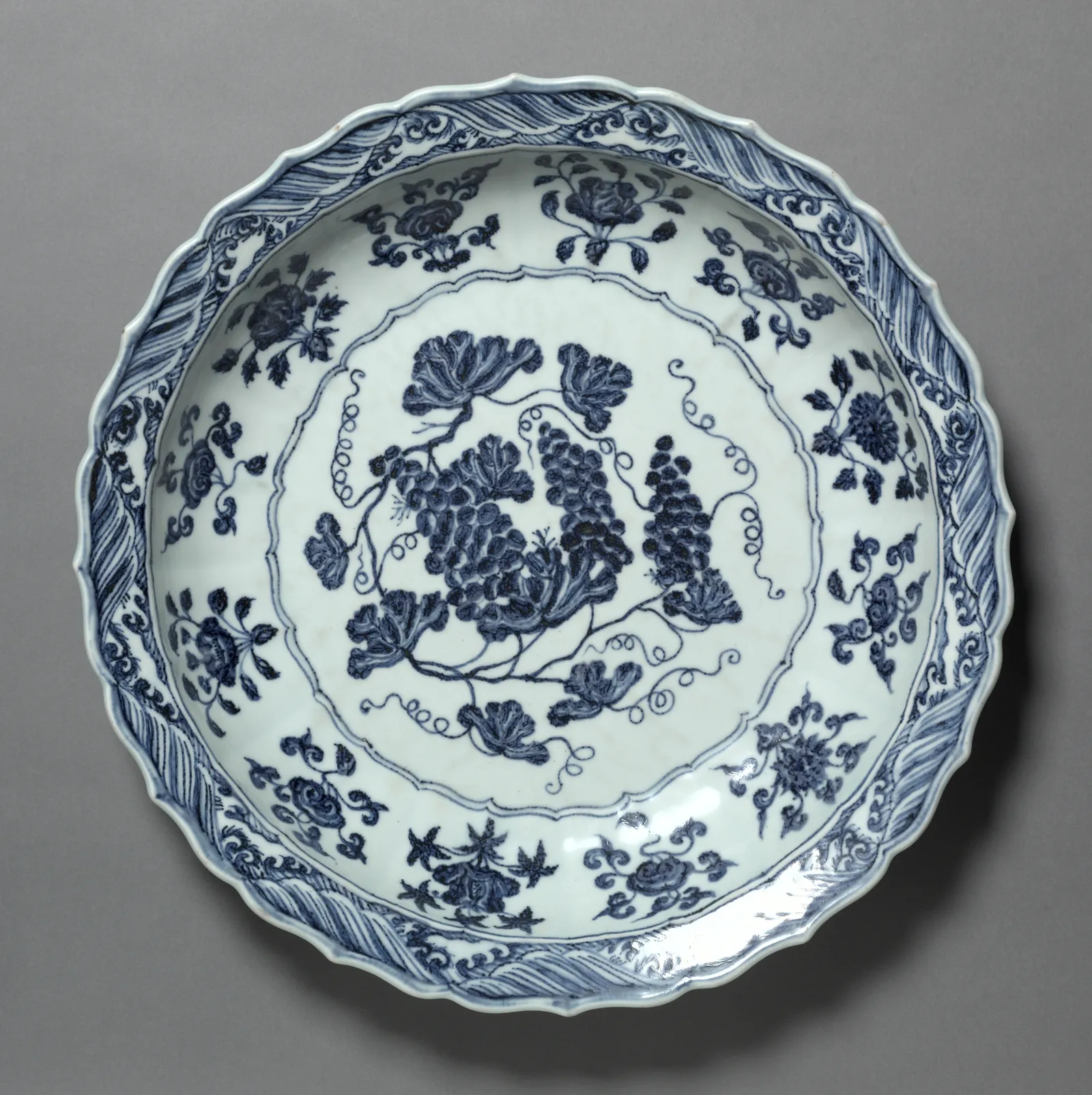
The plate 1953.127, painted in blue with grapes at the center. Its record dates it to the Yongle period and mentions a similar example excavated at the Ming imperial kilns.
Museum no. 1953.127 · Findspot: unrecorded
"Plate with Grapes and Floral Sprays" by The Cleveland Museum of Art, Anonymous Gift — https://clevelandart.org/art/1953.127 — CC0 1.0 (https://creativecommons.org/publicdomain/zero/1.0/)
That parallel has a findspot, a kiln site, but the plate itself has none. The record leaves a gap of its own. It dates the plate to the Yongle period while the excavated example bears the mark of the Xuande reign, which the records place later, and it does not say how the one bears on the other.
Ming or Qing? The bowl the record leaves open
A third piece with the Jiajing mark, the green-glazed bowl 1964.175, is shaped like an archaic gui, in the words of its title; Cleveland's record for a bronze gui, 1974.73, describes one as "a ritual food vessel." The bowl's record calls the mark apocryphal and dates the bowl 1628–61 · museum attribution. The range is wide because the record names two possibilities: "Chongzhen reign (1628-44) or Qing dynasty, Shunzhi reign (1644-61)," the first in the Ming dynasty and the second in the Qing.
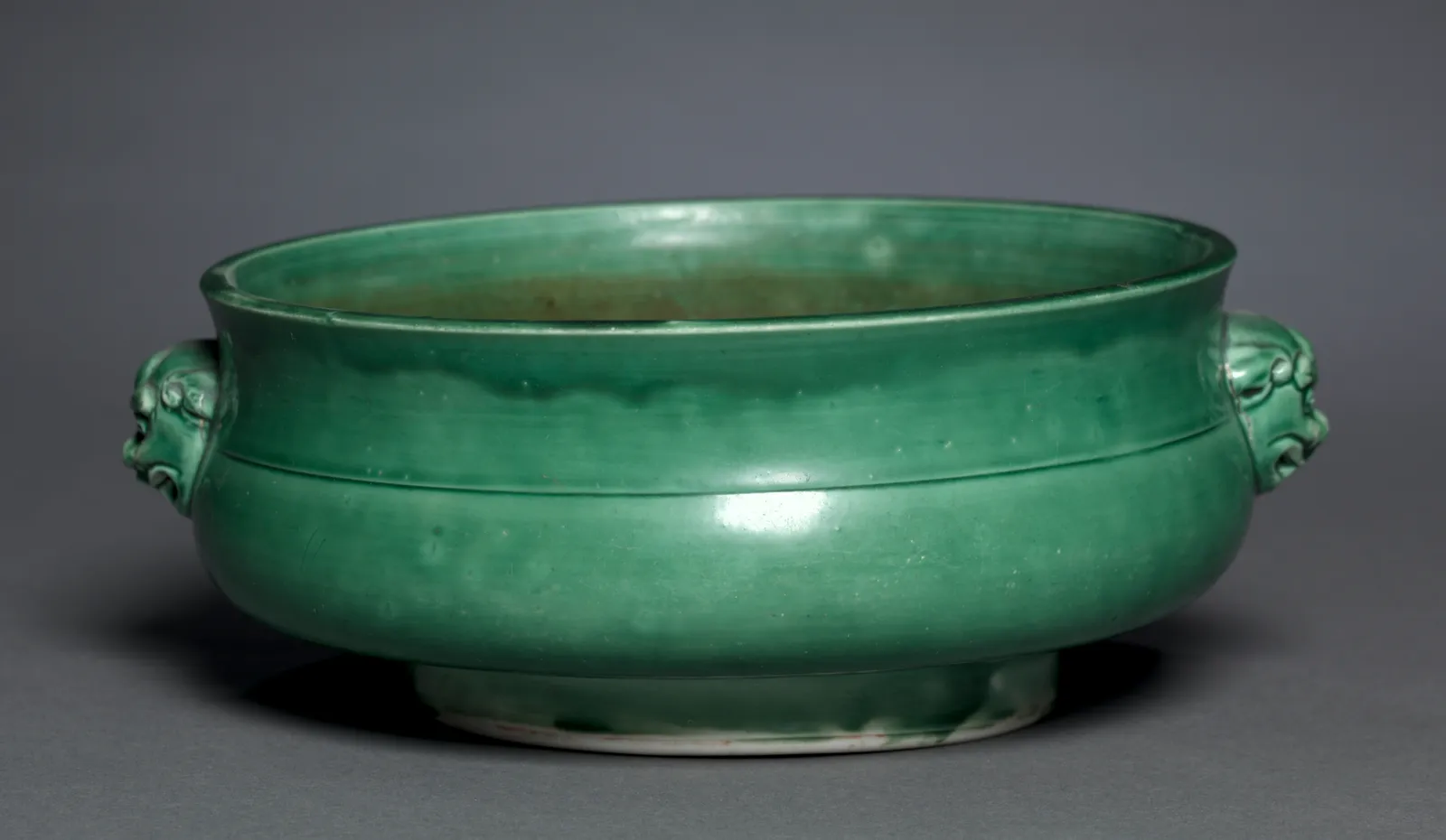
The green-glazed bowl 1964.175. Its record dates it to the Chongzhen reign of the Ming or the Shunzhi reign of the Qing, and calls its Jiajing mark apocryphal.
Museum no. 1964.175 · Findspot: unrecorded
"Bowl in Form of Archaic Gui" by The Cleveland Museum of Art, Severance and Greta Millikin Collection — https://clevelandart.org/art/1964.175 — CC0 1.0 (https://creativecommons.org/publicdomain/zero/1.0/)
The two reigns meet at 1644, the year the same records give for the end of the Ming dynasty, so the museum's date for this bowl sits across the line between two dynasties. By this page's calculation, its mark names a reign that ended, in the records' years, 62 years before the earliest year the museum allows, and the record does not say which of its two reigns it favors.
Proof radius
What this box is for: the proof radius.
Proves: The vase's mark names the Jiajing reign of the Ming, and Cleveland's record dates the vase to that reign; the bowl's record shows that the same six characters do not, by themselves, settle the museum's date.
Doesn't prove: That the vase's Ming date rests on its mark, or that either museum date, as of 2026, rests on a test or a findspot. Neither record states what its date rests on, so the vase's Ming date and the bowl's Qing date are both the museum's published judgment.
Read next: Panathenaic amphora: a prize vase of the Panathenaic Games, another pot read against its museum record. Egyptian civil calendar: a date counted in a ruler's years and converted by calculation, not by a museum's judgment.
Sources
Primary sources first.
- 1Cleveland Museum of Art, "Square Double-Gourd Vase with Floral Scrolls," China, Jiangxi Province, Jingdezhen kilns, Ming dynasty, Jiajing mark and reign (1522–66), accession no. 1964.172, collection record (Open Access data, CC0). https://clevelandart.org/art/1964.172 Read: full record (Open Access record 140174, last updated 2026-05-29)
- 2Cleveland Museum of Art, "Bowl," China, Qing dynasty, Kangxi reign, with an apocryphal Jiajing mark, accession no. 1940.962, collection record (Open Access data, CC0). https://clevelandart.org/art/1940.962 Read: full record (Open Access record 120195, last updated 2026-05-29)
- 3Cleveland Museum of Art, "Bowl in Form of Archaic Gui," China, Jiangxi province, Jingdezhen, Ming dynasty, Chongzhen reign (1628–44) or Qing dynasty, Shunzhi reign (1644–61), Jiajing mark, accession no. 1964.175, collection record (Open Access data, CC0). https://clevelandart.org/art/1964.175 Read: full record (Open Access record 140177, last updated 2026-05-29)
- 4Cleveland Museum of Art, "Food Container (Gui)," China, Eastern Zhou dynasty, Spring and Autumn period, bronze, accession no. 1974.73, collection record (Open Access data, CC0). https://clevelandart.org/art/1974.73 Read: full record (Open Access record 147977, last updated 2026-05-29)
- 5Cleveland Museum of Art, "Bowl," China, Jiangxi province, Jingdezhen, Ming dynasty, Hongzhi mark and period (1488–1505), accession no. 1989.289, collection record (Open Access data, CC0). https://clevelandart.org/art/1989.289 Read: full record (Open Access record 154697, last updated 2026-05-29)
- 6Cleveland Museum of Art, "Plate with Grapes and Floral Sprays," China, Jiangxi province, Jingdezhen, Ming dynasty, Yongle period (1403–24), accession no. 1953.127, collection record (Open Access data, CC0). https://clevelandart.org/art/1953.127 Read: full record (Open Access record 130362, last updated 2026-08-15)
- 7Cleveland Museum of Art Open Access API, Chinese Art department, ceramics, 690 records (all CC0), queried 13 October 2026; 40 records whose inscriptions field transcribes a complete Ming reign mark, 34 objects after parts are merged. https://openaccess-api.clevelandart.org/api/artworks/?department=Chinese%20Art&type=Ceramic&cc0=1&limit=1000 Read: full query result
- 8Cleveland Museum of Art, "Black-Figure White-Ground Lekythos (Oil Vessel): Athena between Cocks and Hieropoioi (Officials)," 500–485 BCE, accession no. 2022.42, collection record (Open Access data, CC0). https://clevelandart.org/art/2022.42 Read: full record (Open Access record 457392)
- 9Unicode Consortium, Unicode Character Database 18.0.0, UnicodeData.txt (Unicode License v3). https://www.unicode.org/Public/18.0.0/ucd/UnicodeData.txt Read: UnicodeData.txt (full data file); reference glyphs checked against the Unicode 18.0 code chart U4E00.pdf (viewed only, not reproduced)
Cite this page
Sherd and Script. “Ming Vase: One Reign Mark, Two Museum Dates.” Sherd and Script. Published 13 October 2026. https://sherdandscript.com/ceramics/ming-vase/ (accessed ).
Corrections
None yet.