How we know
Egyptian Civil Calendar: Midwinter to Midsummer in 730 Years
Sherd and Script · Published 13 October 2026 · Revised 23 October 2026
The Rosetta Stone's decree is dated by a king's reign and an Egyptian month. Reaching a Julian date takes a 365-day year with no leap day, a reign count and a day count anyone can rerun.
Find card
- Calendar
- Egyptian civil calendar, the 365-day "wandering year"
- Type
- solar, fixed at 365 days (12 months of 30 days + 5 added days)
- Epoch
- No fixed civil era: years counted by reign, each starting on 1 Thoth. Astronomers' Era of Nabonassar: 1 Thoth of year 1 =
26 February 747 BCE · computed, proleptic Julian(JD 1448638) - Leap rule
- None. The Canopus decree (
238 BCE · computed, proleptic Julian) ordered a sixth added day every fourth year; the reform failed. A lasting leap day was adopted under Augustus from26/25 BCE · documentary - In use
- Dates the Canopus decree (
238 BCE · computed, proleptic Julian) and the Rosetta decree (196 BCE · computed, proleptic Julian); still counted in238 CE · documentary(Censorinus) - Computed with
- This site's Python day count from JD 1448638; Julian calendar arithmetic after Reingold & Dershowitz's method (code not copied); cross-checked with convertdate 2.4.0, jdcal 1.4.1 and Skyfield 1.55; proleptic Julian; astronomical years (1 BCE = 0)
Find card as CSV egyptian-civil-calendar-find-card.csv (sources and license, JSON)Data: Censorinus, De die natali 18.10 and 21.9-10, Latin text ed. J. Cholodniak (St Petersburg, 1889), public domain, LacusCurtius transcription, https://penelope.uchicago.edu/Thayer/L/Roman/Texts/Censorinus/text*.html; Herodotus, Histories 2.4, trans. A. D. Godley (Loeb Classical Library, 1920), public domain, LacusCurtius transcription, https://penelope.uchicago.edu/Thayer/E/Roman/Texts/Herodotus/2A*.html; E. R. Bevan, The House of Ptolemy (1927), chapters VI and VIII with translations of the Canopus and Memphis decrees, public domain, LacusCurtius transcription, https://penelope.uchicago.edu/Thayer/E/Gazetteer/Places/Africa/Egypt/_Texts/BEVHOP/home.html
TL;DR. The Egyptian civil year had 12 months of 30 days plus 5 added days and no leap day, so its new year slid one day earlier against the Julian calendar every four years. Counting from 1 Thoth of Ptolemy V's Year 9, which fell on 11 October 197 BCE, the decree's 18 Mekhir is day 168, or 27 March 196 BCE · computed, proleptic Julian. The Macedonian half, 4 Xandikos, does not match the Egyptian day, and one emendation changes the Egyptian month, so the double date stays Disputed.
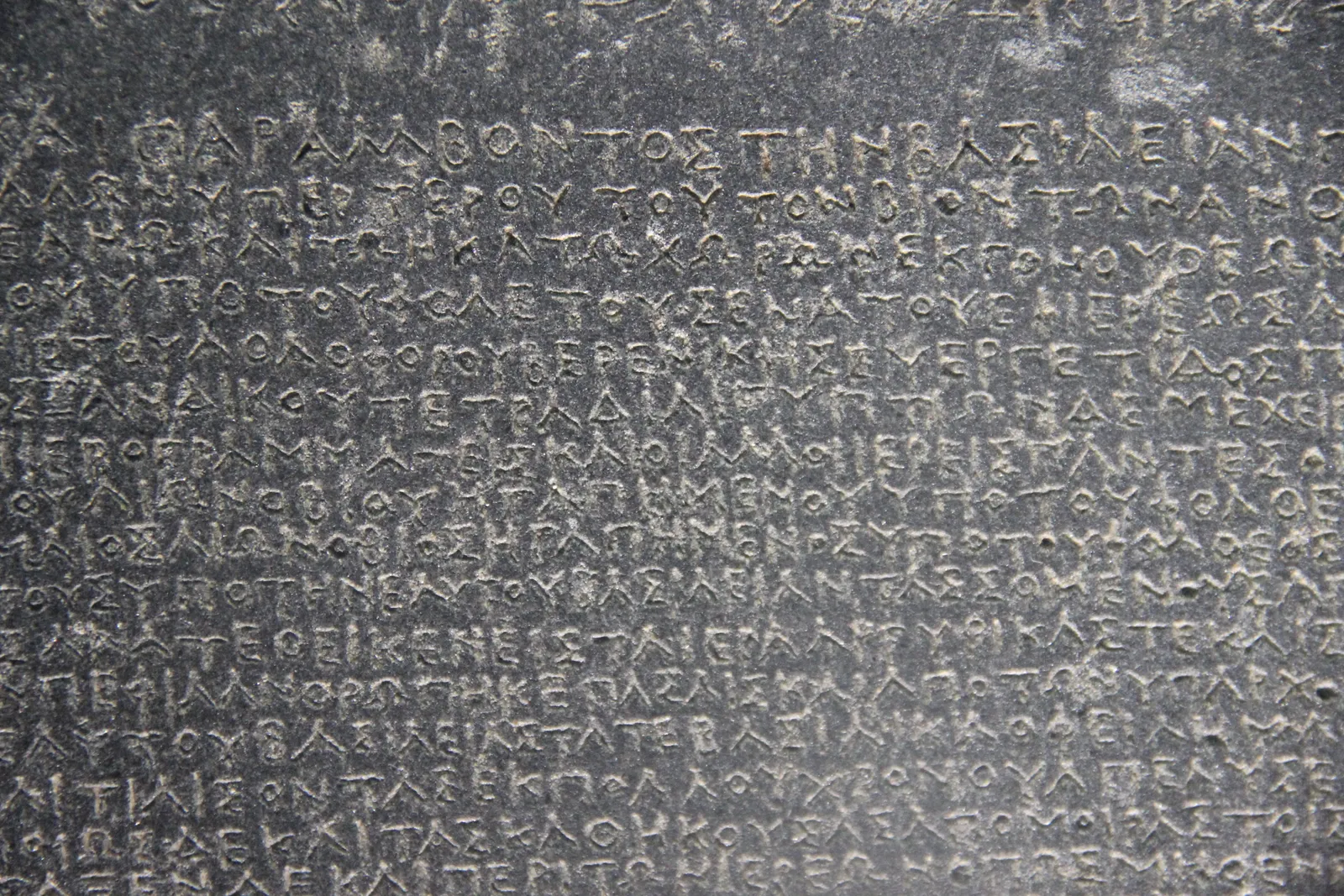
The opening lines of the Rosetta Stone's Greek text. The month names Xandikos and Mecheir, the two halves of the decree's double date, can be read a few lines down.
Museum no. EA 24 · Findspot: Fort Julien, near Rashid (Rosetta), reused in a wall
"Greek Script from Rosetta Stone" by Gary Todd — https://commons.wikimedia.org/wiki/File:Greek_Script_from_Rosetta_Stone_(36140199340).jpg — CC0 1.0 (https://creativecommons.org/publicdomain/zero/1.0/)

Near the top of the Rosetta Stone's Greek text, the priests named a single day in two calendars. In the translation printed by Edwyn Bevan in 1927, the decree is dated "the 4th of the month Xandikos, according to the Egyptians the 18th of Mechir," in the ninth year of Ptolemy V. The Egyptian half is a date in the Egyptian civil calendar. The familiar 27 March 196 BCE is a modern conversion of it.
A converted date printed without its algorithm is a bare date, a date given without its basis. This page rebuilds the conversion for the decree on the Rosetta Stone one step at a time with a script; its results are in two CSV files that can be checked, and a JSON file of the same name beside each one records the library versions used to cross-check it. The stone is British Museum EA 24, the number as given by Wikidata Q48584. The museum's own page was not read.
How was the Egyptian civil year built?
Herodotus gave the arithmetic in Book 2 of his Histories: the Egyptians, "reckoning thirty days to each of the twelve months, add five days in every year over and above the number" (A. D. Godley's 1920 translation). He added that in this way "the complete circle of seasons is made to agree with the calendar." That last claim did not hold.
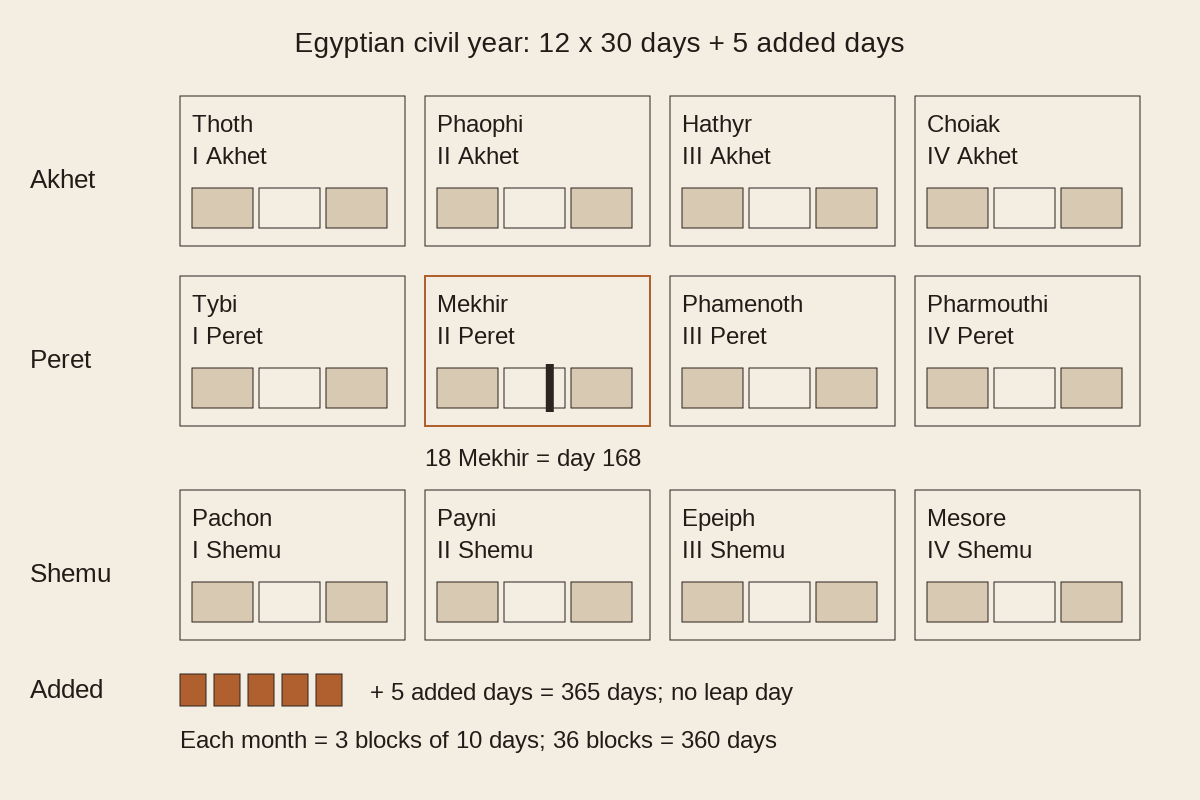
The months fell into three seasons of four months each, Akhet, Peret and Shemu, according to Chris Bennett's online chronology of Ptolemaic Egypt. In Ptolemaic times they also had names, such as Thoth for the first month and Mekhir (Greek Mecheir) for the sixth. The five extra days, called epagomenal days because they stood outside the months, closed the year. Bennett also notes that the Egyptian day began at dawn or sunrise, so by convention a conversion to a Julian date refers to the daylight hours.
Scroll sideways to read every label, or open the full drawing.
The civil year as twelve 30-day months in three seasons, plus five added days. The 18th of Mekhir, the decree's Egyptian date, is day 168.
"The Egyptian civil year: 12 months of 30 days plus 5 added days" by Sherd and Script, https://sherdandscript.com/calendars/egyptian-civil-calendar/, licensed under CC BY 4.0 (https://creativecommons.org/licenses/by/4.0/)
Data sources for this figure
Data: Herodotus, Histories 2.4, trans. A. D. Godley (Loeb Classical Library, 1920), public domain, LacusCurtius transcription, https://penelope.uchicago.edu/Thayer/E/Roman/Texts/Herodotus/2A*.html; Regnal-year readings and month order after C. Bennett, Egyptian Royal Genealogy (Ptolemaic chronology pages), https://www.instonebrewer.com/TyndaleSites/Egypt/ptolemies/; É. Aubourg, BIFAO 95 (1995) 1-10 (single fact: 36 decans, 360 days)
Two kinds of user show up in the sources: scribes counting reigns and priests fixing festivals. Years were counted by reign, each beginning on 1 Thoth, and a new king's Year 1 usually ran only to the end of the civil year already under way (Bennett). In Bevan's translation, the Rosetta decree itself sets its festivals by civil dates: the king's birthday on 30 Mesore and his accession on 17 Phaophi.
What do the Dendera decans add?
Ten-day units fit inside this year exactly. Éric Aubourg wrote in 1995 about the zodiac ceiling from the temple of Hathor at Dendera. He describes the 36 decans around it, star groups that divided the night into 12 hours and the year into 360 days. Add the five extra days and the total is the 365-day civil year.
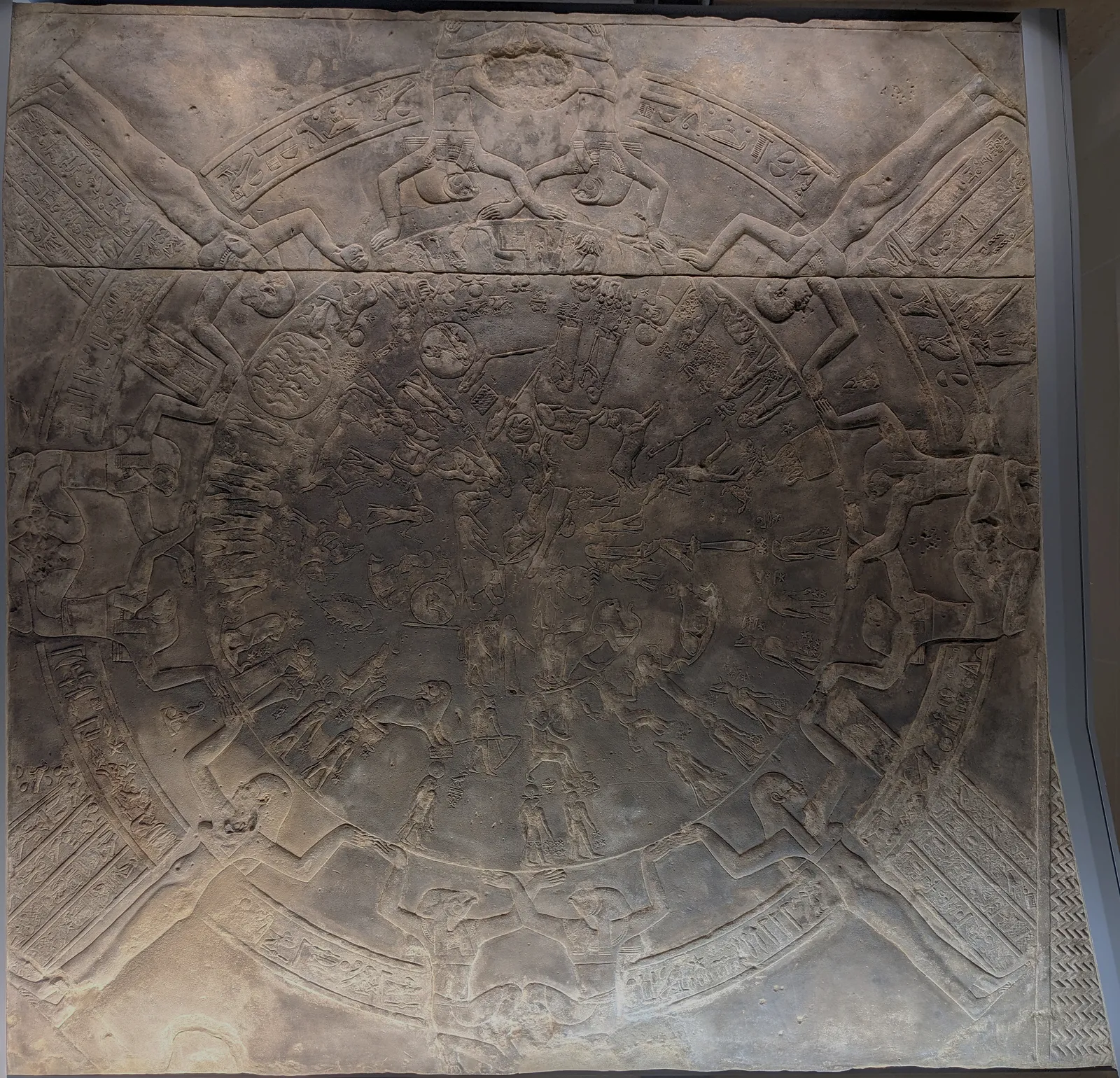
The Dendera zodiac in the Louvre. Aubourg describes the 36 decans, star groups that divided the night into hours and the year into 360 days, around its circle of constellations.
Museum no. E 13482 (D 38) · Findspot: Temple of Hathor, Dendera, ceiling of a roof chapel of Osiris
"Zodiaque de Dendéra - Musée du Louvre Antiquités Egyptiennes D 38 ; E 13482" by Shonagon — https://commons.wikimedia.org/wiki/File:Zodiaque_de_Dend%C3%A9ra_-_Mus%C3%A9e_du_Louvre_Antiquit%C3%A9s_Egyptiennes_D_38_%3B_E_13482.jpg — CC0 1.0 (https://creativecommons.org/publicdomain/zero/1.0/)

The Louvre's record lists decans among the carved decoration and dates the ceiling to June to August 50 BCE · museum attribution, under Cleopatra VII and Ptolemy XIII. Aubourg reached that window by matching the planets carved on the ceiling to the points where each planet appears to stop and turn back in the sky. The same record traces the slab's path: removed from the temple in 1821 under a permit from Muhammad Ali, bought by Louis XVIII in April 1822, and back in the Louvre since 1919.
When did the 365-day civil year begin?
The year the 365-day civil calendar began is unknown; as of 2026 its earliest known record comes from the reign of Khufu. In a 2017 study, Pierre Tallet reports that papyrus H, an accounts papyrus from the Red Sea harbor of Wadi al-Jarf, gives a separate entry to "the five additional days that are added to the civil year to make the count of 365" (this page's translation). He calls this their first appearance known to him; the record accepted before was the offering calendar of Niuserre's sun temple.
The archive that held papyrus H dates to the very end of Khufu's reign: one of its documents is dated "the year after the 13th census," which Tallet equates with year 26 or 27 of Khufu · documentary. The entry for the added days records exactly one-sixth of the food usually delivered for a 30-day month, which fits five days. Tallet's papyrus shows only that the calendar was in use by Khufu's last years.
How does 18 Mekhir become 27 March 196 BCE?
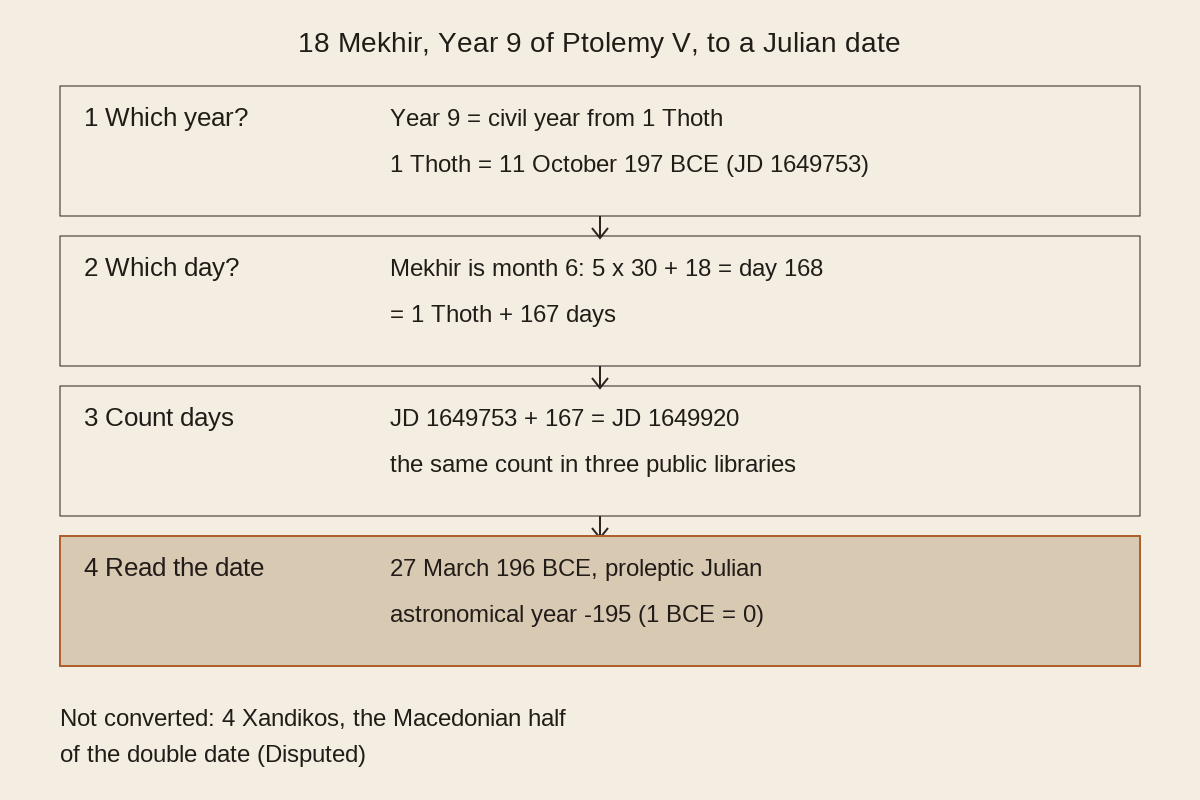
Step one, the year, is the hard part. Bennett's chronology puts Ptolemy V's accession in summer 204 BCE, before 1 Mesore (8 September 204), so his Year 1 was the civil year already running. By this page's calculation that year began on 13 October 205 BCE, the date this site also gives for 1 Thoth of 205 BCE in the Antikythera mechanism case file, and Year 9 began on 11 October 197 BCE.
The second step is the day. Mekhir is the sixth month, so five full months of 30 days come first, and the 18th of Mekhir is day 168 of the year, or 1 Thoth plus 167 days. Step three counts those days in Julian Day numbers, a continuous count of days used by astronomers: 1 Thoth of Year 9 is JD 1649753, and 167 days later is JD 1649920.
Scroll sideways to read every label, or open the full drawing.
The conversion in four steps, from the decree's regnal date to a day number and a Julian date. The Macedonian half of the date is left unconverted.
"18 Mekhir, Year 9 of Ptolemy V, converted step by step" by Sherd and Script, https://sherdandscript.com/calendars/egyptian-civil-calendar/, licensed under CC BY 4.0 (https://creativecommons.org/licenses/by/4.0/)
Data sources for this figure
Data: E. R. Bevan, The House of Ptolemy (1927), chapters VI and VIII with translations of the Canopus and Memphis decrees, public domain, LacusCurtius transcription, https://penelope.uchicago.edu/Thayer/E/Gazetteer/Places/Africa/Egypt/_Texts/BEVHOP/home.html; Regnal-year readings and month order after C. Bennett, Egyptian Royal Genealogy (Ptolemaic chronology pages), https://www.instonebrewer.com/TyndaleSites/Egypt/ptolemies/; Cross-checks: convertdate 2.4.0 (MIT), jdcal 1.4.1 (BSD), Skyfield 1.55 (MIT)
The fourth step reads that day number as 27 March 196 BCE in the proleptic Julian calendar, meaning the Julian calendar extended to years before it existed. In the astronomical numbering used inside the script, where 1 BCE is year 0, the year is −195. The libraries convertdate 2.4.0, jdcal 1.4.1 and Skyfield 1.55 return the same date for the same day number, and Bevan's 1927 equation, "Mechir 18 (= March 27,) 196," agrees.
| Step | Input | Result (computed, proleptic Julian) |
|---|---|---|
| Year | Year 9 of Ptolemy V | 1 Thoth = 11 October 197 BCE (JD 1649753) |
| Day | 18 Mekhir | day 168 = 1 Thoth + 167 days |
| Count | JD 1649753 + 167 | JD 1649920 |
| Date | JD 1649920 | 27 March 196 BCE |
| Check | 17 Phaophi, Year 9 | 26 November 197 BCE; Bevan: "Phaophi 17 (= November 26), 197" |
Download: conversions with sources (Data: E. R. Bevan, The House of Ptolemy (1927), chapters VI and VIII with translations of the Canopus and Memphis decrees, public domain, LacusCurtius transcription, https://penelope.uchicago.edu/Thayer/E/Gazetteer/Places/Africa/Egypt/_Texts/BEVHOP/home.html; Censorinus, De die natali 18.10 and 21.9-10, Latin text ed. J. Cholodniak (St Petersburg, 1889), public domain, LacusCurtius transcription, https://penelope.uchicago.edu/Thayer/L/Roman/Texts/Censorinus/text*.html; Eduard Meyer, Aegyptische Chronologie (Berlin, 1904), pp. 46-48, public domain, https://archive.org/details/aegyptischechron00meye; Regnal-year readings and month order after C. Bennett, Egyptian Royal Genealogy (Ptolemaic chronology pages), https://www.instonebrewer.com/TyndaleSites/Egypt/ptolemies/; Cross-checks: convertdate 2.4.0 (MIT), jdcal 1.4.1 (BSD), Skyfield 1.55 (MIT)) (sources and license, JSON), 1 Thoth for every year from 747 BCE to 238 CE (Data: Censorinus, De die natali 18.10 and 21.9-10, Latin text ed. J. Cholodniak (St Petersburg, 1889), public domain, LacusCurtius transcription, https://penelope.uchicago.edu/Thayer/L/Roman/Texts/Censorinus/text*.html; Cross-checks: convertdate 2.4.0 (MIT), jdcal 1.4.1 (BSD), Skyfield 1.55 (MIT)) (sources and license, JSON).
The weak link is step one, not the arithmetic. Think of a regnal date as a word whose meaning depends on its sentence: "18 Mekhir" is fixed, but "Year 9" points to a single year only once the reign around it has been placed. Every later step inherits that choice.
What about 4 Xandikos?
The Macedonian half resists conversion. Xandikos is a month of the Macedonian calendar, which Greeks in Ptolemaic Egypt commonly added when dating documents (Bevan). Bennett writes that from the start of Ptolemy V's reign Macedonian months were tied to Egyptian ones, almost always with the same day number, and that the Rosetta Stone's 4 against 18 is one of only five known exceptions.
Others read the mismatch differently. Bennett reports that R. A. Hazzard cites this double date, with two later ones, as evidence that a lunar Macedonian calendar was still used in Alexandria under Ptolemy V and VI. Bennett himself argues for emending it to 4 Xandikos = 18 Phaophi, which would move the decree out of Mekhir, and his preliminary table of double dates lists it that way. The double date is Disputed; this page converts the Egyptian date as the Greek text gives it, 18 Mekhir.
One more assumption sits under step one: the conversion uses the 365-day wandering year. Bennett's preliminary study suggests that Ptolemaic officials used the leap-year calendar of the Canopus decree, discussed below, off and on until the end of Ptolemy VI's reign. On that scheme 1 Thoth fell on 21 to 23 October, 10 to 12 days later than the wandering year's 11 October 197 BCE (by this page's calculation). Bevan's 1927 equation matches the wandering-year count.
Why did the Egyptian new year wander?
A solar year is about a quarter of a day longer than 365 days, as Censorinus put it in 238 CE, and the civil year never added the difference. He said the Egyptian civil year had 365 days "sine ullo intercalari," without any intercalary day (this page's translation). Every four years it therefore fell about a day short. Only after 1,461 of its years did it return to the same starting point.
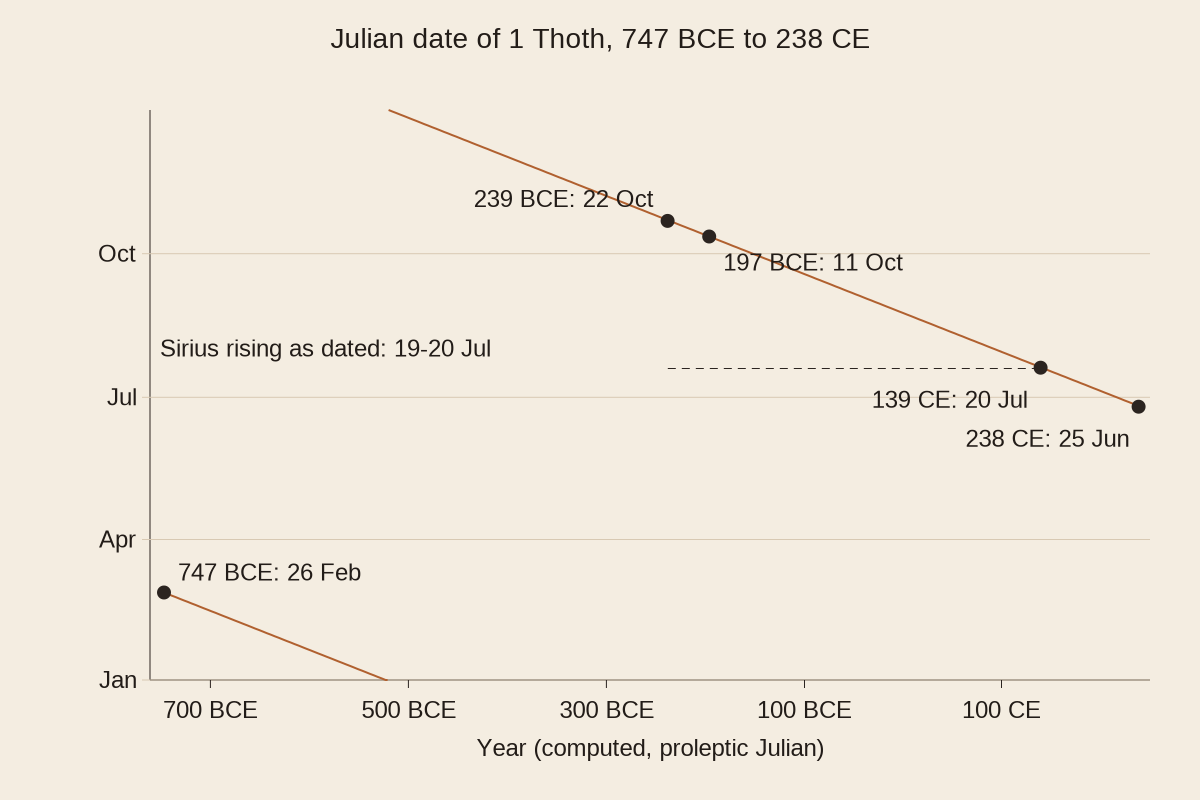
Bevan spelled out what that meant for a festival held on a fixed date: it "would at one time be a midwinter festival, and 730 years later have become a midsummer one." Against the Julian calendar the slide is exact, because the Julian calendar adds its leap day every fourth year: the Egyptian new year moved one day earlier every four Julian years.
Never look straight at the sun. A heliacal rising is a star's first reappearance just before dawn after weeks lost in the sun's glare, and Censorinus tied an anchor date to one. In year 986 of the Nabonassar era, which he says Egyptian records used, 1 Thoth fell on 25 June 238 CE. A hundred years earlier, counting both ends, it fell on 20 July 139 CE, "quo tempore solet canicula in Aegypto facere exortum," when the Dog Star usually rises in Egypt (this page's translation).
Never look straight at the sun. One star low in the sky before dawn, the sun still below the horizon: the kind of reappearance Censorinus tied an anchor date to.
Illustration: Sherd and Script. Generated schematic illustration — not a photograph or record of any real object or site. Reuse: CC BY 4.0 (https://creativecommons.org/licenses/by/4.0/), to the extent Sherd and Script holds rights in it.
The script starts from JD 1448638 for 1 Thoth of Nabonassar year 1, which is 26 February 747 BCE. It reproduces both of those days. The 99 Egyptian years between them moved the new year 25 days earlier, from 20 July to 25 June (by this page's calculation).
Scroll sideways to read every label, or open the full drawing.
The Egyptian new year slid one day earlier in the Julian calendar every four years. The dashed line marks Sirius's rising as dated in 238 BCE and 139 CE.
"The Egyptian new year against the Julian calendar, 747 BCE to 238 CE" by Sherd and Script, https://sherdandscript.com/calendars/egyptian-civil-calendar/, licensed under CC BY 4.0 (https://creativecommons.org/licenses/by/4.0/)
Data sources for this figure
Data: Censorinus, De die natali 18.10 and 21.9-10, Latin text ed. J. Cholodniak (St Petersburg, 1889), public domain, LacusCurtius transcription, https://penelope.uchicago.edu/Thayer/L/Roman/Texts/Censorinus/text*.html; E. R. Bevan, The House of Ptolemy (1927), chapters VI and VIII with translations of the Canopus and Memphis decrees, public domain, LacusCurtius transcription, https://penelope.uchicago.edu/Thayer/E/Gazetteer/Places/Africa/Egypt/_Texts/BEVHOP/home.html; Regnal-year readings and month order after C. Bennett, Egyptian Royal Genealogy (Ptolemaic chronology pages), https://www.instonebrewer.com/TyndaleSites/Egypt/ptolemies/; Cross-checks: convertdate 2.4.0 (MIT), jdcal 1.4.1 (BSD), Skyfield 1.55 (MIT)
The text of that passage is not settled. Bennett notes that Censorinus's figure for 139 CE, the 12th day before the Kalends of August (21 July), is conventionally amended to the 13th (20 July), the reading in the online transcription of the 1889 edition used here. The 365-day arithmetic agrees with the amendment. Bennett also reports, and rejects, P. F. O'Mara's 2003 argument that Censorinus chose his date to honor his patron's birthday, so the 139 CE date as an observation is Disputed, even though its calendar arithmetic checks.
What did the Canopus decree try to fix?
Forty-two years before the Rosetta decree, another synod of priests tried to stop the slide. Their decree, passed at Canopus on 17 Tybi in Year 9 of Ptolemy III, converts to 7 March 238 BCE · computed, proleptic Julian when Year 9 is the civil year that began on 22 October 239 BCE, as Bennett dates it. The Louvre's record of its copy also gives 238 BC.
The priests gave their reason in calendar terms. In the translation printed by Bevan, they wanted to prevent "that some of the national feasts kept in winter may come to be kept in the summer," so "one day, a feast of the Benefactor Gods, shall be added every four years to the five additional days before the new year." The decree frames the problem as one of festivals, the schedule that the temples kept.
Never look directly into the sun, not even at sunrise. The same decree set a yearly festival on the day "the star of Isis rises," which in that ninth year was kept on 1 Payni. By this page's calculation, 1 Payni of that year was 19 July 238 BCE, one day from the 20 July that Censorinus gives for 139 CE.
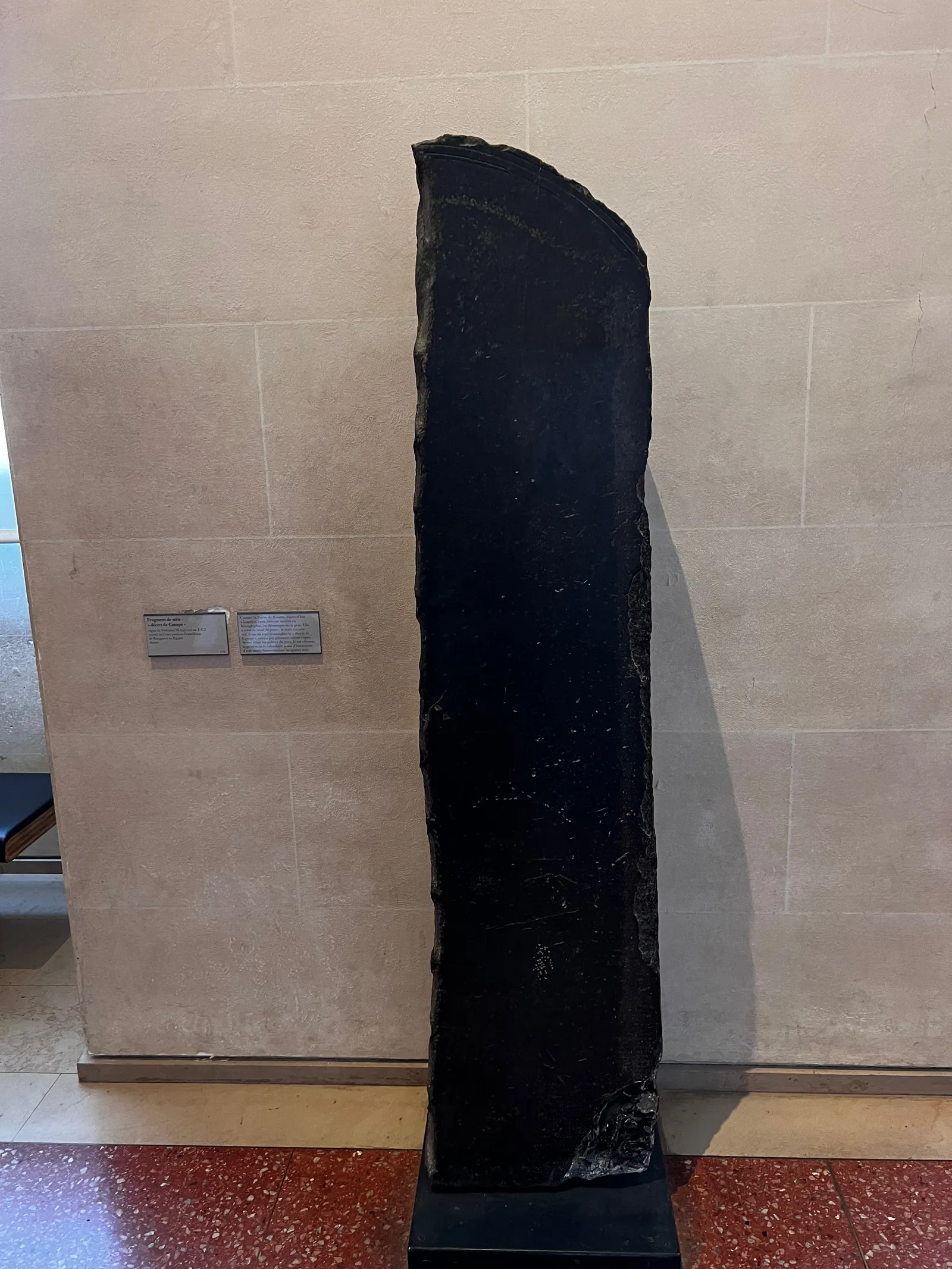
The Louvre's copy of the Canopus decree, a tall fragment with its left side missing. Before it reached France, it lay as a doorstep in a Cairo mosque.
Museum no. N 273 (C 122) · Findspot: Amir Akhor mosque, Cairo, reused as a doorstep
"Stèle, Décret de Canope, N 273 (2022 266)" by Onceinawhile — https://commons.wikimedia.org/wiki/File:St%C3%A8le,_D%C3%A9cret_de_Canope,_N_273_(2022_266).jpg — CC BY-SA 4.0 (https://creativecommons.org/licenses/by-sa/4.0/)

That findspot is a second life, not an original setting. The Louvre's record says the fragment was given by Muhammad Ali to the French consul Bernardino Drovetti in 1829 and bought at the sale of Jean-François Mimaut's collection in 1837. So the slab carries the decree's text but no record of where it first stood.
The date of the decree shows how much rides on the regnal year. Bevan in 1927 equated it with 6 March 237 BC, now an Outdated claim. That is the same 17 Tybi one civil year later, and it falls a day earlier in March because a Julian leap day comes in between (by this page's calculation).
Whether anyone kept the new day is less clear. Bennett writes that "there is no doubt that the Canopic reform failed," yet his preliminary analysis suggests intermittent official use through Ptolemy VI's reign, and A. E. Samuel, as quoted by Bennett, saw "no evidence that this decree ever had any effect on the Egyptian calendar." How long any of it lasted is Disputed. A lasting leap day came under Augustus, from his fifth year, 26/25 BCE · documentary, and the wandering year stayed in use beside it (Bennett).
How do Sothic dates reach back to the pharaohs?
The same arithmetic runs back to the New Kingdom through a calendar on the back of the first column of the Ebers Papyrus, a long medical roll held by Leipzig University Library. Never look directly into the sun, not even at sunrise. In Eduard Meyer's 1904 reading, the calendar is headed "Jahr 9 unter S. M. König Zeserkere" (Year 9 under His Majesty King Zeserkere; this page's translation), the throne name of Amenhotep I, and marks 9 Epiphi, in the 11th month, as the day Sothis rose.
The roll's context cannot date it. Georg Ebers bought it from a seller in Luxor in the winter of 1872–73 (Joachim 1890; Bolton 1884), and the only findspot is the seller's account, reported by Bolton, of a tomb in the Theban necropolis. The date has to come from the text.
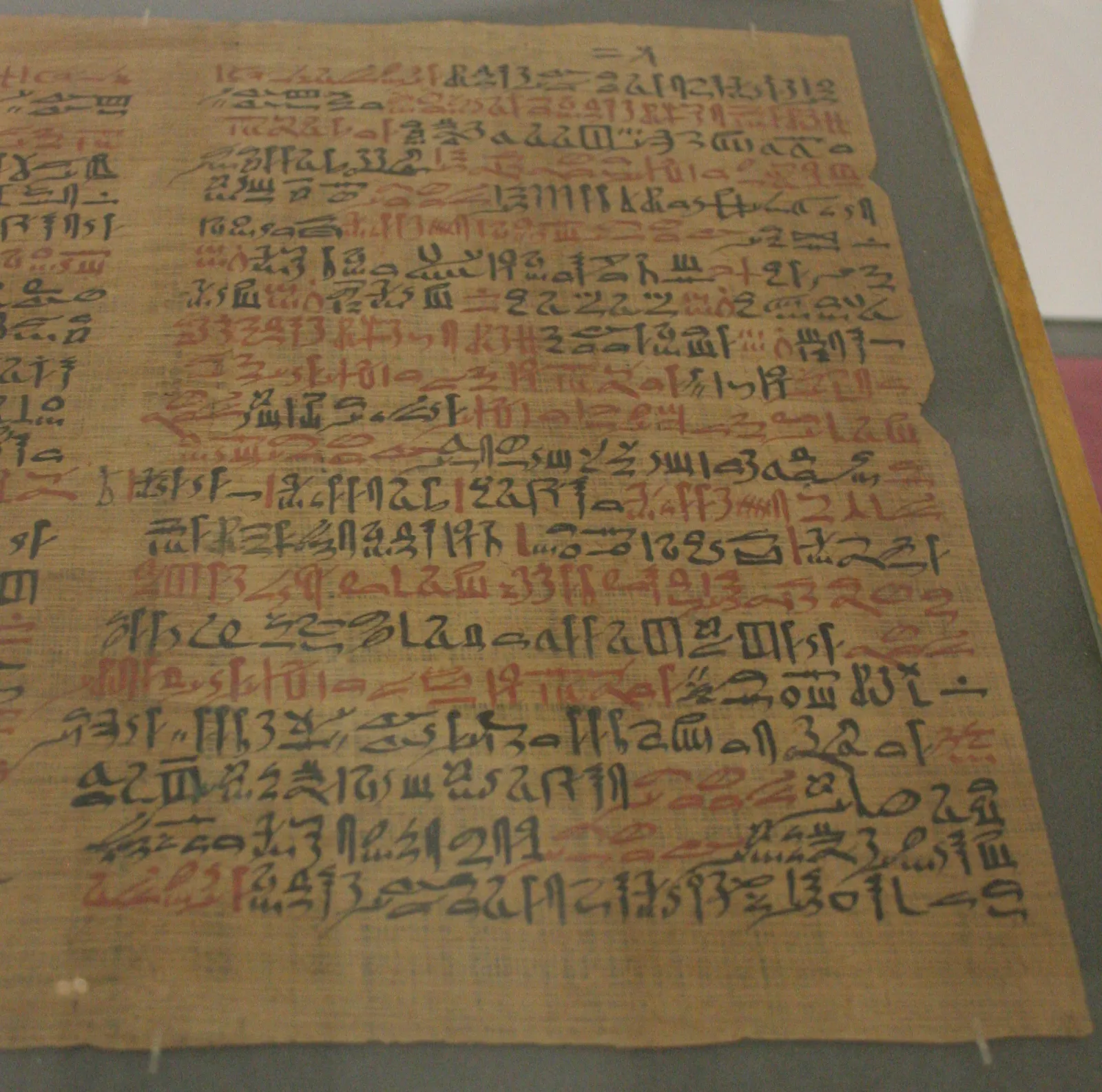
Column 38 of the Ebers Papyrus, a medical text in black and red ink. The calendar discussed here, on the back of the roll's first column, is not in this photo.
Findspot: unrecorded
"PEbers c38" by Einsamer Schütze — https://commons.wikimedia.org/wiki/File:PEbers_c38.jpg — CC BY-SA 3.0 (https://creativecommons.org/licenses/by-sa/3.0/)

Never look straight at the sun. Meyer worked from the premise that the rising fell on 19 July (Julian) and placed Year 9 of Amenhotep I in one of the Egyptian years 1550/49–1547/46 BCE · computed, Sothic (Meyer). This page's script reproduces that window from the same premise. If 9 Epiphi was 20 July, the window moves four years earlier, and if 18 July, four years later.
Early readers claimed more than the calendar could carry. Joachim in 1890 reported that Ebers dated the writing to 1553–1550 BC from the calendar and quoted his claim, "mit einer an Gewissheit grenzenden Wahrscheinlichkeit" (with a probability bordering on certainty), that the roll was written in the middle of the 16th century BC. Meyer recorded that Dümichen had read the king as an Old Kingdom ruler, a reading Meyer called "gänzlich unhaltbar" (entirely untenable) and now an Outdated claim, replaced by the Amenhotep I reading. Both translations are this page's.
Radiocarbon now tests these anchors from outside. Bronk Ramsey and colleagues (2010), using 211 measurements on short-lived plants and a Bayesian model of reign lengths, put the start of the New Kingdom at 1570–1544 BCE · radiocarbon, Bayesian model. The abstract does not state the probability level. Radiocarbon dating explains how a measured range is built.
The same abstract says the few ancient astronomical observations that link Egypt's floating chronologies to the absolute calendar "remain a source of debate." The Ebers calendar is one of them. It is also one of only three Sothic dates tied to a king's year that Meyer could use in 1904, after setting aside the Canopus decree and Censorinus. The window drawn from it moves four years with each day assumed for 9 Epiphi, so it stays Disputed as of 2026.
Proof radius
What this box is for: the proof radius.
Proves: Counted in the 365-day wandering year from Ptolemy V's Year 9, the Rosetta decree's 18 Mekhir is 27 March 196 BCE (proleptic Julian), and the same count reproduces both of Censorinus's new-year dates.
Doesn't prove: That 27 March 196 BCE is beyond question. The result depends on which civil year "Year 9" names, on the wandering year rather than the Canopus scheme, and on the month Mekhir as written, which one emendation changes; it says nothing about the Macedonian date, 4 Xandikos.
Read next: Antikythera mechanism: an Egyptian calendar ring on a geared instrument, and a dispute over the holes beneath it. Maya Long Count: another calendar that counts days instead of correcting them.
Sources
Primary sources first.
- 1Edwyn R. Bevan, The House of Ptolemy: A History of Hellenistic Egypt under the Ptolemaic Dynasty (1927), chapter VIII, "Ptolemy V, Epiphanes," with a translation of the Memphis decree on the Rosetta Stone. LacusCurtius transcription from the 1989 Ares reprint of the 1968 edition. https://penelope.uchicago.edu/Thayer/E/Gazetteer/Places/Africa/Egypt/_Texts/BEVHOP/8*.html Read: full chapter text (LacusCurtius transcription)
- 2Edwyn R. Bevan, The House of Ptolemy: A History of Hellenistic Egypt under the Ptolemaic Dynasty (1927), chapter VI, "Ptolemy III, Euergetes I," with a translation of the Canopus decree and note 35. LacusCurtius transcription from the 1989 Ares reprint of the 1968 edition. https://penelope.uchicago.edu/Thayer/E/Gazetteer/Places/Africa/Egypt/_Texts/BEVHOP/6*.html Read: full chapter text and notes (LacusCurtius transcription)
- 3Censorinus, De die natali 18.3, 18.10 and 21.9-10 (written 238 CE), Latin text ed. J. Cholodniak (St Petersburg, 1889). LacusCurtius transcription. https://penelope.uchicago.edu/Thayer/L/Roman/Texts/Censorinus/text*.html Read: full Latin text, chapters 18 and 21, and the transcriber's note on the date a.d. XIII Kal. Aug.
- 4Herodotus, Histories 2.4, trans. A. D. Godley (Loeb Classical Library, 1920). LacusCurtius transcription. https://penelope.uchicago.edu/Thayer/E/Roman/Texts/Herodotus/2A*.html Read: Book 2, chapter 4 (LacusCurtius page for the opening chapters of Book 2)
- 5Musée du Louvre, Département des Antiquités égyptiennes, "Décret de Canope", stele fragment N 273 (C 122), collections record, last updated 14 February 2024. https://collections.louvre.fr/en/ark:/53355/cl010027713 Read: full record text (Etalab Open Licence); images not accessed
- 6Musée du Louvre, Département des Antiquités égyptiennes, "Zodiaque de Dendéra", E 13482 (D 38), collections record, last updated 11 September 2025. https://collections.louvre.fr/en/ark:/53355/cl010028871 Read: full record text (Etalab Open Licence); images not accessed
- 7Wikidata, "Rosetta Stone" (Q48584): inventory number EA24, collection British Museum. https://www.wikidata.org/wiki/Q48584 Read: Wikidata item (structured statements)
- 8Eduard Meyer, Aegyptische Chronologie (Berlin: Königliche Akademie der Wissenschaften, 1904), pp. 45-48. https://archive.org/details/aegyptischechron00meye Read: pp. 41 and 45-48 (Internet Archive)
- 9Heinrich Joachim, Papyros Ebers: Das älteste Buch über Heilkunde (1890), introduction. https://archive.org/details/papyrosebersdas00joac Read: introduction (Internet Archive)
- 10H. Carrington Bolton, Papyrus Ebers: The Earliest Medical Work Extant (New York: Weekly Drug News Press, 1884), reprinted from The Weekly Drug News 9, no. 15. https://archive.org/details/101705945.nlm.nih.gov Read: full pamphlet (Internet Archive)
- 11Chris Bennett, "Egyptian to Julian conversion: Civil calendar structure," Egyptian Royal Genealogy (website, 2001-2011). https://www.instonebrewer.com/TyndaleSites/Egypt/ptolemies/chron/egyptian/chron_eg_cal.htm Read: full page
- 12Chris Bennett, "Egyptian to Julian conversion: Canopic reform analysis" (preliminary), Egyptian Royal Genealogy (website, 2001-2011). https://www.instonebrewer.com/TyndaleSites/Egypt/ptolemies/chron/egyptian/chron_eg_anl_canopus.htm Read: full page, including the preliminary table of double dates
- 13Chris Bennett, "Ptolemy V," Egyptian Royal Genealogy (website, 2001-2011). https://www.instonebrewer.com/TyndaleSites/Egypt/ptolemies/ptolemy_v.htm Read: full page with notes
- 14Éric Aubourg, "La date de conception du zodiaque du temple d'Hathor à Dendera," Bulletin de l'Institut français d'archéologie orientale 95 (1995): 1-10. https://www.ifao.egnet.net/bifao/095/01/ Read: full text (IFAO online PDF)
- 15C. Bronk Ramsey, M. W. Dee, J. M. Rowland, T. F. Higham, S. A. Harris, F. Brock, A. Quiles, E. M. Wild, E. S. Marcus and A. J. Shortland, "Radiocarbon-based chronology for dynastic Egypt," Science 328 (2010): 1554-1557. https://doi.org/10.1126/science.1189395 Read: abstract only (Europe PMC)
- 16Wikidata, "Ebers Papyrus" (Q310301): location and owner Leipzig University Library. https://www.wikidata.org/wiki/Q310301 Read: Wikidata item (structured statements)
- 17Pierre Tallet, "Du pain et des céréales pour les équipes royales : le grand papyrus comptable du ouadi el-Jarf (papyrus H)," Nehet 5 (2017): 99-117. https://www.orient-mediterranee.com/wp-content/uploads/2026/04/06-NEHET-5-TALLET.pdf Read: full text (PDF, pp. 99-117)
Cite this page
Sherd and Script. “Egyptian Civil Calendar: Midwinter to Midsummer in 730 Years.” Sherd and Script. Published 13 October 2026; last substantive revision 23 October 2026. https://sherdandscript.com/calendars/egyptian-civil-calendar/ (accessed ).
Corrections
- 2026-10-23 — Opening section: what can be checked restated (was: "This page rebuilds the conversion for the decree on the Rosetta Stone one step at a time, with a script and CSV files that can be checked." → now: "This page rebuilds the conversion for the decree on the Rosetta Stone one step at a time with a script; its results are in two CSV files that can be checked, and a JSON file of the same name beside each one records the library versions used to cross-check it.") — the script is not published on this site; the CSV files and the JSON files beside them are
- 2026-10-23 — Page description shown in search results and link previews: calendar named (was: "… turn it into 27 March 196 BCE." → now: "… turn it into 27 March 196 BCE (proleptic Julian).") — the date is a conversion into the proleptic Julian calendar, as the TL;DR and the conversion section state
- 2026-10-14 — Added the section "When did the 365-day civil year begin?" (was: no such section → now: two paragraphs beginning "The year the 365-day civil calendar began is unknown; as of 2026 its earliest known record comes from the reign of Khufu.") — P. Tallet 2017