Case file
Rosetta Stone: Its Broken Hieroglyphs Held Only One Royal Name
Sherd and Script · Published 13 October 2026
Champollion said so himself in 1822. Reading its hieroglyphs took a second monument, the Coptic language and twenty years of other scholars' sign lists.
Find card
- Object / Site
- Rosetta Stone: fragment of a granodiorite stele, 112.3 cm high, inscribed with one decree in hieroglyphic, Demotic and Greek
- Findspot
- Fort Julien, near Rashid (Rosetta), western Nile Delta, Egypt; site-level only
- Context
- Secondary: reused as building stone. Found in
1799 · documentary(mid-July in current summaries; Budge 1913's August is an outdated claim), reported built into an old wall of the fort; Budge 1913 also reports an account that it lay on the ground. Original temple setting unrecorded - Dated by
- Documentary: the decree's own dating clause
- Range
Year 9 of Ptolemy V · 4 Xandikos (Macedonian) = 18 Mekhir (Egyptian); equated with 27 March 196 BCE in current summaries- Dated event
- Issue of the decree by the priests assembled at Memphis. This copy was carved afterwards; when is unrecorded
- Now at
- British Museum, London, EA 24
- Primary record
- British Museum collection record EA 24, https://www.britishmuseum.org/collection/object/Y_EA24 (number and record URL as given by Wikidata Q48584; the museum's page was not read). Text and line counts: Budge, The Rosetta Stone (British Museum, 1913)
Find card as CSV rosetta-stone-find-card.csv (sources and license, JSON)Data: Wikidata Q48584 (CC0), https://www.wikidata.org/wiki/Q48584; E. A. Wallis Budge, The Rosetta Stone (London: British Museum, 1913), public domain, Project Gutenberg eBook #48649, https://www.gutenberg.org/ebooks/48649
TL;DR. The Rosetta Stone is a broken granodiorite slab carrying one priestly decree in hieroglyphic, Demotic and Greek, dated 196 BCE · computed, proleptic Julian from its own regnal date, now British Museum EA 24 (number as given by Wikidata Q48584; the museum's page was not read). Its hieroglyphic text survives in only 14 lines, which match the last 28 of the 54 Greek lines, and holds a single royal name, Ptolemy. To test that one name, Champollion needed a second, Cleopatra, from an obelisk shipped from Philae to England.
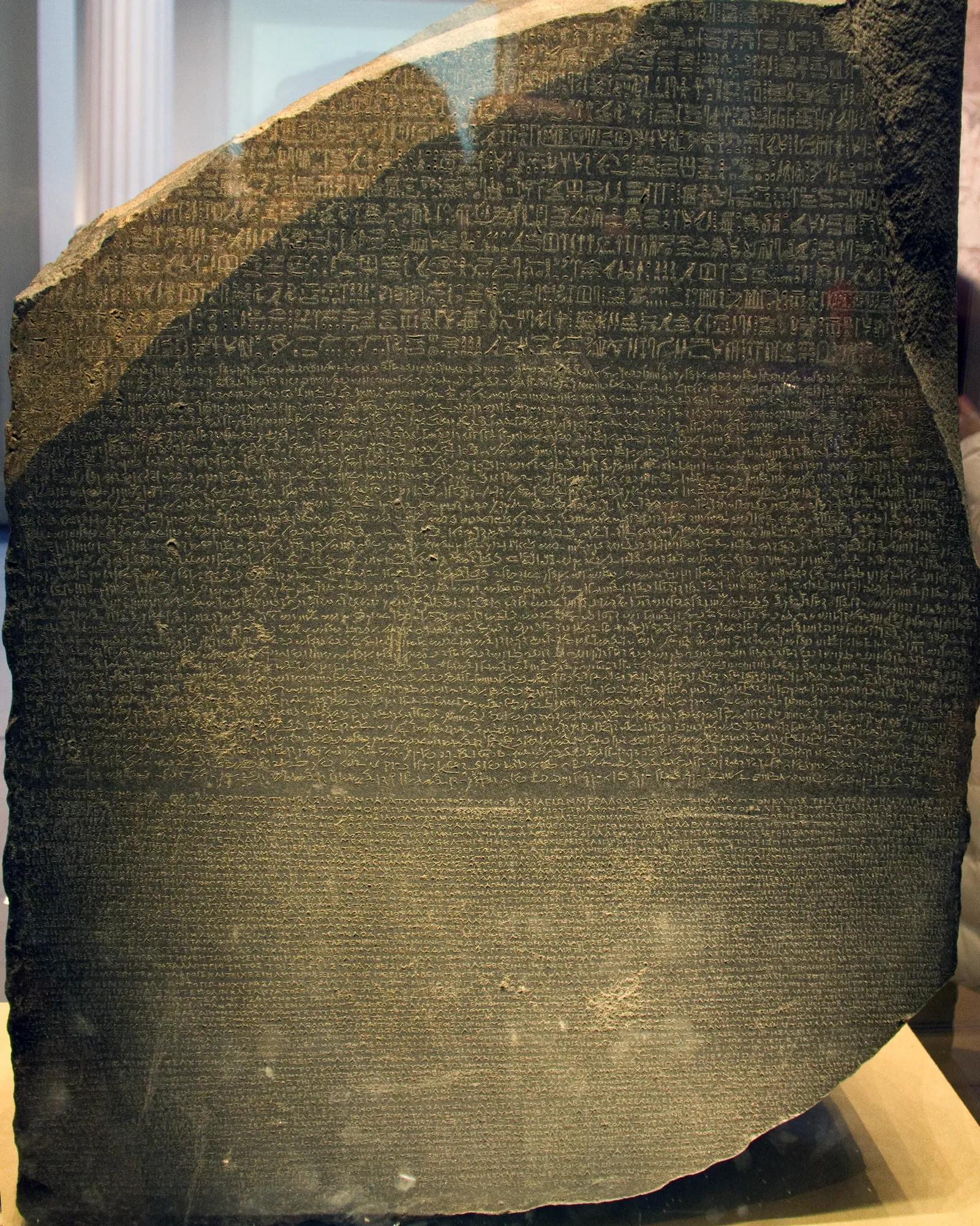
The Rosetta Stone on display in London. The hieroglyphic band at the top is the smallest of the three and the most damaged.
Museum no. EA 24 · Findspot: Fort Julien, near Rashid (Rosetta), reused in a wall
"Rosetta Stone" by Tony Hisgett — https://commons.wikimedia.org/wiki/File:Rosetta_Stone_(6488613003).jpg — CC BY 2.0 (https://creativecommons.org/licenses/by/2.0/)

The Rosetta Stone's hieroglyphic text is the most damaged of its three, and it holds only one royal name. That is not a modern complaint. Jean-François Champollion made it himself in the letter that announced his decipherment: the hieroglyphic text, he wrote, "ne présentait, à cause de ses fractures, que le seul nom de Ptolémée" (because of its fractures, it offered only the single name of Ptolemy; our translation).
The popular summary runs the other way. Wikipedia's article calls the stone "key to deciphering the Egyptian scripts," and the phrase "Rosetta Stone" has come to mean any essential clue to a new field of knowledge. The record supports part of that. The stone started the work, but finishing it took a second monument, the Coptic language and a chain of earlier sign lists.
What does the Rosetta Stone say?
The text is a decree in which priests assembled at Memphis voted new honors for the young king Ptolemy V. It is dated in two calendars at once, the 4th of the Macedonian month Xandikos and the 18th of the Egyptian month Mekhir in the king's ninth year, which current summaries equate with 27 March 196 BCE.
The regnal date comes from the decree's own dating clause rather than from a laboratory measurement or a modern estimate. So it is not a bare date, meaning a date given without its basis. Turning 18 Mekhir into 27 March 196 BCE · computed, proleptic Julian is a separate calculation with its own assumptions, and the double date itself is Disputed. It belongs in Egyptian Civil Calendar: Midwinter to Midsummer in 730 Years.
The last clause matters most for this case file. In E. A. Wallis Budge's 1913 rendering of that clause, the priests ordered copies "cut upon slabs" in three writings and "set up in the temples of the first, second and third orders, side by side with the statue of Ptolemy." The Rosetta Stone is therefore one of many intended copies, and its three texts carry one decree rather than three separate documents.
| Register | Script | Name in the decree (Budge 1913 rendering) | Lines surviving | Condition (Budge 1913) |
|---|---|---|---|---|
| Top | Hieroglyphic | "writing of the speech of the god" | 14 | 14 lines only |
| Middle | Demotic | "writing of the books" | 32 | first 14 imperfect at the beginnings |
| Bottom | Greek | "writing of the Ueienin" | 54 | last 26 imperfect at the ends |
Download: rosetta-stone-text-survival.csv (Data: E. A. Wallis Budge, The Rosetta Stone (London: British Museum, 1913), public domain, Project Gutenberg eBook #48649, https://www.gutenberg.org/ebooks/48649) (sources and license, JSON).
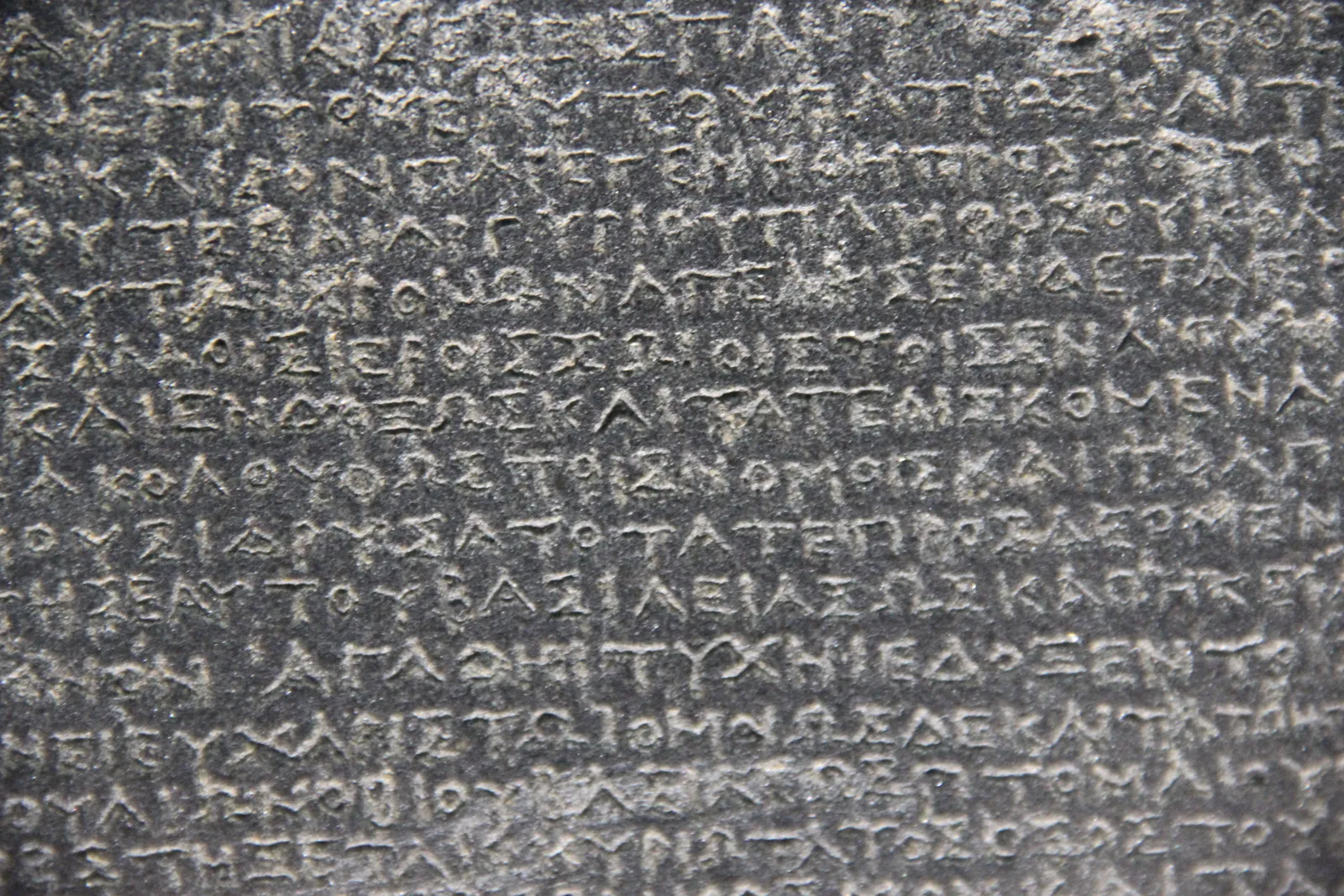
Part of the Greek text in the bottom register, the version that gave scholars the content of the broken Egyptian versions.
Museum no. EA 24 · Findspot: Fort Julien, near Rashid (Rosetta), reused in a wall
"Greek Script from Rosetta Stone" by Gary Todd — https://commons.wikimedia.org/wiki/File:Greek_Script_from_Rosetta_Stone_(36536689805).jpg — CC0 1.0 (https://creativecommons.org/publicdomain/zero/1.0/)

Where was the Rosetta Stone found?
French soldiers found the stone in 1799 · documentary at Fort Julien, near the port of Rashid, which Europeans called Rosetta. Budge names the finder as an officer of engineers whose name was spelled "Boussard" or "Bouchard." Budge also records two versions of the find: in one the stone lay on the ground, and in the other it was built into "a very old wall" that soldiers were clearing for an addition to the fort.
Budge's 1913 guide gives the month as August, which is now an Outdated claim. Wikipedia's summary, citing Parkinson et al. (1999), follows the wall account, dates the find to mid-July and says a report on it was received at the Institut d'Égypte on 19 July 1799. The findspot is a fort. A fort is not where a temple decree was meant to stand.
A stone reused as building material sits in a secondary context, so the fort shows where the slab ended up rather than where the priests' copy was displayed. Think of the stone as a word lifted out of its sentence and set into a wall: the word still reads, but the sentence around it, the temple and the royal statue that the decree itself prescribed, left no record at Rashid.
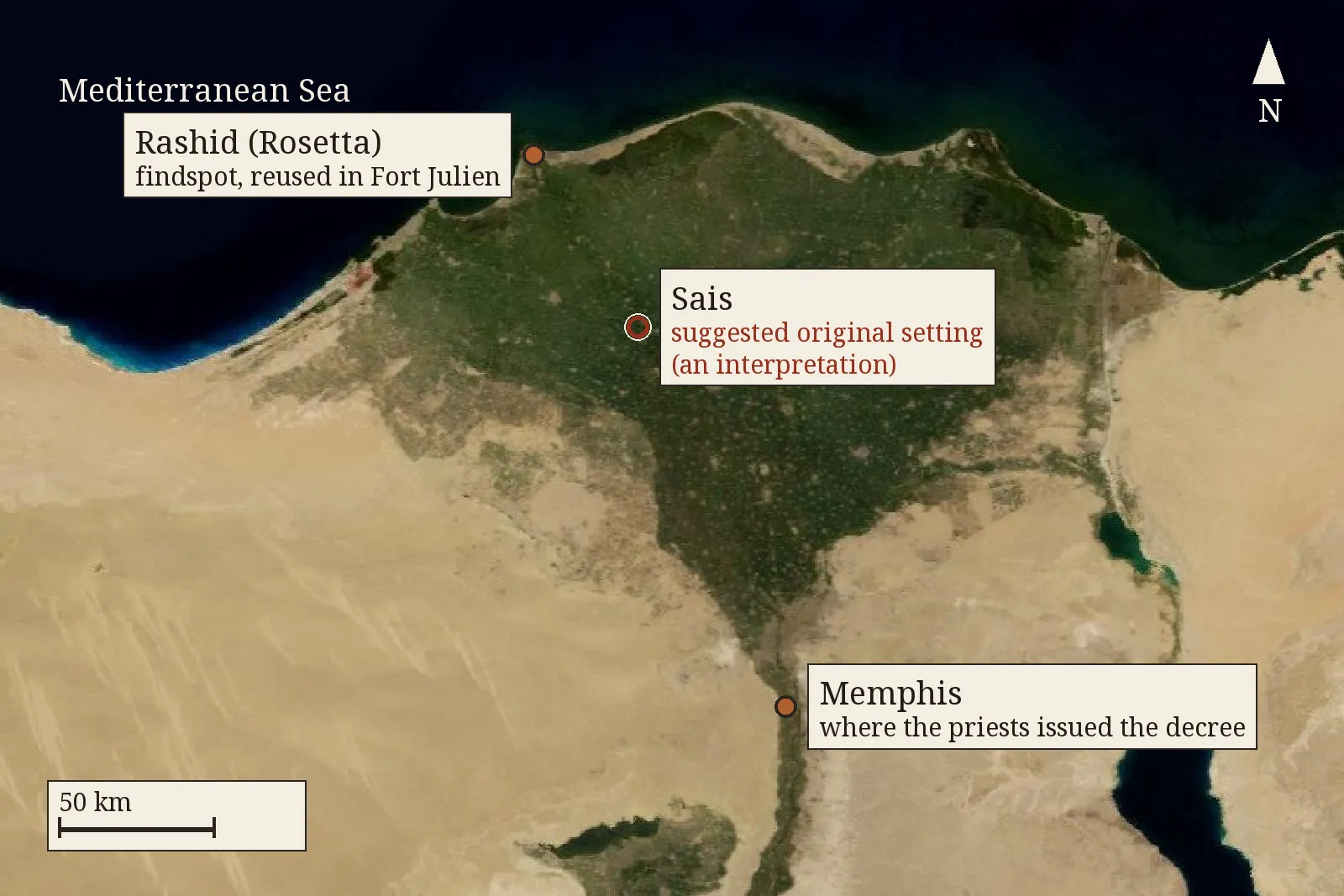
Open the full-size image to read the labels.
Where the stone was found and where the decree was issued, marked at town level. Sais, a suggested original setting, is an interpretation, not an observation.
"Rosetta Stone: findspot and the decree's place of issue" by Sherd and Script, https://sherdandscript.com/scripts/rosetta-stone/, licensed under CC BY 4.0 (https://creativecommons.org/licenses/by/4.0/)Data: Base image: NASA Blue Marble Next Generation (layer BlueMarble_NextGeneration), provided by services from NASA's Global Imagery Browse Services (GIBS), part of NASA's Earth Science Data and Information System (ESDIS), https://nasa-gibs.github.io/gibs-api-docs/; Town locations: Wikidata (CC0), rounded to town level
Where it first stood is an interpretation rather than an observation. Wikipedia's summary, citing Parkinson (2005), says it more likely came from a temple farther inland, "possibly the royal town of Sais," but no excavation record places it there.
How did the Rosetta Stone reach the British Museum?
The later chain of custody is better documented, in Budge's guide and in Wikipedia's summary. Under the capitulation of 1801 · documentary the French surrendered the stone to the British. It reached Portsmouth in February 1802 and was shown at the Society of Antiquaries of London on 11 March 1802 · documentary. It entered the British Museum before the end of that year and received its inventory number, EA 24, in the middle of the 19th century (the number as given by Wikidata Q48584; the museum's own record was not read).
Budge called the slab "black basalt," a label that is now an Outdated claim. According to Wikipedia's summary, carnauba wax applied in London darkened the surface and led to the basalt label, the 1999 cleaning removed it, and the rock is granodiorite.
How much of the hieroglyphic text survives?
Look at the top band first. Budge counted 14 hieroglyphic lines and matched them to "the last 28 lines of the Greek text," and since the Greek runs to 54 lines, its first 26 lines have no hieroglyphic counterpart on this stone.
That is 26 of 54 Greek lines, or 48 percent, computed from Budge's counts. On average, each surviving hieroglyphic line matches two Greek lines. The Demotic, with 32 lines, is in the best state of the three according to Wikipedia's summary, and Budge notes that only its first 14 lines are imperfect at the beginnings. How that middle script works is a subject beyond this case file.
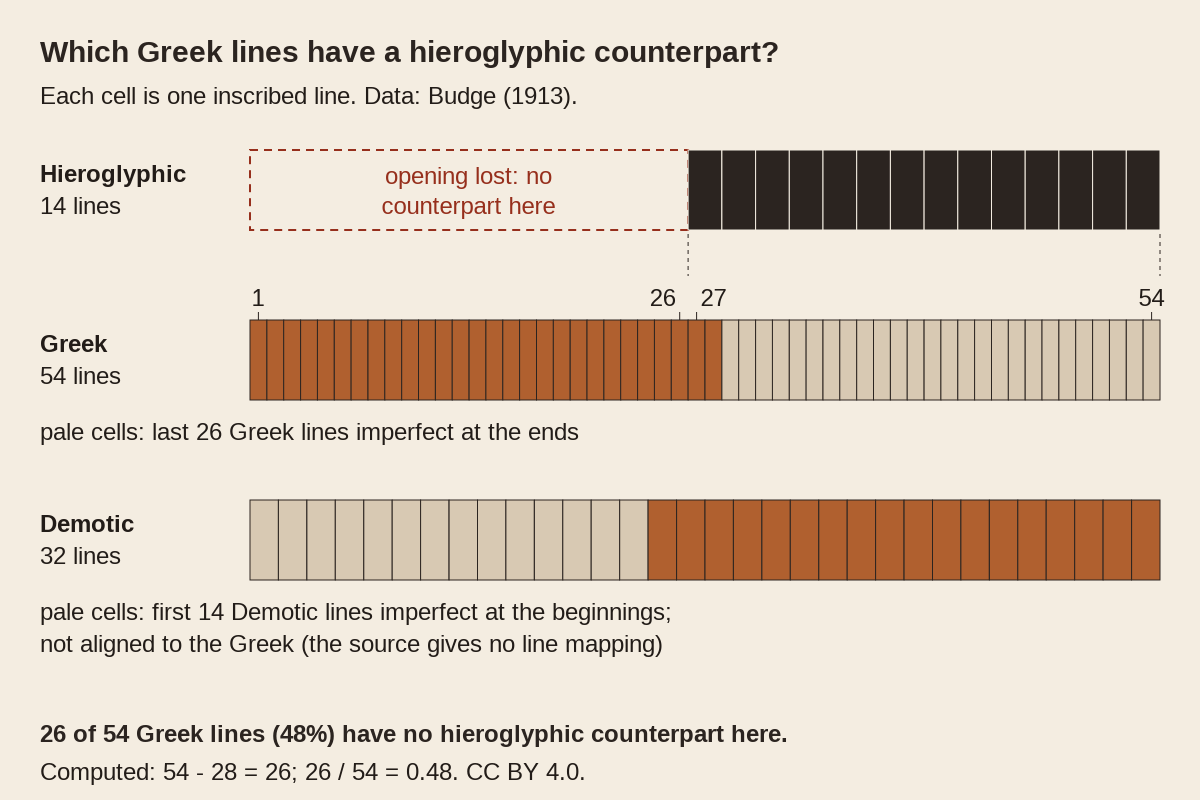
Scroll sideways to read every label, or open the full drawing.
Each cell is one inscribed line. Greek lines 1 to 26 have no hieroglyphic counterpart on the stone. Download the CSVs: line counts (sources and license, JSON), computed measures (sources and license, JSON).
"Rosetta Stone: which Greek lines still have a hieroglyphic counterpart" by Sherd and Script, https://sherdandscript.com/scripts/rosetta-stone/, licensed under CC BY 4.0 (https://creativecommons.org/licenses/by/4.0/)Data: E. A. Wallis Budge, The Rosetta Stone (London: British Museum, 1913), public domain, Project Gutenberg eBook #48649, https://www.gutenberg.org/ebooks/48649
One small conflict stays visible in the chart. Budge says the last 26 Greek lines are imperfect, which leaves 28 complete, while Wikipedia's summary, read in 2026, says the first 27 survive in full; the chart follows Budge because his counts were printed by the museum that holds the stone.
The missing hieroglyphs are not lost everywhere. Budge wrote that "a large portion" of them could be restored from a stele found at Damanhur in 1898 · documentary and from a copy cut on a temple wall at Philae. Wikipedia's summary, as of 2026, lists three other copies of the decree. The Damanhur stele, at least, came too late to help, since it turned up 76 years after Champollion's letter.
Why couldn't the Rosetta Stone alone crack hieroglyphs?
Champollion spelled out what his method needed. In the Lettre he wrote that it would have been enough to have the names of two Greek kings "écrits en hiéroglyphes purs" (written in pure hieroglyphs), known in advance and sharing several letters, "tels que Ptolémée et Cléopâtre." One name gives you guesses, while two names that overlap give you a test.
The stone supplied only one. Budge put it plainly in 1913: "There is only one cartouche (five times repeated with slight modifications) on the Rosetta Stone." A cartouche is the oval ring that encloses a royal name. Five writings of the same name, even with slight variations, spell the same name, so they cannot test a sound value against a different word.
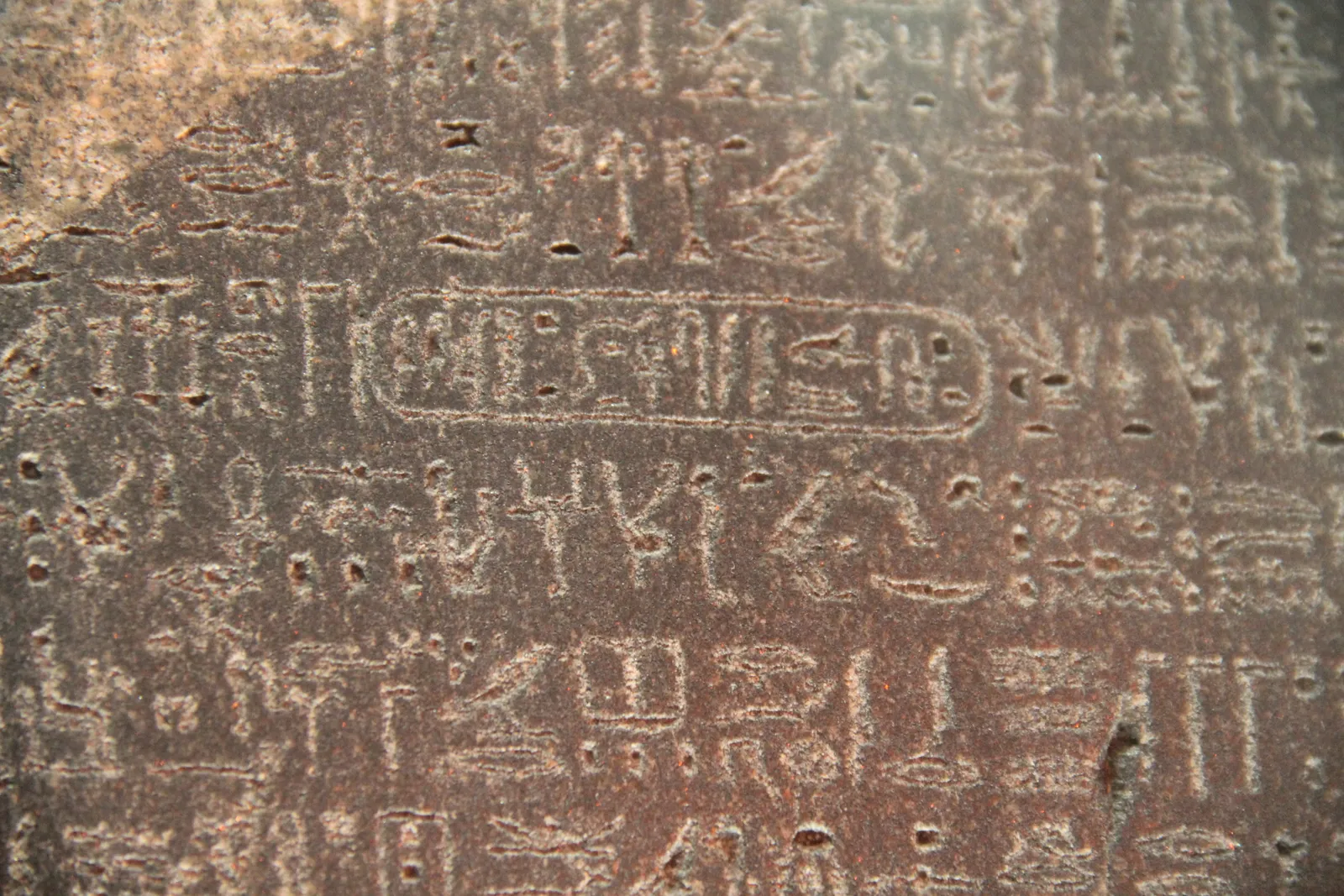
A cartouche in the stone's hieroglyphic text. Budge counted only one cartouche on the stone, repeated five times with slight modifications.
Museum no. EA 24 · Findspot: Fort Julien, near Rashid (Rosetta), reused in a wall
"Egyptian Hieroglyphics with Royal Cartouche from Rosetta Stone" by Gary Todd — https://commons.wikimedia.org/wiki/File:Egyptian_Hieroglyphics_with_Royal_Cartouche_from_Rosetta_Stone_(35483685014).jpg — CC0 1.0 (https://creativecommons.org/publicdomain/zero/1.0/)

| With Ptolemy alone | With Ptolemy and Cleopatra |
|---|---|
| Assign a sound to each sign by position in the Greek name | Shared letters (P, O, L) must use the same signs in both names |
| Nothing can show that a guess is wrong | Letters found in only one name (K, A, R) must not appear in the other |
| Any spelling theory fits one word | A wrong value shows up as a mismatch |
A second problem sat inside the stone itself: the three versions do not match word for word. Wikipedia's summary, citing Parkinson (1999), says this made the work harder than early scholars expected. Its article on the decipherment, citing Adkins (2000) and Pope (1999), says Thomas Young's attempt to break the texts into matching sign groups was "of limited use" for the same reason.
How did the Philae obelisk test the Ptolemy cartouche?
The second name came from an obelisk that William John Bankes had found at Philae, in Upper Egypt, in 1815 · documentary, according to Budge, and had shipped to England. Wikipedia's summary, citing Masséglia (2020), says it reached London in December 1821 · documentary, and it now stands in the garden at Kingston Lacy in Dorset.
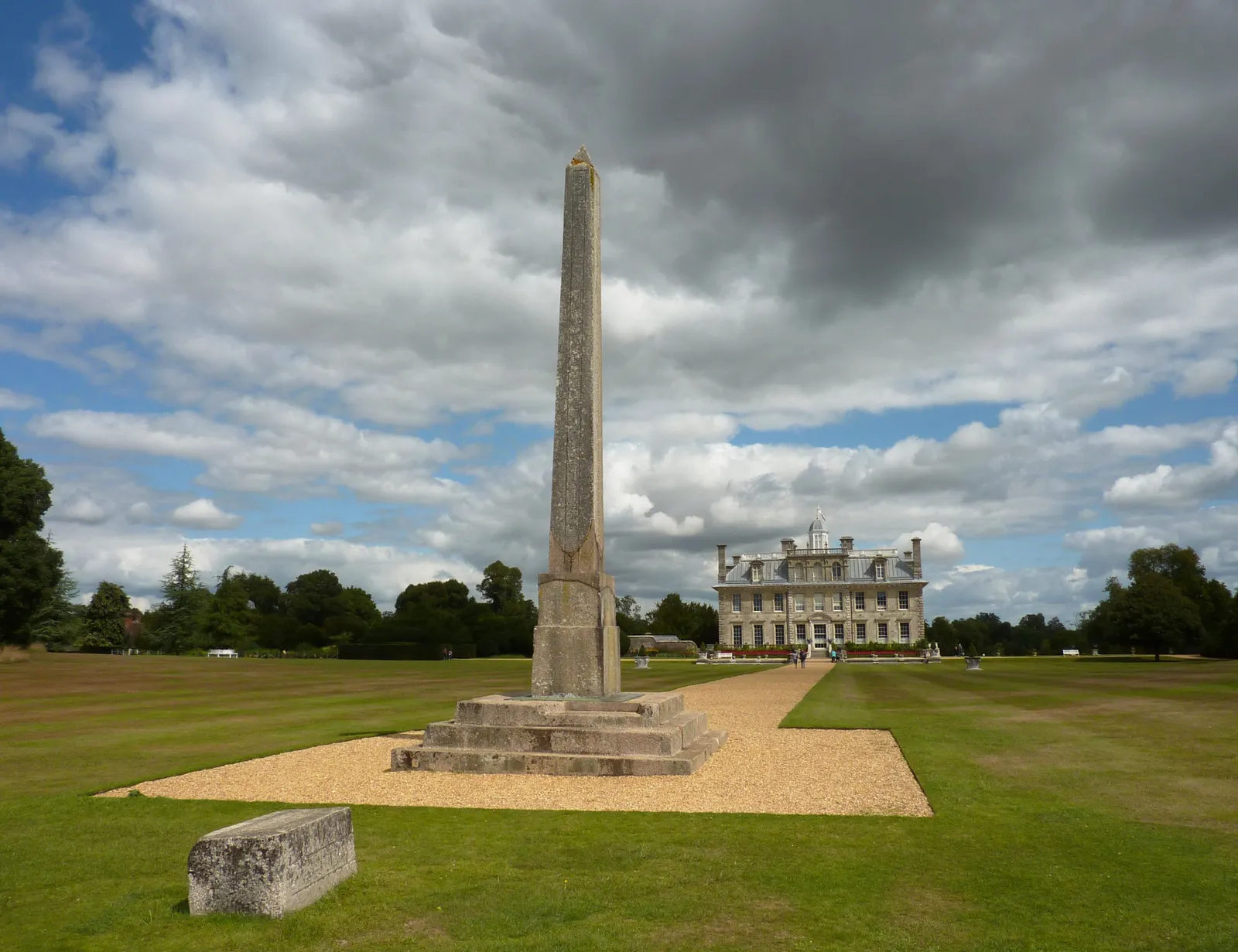
The Philae obelisk in the garden at Kingston Lacy, Dorset.
Findspot: Philae, Upper Egypt
"Egyptian Obelisk at Kingston Lacy" by Adrian Farwell — https://commons.wikimedia.org/wiki/File:Egyptian_Obelisk_at_Kingston_Lacy_-_panoramio.jpg — CC BY 3.0 (https://creativecommons.org/licenses/by/3.0/)

Champollion described it in the Lettre as "récemment transporté à Londres" (recently brought to London). It carries the Ptolemy cartouche in the same signs as the Rosetta Stone, followed by a second cartouche that ends in the signs Egyptian writing uses for female names.
A Greek inscription on a base, which Champollion noted was said to belong with the obelisk, is a petition from the priests of Isis at Philae to King Ptolemy, "à Cléopâtre sa sœur, et à Cléopâtre sa femme" (to Cleopatra his sister and to Cleopatra his wife). Letronne had published a study of that inscription in 1822.
Champollion's identification was conditional. He wrote the condition down: if the obelisk and its hieroglyphs followed from the priests' petition, he argued, then the woman's cartouche had to name a Cleopatra. Modern summaries support the caution, since the two inscriptions are not a single bilingual text (Wikipedia, citing Parkinson 1999).
How did Champollion compare Ptolemy and Cleopatra?
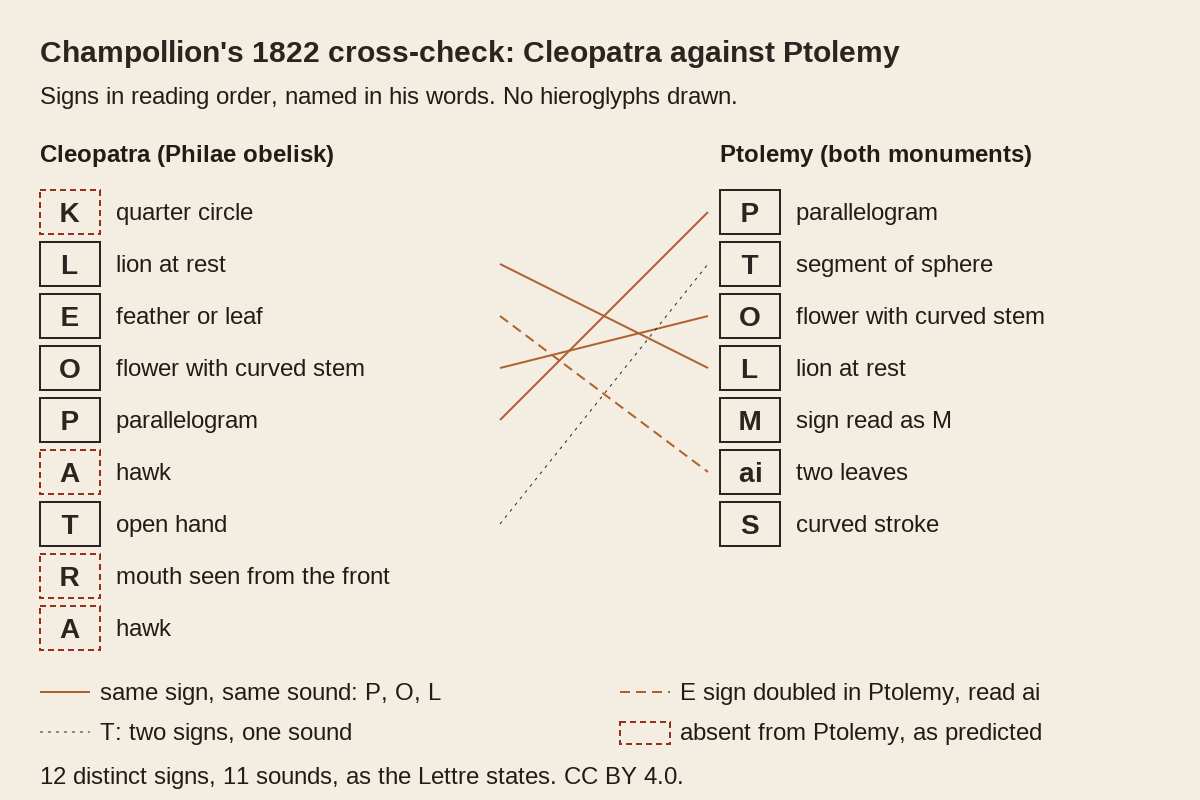
Then came the test, sign by sign. Champollion wrote that the quarter-circle sign for K "ne devait point se trouver dans le nom de Ptolémée : il n'y est point en effet" (should not be in the name of Ptolemy, and indeed is not). The lion for L matched Ptolemy's fourth sign, the flower for O the third and the parallelogram for P the first, while the hawk for A and the mouth for R were absent from Ptolemy, as he said they should be.
Scroll sideways to read every label, or open the full drawing.
Champollion's cross-check, with signs named in his own words. No hieroglyphs are drawn. Download the CSV (sources and license, JSON).
"Champollion's 1822 cross-check: Cleopatra against Ptolemy" by Sherd and Script, https://sherdandscript.com/scripts/rosetta-stone/, licensed under CC BY 4.0 (https://creativecommons.org/licenses/by/4.0/)Data: J.-F. Champollion, Lettre à M. Dacier (Paris: Firmin Didot, 1822), public domain, French Wikisource transcription, https://fr.wikisource.org/wiki/Lettre_%C3%A0_M._Dacier_relative_%C3%A0_l%E2%80%99alphabet_des_hi%C3%A9roglyphes_phon%C3%A9tiques
One letter failed the simple version of the test: Cleopatra writes T with an open hand, while Ptolemy writes it with what Champollion called a segment of a sphere. He kept both values and argued that the two signs were homophones, different signs for one sound. That was an extra hypothesis, and he promised to justify it later in the letter.
The combined result was modest and exact: "douze signes" for "onze" sounds, twelve signs answering to eleven Greek letters or diphthongs. A script check on the CSV gives the same count. The test showed that hieroglyphs could spell two Greek royal names by sound, but it did not yet show anything about Egyptian words.
Who did the groundwork before Champollion?
On this site's reading, decipherments rest on dull tables. This one had several sign lists and studies behind it by 1822. Popular accounts compress it into one scene: Wikipedia's article on the Lettre, citing Adkins and Adkins (2000), says that on 14 September 1822 · biographical account Champollion cried "Je tiens l'affaire!" ("I've got it!") and fainted. Wikipedia's decipherment article, citing Buchwald and Josefowicz (2020), traces the earliest version of that story to an account written in 1856.
The ledger below shows what was already on his desk. Cuneiform shows why a single sign can need several entries in such a list.
| Date and basis | Who | What they added | Source read |
|---|---|---|---|
1802 · documentary | Silvestre de Sacy and Johan David Åkerblad | Found Greek names such as Alexander and Ptolemy in the Demotic text | Budge 1913 (Åkerblad); Wikipedia summary (Silvestre de Sacy); credited in the Lettre |
1819 · documentary | Thomas Young | Read Ptolemy in the hieroglyphic text and Berenice on another monument; published in a Britannica supplement | Budge 1913; Lettre footnote |
1815–1818 · documentary | William John Bankes | Found the Philae obelisk; proposed Cleopatra for its second cartouche | Budge 1913; Wikipedia summary of Robinson 2012 |
1822 · documentary | Antoine-Jean Letronne | Published a study of the Greek petition linked to the obelisk | Lettre footnote |
1822 · documentary | Jean-François Champollion | Lettre à M. Dacier, dated 22 September; extract read to the Académie on 27 September | Lettre |
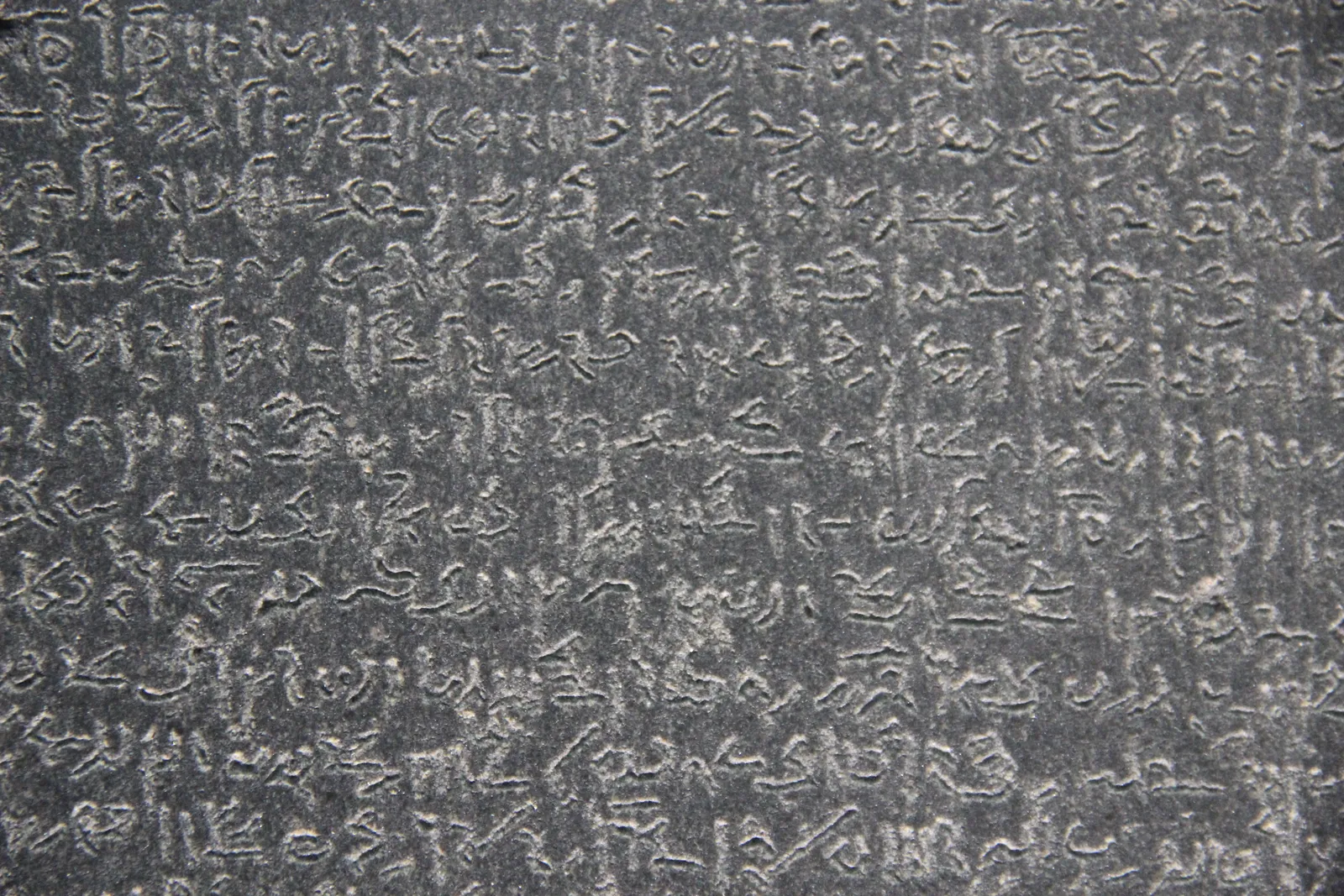
Part of the Demotic text, in which Budge credits Åkerblad with identifying the names Alexander and Ptolemy.
Museum no. EA 24 · Findspot: Fort Julien, near Rashid (Rosetta), reused in a wall
"Egyptian Demotic Script from Rosetta Stone" by Gary Todd — https://commons.wikimedia.org/wiki/File:Egyptian_Demotic_Script_from_Rosetta_Stone_(35701836264).jpg — CC0 1.0 (https://creativecommons.org/publicdomain/zero/1.0/)

How much Young got right is Disputed. The two older sources used here disagree. Champollion's footnote credits Young with the correct values of four signs but says Young treated name signs as whole syllables, "une sorte de rébus," a starting point that largely distorted the rest of his analysis.
Budge in 1913 says Young's values were correct "in most cases" and that he "was the first to grasp the idea of a phonetic principle." Wikipedia's summary, citing Robinson (2012), adds that scholarly opinion has been divided over Champollion's later claim, made in the Précis, that he had not seen Young's article.
Bankes fares worse in the Lettre, where a text search of the Wikisource transcription finds no mention of him. Budge credits Bankes with deciphering Cleopatra's name in 1818. Wikipedia's summary of Robinson (2012) calls it a penciled guess on his copy, which Champollion saw in January 1822, and says Bankes, assuming his idea had been taken without credit, refused further help.
The Lettre itself rests on no new fieldwork. Champollion worked from copies of the obelisk, a Demotic papyrus in the royal library and plates printed in the Description de l'Égypte, so in this site's terms it was an archive dig: new conclusions drawn from old records.
What turned names into a language?
Names spelled by sound are not yet a language, and to translate one, Budge wrote in 1913, "a competent knowledge of Coptic was required." Coptic is the last stage of Egyptian, written with an alphabet taken from Greek and kept readable by its church books. Champollion had studied it since his youth, and the Lettre already reaches for Coptic words when it discusses sign values.
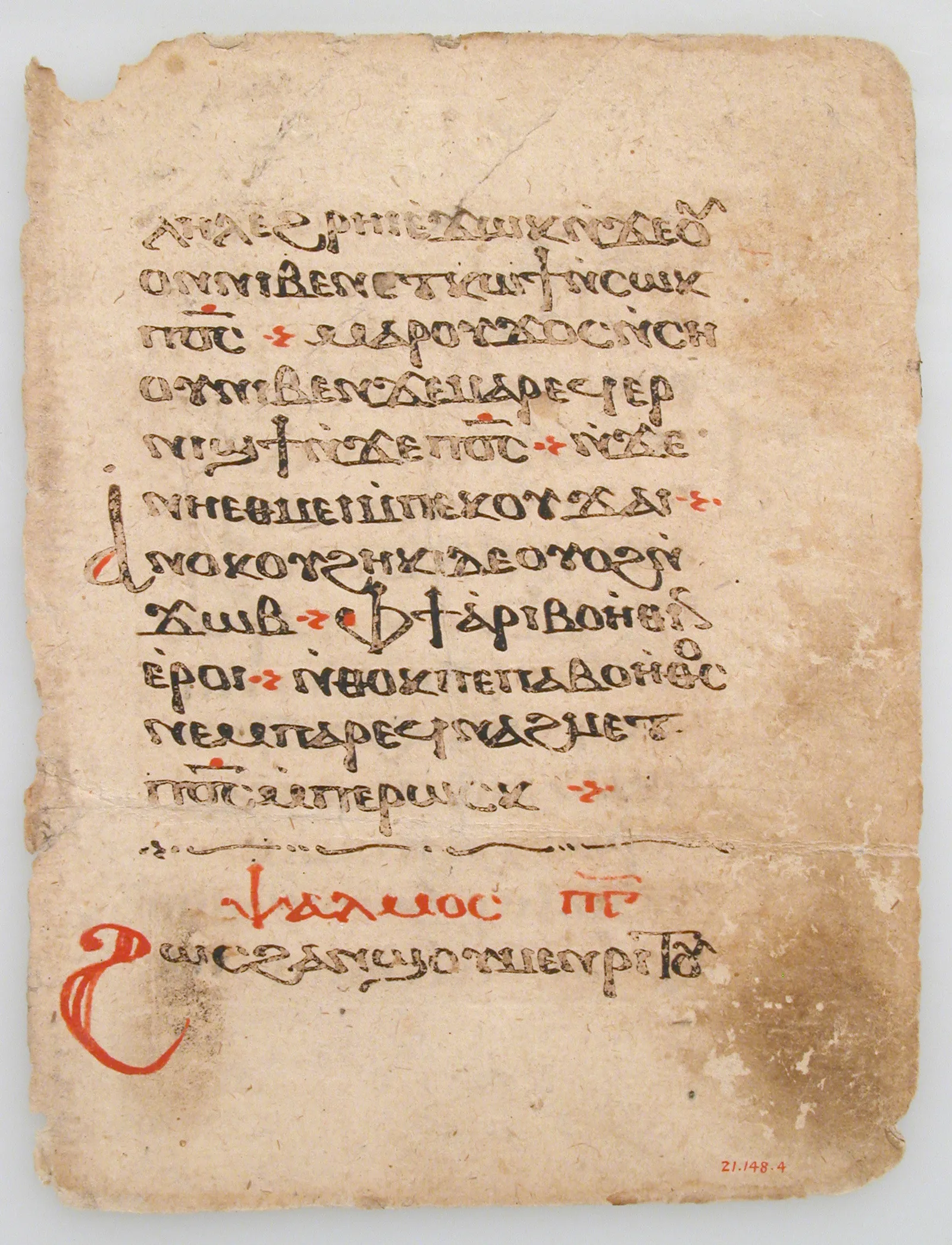
A leaf from a Coptic manuscript, as the museum catalogs it. Its findspot is unrecorded, so the leaf shows the script but not where this copy was used.
Museum no. 21.148.4a, b · Findspot: unrecorded
"Leaf from a Coptic Manuscript" by The Metropolitan Museum of Art — https://commons.wikimedia.org/wiki/File:Leaf_from_a_Coptic_Manuscript_MET_sf21-148-4s1.jpg — CC0 1.0 (https://creativecommons.org/publicdomain/zero/1.0/)

The Lettre also marks its own limit. Near the end, Champollion says he is certain that the same sound signs appear in texts carved long before the Greeks arrived, then defers the proof to later work. Wikipedia's summary, citing Buchwald and Josefowicz (2020), describes this as a suggestion made "without elaboration."
| Claim | Where it was made | Evidence offered there |
|---|---|---|
| Hieroglyphs spell Greek and Roman royal names by sound | Lettre, 1822 · documentary | Cartouche comparisons, beginning with Ptolemy and Cleopatra |
| The same sound signs occur in much older native texts | Lettre, 1822 · documentary | Asserted; proof deferred |
| Native pharaohs' names, such as Ramesses, are partly spelled by sound | Précis du système hiéroglyphique, 1824 · documentary | Cartouches from Abu Simbel copied by Huyot |
The Précis, printed in Paris in 1824, reads Ramesses from cartouches at Abu Simbel copied by Huyot, a member of the Institut. Wikipedia's summary, citing Buchwald and Josefowicz (2020) on Hartleben's 1906 biography, places a breakthrough with those copies on 14 September 1822 · biographical account, eight days before the Lettre is dated. By that account, he read a native king's name, Ramesses, partly by sound.
What did Champollion still get wrong?
Even then the system was incomplete. Wikipedia's summary of Robinson (2012) notes that Champollion read the middle sign in Ramesses and Thutmose as a single m, when it stands for two consonants, ms. Young's Demotic work also waited for a second bilingual: in November 1822 · documentary he matched a Greek papyrus to a Demotic one and made his main progress after that (Wikipedia, citing Buchwald and Josefowicz 2020).
One question about the stone itself is still open. Which version was composed first is Disputed: Letronne argued in 1841 · documentary for the Greek, Budge wrote in 1913 that "the original form of the Decree is given by the Demotic section," and later authors cited by Wikipedia, Derchain and Thissen, argue that all three were drafted together.
Proof radius
What this box is for: the proof radius.
Proves: The Rosetta Stone carries one decree in three scripts, so its Greek gave the content of the broken Egyptian versions and showed where the royal name had to fall; read against Cleopatra, its one cartouche showed that hieroglyphs could spell a Greek name by sound.
Doesn't prove: That the stone, or one person in one moment, deciphered hieroglyphs. Its single name could not test itself, and the step from foreign names to Egyptian words leaned on other monuments and on Coptic.
Read next: Linear B: another script that yielded to tables before anyone read a sentence. Egyptian civil calendar: the decree's date clause, converted step by step.
Sources
Primary sources first.
- 1Jean-François Champollion, Lettre à M. Dacier relative à l'alphabet des hiéroglyphes phonétiques (Paris: Firmin Didot, 1822), French Wikisource transcription. https://fr.wikisource.org/wiki/Lettre_%C3%A0_M._Dacier_relative_%C3%A0_l%E2%80%99alphabet_des_hi%C3%A9roglyphes_phon%C3%A9tiques Read: full text (French Wikisource transcription)
- 2Jean-François Champollion, Précis du système hiéroglyphique des anciens Égyptiens (Paris: Treuttel et Würtz, 1824), Internet Archive scan. https://archive.org/details/prcisdusystmehi00chamgoog Read: scan (Internet Archive)
- 3E. A. Wallis Budge, The Rosetta Stone (London: British Museum, 1913), Project Gutenberg eBook #48649. https://www.gutenberg.org/ebooks/48649 Read: full text (Project Gutenberg)
- 4Wikidata, "Rosetta Stone" (Q48584): inventory number, collection, dimensions. https://www.wikidata.org/wiki/Q48584 Read: Wikidata item (structured statements, CC0)
- 5Wikipedia, "Rosetta Stone" (read 2026-10-07; used for current summaries and the scholarship it cites). https://en.wikipedia.org/wiki/Rosetta_Stone Read: article text
- 6Wikipedia, "Decipherment of ancient Egyptian scripts" (read 2026-10-07). https://en.wikipedia.org/wiki/Decipherment_of_ancient_Egyptian_scripts Read: article text
- 7Wikipedia, "Philae obelisk" (read 2026-10-07). https://en.wikipedia.org/wiki/Philae_obelisk Read: article text
- 8Wikipedia, "Lettre à M. Dacier" (read 2026-10-07). https://en.wikipedia.org/wiki/Lettre_%C3%A0_M._Dacier Read: article text
- 9Wikimedia Commons, file page "Leaf from a Coptic Manuscript MET sf21-148-4s1.jpg" (Metropolitan Museum of Art record 21.148.4a, b as mirrored on Commons; the museum's page was not read). https://commons.wikimedia.org/wiki/File:Leaf_from_a_Coptic_Manuscript_MET_sf21-148-4s1.jpg Read: file page and its metadata
Cite this page
Sherd and Script. “Rosetta Stone: Its Broken Hieroglyphs Held Only One Royal Name.” Sherd and Script. Published 13 October 2026. https://sherdandscript.com/scripts/rosetta-stone/ (accessed ).
Corrections
None yet.