How we know
Carbon Dating: How One Lab Result Became a 114-Year Range
Sherd and Script · Published 13 October 2026 · Revised 23 October 2026
A linen wrapping tied to an Egyptian queen shows how a radiocarbon measurement becomes a calendar range, and why that range dates the flax, not the burial.
Find card
- Object / Site
- Linen mummy wrapping associated with Queen Satdjehuty: a bundle 23 × 16 cm with a plain warp fringe and no inscription; the dated sample was taken from it in 2013
- Findspot
- Unrecorded. Satdjehuty's burial remains were found around 1820 with no record of the findspot; Dra Abu el-Naga, Thebes, is only a suggestion
- Context
- No excavation context. Bought by the British Museum in 1880 from Morten & Son (sale of Samuel Hull's collection) with a mask and other wrappings; Samuel Birch suggested in 1880 that they belonged to one person
- Dated by
- Radiocarbon: AMS, two measurements averaged (GrA-59770, Groningen), calibrated by the study's authors in OxCal 4.4.4 against IntCal20
- Range
1624–1510 BCE · radiocarbon, cal. 2σ(95.4%), from 3310 ± 25 BP; at 68.3%, 1612–1573 BCE (39.8%) and 1566–1538 BCE (28.5%); median 1574 BCE; as of 2026- Dated event
- Growth and harvest of the flax whose fibers made the cloth; not the weaving, the wrapping or Satdjehuty's burial
- Now at
- British Museum, London, EA 37106 (registration number 1880,0521.12), as given by Bruins and van der Plicht 2025; the museum's page was not read
- Primary record
- Bruins and van der Plicht, PLOS ONE 20(9): e0330702 (2025), Table 5 and Fig 10, https://doi.org/10.1371/journal.pone.0330702. The British Museum collection record was not read
Find card as CSV carbon-dating-find-card.csv (sources and license, JSON)Data: H. J. Bruins and J. van der Plicht, "The Minoan Thera eruption predates Pharaoh Ahmose," PLOS ONE 20(9): e0330702 (2025), CC BY 4.0, https://doi.org/10.1371/journal.pone.0330702
TL;DR. Carbon dating measures the carbon-14 left in material that was once alive, so it dates when that plant or animal stopped taking in carbon. A linen wrapping linked to Queen Satdjehuty measured 3310 ± 25 BP, and the IntCal20 curve turns that into 1624–1510 BCE · radiocarbon, cal. 2σ, a range 114 years wide, as of 2026. The range belongs to the flax harvest rather than her burial, and only special cases, such as L'Anse aux Meadows, can be fixed to a single year.
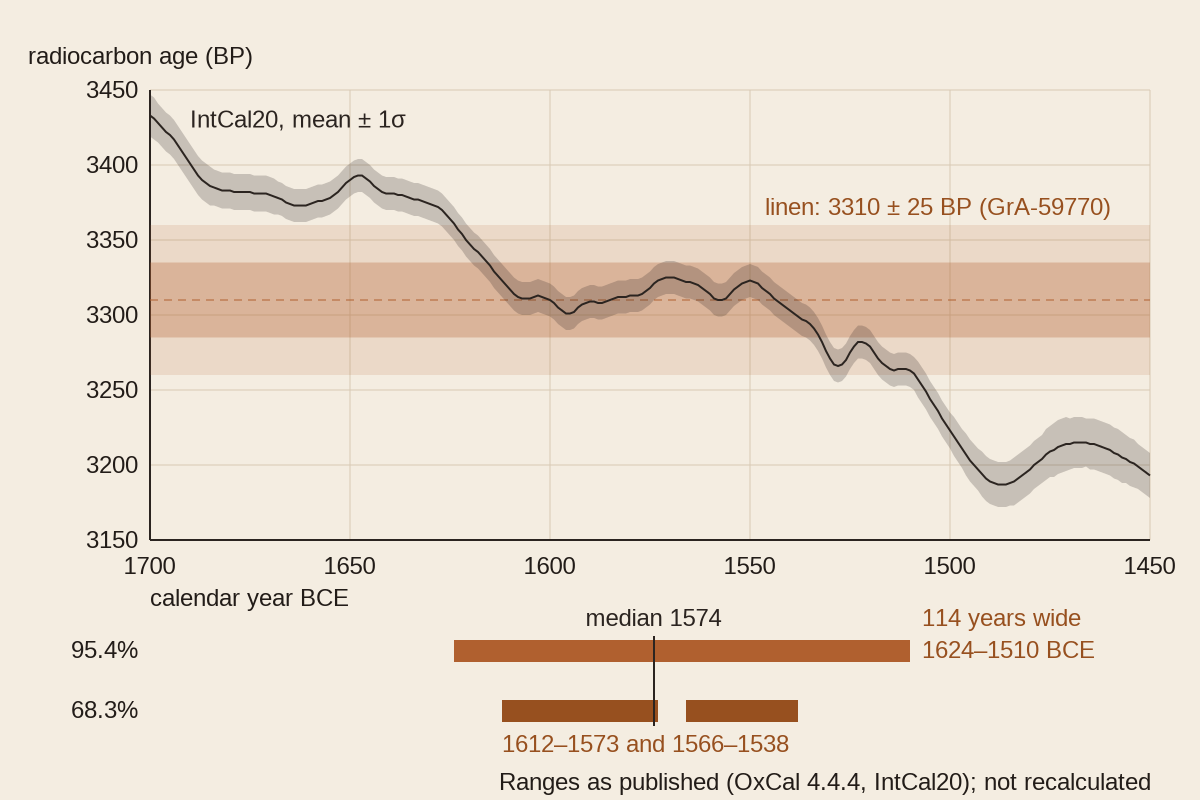
Scroll sideways to read every label, or open the full drawing.
The linen's measurement drawn across the IntCal working group's IntCal20 curve, with the ranges the study published marked below. The chart draws those ranges; it does not recalibrate the result.
Museum no. EA 37106 · Findspot: unrecorded
"Linen EA 37106: one radiocarbon measurement against the IntCal20 curve" by Sherd and Script, https://sherdandscript.com/evidence/carbon-dating/, licensed under CC BY 4.0 (https://creativecommons.org/licenses/by/4.0/)Data used under CC BY: Published ranges: H. J. Bruins and J. van der Plicht, PLOS ONE 20(9): e0330702 (2025), Table 5, CC BY 4.0, https://doi.org/10.1371/journal.pone.0330702
Data sources for this figure
Data: IntCal20 calibration curve (Reimer et al. 2020), file intcal20.14c from the IntCal working group, https://intcal.org/curves.html (no reuse license stated; values drawn only, not redistributed); Published ranges: H. J. Bruins and J. van der Plicht, PLOS ONE 20(9): e0330702 (2025), Table 5, CC BY 4.0, https://doi.org/10.1371/journal.pone.0330702
A linen fragment in the British Museum, EA 37106, measured 3310 ± 25 radiocarbon years old. That figure is the laboratory result of carbon dating. It is counted in radiocarbon years before 1950 (BP) rather than calendar years. Calibrated against the IntCal20 curve, it becomes 1624–1510 BCE · radiocarbon, cal. 2σ, according to a 2025 study by Hendrik Bruins and Johannes van der Plicht.
Each step between the laboratory and the calendar widens or moves that answer. The last step decides what the answer is about: the range belongs to the flax that made the cloth, a different event from the burial the cloth was used for.
What does carbon dating actually measure?
Carbon-14 forms in the atmosphere when neutrons from cosmic rays strike nitrogen atoms. It is oxidized to carbon dioxide and mixes through the air and the rest of the exchanging carbon, so living things carry a steady level of it while they live, as L. A. Currie's 2004 history of the method summarizes Willard Libby's work.
When the plant or animal dies, its intake stops. The carbon-14 already inside decays. Half of it is gone after about 5,730 years, the half-life of 5,730 ± 40 years that Godwin published in 1962, as cited by Currie. By convention, laboratories still compute reported ages with Libby's older value of 5,568 years and count "present" as 1950.
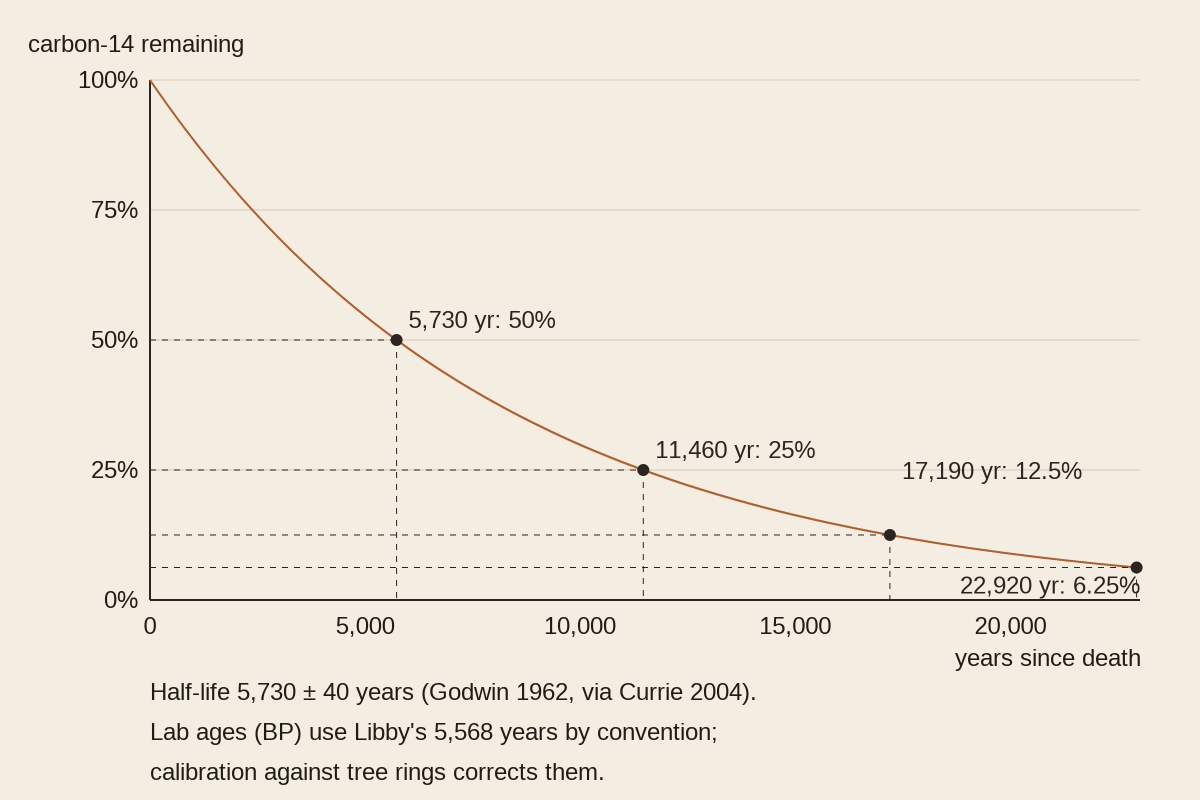
Scroll sideways to read every label, or open the full drawing.
Carbon-14 left after death, by this page's calculation from the 5,730-year half-life. Each half-life halves what is left; none of this yet gives a calendar year.
"How much carbon-14 is left after death" by Sherd and Script, https://sherdandscript.com/evidence/carbon-dating/, licensed under CC BY 4.0 (https://creativecommons.org/licenses/by/4.0/)Data: Half-life values: L. A. Currie, "The Remarkable Metrological History of Radiocarbon Dating [II]," J. Res. Natl. Inst. Stand. Technol. 109(2): 185-217 (2004), CC0, https://doi.org/10.6028/jres.109.013
So the dated event is the moment an organism stopped taking in carbon, and for the linen that organism was a flax plant. Laboratories measure the carbon-14 that remains against a modern standard. The Groningen and Mannheim laboratories in this page's examples use accelerator mass spectrometry (AMS), which measures the ratio of carbon-14 to carbon-12 in a sample (Kuitems et al. 2022).
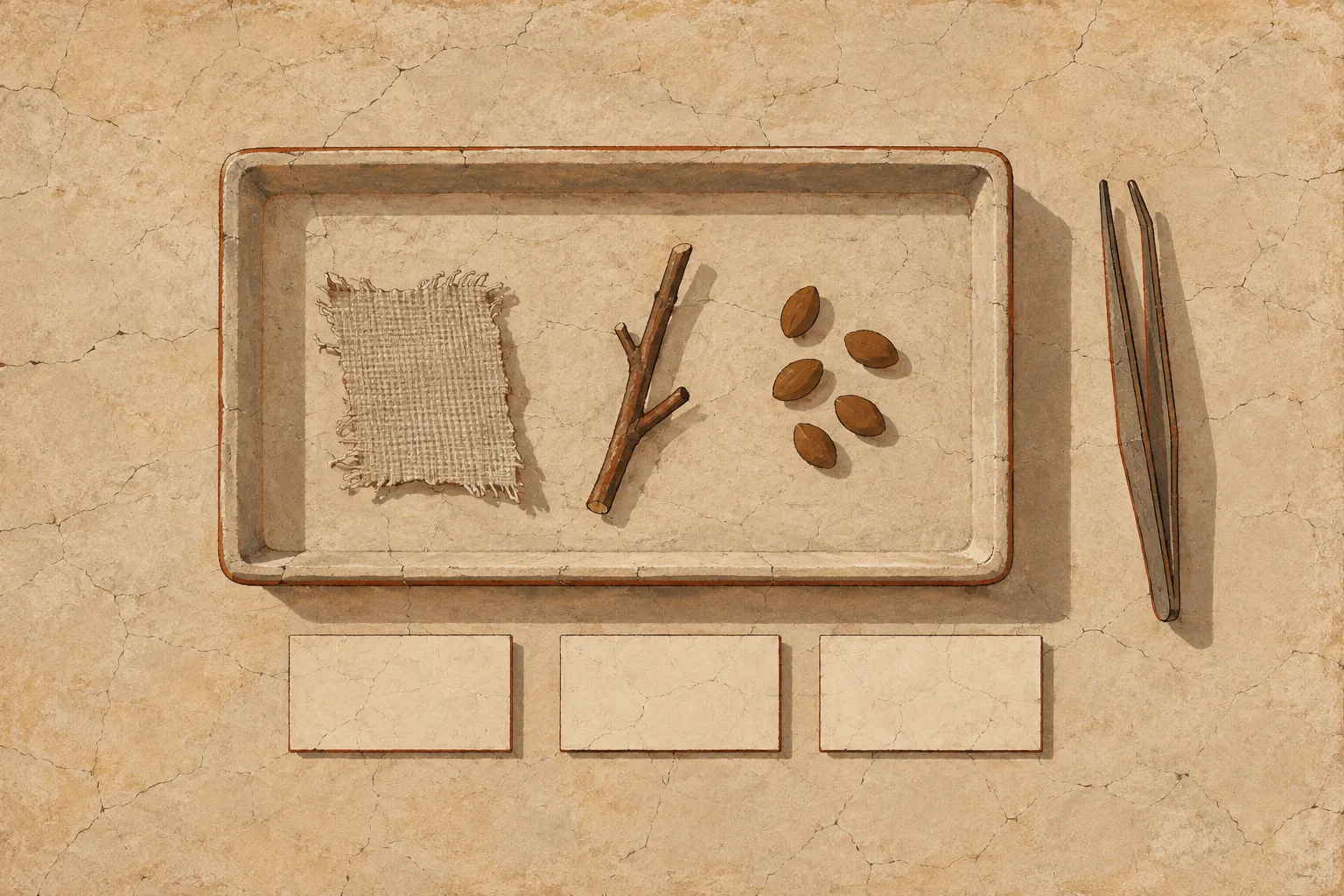
Linen, a twig and seeds, each once part of a living plant. The dated event is the moment an organism stopped taking in carbon.
Illustration: Sherd and Script. Generated schematic illustration — not a photograph or record of any real object or site. Reuse: CC BY 4.0 (https://creativecommons.org/licenses/by/4.0/), to the extent Sherd and Script holds rights in it.
How far back can carbon dating reach?
Carbon dating reaches back about 50,000 radiocarbon years, because by then too little carbon-14 is left to tell from the instrument's own background. L. A. Currie's 2004 history of the method puts the background of accelerator mass spectrometry at no more than 0.2% of the modern level, "equivalent to a 14C age of ≥50 000 years BP." That 0.2% is about what is left after nine half-lives, by this page's arithmetic.
The calibration curve ends at a similar depth. The IntCal working group's IntCal20 file covers 0 to 55,000 calibrated years before 1950, and its oldest row pairs 55,000 cal BP with a radiocarbon age of 50,100 ± 1,024 BP, so an older sample has no point on that curve to be calibrated against.
Why can't a radiocarbon age be read as a calendar year?
Libby's model assumed that the level of carbon-14 in the air had stayed constant. His early tests against tree rings and Egyptian objects of known age agreed with that model within their errors over nearly 5,000 years, Currie writes.
Then the measurements improved and the assumption failed. Radiocarbon ages from counted tree rings drifted away from calendar ages beginning about 3,000 years ago, because carbon-14 production and mixing had changed with Earth's magnetic field, solar activity and the movement of carbon between reservoirs (Currie 2004). The early tree-ring curves owed much to the bristlecone pine, a species in which one tree can hold rings going back 4,000 years or more.
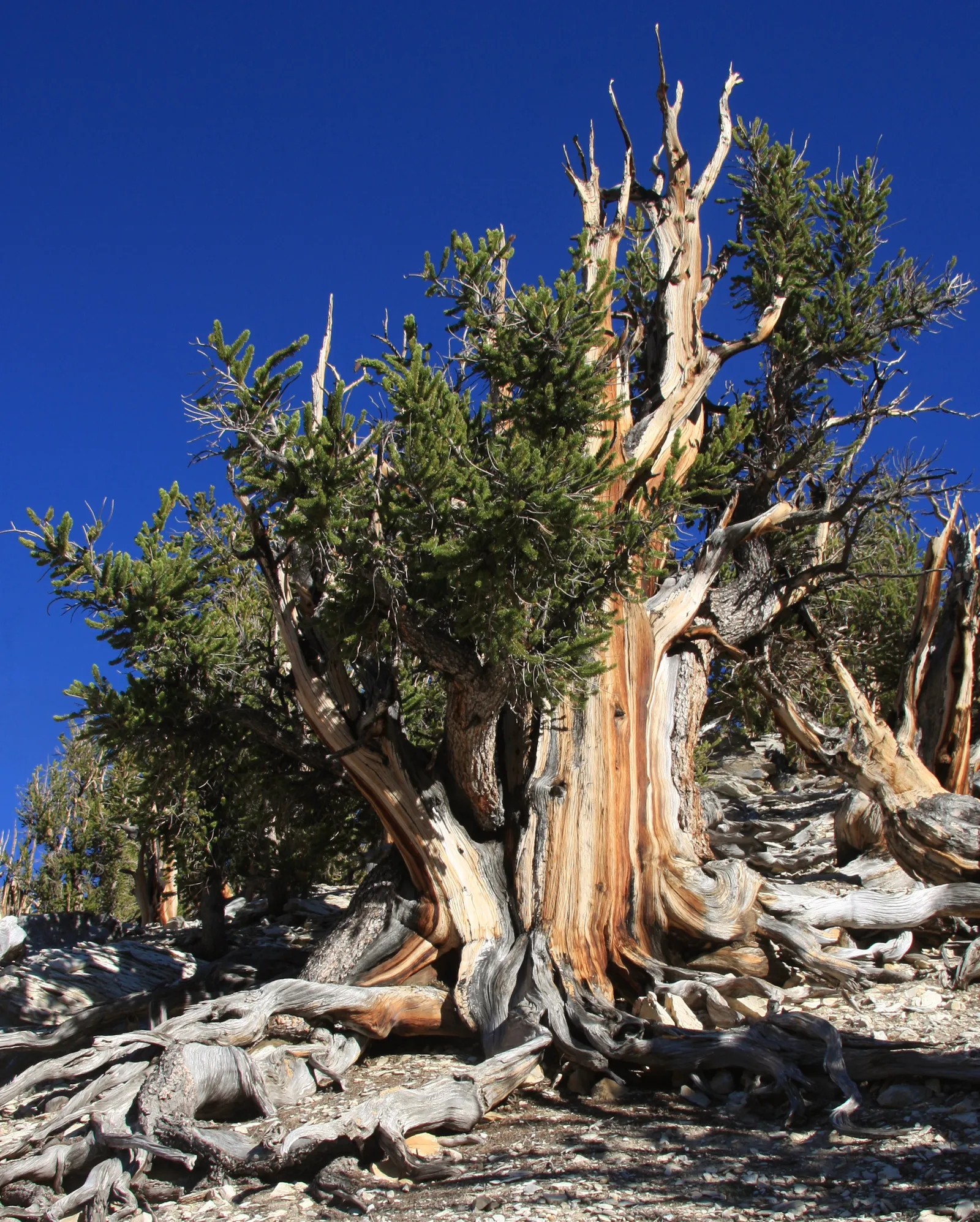
A Great Basin bristlecone pine in the White Mountains of California. Trees of this long-lived species made a large contribution to the early tree-ring record of carbon-14.
"Big bristlecone pine Pinus longaeva" by Dcrjsr — https://commons.wikimedia.org/wiki/File:Big_bristlecone_pine_Pinus_longaeva.jpg — CC BY-SA 3.0 (https://creativecommons.org/licenses/by-sa/3.0/)

A calibration curve is that record put to work. It pairs the radiocarbon age measured in material of known calendar age with the calendar age itself. IntCal20, which as of 2026 is the current curve for land samples from the Northern Hemisphere, rests on tree rings for the past 14,000 years (Bruins and van der Plicht 2025; IntCal working group).
Curves are revised, and calibrated ranges move with each revision, while the BP result stays the same (Bruins and van der Plicht 2025). So this site reports a published result with the curve its study used rather than recalibrating it, as the Sutton Hoo case file does for two older results.
How did 3310 ± 25 BP become a 114-year range?
The sample came from a linen mummy wrapping, EA 37106 in the British Museum (registration number 1880,0521.12, as given by Bruins and van der Plicht; the museum's own page was not read). Museum staff took the sample on 24 September 2013. The cloth has a plain warp fringe and no inscription, and as a bundle it measures 23 by 16 cm.
In Groningen the fragment, 42.4% carbon, went through the standard acid–base–acid cleaning and was measured twice, and the two results were averaged to 3310 ± 25 BP, laboratory number GrA-59770. The ± 25 is one standard deviation, which corresponds to 68.3% probability.
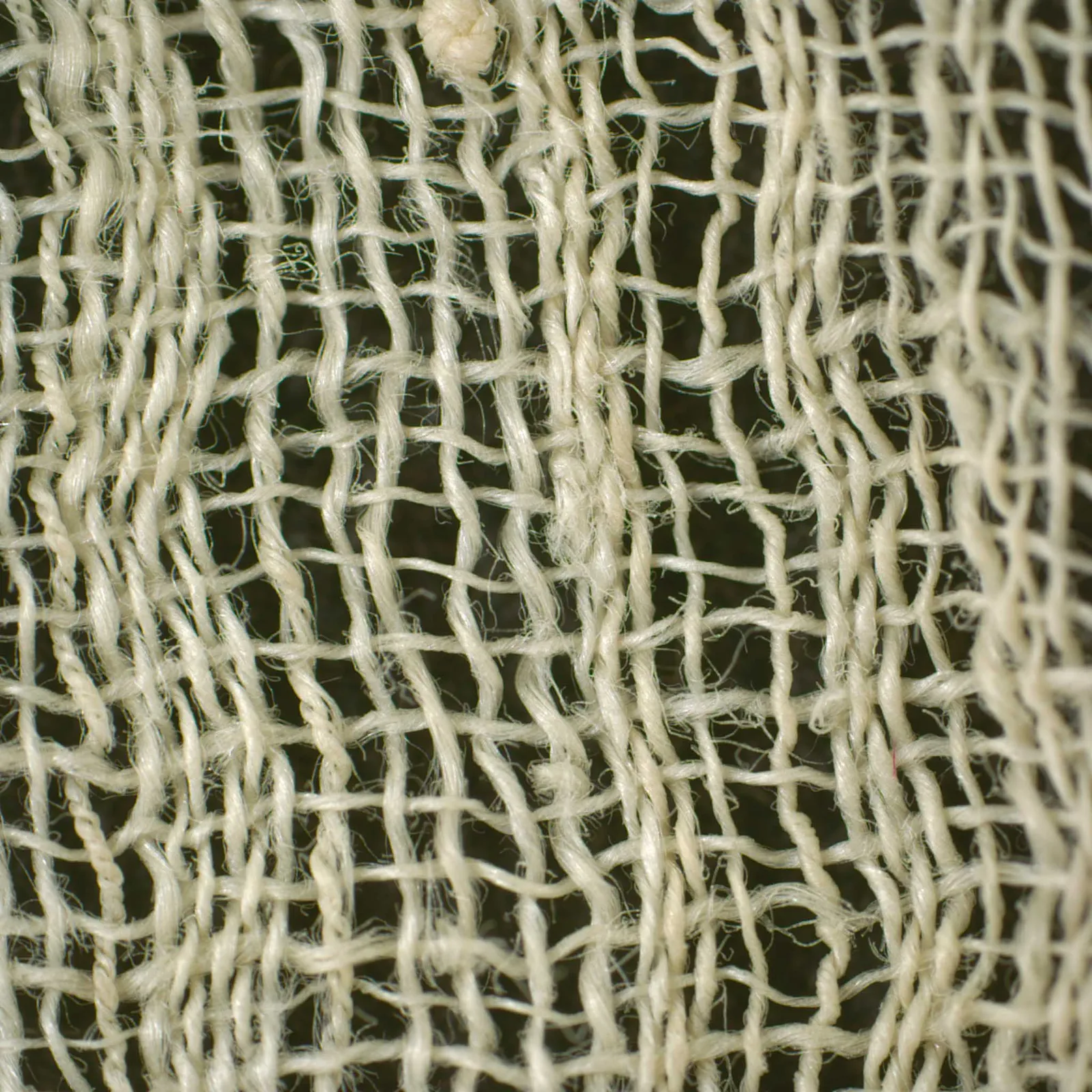
Undyed linen from a tomb at Thebes, magnified 20 times: spliced, S-twisted flax threads. This sheet at the Met is not the dated sample.
Museum no. 36.3.274 · Findspot: Thebes, Sheikh Abd el-Qurna, tomb of Hatnefer and Ramose (below TT 71)
"Linen Sheet" by The Metropolitan Museum of Art — https://commons.wikimedia.org/wiki/File:Linen_Sheet_MET_36.3.274_magnified_20x.jpg — CC0 1.0 (https://creativecommons.org/publicdomain/zero/1.0/)

The authors calibrated the result in the OxCal program, version 4.4.4, against IntCal20. At 68.3% probability it falls in two separate pieces, 1612–1573 BCE (39.8%) and 1566–1538 BCE (28.5%). At 95.4% it covers 1624–1510 BCE · radiocarbon, cal. 2σ, with a median of 1574 BCE.
Download: the linen's published ranges (CSV) (Data: Published ranges: H. J. Bruins and J. van der Plicht, PLOS ONE 20(9): e0330702 (2025), Table 5, CC BY 4.0, https://doi.org/10.1371/journal.pone.0330702) (sources and license, JSON).
Why is the range wider than the measurement?
The calendar answer comes out wider than the measurement because the curve is not a straight line. Calibration turns the bell-shaped measurement into an irregular spread of probability (Bruins and van der Plicht 2025). Where the curve runs flat or doubles back, one radiocarbon age fits several decades of calendar time. The curve in the chart at the top of this page does so from about 1610 to 1540 BCE (by this page's reading of the IntCal20 file).
Flax grew partly in the late winter, when carbon-14 in the air is at its seasonal low, so some studies of Egyptian material add a small offset. With the offset of 12 ± 5 radiocarbon years that Manning and colleagues recalculated for IntCal20, the linen's 95.4% range moves only to 1617–1508 BCE (Bruins and van der Plicht 2025).
Quote only the median, 1574 BCE, and the basis disappears. That is what this site calls a bare date: a year given without its method, its curve and its probability.
What does the linen's date belong to?
Linen is spun from fibers in the stalks of the flax plant, and in ancient Egypt flax was an annual crop, sown in autumn and harvested in March or April (Bruins and van der Plicht 2025). The carbon in the cloth was taken in during that growing season, so the radiocarbon range dates the crop. Spinning, weaving and the wrapping of a body all came afterward, by an interval that nothing in the measurement records.
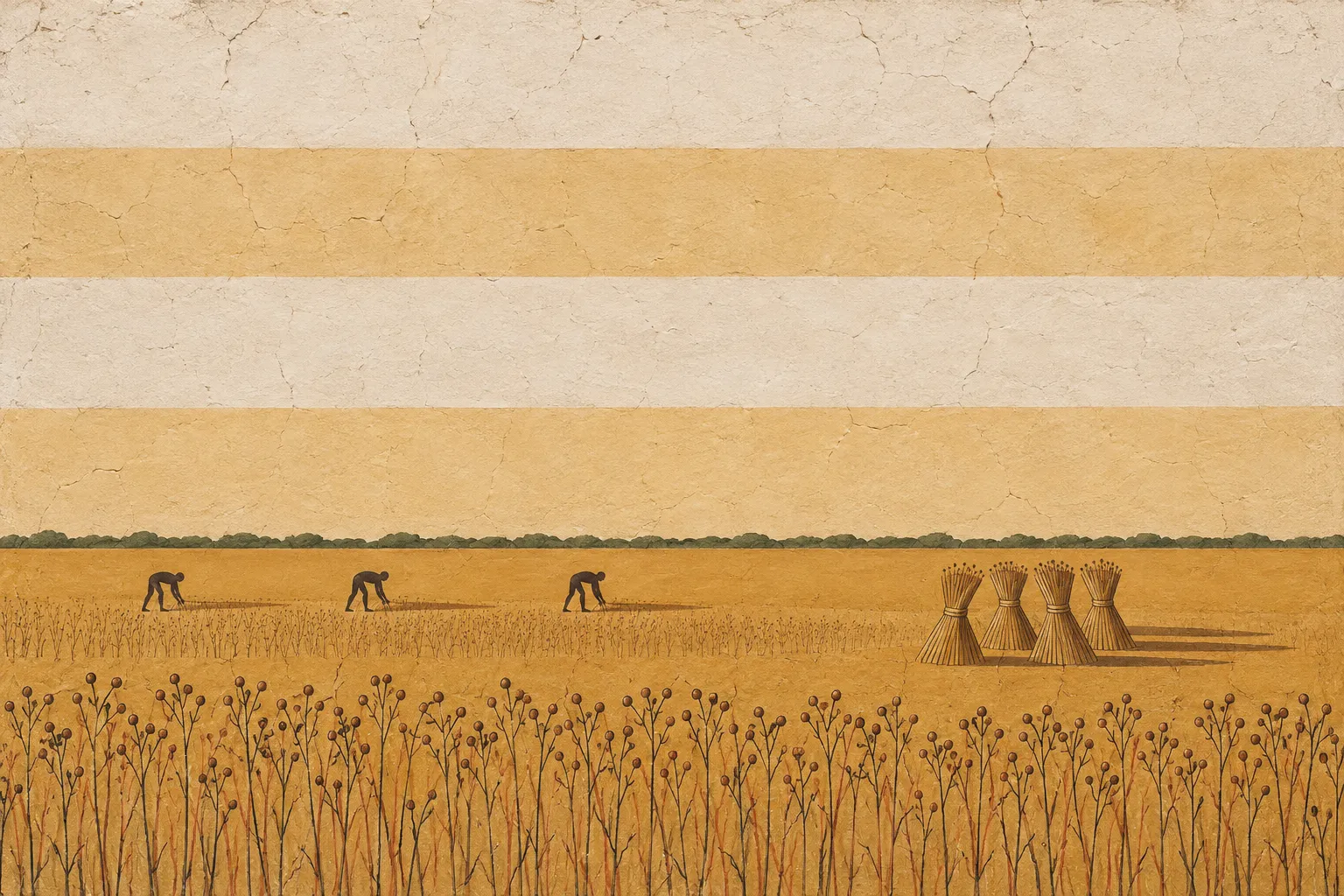
Flax at harvest. The carbon in linen was taken in during the growing season, so the radiocarbon range dates the crop; spinning, weaving and wrapping came afterward.
Illustration: Sherd and Script. Generated schematic illustration — not a photograph or record of any real object or site. Reuse: CC BY 4.0 (https://creativecommons.org/licenses/by/4.0/), to the extent Sherd and Script holds rights in it.
The written evidence points later. Satdjehuty was a queen of the 17th Dynasty, the second wife of King Seqenenre Tao, and a text on another of her wrappings names Queen Ahmose-Nefertari as "king's mother." On that reading she died after Amenhotep I became king. Six published chronologies place that accession at 1557–1498 BCE · documentary, range of chronologies, from Breasted's high date to Krauss and Warburton's low one, with those of Wente and Van Siclen, Shaw, Schneider, and Hornung and colleagues in between (Bruins and van der Plicht 2025).
The linen's 68.3% range is older than most of those options. The authors list three ways to account for the gap and do not choose among them: the cloth may be a 17th Dynasty heirloom, Satdjehuty may have died earlier than the inscription suggests, or the wrapping may not be hers. As of 2026 the question is open.
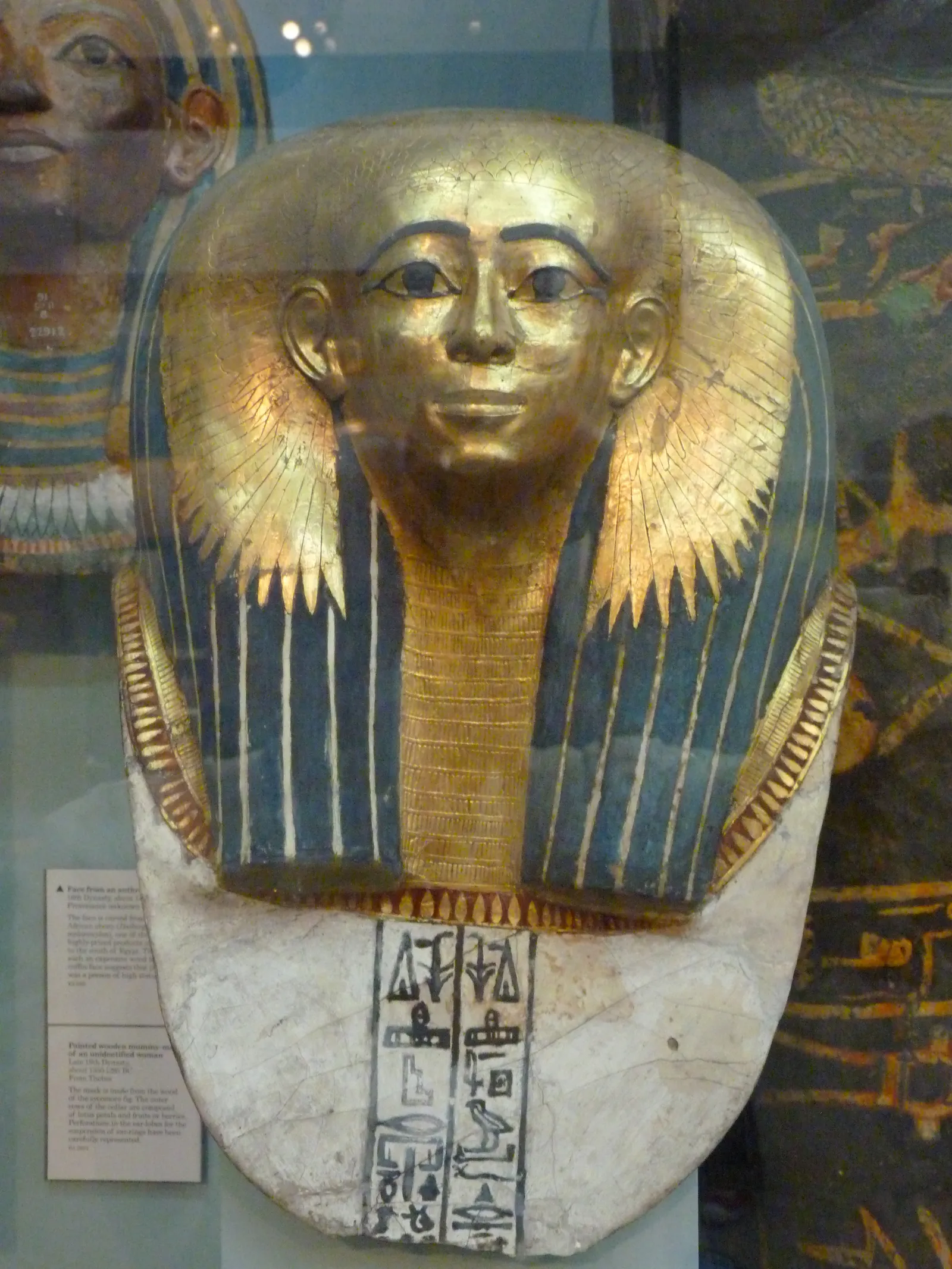
The gilded mask associated with Satdjehuty, bought by the British Museum together with the dated wrappings. A museum judgment, not a record from the ground, links the two.
Museum no. EA 29770 · Findspot: unrecorded
"Funerary mask of Sitdjehuti" by Ricardo Tulio Gandelman — https://commons.wikimedia.org/wiki/File:Funerary_mask_of_Sitdjehuti.jpg — CC BY 2.0 (https://creativecommons.org/licenses/by/2.0/)

The third option is a provenance problem. Her burial was found c. 1820 · documentary with no record of where. The mask (EA 29770, per the study) and wrappings reached the British Museum by purchase in 1880 · documentary, from the sale of Samuel Hull's collection, and Samuel Birch suggested that they belonged to one person (Bruins and van der Plicht 2025). Think of the wrapping as a word with no surviving sentence: the word can be dated, but the sentence that would place it beside Satdjehuty was never written down.
What can make a carbon date wrong?
A precise result is not automatically a correct one. In the same study, a lump from a mudbrick stamped with the throne name of King Ahmose, British Museum EA 32689 (number as given by the study), gave the most precise of the brick's results, 3385 ± 20 BP. Its 95.4% range, 1741–1619 BCE · radiocarbon, cal. 2σ in two parts, is older than every historical date for the brick; the authors blame older organic matter in the Nile mud and conclude that "a precise date is not necessarily an accurate date."
Old material is a second trap. Wood and charcoal can carry what Kuitems and colleagues call inbuilt age, the gap between the death of the organism and the context it ended up in, which can reach hundreds of years. Those authors set such samples apart from short-lived ones, such as turf and outermost twigs. A season's flax belongs in the second group.
The curve also has to match where the carbon came from. IntCal20 is for land samples from the Northern Hemisphere. Land samples from the Southern Hemisphere use SHCal20. Marine samples, such as whale bone, use Marine20, adjusted for a local reservoir offset (IntCal working group).
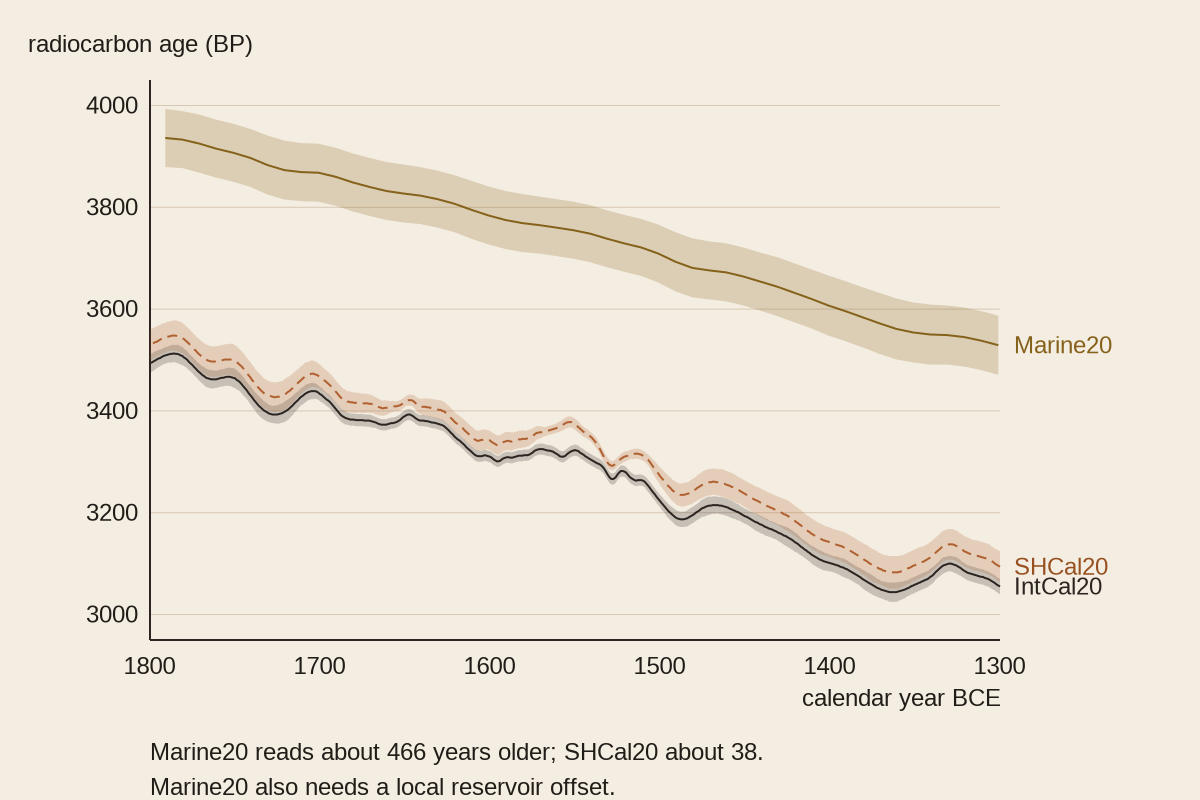
Scroll sideways to read every label, or open the full drawing.
The IntCal working group's IntCal20, SHCal20 and Marine20 curves, 1800 to 1300 BCE. For the same calendar year, Marine20 reads on average about 466 radiocarbon years older than IntCal20 here, by this page's calculation.
"IntCal20, SHCal20 and Marine20 between 1800 and 1300 BCE" by Sherd and Script, https://sherdandscript.com/evidence/carbon-dating/, licensed under CC BY 4.0 (https://creativecommons.org/licenses/by/4.0/)Data: IntCal20 (Reimer et al. 2020), SHCal20 (Hogg et al. 2020) and Marine20 (Heaton et al. 2020) calibration curves, files from the IntCal working group, https://intcal.org/curves.html (no reuse license stated; values drawn only, not redistributed)
A sound measurement can still answer the wrong question. Whether a find belongs in the layer where it was found is a separate matter from what any test measures, and it is the question behind the Piltdown Man claim check.
How did L'Anse aux Meadows get a single year?
L'Anse aux Meadows, in Newfoundland, was the only confirmed Norse site in the Americas when Margot Kuitems and colleagues published a study in Nature, in print in 2022. More than 150 radiocarbon dates had been measured there, 55 of them on Norse contexts, but their calibrated ranges ran across and beyond the whole Viking Age. The authors blame the larger errors of measurements from the 1960s and 1970s, and inbuilt age.
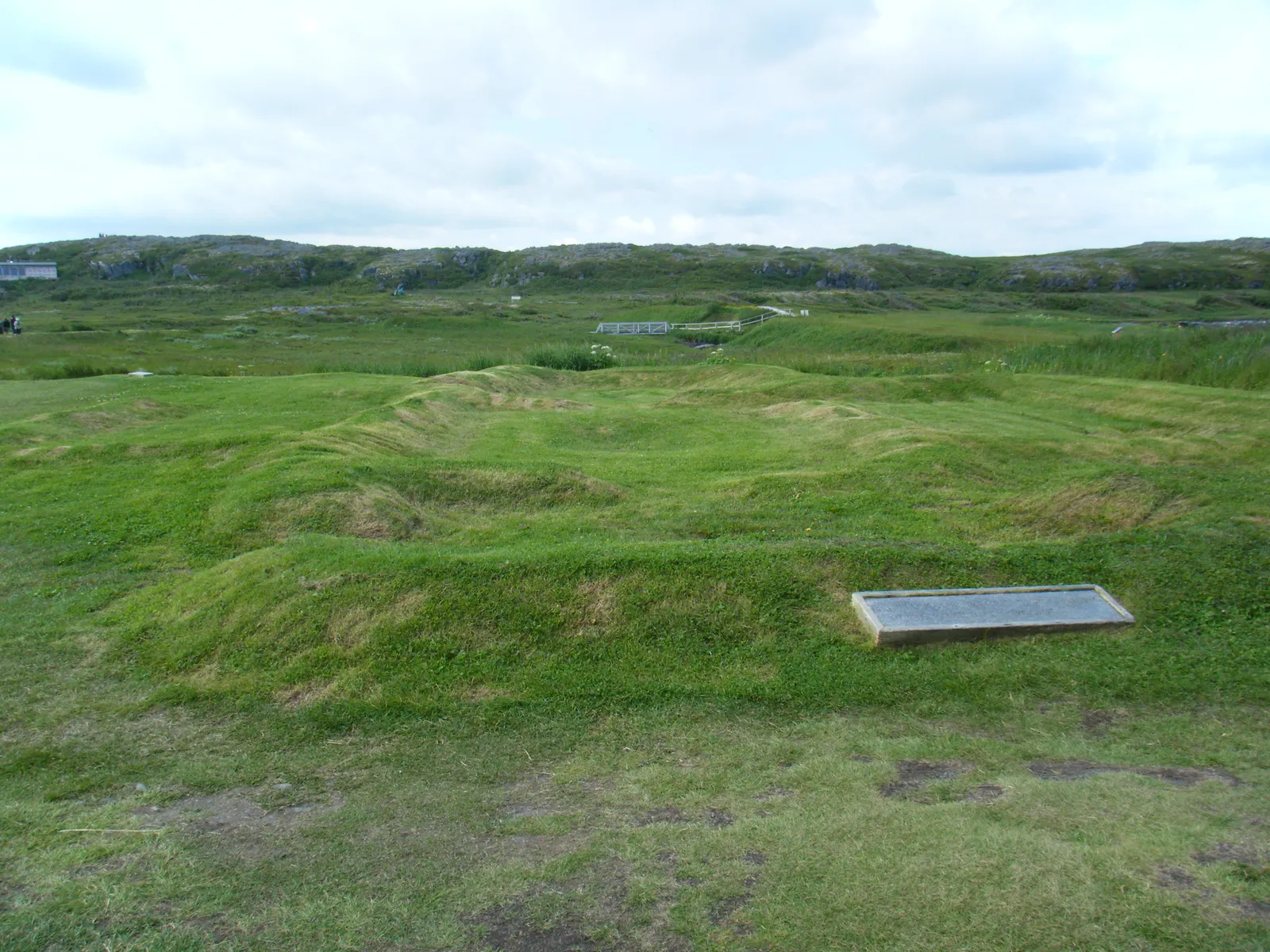
The turf-covered outline of an excavated Norse building at L'Anse aux Meadows, Newfoundland. The three wood pieces dated by Kuitems and colleagues came from the Norse deposit at this site.
"LanseAuxMeadows LargeBuilding" by Clinton Pierce — https://commons.wikimedia.org/wiki/File:LanseAuxMeadows_LargeBuilding.JPG — CC BY-SA 3.0 (https://creativecommons.org/licenses/by-sa/3.0/)

What marker fixed the year?
The new study used a marker in the air itself. In 993 CE · tree rings a burst of cosmic radiation increased carbon-14 production by about 9 parts per thousand, which shows up as a drop of about 70 years in radiocarbon age. Tree rings around the world record the burst.
The team measured single rings from three pieces of wood that had been cut with metal tools and still kept their waney edge, the last ring grown under the bark. Matching each series to IntCal20 placed all three felling years at 1019–1024 CE · radiocarbon, wiggle-match, 95%. A second test against a sharper tree-ring record of the 993 jump then gave the best fit for all three at 1021 CE.
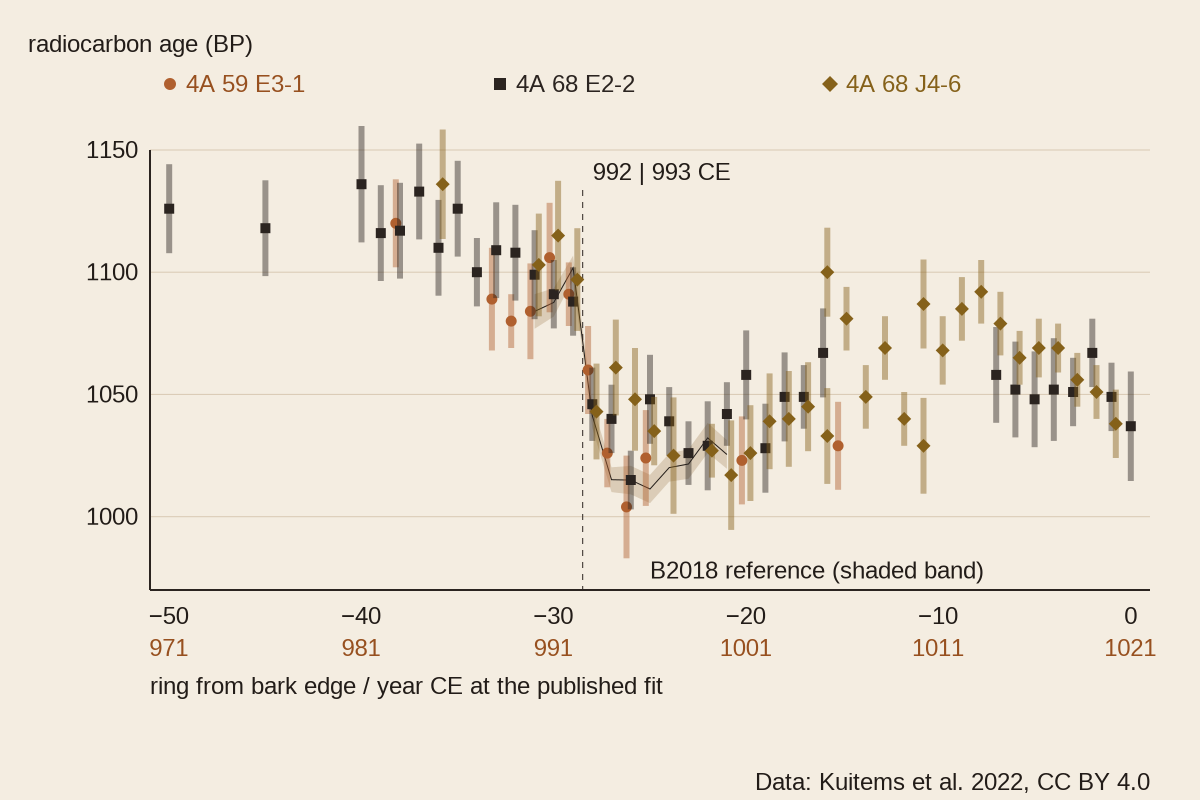
Scroll sideways to read every label, or open the full drawing.
Radiocarbon ages of single rings from the three Norse-cut pieces, aligned at the bark edge. All three drop after ring −29, as the B2018 reference does at 993 CE. Data: Kuitems et al. 2022.
"L'Anse aux Meadows: radiocarbon age ring by ring in three Norse-cut wood pieces" by Sherd and Script, https://sherdandscript.com/evidence/carbon-dating/, licensed under CC BY 4.0 (https://creativecommons.org/licenses/by/4.0/)Data used under CC BY: Ring data and B2018 reference values: M. Kuitems, B. L. Wallace, C. Lindsay, A. Scifo, P. Doeve, K. Jenkins, S. Lindauer, P. Erdil, P. M. Ledger, V. Forbes, C. Vermeeren, R. Friedrich and M. W. Dee, "Evidence for European presence in the Americas in AD 1021," Nature 601, 388-391 (2022), Source Data Fig. 2, https://doi.org/10.1038/s41586-021-03972-8, licensed under CC BY 4.0 (https://creativecommons.org/licenses/by/4.0/); redrawn as a new chart by Sherd and Script
Data sources for this figure
Data: Ring data and B2018 reference values: M. Kuitems, B. L. Wallace, C. Lindsay, A. Scifo, P. Doeve, K. Jenkins, S. Lindauer, P. Erdil, P. M. Ledger, V. Forbes, C. Vermeeren, R. Friedrich and M. W. Dee, "Evidence for European presence in the Americas in AD 1021," Nature 601, 388-391 (2022), Source Data Fig. 2, https://doi.org/10.1038/s41586-021-03972-8, licensed under CC BY 4.0 (https://creativecommons.org/licenses/by/4.0/); redrawn as a new chart by Sherd and Script; B2018 reference: U. Büntgen et al., "Tree rings reveal globally coherent signature of cosmogenic radiocarbon events in 774 and 993 CE," Nature Communications 9, 3605 (2018), https://doi.org/10.1038/s41467-018-06036-0, values as given in the Kuitems et al. source data
The best fit puts ring −29, counted in from the bark, in 992 CE, the year before the jump, so the trees were felled 29 years later. Wood cells in the last ring show that one piece was cut in spring and another in summer or autumn. An earlier conservation treatment hides the season of the third.
Download: ring-by-ring radiocarbon data (CSV) (Data: Ring data: M. Kuitems, B. L. Wallace, C. Lindsay, A. Scifo, P. Doeve, K. Jenkins, S. Lindauer, P. Erdil, P. M. Ledger, V. Forbes, C. Vermeeren, R. Friedrich and M. W. Dee, "Evidence for European presence in the Americas in AD 1021," Nature 601, 388-391 (2022), Source Data Fig. 2, https://doi.org/10.1038/s41586-021-03972-8, licensed under CC BY 4.0 (https://creativecommons.org/licenses/by/4.0/); changes: rows for the three dated wood items only, replicate averages as given in the source, year column computed by Sherd and Script) (sources and license, JSON).
So the single year is still a measured date, 1021 CE · radiocarbon, 993 CE marker and ring count, and it rests on three things the study names: single rings measured with high precision, a sharp spike in the air's carbon-14 and an intact bark edge. It dates the felling of three trees, and the authors read it as Norse activity at the site in that year, as of 2026.
Can carbon dating settle Egypt's king lists?
Egypt was part of the method's early validation, when Libby checked his results against Egyptian objects of known age (Currie 2004). The test now runs the other way. Radiocarbon is used to choose among historical chronologies of Egypt, the older "High" and younger "Low" schemes, which can differ by as much as a century (Erdil et al. 2025). The written side rests on king lists and dated records, and turning a date in the Egyptian calendar into a year BCE is the subject of Egyptian civil calendar.
Do not look directly at the sun. For the Middle Kingdom the debate turns on a papyrus from Illahun, assigned to year 7 of King Senusret III, that records the heliacal rising of Sirius, its first appearance at dawn. Parker computed that observation to 1872 BCE · computed, Sothic (Parker), and Krauss, assuming a different place of observation, to 1830 BCE · computed, Sothic (Krauss); the two are Disputed, though the study below supports the earlier one (Erdil et al. 2025).
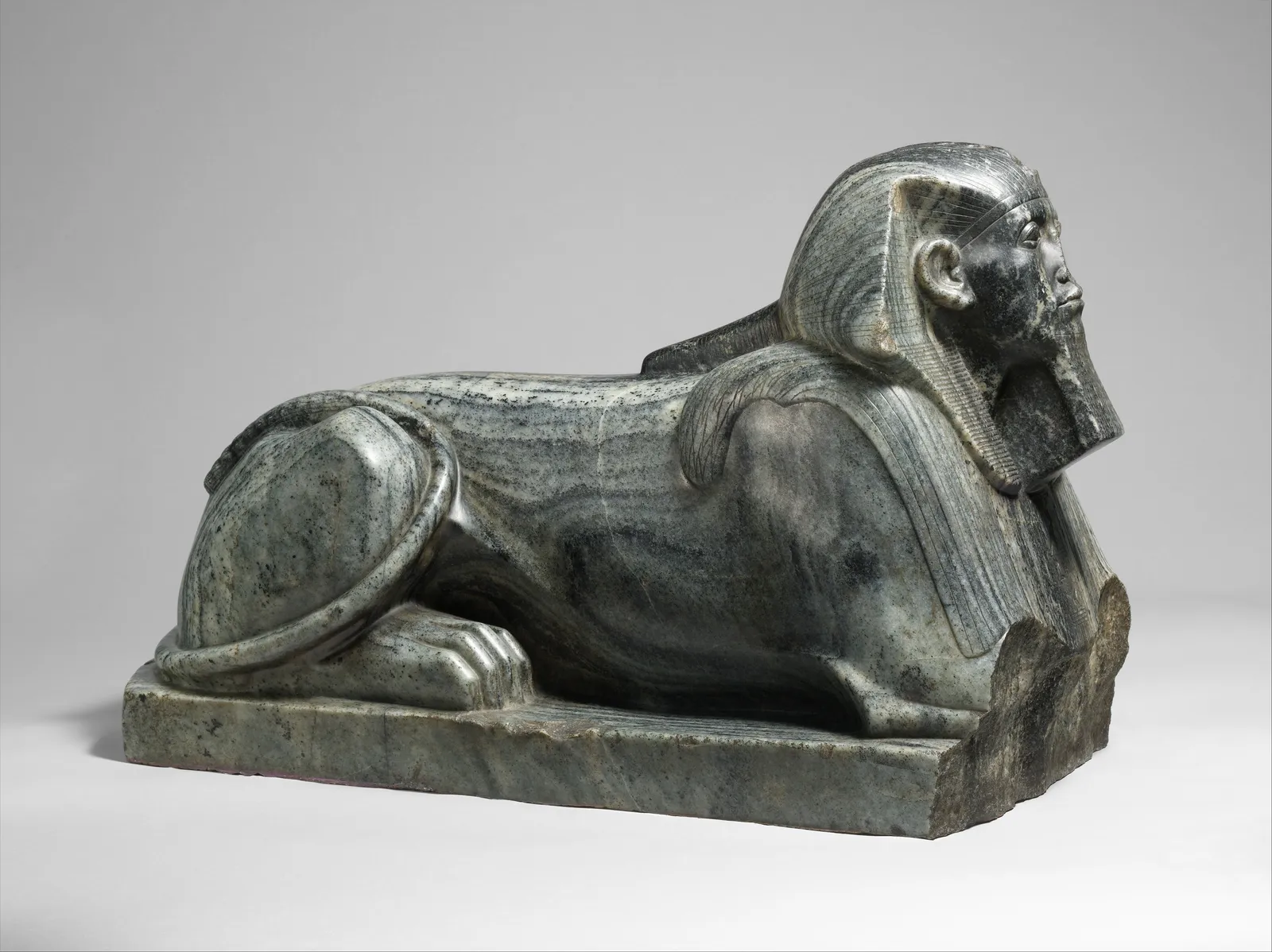
Senusret III as a sphinx, at the Met; its findspot is uncertain. A papyrus assigned to his seventh year records the rising of Sirius at the center of the High and Low debate.
Museum no. 17.9.2 · Findspot: possibly Karnak, Thebes (museum record); not confirmed
"Senwosret III as a Sphinx" by The Metropolitan Museum of Art — https://commons.wikimedia.org/wiki/File:Senwosret_III_as_a_Sphinx_MET_DP248998.jpg — CC0 1.0 (https://creativecommons.org/publicdomain/zero/1.0/)

Erdil and colleagues combined 160 radiocarbon dates, 48 of them new, with recorded reign lengths in Bayesian models calibrated against IntCal20. Their Middle Kingdom models support only the High positions, and their Old Kingdom models rule out the Low position at 95% probability. They add that major revisions to inputs such as reign lengths would change the conclusions. As of 2026, this page found no published reply.
Can radiocarbon name a king's first year?
Radiocarbon still cannot name the year a king came to the throne. Bruins and van der Plicht say so directly: "Radiocarbon dating by itself cannot determine the accession year and reign length of a king." Their Ahmose brick shows the limit: its one clean piece of straw, 3230 ± 60 BP, has a most probable range of 1542–1427 BCE · radiocarbon, cal. 66.4%. That range is wide enough to fit every date in their table for the brick's making except the two highest.
Proof radius
What this box is for: the proof radius.
Proves: One radiocarbon measurement on a short-lived sample, calibrated against the right curve, places the death of that plant or animal within a stated range at a stated probability; for the linen EA 37106,
1624–1510 BCE · radiocarbon, cal. 2σ.Doesn't prove: When the cloth was woven, when it was wrapped around a body, or when Satdjehuty died. Those came after the flax harvest, and only a recorded context could close the gap.
Read next: Sutton Hoo: coins and two older radiocarbon results weighed against one grave. Egyptian civil calendar: how a date written in the Egyptian calendar becomes a year BCE.
Sources
Primary sources first.
- 1Hendrik J. Bruins and Johannes van der Plicht, "The Minoan Thera eruption predates Pharaoh Ahmose: Radiocarbon dating of Egyptian 17th to early 18th Dynasty museum objects," PLOS ONE 20, no. 9 (2025): e0330702. https://doi.org/10.1371/journal.pone.0330702 Read: full text (CC BY 4.0), PubMed Central PMC12422448
- 2Margot Kuitems, Birgitta L. Wallace, Charles Lindsay, et al., "Evidence for European presence in the Americas in AD 1021," Nature 601 (2022): 388–391. https://doi.org/10.1038/s41586-021-03972-8 Read: full text (CC BY 4.0), PubMed Central PMC8770119; source data for Fig. 2
- 3Pınar Erdil et al., "Resolution of the High versus Low debate for Old and Middle Kingdom Egypt," PLOS ONE 20, no. 5 (2025): e0314612. https://doi.org/10.1371/journal.pone.0314612 Read: full text (CC BY 4.0), PubMed Central PMC12119019
- 4IntCal working group, "Calibration curves" and "Data" pages, with the curve files intcal20.14c (IntCal20, Reimer et al. 2020), shcal20.14c (SHCal20, Hogg et al. 2020) and marine20.14c (Marine20, Heaton et al. 2020), intcal.org. https://intcal.org/curves.html Read: web pages (index, data, curves) and the three curve files; no reuse license is stated, so the curve values are drawn but not redistributed
- 5The Metropolitan Museum of Art, Linen Sheet, accession 36.3.274, collection record as transcribed on Wikimedia Commons (File:Linen Sheet MET 36.3.274 magnified 20x.jpg); the museum's own page was not read. https://commons.wikimedia.org/wiki/File:Linen_Sheet_MET_36.3.274_magnified_20x.jpg Read: Commons file page (Artwork template mirroring the museum record)
- 6The Metropolitan Museum of Art, Senwosret III as a Sphinx, accession 17.9.2, collection record as transcribed on Wikimedia Commons (File:Senwosret III as a Sphinx MET DP248998.jpg); the museum's own page was not read. https://commons.wikimedia.org/wiki/File:Senwosret_III_as_a_Sphinx_MET_DP248998.jpg Read: Commons file page (Artwork template mirroring the museum record)
- 7L. A. Currie, "The Remarkable Metrological History of Radiocarbon Dating [II]," Journal of Research of the National Institute of Standards and Technology 109, no. 2 (2004): 185–217. https://doi.org/10.6028/jres.109.013 Read: full text (CC0), PubMed Central PMC4853109
Cite this page
Sherd and Script. “Carbon Dating: How One Lab Result Became a 114-Year Range.” Sherd and Script. Published 13 October 2026; last substantive revision 23 October 2026. https://sherdandscript.com/evidence/carbon-dating/ (accessed ).
Corrections
- 2026-10-23 — Page description shown in search results and link previews: probability level added to the range (was: "… became 1624–1510 BCE on the IntCal20 curve." → now: "… became 1624–1510 BCE (95.4%) on the IntCal20 curve.") — the range is the study's 95.4% range, as the body of the page states
- 2026-10-14 — Added the section "How far back can carbon dating reach?" (was: no such section → now: two paragraphs beginning "Carbon dating reaches back about 50,000 radiocarbon years, because by then too little carbon-14 is left to tell from the instrument's own background.") — L. A. Currie 2004; IntCal working group, IntCal20 curve file