Case file
Sutton Hoo: What a Ship Made of Sand and Rivets Can Prove
Sherd and Script · Published 13 October 2026 · Revised 23 October 2026
The timber of the Mound 1 ship rotted away, but its iron rivets stayed where they were driven. They measure a working ship. They do not name the person it was buried for.
Find card
- Object / Site
- Sutton Hoo Mound 1 ship burial: the impression and iron rivets of a clinker-built ship about 27 m long, with a burial chamber amidships
- Findspot
- Sutton Hoo, Suffolk, England, across the River Deben from Woodbridge; Mound 1 of the burial ground; site-level only
- Context
- Unrobbed burial: ship set in a trench below the seventh-century ground surface, chamber amidships, mound about 36 m across; a 16th-century robber pit missed the chamber
- Dated by
- Associated finds: 37 Frankish gold coins, 3 blanks and 2 small ingots found with the purse. Two radiocarbon results from the early 1970s (lamp beeswax, chamber wood) are treated with caution
- Range
c. 610–635 CE · associated finds, coins(museum label, as of 2026). Earlier estimates: c. 625–c. 637 (Bruce-Mitford 1975, as quoted by Carver) and 620–c. 630 (Carver 2005)- Dated event
- The burial. The coins date it from below: the purse cannot have been closed before its newest coin was struck
- Now at
- British Museum, London: finds registered as 1939,1010 (helmet 1939,1010.93) and coins as 1939,1003.1–42, numbers as given by Wikidata Q1603141 and by museum labels photographed on Commons (the museum's pages were not read). The ship survives only in records and molds of parts of it
- Primary record
- R. L. S. Bruce-Mitford, The Sutton Hoo Ship-Burial, 3 vols (British Museum, 1975–83), not read here; revisited from the records in M. Carver, Sutton Hoo (2005), ch. 6, open access at https://martincarver.com/publications/sutton-hoo-report
Find card as CSV sutton-hoo-find-card.csv (sources and license, JSON)Data: M. Carver, Sutton Hoo: A Seventh-Century Princely Burial Ground and its Context (London: British Museum Press and Society of Antiquaries of London, 2005), Society of Antiquaries Research Report 69, open access at https://martincarver.com/publications/sutton-hoo-report; single published values (dimensions, dates); British Museum gallery label text (single facts: registration numbers, date range), read from Wikimedia Commons photographs by JASpencer (CC0); Wikidata (CC0), https://www.wikidata.org/wiki/Q1603141 and https://www.wikidata.org/wiki/Q503256
TL;DR. The Sutton Hoo ship survived only as more than 2,000 iron rivets and stains in the sand, enough to record a hull about 27 m long and the repairs from its working life. The 37 Frankish gold coins from the purse set the earliest date the burial could have; on the British Museum's reading they put it at c. 610–635 CE · associated finds, coins, as of 2026, while two radiocarbon results from the 1970s are treated with caution. No bone, inscription or document names the dead, so Rædwald is the most economical candidate rather than a reading from the grave.
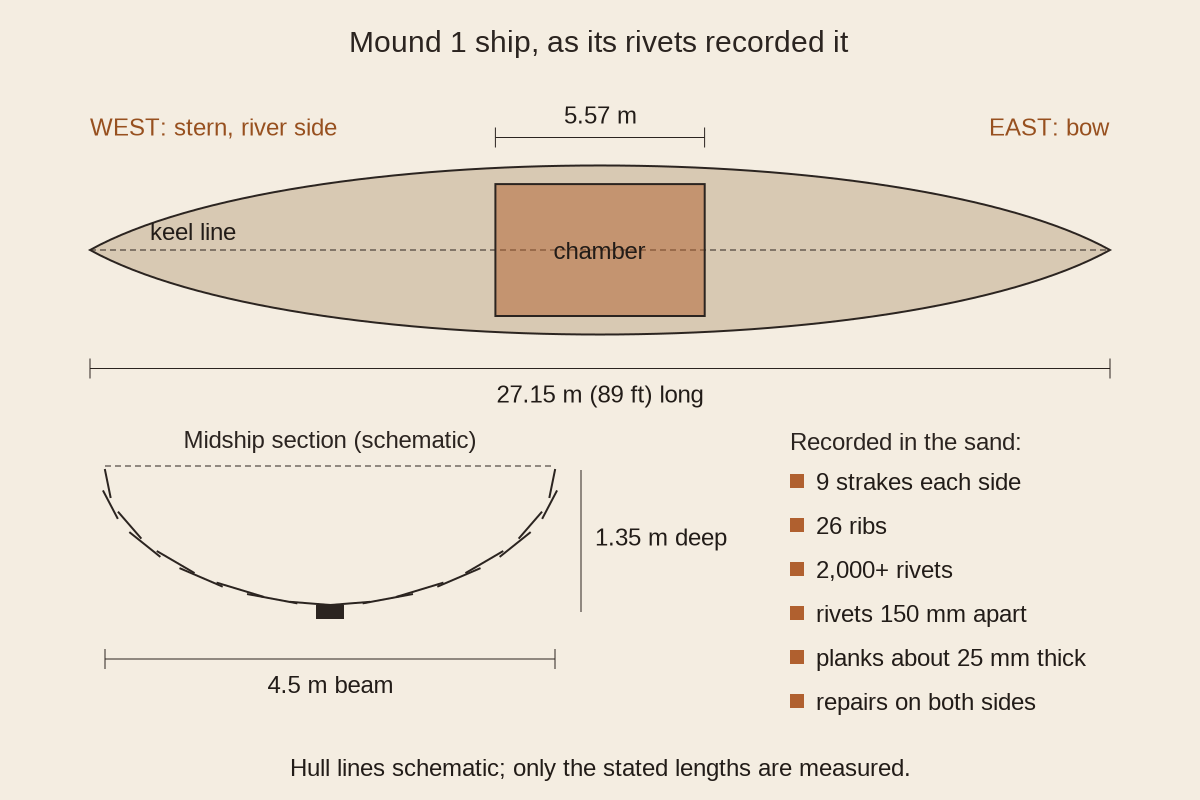
Scroll sideways to read every label, or open the full drawing.
The Mound 1 ship as its rivets recorded it: 27.15 m long, 4.5 m wide and 1.35 m deep amidships, with a burial chamber about 5.57 m long. Hull curves are schematic.
Findspot: Sutton Hoo, Suffolk, England, Mound 1
"Sutton Hoo Mound 1 ship: dimensions recorded from its rivets" by Sherd and Script, https://sherdandscript.com/evidence/sutton-hoo/, licensed under CC BY 4.0 (https://creativecommons.org/licenses/by/4.0/)Data: M. Carver, Sutton Hoo: A Seventh-Century Princely Burial Ground and its Context (London: British Museum Press and Society of Antiquaries of London, 2005), Society of Antiquaries Research Report 69, open access at https://martincarver.com/publications/sutton-hoo-report; single published values (dimensions, dates)
Almost none of the Sutton Hoo ship's wood survived, so the excavators of 1939 recorded its iron rivets instead. A 2016 study in PLOS ONE puts it plainly: no original timbers survived in Mound 1, but stains in the sand kept many details of the build, and nearly all of the planking rivets stayed in place. From that rust, and from the objects in the chamber amidships, comes the usual label for the grave: a king's burial, probably Rædwald's.
That label packs several claims into one, and each rests on a different kind of evidence. This case file takes them one at a time, from the rivets to the coins to the name, and marks where each one stops.
What did the 1939 excavators actually find?
Sutton Hoo is a burial ground on a hill spur above the upper estuary of the River Deben in Suffolk, across the river from Woodbridge. In 1938 the landowner, Edith Pretty, had her excavator Basil Brown open three smaller mounds. Each had been robbed long before, but Mound 2 still held iron rivets from a ship, according to Martin Carver's 2005 report on the site.
On 8 May 1939 Brown and two assistants, John Jacobs and William Spooner, cut a trench into the east side of Mound 1. Jacobs found a rivet on 11 May. Brown, drawing on what he had seen in Mound 2, saw that a whole ship might lie in place. From then on he followed the inner face of the buried hull "from rivet to rivet," as Carver puts it, guided by bright orange patches in the sand.
By 14 June Brown had his first sight of a collapsed wooden chamber in the middle of the ship. In July a team led by Charles Phillips of Cambridge took over the chamber, and over 17 days it recorded and lifted 263 objects. No body was found. A Science Museum team recorded the ship itself in September 1939.
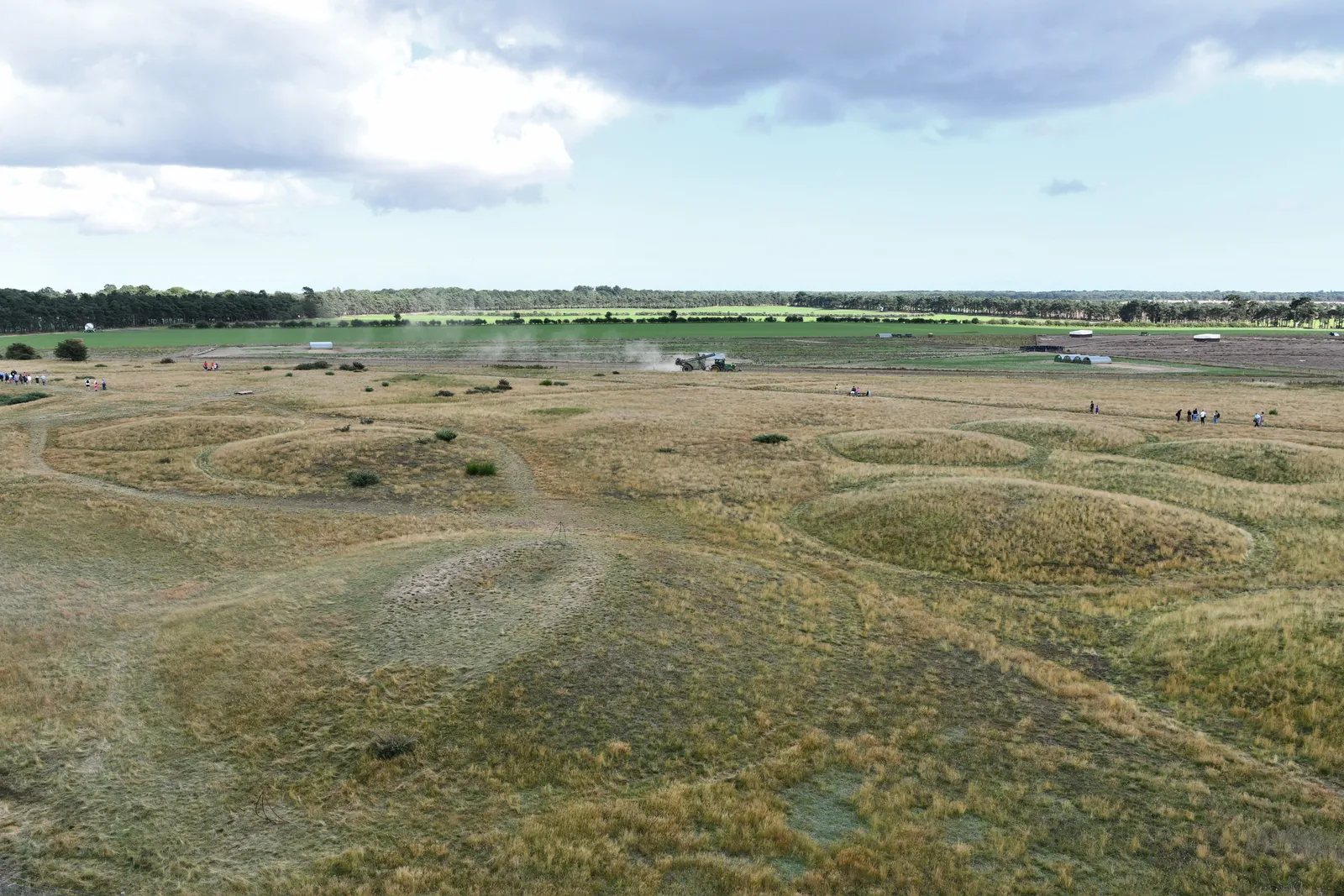
The Sutton Hoo burial ground, with Mound 1, the ship burial, in the foreground. The ship lay in a trench cut below the old ground surface.
"Sutton Hoo, The Royal Burial Ground: The Great Ship Burial Mound in the foreground" by Michael Garlick — https://commons.wikimedia.org/wiki/File:Sutton_Hoo,_The_Royal_Burial_Ground,_The_Great_Ship_Burial_Mound_in_the_foreground_-_geograph.org.uk_-_6945283.jpg — CC BY-SA 2.0 (https://creativecommons.org/licenses/by-sa/2.0/)

The burial had escaped the robbers: a 16th-century pit dug into the mound missed the chamber, Carver notes. Later in 1939 an inquest heard evidence from the excavators, and Pretty, the legal owner of the finds under the treasure trove law of the time, gave them to the British Museum. Museum numbers on this page are as given by Wikidata, Commons file pages or museum labels photographed on Commons; the museum's own pages were not read.
How can rivets measure a ship that rotted away?
A clinker-built ship is made of overlapping planks. Each row of planks, called a strake, laps over the outside of the one below and is fixed to it with iron rivets. At Sutton Hoo the wood became stains in the sand, but the iron stayed where it had been driven, and Carver's summary of the records lists upwards of 2,000 rivets, spaced about 150 mm apart along each seam.
The rows of rivets give the shape. Angela Evans reconstructed the hull from the 1939 records and a survey of what was left in 1965–71: 27.15 m (89 ft) long, 4.5 m wide and 1.35 m deep amidships, with nine strakes on each side of a keel. There was evidence for 26 ribs, the frames inside the hull. The 2016 study gives the length as 27.3 m, citing a reference work.
Single rivets carry measurements too: the rivets that joined the planks are just under 50 mm long, which Carver reads as two overlapping planks about 25 mm thick each. That thickness is an inference from iron, since no wood was left to measure. The planks narrowed from about 262 mm wide amidships to 62 mm or less at the stem and stern.
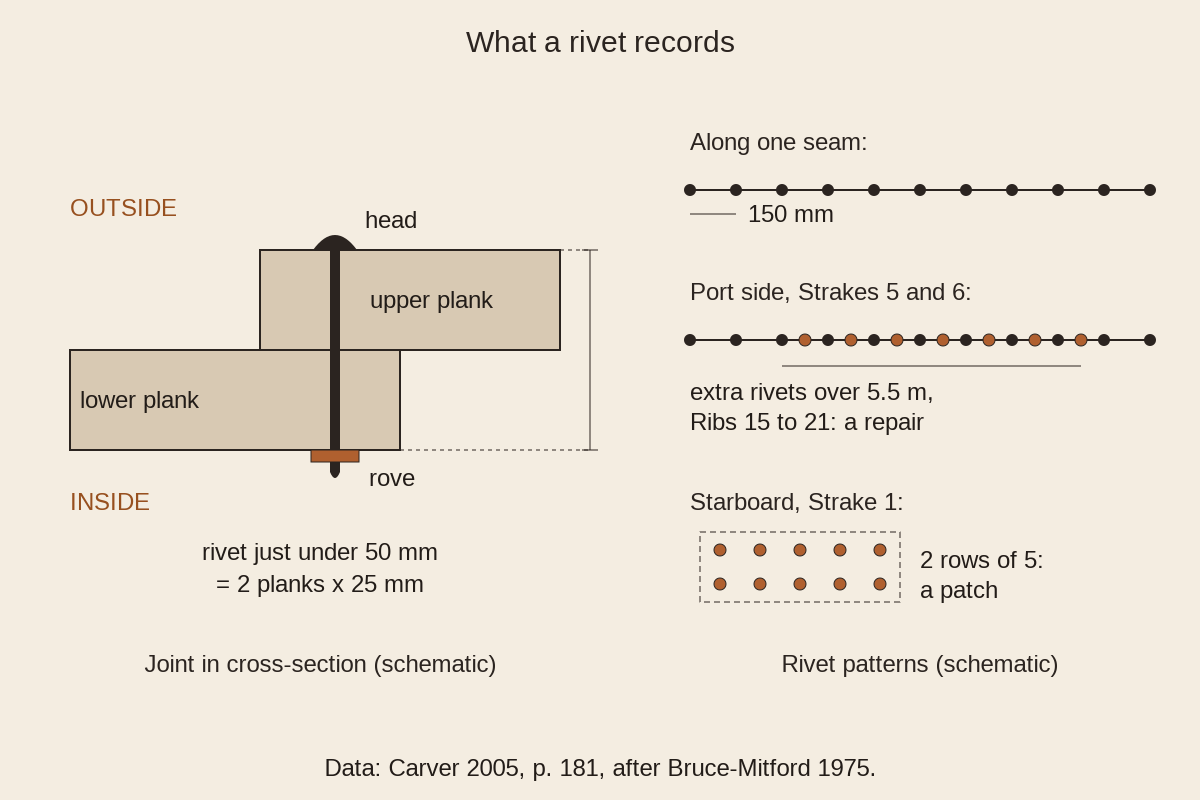
Scroll sideways to read every label, or open the full drawing.
A rivet just under 50 mm long implies two planks about 25 mm thick. Extra rivets mark a long repair on the port side and a patch on the starboard side.
"What one Sutton Hoo rivet records, and what the rivet pattern records" by Sherd and Script, https://sherdandscript.com/evidence/sutton-hoo/, licensed under CC BY 4.0 (https://creativecommons.org/licenses/by/4.0/)
Data sources for this figure
Data: M. Carver, Sutton Hoo: A Seventh-Century Princely Burial Ground and its Context (London: British Museum Press and Society of Antiquaries of London, 2005), Society of Antiquaries Research Report 69, open access at https://martincarver.com/publications/sutton-hoo-report; single published values (dimensions, dates)
What do the extra rivets show?
Some rivets were added later. Between Strakes 5 and 6 on the port side, extra rivets reinforce the hull for 5.5 m between Ribs 15 and 21, which Carver reads as a repair after a collision. On the starboard side two rows of five rivets on the lowest strake mark a patch, and a cluster of rivets at Rib 24 probably marks the fitting for a steering oar, which makes the west end the stern.
The repairs matter for the story of the burial. The 2016 study reads them as signs that the ship had been in use on the water and was not built for the funeral. Carver records that its bottom lay 2.57 to 3.05 m below the seventh-century ground surface amidships, and the 2016 study puts the haul from the Deben at some 700 m.
What lay in the burial chamber, and where?
The chamber stood amidships, about 5.57 m long, with its end walls near Ribs 10 and 16. Those walls showed in plan as thin dark lines that implied horizontal planking. Carver's 2005 reconstruction gives it a ridged roof on two posts, like the chamber in the Oseberg ship, a Viking ship of the early ninth century, a structure that could have carried the weight of the mound.
The objects lay in three zones, Carver's summary of the records shows. At the west end, the river side, were weapons, including a shield, spears and three barbed spears called angons, with regalia, a standard and a scepter. At the east end was feasting gear: three cauldrons, a tub and a bucket.
Down the middle ran a strip about 1 m by 3 m. From the west it held ten silver bowls with two spoons beneath them, a helmet in fragments, gold and garnet shoulder clasps, the great gold buckle, gold and garnet buckles from a leather shoulder belt, a sword and a purse of gold coins. East of the strip lay two drinking horns, six maplewood bottles and a heap of clothing and personal things, topped by a large Byzantine silver dish.
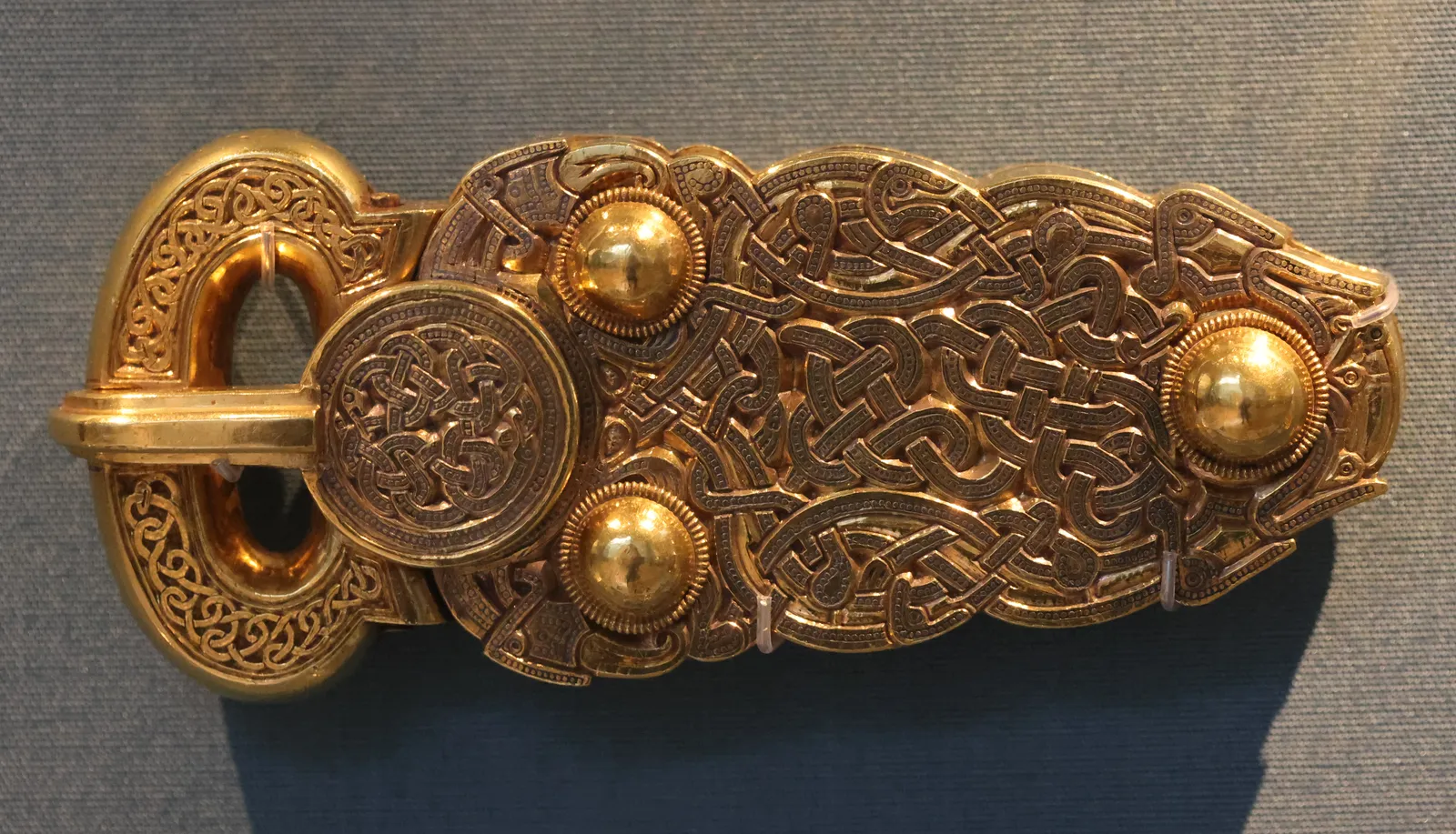
The great gold buckle. It lay in the narrow central strip of the chamber with the sword, the shoulder clasps and the purse.
Museum no. 1939,1010.1 · Findspot: Sutton Hoo, Mound 1, burial chamber
"Sutton hoo Great gold buckle" by Geni — https://commons.wikimedia.org/wiki/File:Great_gold_buckle_sutton_hoo.JPG — CC BY-SA 4.0 (https://creativecommons.org/licenses/by-sa/4.0/)

Was anyone buried in the ship?
No bone was found, and the absence has been argued over since 1939. An early suggestion, the 2016 study notes, was that the ship was a cenotaph, a monument to someone buried elsewhere. At the 1939 inquest the archaeologist Stuart Piggott had already given the excavators' explanation: "Owing to the acid nature of the sand however no visible trace of the skeleton remained."
Chemistry later tested that answer. A British Museum team measured phosphate, a residue that decayed bodies leave in soil, on the objects, at each rivet and across the chamber on a 300 mm grid. The residues clustered around what Carver calls a "body space," and the places of the helmet, the shoulder clasps and the shoes suggested that the head lay at the west end.
Not every reading agrees. Vierck argued in 1973 and 1980 for a cremation on the large silver dish, where iron phosphate residues implied perhaps 1 kg or more of burnt bone. That bone could equally have been cooked animal bone, and the 1975 report left the question open. Fieldwork from 1983 then showed that a body at Sutton Hoo could survive as a shape in the sand with no visible bone, which Carver says "greatly strengthened" the case for a body in Mound 1.
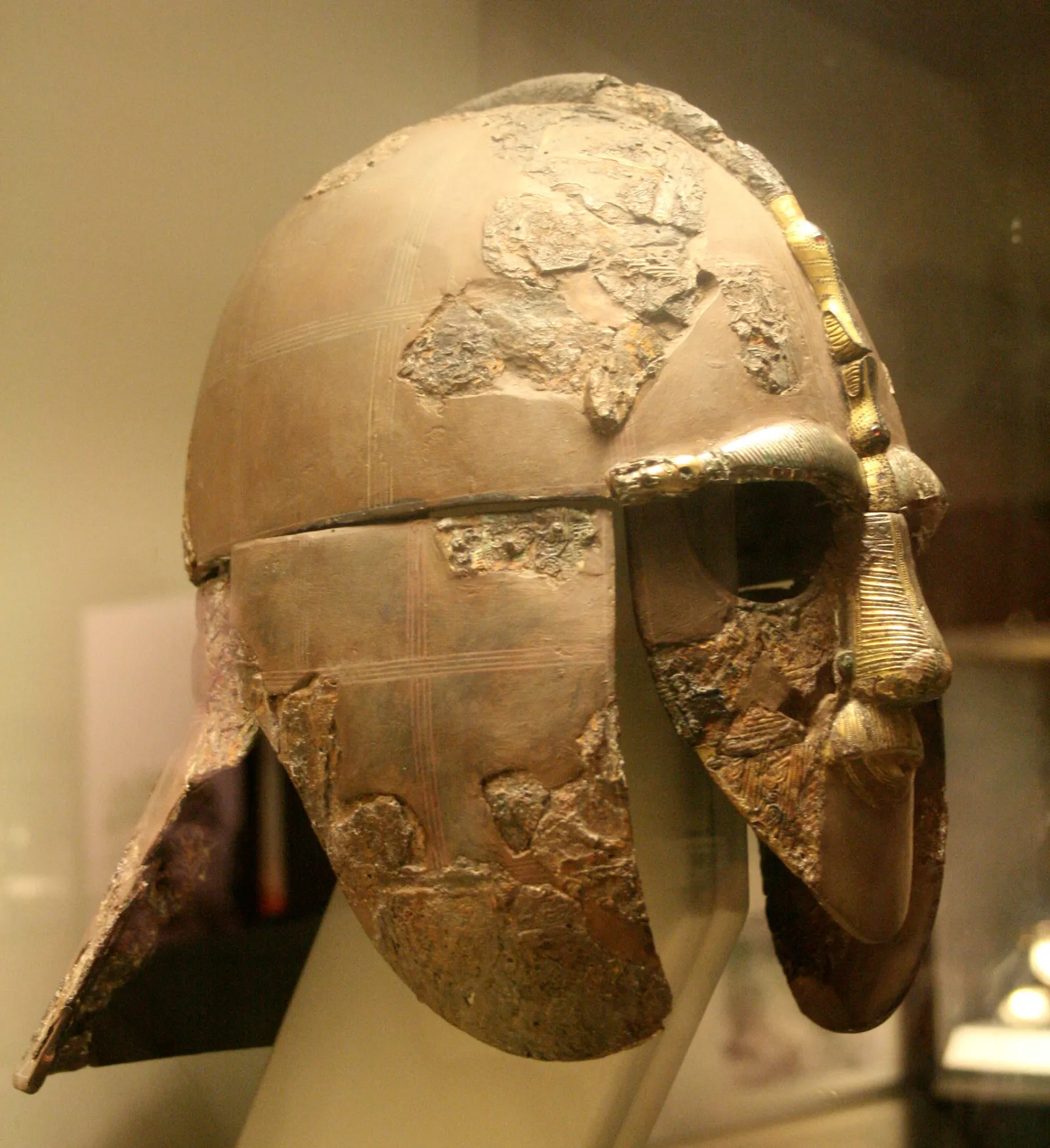
The Sutton Hoo helmet, rebuilt from the fragments it broke into in the ground. Its place in the chamber is one of the clues to where the head lay.
Museum no. 1939,1010.93 · Findspot: Sutton Hoo, Mound 1, burial chamber
"Original Sutton Hoo Helmet" by Michel wal — https://commons.wikimedia.org/wiki/File:Original_Sutton_Hoo_Helmet.jpg — CC BY-SA 3.0 (https://creativecommons.org/licenses/by-sa/3.0/)

As of 2026 the question is Disputed. The most economical reading is a body laid in the chamber and dissolved by the acid sand, but no bone survives to show it.
What date do the coins put on the burial?
The purse carries the firmest date in the grave. Its leather has gone, but its gold frame survives. With it were found 37 Frankish gold coins called tremisses, three blank coins and two small ingots, according to Carver's inventory and the British Museum's gallery label. The label adds that each coin was struck at a different mint.
Coins date a burial from below. A purse cannot be closed before its newest coin was struck, so coins give a no-earlier-than date, and how long they circulated first has to be argued from other evidence. The museum's current label, photographed in 2025, says: "Analysis of their gold content and date of minting point towards the period around AD 610–635."
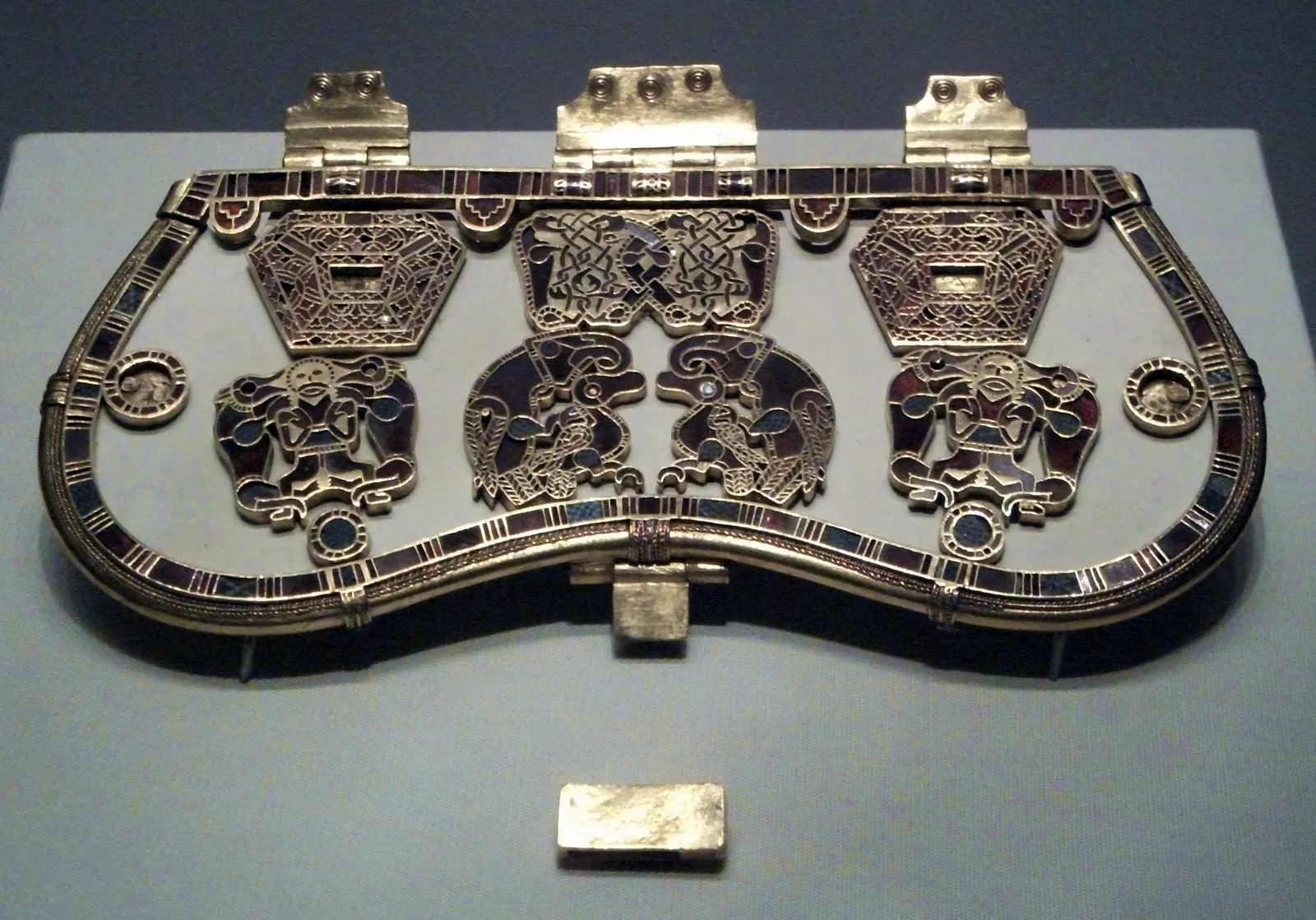
The purse lid. The 37 gold coins, three blanks and two ingots were found with it; the leather pouch beneath the lid decayed in the ground.
Museum no. 1939,1010.2.a–i and 1939,1010.3 · Findspot: Sutton Hoo, Mound 1, burial chamber
"Sutton Hoo purse lid" by Johnbod — https://commons.wikimedia.org/wiki/File:Sutton_HooDSCF7230.jpg — CC BY-SA 3.0 (https://creativecommons.org/licenses/by-sa/3.0/)

That range is the newest of several estimates. A 2012 review in Saxon, the Sutton Hoo Society's newsletter, says research in the 1970s had moved the coins back from the mid-seventh century to "no later than 617, pointing to a burial date of 625." Carver quotes Rupert Bruce-Mitford's 1975 report on the burial as "c.625–c.637 AD."
Carver's own figure, in 2005, is "AD 620–c.630," and his model of the whole cemetery puts Mound 1 in a phase from 615 to 635, with spans he says were "attributed somewhat arbitrarily." The museum's coin curator, Gareth Williams, then urged "a more cautious approach" in a 2011 booklet: the latest coins are unlikely to date "any earlier than c.610 or much later than c.635."
On the museum's reading, the coin evidence puts the burial at c. 610–635 CE · associated finds, coins, as of 2026. Williams's range dates the latest coins, so it sets the earliest the burial could be. Older estimates run as late as c. 637.
What does radiocarbon add?
Two radiocarbon dates from Mound 1 were measured in the early 1970s, and Carver's report lists them as calibrated in the OxCal 2.18 program against the IntCal98 curve. Beeswax from an iron lamp gave 1427 ± 45 BP (radiocarbon years before present), or 540–680 CE · radiocarbon, cal. 95%; wood from the chamber gave 1256 ± 45 BP, or 670–890 CE · radiocarbon, cal. 95%. The beeswax dates when the wax was made, and the wood dates when that timber grew.
Timber cannot have grown after its own burial, so the wood result conflicts with the coins. The laboratory's assessment, by Janet Ambers, says these early measurements should be treated with caution and that their quoted errors are "almost certainly underestimates." This page reports both results as published and does not recalibrate them; carbon dating shows how one measurement becomes a range like these.
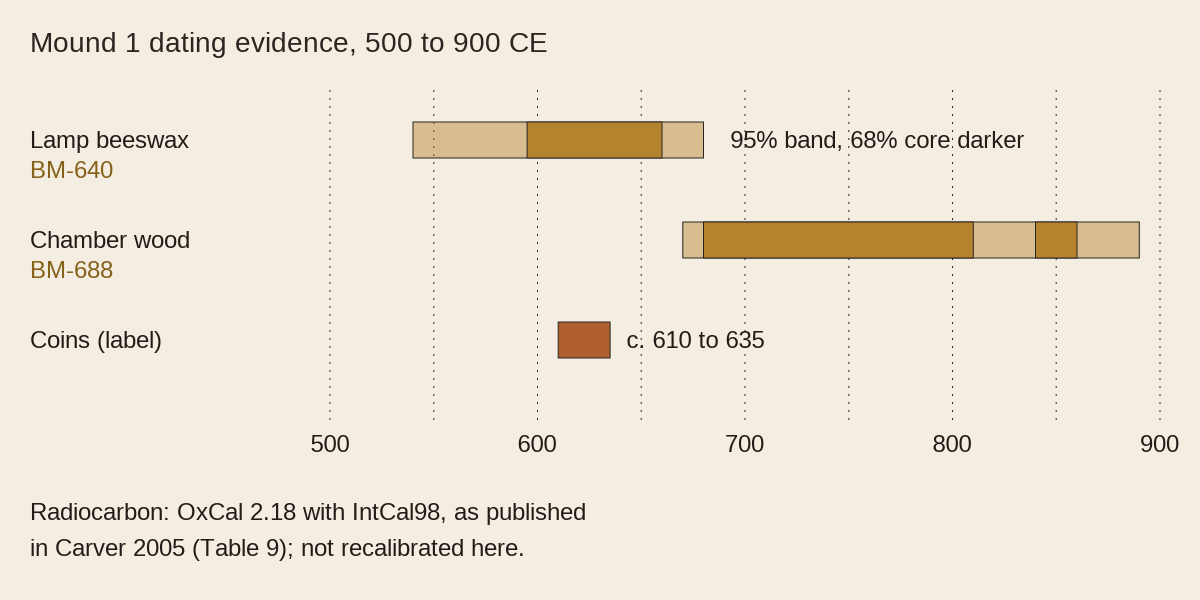
Scroll sideways to read every label, or open the full drawing.
Radiocarbon results for Mound 1 against the coin date. Bands are 95% ranges with darker 68% cores, as published; the chamber wood falls after the coins.
"Sutton Hoo Mound 1: radiocarbon results against the coin date" by Sherd and Script, https://sherdandscript.com/evidence/sutton-hoo/, licensed under CC BY 4.0 (https://creativecommons.org/licenses/by/4.0/)
Data sources for this figure
Data: M. Carver, Sutton Hoo: A Seventh-Century Princely Burial Ground and its Context (London: British Museum Press and Society of Antiquaries of London, 2005), Society of Antiquaries Research Report 69, open access at https://martincarver.com/publications/sutton-hoo-report; single published values (dimensions, dates); British Museum gallery label text (single facts), read from a Wikimedia Commons photograph by JASpencer (CC0)
Why is the grave usually given to Rædwald?
The identification is old and often repeated. Carver cites H. M. Chadwick (1940), the 1975 report and later work for it. The 2016 study still describes the burial as "commonly attributed to Raedwald (d. 624/5 AD), King of East Anglia." The case rests on a book and a map as much as on the grave.
The book is Bede's Ecclesiastical History, finished in 731. Bede names Rædwald as the fourth king to rule the English kingdoms south of the Humber, after Æthelberht of Kent, and says he was baptized in Kent but kept an altar to Christ and a smaller one for sacrifices in the same temple. Bede gives no year and no place for Rædwald's death or burial.
The map is Bede's too: he names Rendlesham as a royal township of the East Angles, and by this page's calculation the Wikidata points for Sutton Hoo and Rendlesham village lie 6.8 km apart in a straight line. The village point is not the site of the royal settlement, so the figure only shows that the two places are near neighbors.
The most economical reading is that the burial honored a member of the East Anglian royal house, given the coin dates, the wealth of the chamber and the nearby royal township. Rædwald has been the favored name since 1940, though Wikipedia's summary notes that his son Eorpwald, who died in 627 or 628, also fits the coin range.
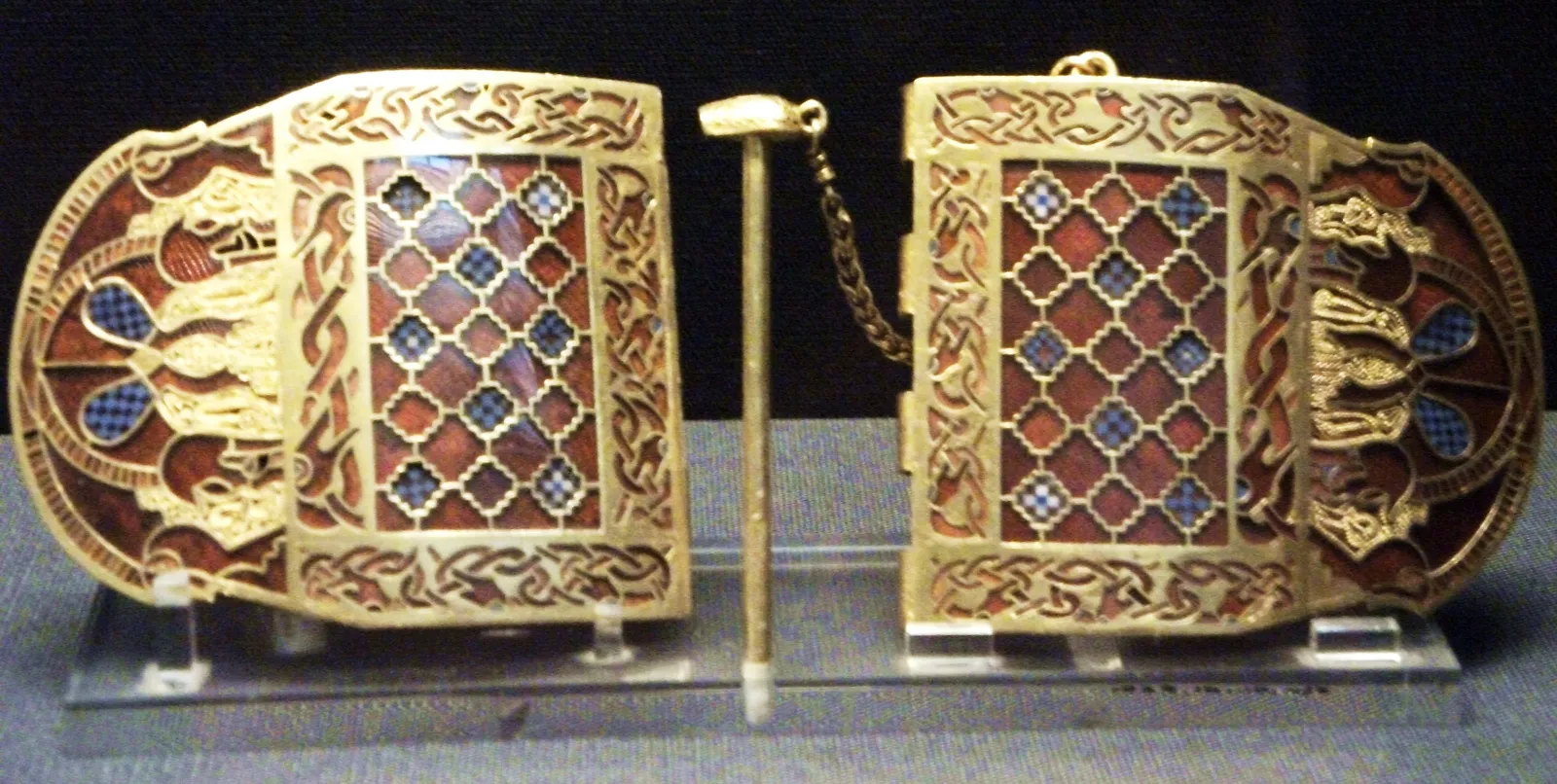
One of the two gold and garnet shoulder clasps, made in two hinged halves. Nothing in the grave names the person who wore them.
Museum no. 1939,1010.4–4.a and 5–5.a (pair) · Findspot: Sutton Hoo, Mound 1, burial chamber
"Shoulder clasp (open) from Sutton Hoo burial" by Johnbod — https://commons.wikimedia.org/wiki/File:Brit_Mus_17sept_081.jpg — CC BY-SA 3.0 (https://creativecommons.org/licenses/by-sa/3.0/)

How firm is Rædwald's death year?
It is less firm than the usual 624 suggests. Bede's sequence has Rædwald alive after Æthelberht's death, which Bede dates to 616, and succeeded by his son Eorpwald by the time Eorpwald was converted, which the 1907 translation dates in a chapter heading to 627–628. Wikipedia traces 624 to Roger of Wendover's 13th-century history, which records Rædwald's death twice, in 599 and 624, and appears to include earlier annals of unknown origin. Citing Steven Plunkett, Wikipedia calls 624 the date commonly given.
Even one report can move the year. Carver's 2005 volume gives Rædwald "d. c.626" on one page and "d. 624/5" on the next, without a basis for either. On this site's terms a year quoted without its source is a bare date, a date given without its basis, and Bede's own sequence supports only a window: after 616 and before 627 or 628.
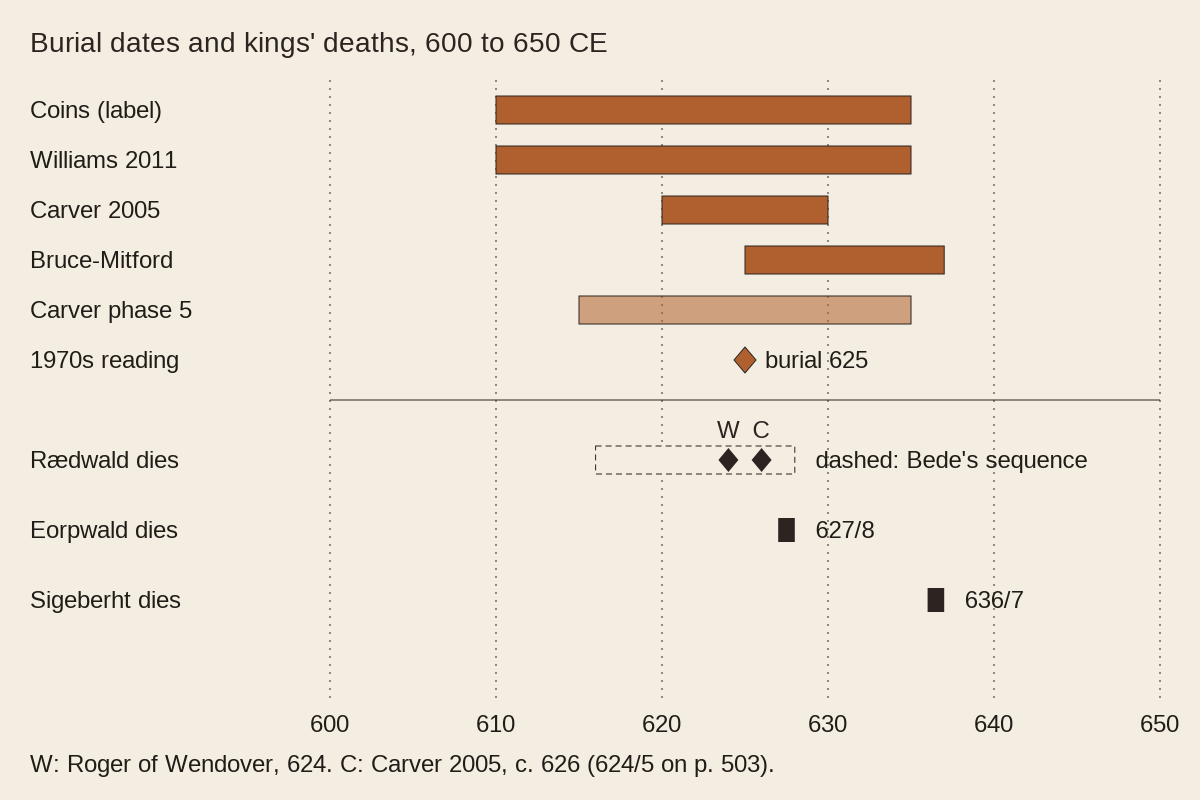
Scroll sideways to read every label, or open the full drawing.
Burial dates from the coins and from later estimates, against the deaths of three candidate kings. Williams's band dates the latest coins; the dashed box is the window Bede's sequence allows for Rædwald.
"Sutton Hoo Mound 1: published burial dates and the deaths of candidate kings" by Sherd and Script, https://sherdandscript.com/evidence/sutton-hoo/, licensed under CC BY 4.0 (https://creativecommons.org/licenses/by/4.0/)
Data sources for this figure
Data: M. Carver, Sutton Hoo: A Seventh-Century Princely Burial Ground and its Context (London: British Museum Press and Society of Antiquaries of London, 2005), Society of Antiquaries Research Report 69, open access at https://martincarver.com/publications/sutton-hoo-report; single published values (dimensions, dates); British Museum gallery label text (single facts), read from a Wikimedia Commons photograph by JASpencer (CC0); Saxon No. 54 (Sutton Hoo Society, 2012), https://suttonhoo.org/index.php/saxon/53-issue-no-54/file: single dated values, attributed; Bede, Ecclesiastical History of England, tr. A. M. Sellar (1907), public domain, Project Gutenberg eBook #38326; Wikipedia, "Rædwald of East Anglia": single dated fact (Roger of Wendover, 624), attributed
Download the dating evidence (CSV) (Data: M. Carver, Sutton Hoo: A Seventh-Century Princely Burial Ground and its Context (London: British Museum Press and Society of Antiquaries of London, 2005), Society of Antiquaries Research Report 69, open access at https://martincarver.com/publications/sutton-hoo-report; single published values (dimensions, dates); British Museum gallery label text (single facts), read from a Wikimedia Commons photograph by JASpencer (CC0); Saxon No. 54 (Sutton Hoo Society, 2012), https://suttonhoo.org/index.php/saxon/53-issue-no-54/file: single dated values and short quotations, attributed; Bede, Ecclesiastical History of England, tr. A. M. Sellar (London: George Bell and Sons, 1907), public domain, Project Gutenberg eBook #38326, https://www.gutenberg.org/ebooks/38326; Wikipedia, "Rædwald of East Anglia" (CC BY-SA 4.0), single dated fact attributed in the CSV) (sources and license, JSON) · Download the ship measurements (CSV) (Data: M. Carver, Sutton Hoo: A Seventh-Century Princely Burial Ground and its Context (London: British Museum Press and Society of Antiquaries of London, 2005), Society of Antiquaries Research Report 69, open access at https://martincarver.com/publications/sutton-hoo-report; single published values (dimensions, dates); Burger et al. 2016, PLOS ONE 11(12): e0166276, CC BY 4.0, https://doi.org/10.1371/journal.pone.0166276; Wikidata (CC0), coordinates of Q503256 and Q2402451) (sources and license, JSON)
What does the "king's grave" label rest on?
The label bundles claims of different strength. The table separates them by the kind of evidence behind each one.
| Claim | Evidence | Kind | Status, as of 2026 |
|---|---|---|---|
| A ship about 27 m long was buried in a trench | Rivets in place, stains in the sand, 1939 records, 1965–71 survey | Observation | Shown |
| The ship had been in use before the funeral | Repairs in the rivet pattern | Inference from observed repairs (Carver; the 2016 study) | Well supported |
| The burial is no earlier than the newest coin in the purse | 37 coins; Williams dates the latest c. 610–635 CE | Numismatic dating, lower limit | Shown |
| The burial took place about 610–635 CE | The coins, on the British Museum's reading | Estimate | The museum's estimate |
| A body lay in the chamber | Layout of personal gear, phosphate, no bone | Inference | Disputed |
| The burial honored someone of the highest rank | Regalia, gold and garnet work, imported silver | Interpretation | Interpretation |
| The burial was Rædwald's | Coin range, Bede, Rendlesham nearby | Identification | Not shown |
Carver, who directed the Sutton Hoo campaign of 1983–2001, listed six candidates proposed over the years, from Rædwald and members of his family to Sæberht of Essex. He then wrote that such attributions "belong to the realm of the fantastic and unknowable, and indeed to the unnecessary."
What did rereading the 1939 records change?
Digging uses up the evidence it records. At Sutton Hoo a British Museum team returned in 1965–71, surveyed what was left of the ship, took molds of parts of it and dug the rest of Mound 1 down to the subsoil. Since then the ship has existed only as notes, plans, photographs, molds and stored finds.
Think of those records as the only surviving copy of a sentence that the digging erased: the copy can be reread and corrected, but never checked against the original line. The first example below drew new conclusions from those records without new digging at Mound 1, which makes it an archive dig. The second added laboratory tests on stored finds. Old records can also mislead, and Piltdown Man, announced in 1912 and exposed as a forgery in 1953, is a case where the record itself was faked.
Carver's 2005 report rebuilt the Mound 1 account from the published volumes and from Phillips's unpublished memoir and autobiography. From the records of a brittle helmet and a sagging hull, it argued that the chamber stood open for some years under a ridged roof. It also set out five possible bearers for the body, from a platform to a coffin. It did not choose one.
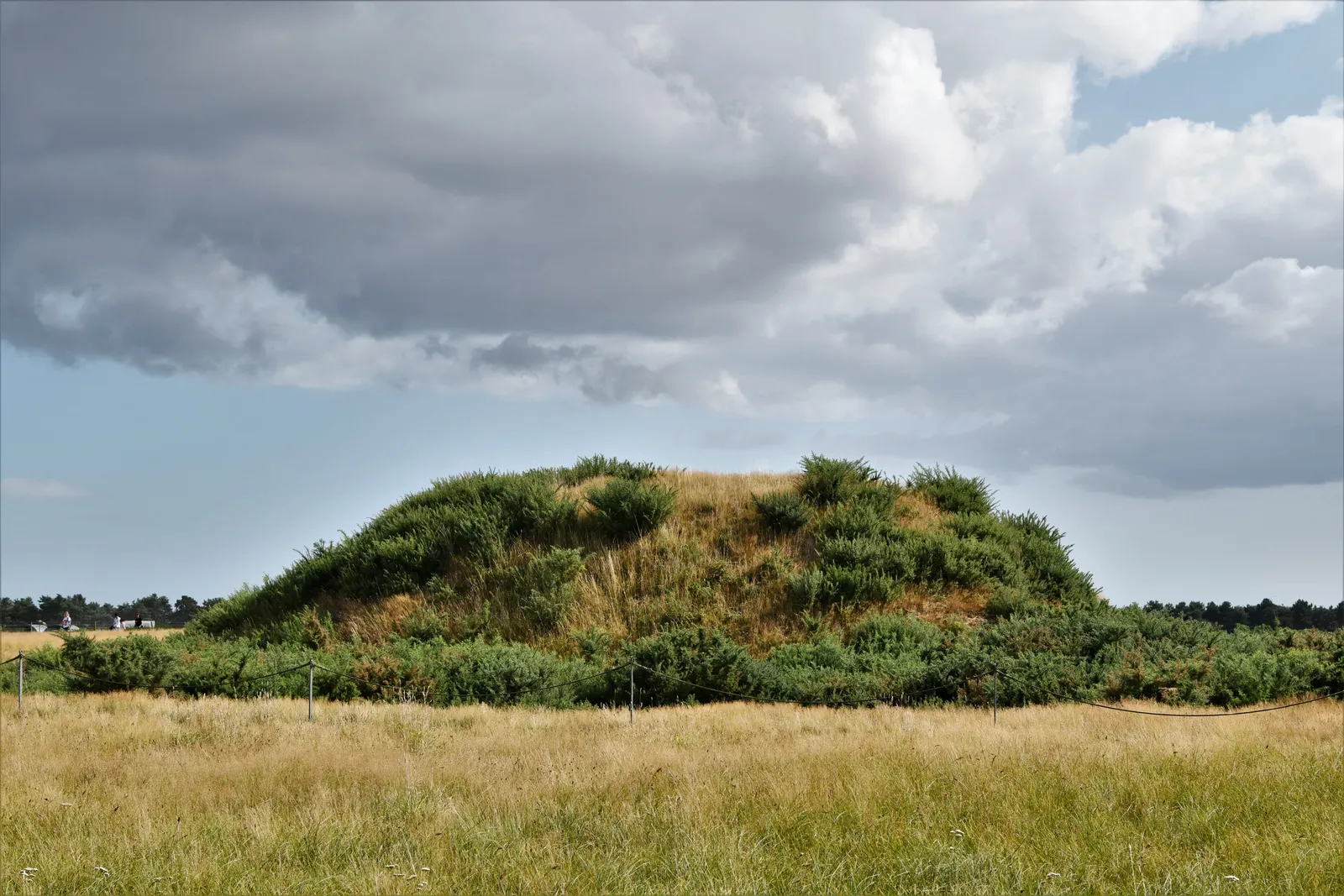
Mound 2, the second ship burial at Sutton Hoo, rebuilt in 1993 to its calculated seventh-century size. Mound 1 was not rebuilt to full height.
"Sutton Hoo, The Royal Burial Ground: Mound 2, robbed ship burial, restored to its original size" by Michael Garlick — https://commons.wikimedia.org/wiki/File:Sutton_Hoo,_The_Royal_Burial_Ground,_Mound_2,_robbed_ship_burial,_restored_to_its_original_size_-_geograph.org.uk_-_6945305.jpg — CC BY-SA 2.0 (https://creativecommons.org/licenses/by-sa/2.0/)

The second example came from a museum store. Six small black lumps from the chamber were noted in 1939 as possible pitch, partly labeled manganese oxide in 1940 and identified in 1970 as Stockholm tar, a tar distilled from pine wood. An unpublished report of 1971 proposed bitumen, but the lumps were still read as material for repairing the ship, and Carver's 2005 account cites the tar as a hint of how holes in the hull were plugged.
In 2016 a team re-analyzed the lumps and found them to be bitumen whose chemistry links it to Middle Eastern sources, closest to the Dead Sea family, and to none of the British sources tested. That makes the 1970 Stockholm tar identification an Outdated claim. The authors argue that the bitumen belongs with the grave goods rather than the ship, but their paper leaves the exact source open: a link to Syrian seepages would need a larger set of comparison samples.
Proof radius
What this box is for: the proof radius.
Proves: A clinker-built ship about 27 m long, with repairs in its rivet pattern, was set in a trench under Mound 1 with a richly furnished chamber, and the burial is no earlier than the newest coin in that chamber; on the British Museum's reading, the coins put it at about 610–635 CE, as of 2026.
Doesn't prove: That the grave was Rædwald's, or beyond dispute that it held a body. No bone, inscription or document ties a name to the chamber, and Rædwald's death year rests on Bede's sequence and a 13th-century chronicle.
Read next: Carbon dating: how one laboratory measurement becomes a calendar range. Antikythera mechanism: a shipwreck find whose date also leans on coins.
Sources
Primary sources first.
- 1Martin Carver, Sutton Hoo: A Seventh-Century Princely Burial Ground and its Context (London: British Museum Press and the Society of Antiquaries of London, 2005), Society of Antiquaries Research Report 69, open-access edition on the author's website. https://martincarver.com/publications/sutton-hoo-report Read: full text (open-access PDFs: front matter, Parts I-III, back matter)
- 2Bede, Bede's Ecclesiastical History of England: A Revised Translation, trans. A. M. Sellar (London: George Bell and Sons, 1907), Project Gutenberg eBook #38326. https://www.gutenberg.org/ebooks/38326 Read: full text (Project Gutenberg)
- 3British Museum, gallery label 'Gold coins, blank coins and ingots' for the Sutton Hoo Mound 1 coins, as photographed by JASpencer on 15 October 2025, Wikimedia Commons, File:Coins IMG 20251015 123838.jpg (CC0); the museum's website was not read. https://commons.wikimedia.org/wiki/File:Coins_IMG_20251015_123838.jpg Read: label text, read from the photograph
- 4"Of coins and treasure," review of Gareth Williams, Treasures from Sutton Hoo (British Museum Press, 2011), Saxon no. 54 (Sutton Hoo Society, January 2012), p. 1. https://suttonhoo.org/index.php/saxon/53-issue-no-54/file Read: full text of page 1 (PDF)
- 5British Museum, gallery label 'Purse-lid' for the Sutton Hoo Mound 1 purse, as photographed by JASpencer on 15 October 2025, Wikimedia Commons, File:Museum IMG 20251015 123544.jpg (CC0); the museum's website was not read. https://commons.wikimedia.org/wiki/File:Museum_IMG_20251015_123544.jpg Read: label text, read from the photograph
- 6British Museum, gallery label 'Shoulder-clasps' for the Sutton Hoo Mound 1 clasps, as photographed by JASpencer on 15 October 2025, Wikimedia Commons, File:Museum IMG 20251015 123529.jpg (CC0); the museum's website was not read. https://commons.wikimedia.org/wiki/File:Museum_IMG_20251015_123529.jpg Read: label text, read from the photograph
- 7Pauline Burger, Rebecca J. Stacey, Stephen A. Bowden, Marei Hacke and John Parnell, "Identification, Geochemical Characterisation and Significance of Bitumen among the Grave Goods of the 7th Century Mound 1 Ship-Burial at Sutton Hoo (Suffolk, UK)," PLOS ONE 11, no. 12 (2016): e0166276, doi:10.1371/journal.pone.0166276. https://doi.org/10.1371/journal.pone.0166276 Read: full text (CC BY 4.0), PubMed Central PMC5132401
- 8Isabelle De Groote et al., "New Genetic and Morphological Evidence Suggests a Single Hoaxer Created 'Piltdown Man'," Royal Society Open Science 3, no. 8 (2016): 160328, doi:10.1098/rsos.160328. https://doi.org/10.1098/rsos.160328 Read: abstract and introduction (CC BY 4.0), PubMed Central PMC5108962
- 9Wikidata, "Sutton Hoo helmet" (Q1603141): inventory number and collection. https://www.wikidata.org/wiki/Q1603141 Read: Wikidata item (structured statements, CC0)
- 10Wikidata, "Sutton Hoo" (Q503256) and "Rendlesham" (Q2402451): coordinate location. https://www.wikidata.org/wiki/Q503256 Read: Wikidata items Q503256 and Q2402451 (coordinates, CC0)
- 11Wikimedia Commons, File:Great gold buckle sutton hoo.JPG, file description by Geni (registration number 1939,1010.1). https://commons.wikimedia.org/wiki/File:Great_gold_buckle_sutton_hoo.JPG Read: file description page
- 12Wikipedia, "Sutton Hoo" (read 2026-10-13; used as a guide to the scholarship it cites). https://en.wikipedia.org/wiki/Sutton_Hoo Read: article HTML
- 13Wikipedia, "Rædwald of East Anglia" (read 2026-10-13). https://en.wikipedia.org/wiki/R%C3%A6dwald_of_East_Anglia Read: article HTML


Cite this page
Sherd and Script. “Sutton Hoo: What a Ship Made of Sand and Rivets Can Prove.” Sherd and Script. Published 13 October 2026; last substantive revision 23 October 2026. https://sherdandscript.com/evidence/sutton-hoo/ (accessed ).
Corrections
- 2026-10-23 — TL;DR: the coin date restated as a lower limit and the museum's reading (was: "The burial inside it is dated by 37 Frankish gold coins from the purse to
c. 610–635 CE · associated finds, coins, as of 2026, while two radiocarbon results from the 1970s are treated with caution." → now: "The 37 Frankish gold coins from the purse set the earliest date the burial could have; on the British Museum's reading they put it atc. 610–635 CE · associated finds, coins, as of 2026, while two radiocarbon results from the 1970s are treated with caution.") — the summary said more than the coin section supports: coins date a burial from below, Williams's range dates the latest coins, and 610–635 CE for the burial is the British Museum's reading (gallery label; G. Williams 2011, as quoted in Saxon 54) - 2026-10-23 — Claims table: the coin row split in two (was: "The burial dates to about 610–635 CE | 37 coins in the purse | Numismatic dating | Shown as a range" → now: "The burial is no earlier than the newest coin in the purse | 37 coins; Williams dates the latest c. 610–635 CE | Numismatic dating, lower limit | Shown" and "The burial took place about 610–635 CE | The coins, on the British Museum's reading | Estimate | The museum's estimate") — same reason as the TL;DR entry
- 2026-10-23 — Proof radius, Proves: the coin date restated the same way (was: "… and the coins in that chamber date the burial to about 610–635 CE, as of 2026." → now: "… and the burial is no earlier than the newest coin in that chamber; on the British Museum's reading, the coins put it at about 610–635 CE, as of 2026.") — same reason as the TL;DR entry