Claim check
Piltdown Man: Its Age Came From the Gravel, Not the Bones
Sherd and Script · Published 13 October 2026
The skull and jaw announced in 1912 took their age from the fossils and flints said to lie beside them. Every one of those neighbors had been planted, and tests on the bones themselves exposed the forgery in 1953.
Find card
- Object / Site
- Piltdown Man (Eoanthropus dawsoni): fragments of a thick human braincase and the right half of an ape-like lower jaw with two molars, announced in 1912 as one early human; a canine (1913) and the Piltdown II fragments and molar (reported 1915) were added later
- Findspot
- A gravel pit near the village of Piltdown, East Sussex, England (village level only). Dawson never revealed the exact place of the Piltdown II finds
- Context
- Planted. The 1913 paper put the jaw in the lowest gravel layer and most skull pieces in spoil heaps; the 1953 and 1955 reports showed that the bones, fossils and flints had been brought in and stained
- Dated by
- Claimed in 1912: associated finds (fossil mammal teeth and flints in the gravel). Tested later: fluorine and nitrogen content (relative, 1949–1955) and radiocarbon (1959 and later)
- Range
- Claimed:
first half of the Pleistocene · associated finds, mammal teeth and flints(Outdated claim). Measured: jaw PA E 594500 ± 100 years · radiocarbon, uncalibrated; braincase piece PA E 590620 ± 100 years · radiocarbon, uncalibrated(de Vries and Oakley 1959, as reported in 2016); to be viewed with great caution, as of 2026 - Dated event
- The claimed range dated the gravel and, by association, the skull and jaw. The radiocarbon ages date the deaths of the ape and of a person whose skull was used, not their burial in the gravel
- Now at
- Natural History Museum, London: PA E 590–594, PA E 610 and PA E 611 (Piltdown I); PA E 646–648 (Piltdown II), numbers as listed by De Groote et al. 2016, table 1
- Primary record
- C. Dawson and A. S. Woodward, Quarterly Journal of the Geological Society 69 (1913): 117–144, read 18 December 1912; exposure: J. S. Weiner, K. P. Oakley and W. E. Le Gros Clark, Bulletin of the British Museum (Natural History), Geology 2, no. 3 (1953): 139–146
Find card as CSV piltdown-man-find-card.csv (sources and license, JSON)Data: C. Dawson and A. S. Woodward, Quarterly Journal of the Geological Society 69 (1913): 117-144 and discussion, public domain, archive.org item quarterlyjourna691913geol; Isabelle De Groote et al., Royal Society Open Science 3: 160328 (2016), doi:10.1098/rsos.160328, CC BY 4.0 (https://creativecommons.org/licenses/by/4.0/); J. S. Weiner, K. P. Oakley and W. E. Le Gros Clark, Bulletin of the British Museum (Natural History), Geology 2(3) (1953): 139-146, archive.org item biostor-265698: single dated facts, cited; J. S. Weiner et al., Bulletin of the British Museum (Natural History), Geology 2(6) (1955), archive.org item biostor-265700: single published values and dated facts, cited
TL;DR. Piltdown Man (Eoanthropus dawsoni), announced on 18 December 1912 · documentary, took its claimed age from fossil teeth and flints reported beside it, not its own bones. Once fluorine, nitrogen and tooth wear were examined, the 1953 report showed a modern ape jaw with filed teeth, and the 1955 follow-up concluded: "Not one of the Piltdown finds genuinely came from Piltdown." A 2016 restudy judged it highly likely that the ape parts came from one orangutan and names Charles Dawson as the most likely single forger, as of 2026.
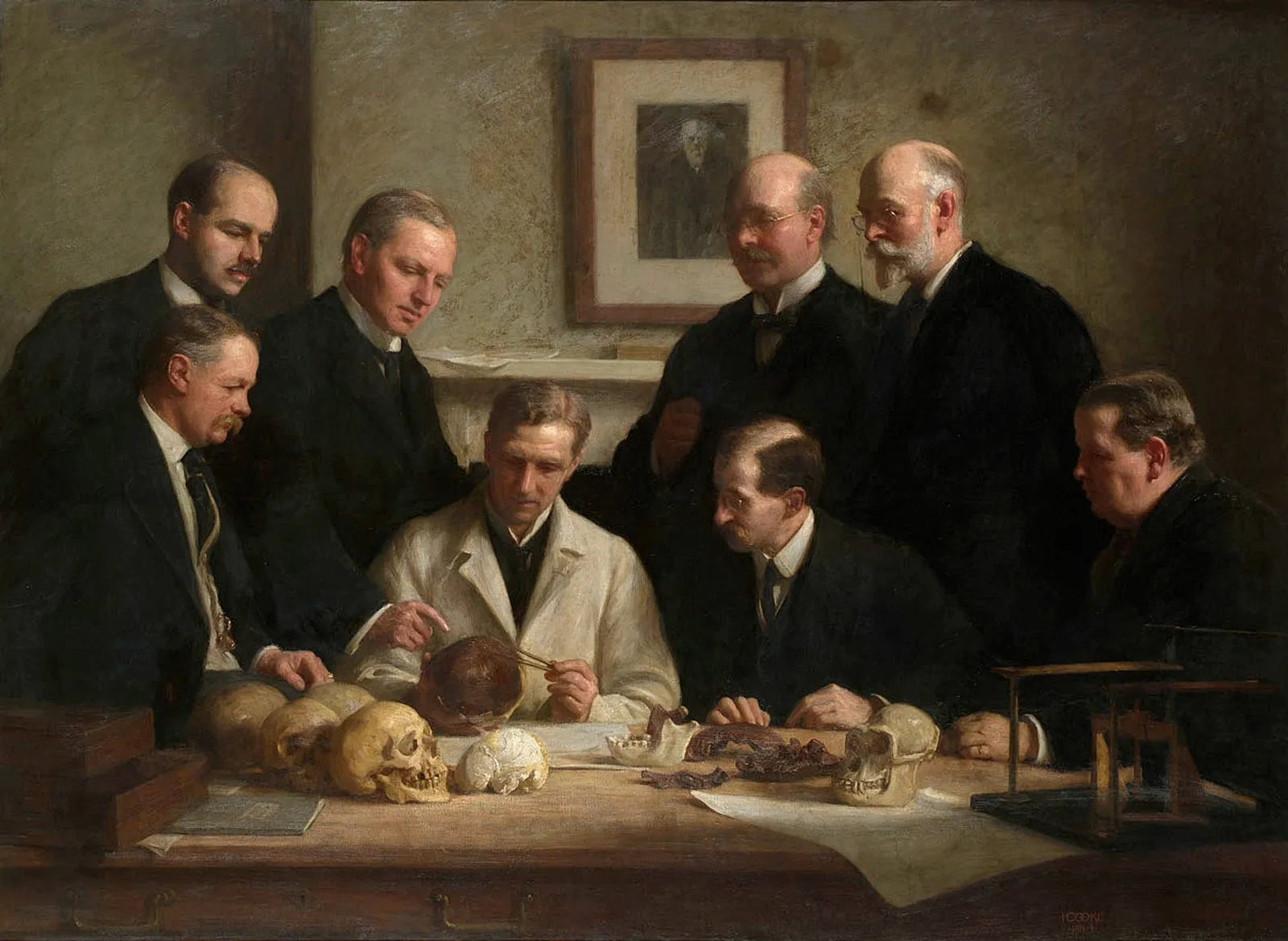
John Cooke's 1915 group portrait of the men who studied the Piltdown skull. Arthur Keith, seated in a white coat, examines it; a portrait of Charles Darwin hangs behind.
Museum no. PA E 590–594 · Findspot: gravel pit near Piltdown, East Sussex, where the pieces were planted
"Group portrait of the Piltdown skull being examined (1915)" by John Cooke — https://commons.wikimedia.org/wiki/File:Piltdown_gang_(dark).jpg — Public domain (painter John Cooke died in 1932 (Wikidata Q21460852): public domain in the EU; painted in 1915: public domain in the US; a faithful photograph of a two-dimensional work adds no new rights)

Piltdown Man's great age never came from its bones; it came from the gravel and fossil teeth around them. Charles Dawson and Arthur Smith Woodward presented the skull and jaw to the Geological Society of London. They dated them by what lay beside them: broken teeth of extinct elephants and other mammals, and flints they read as tools. Their paper put the remains in the first half of the Pleistocene · associated finds, mammal teeth and flints, now an Outdated claim.
Dating a find by its neighbors works when the neighbors were buried together. At Piltdown they were not. Forty-one years later, tests on the bones themselves showed a modern ape jaw beside a human braincase, both stained to match the gravel. A follow-up report found that the fossils and flints had been brought in as well.
What exactly was announced in 1912?
The paper was read on 18 December 1912 · documentary and printed in the society's journal in March 1913 · documentary. Dawson wrote that gravel diggers near Piltdown, in East Sussex, had once handed him a piece of unusually thick skull, and that he picked up a larger piece from their spoil heaps in the autumn of 1911 · documentary. With Smith Woodward, Keeper of Geology at the British Museum (Natural History), he then sifted the spoil heaps and the undisturbed gravel from the spring of 1912 · documentary.
Dawson reported finding the right half of a lower jaw, with two molars still in place, in a hollow of the undisturbed gravel. Smith Woodward fitted nine skull fragments into four larger pieces and modeled the rest. He named a new genus, Eoanthropus, because the braincase looked human while the jaw was "almost precisely that of an ape, with nothing human except the molar teeth."
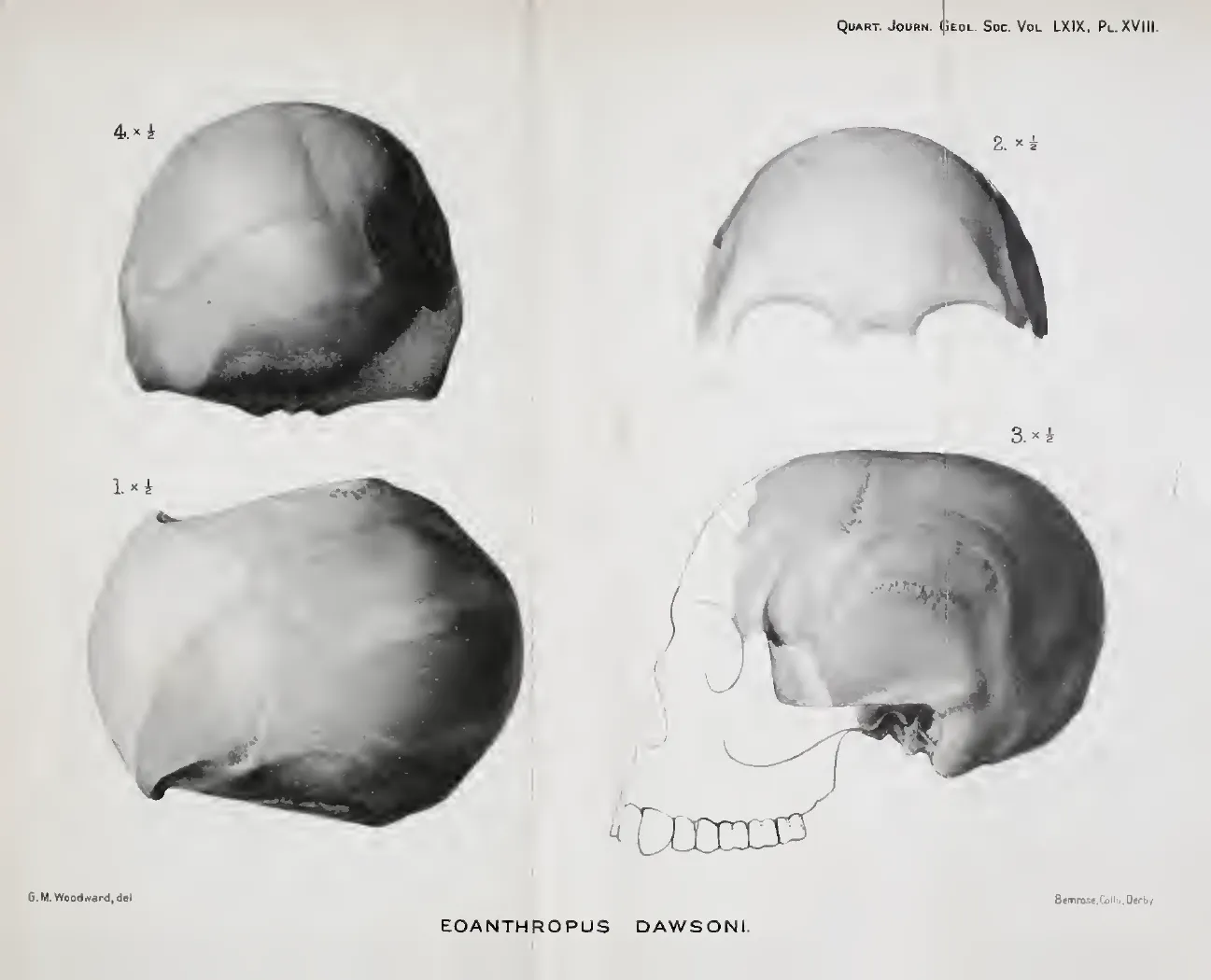
Smith Woodward's restored model of the skull, drawn by G. M. Woodward for the 1913 paper. Only the darkly shaded areas are bone that was actually found.
Museum no. PA E 590–593 · Findspot: gravel pit near Piltdown, East Sussex; planted there
"Eoanthropus dawsoni, Plate XVIII, Quarterly Journal of the Geological Society 69 (1913)" by G. M. Woodward. Public domain.
Full image credit
"Eoanthropus dawsoni, Plate XVIII, Quarterly Journal of the Geological Society 69 (1913)" by G. M. Woodward — https://commons.wikimedia.org/w/index.php?title=File:The_Quarterly_journal_of_the_Geological_Society_of_London_(IA_quarterlyjourna691913geol).pdf&page=221 — Public domain (draughtsman G. M. Woodward, who signed the plate, died in 1939 (Wikidata Q23603371): public domain in the EU; published in London in 1913: public domain in the US); modified: page 221 of the Commons PDF rendered at 300 dpi, 24 px scan edge cropped at left
In The Antiquity of Man (1915 · documentary), the anatomist Arthur Keith wrote that "beyond question he represents the earliest specimen of true humanity yet discovered." Smith Woodward's own book on the find, published in 1948 · documentary, was called The Earliest Englishman. On this site's reading, titles like "earliest" are provisional even when a measured date stands behind them; this one rested on the gravel alone. It is now an Outdated claim: the 1953 report showed that the jaw was a modern ape's.
Where did Piltdown Man's age come from?
The age came from the company the bones kept. Besides the human remains, the 1913 paper lists fossil teeth of extinct animals: broken molar pieces of Stegodon, an early elephant, and a worn cusp of a Mastodon tooth. There were also two Hippopotamus teeth, beaver teeth, a red deer antler and a horse tooth, all "highly mineralized with iron oxide." Flints from the gravel were described as crude tools and as "eoliths," a class the paper itself treated "with due reserve and caution."
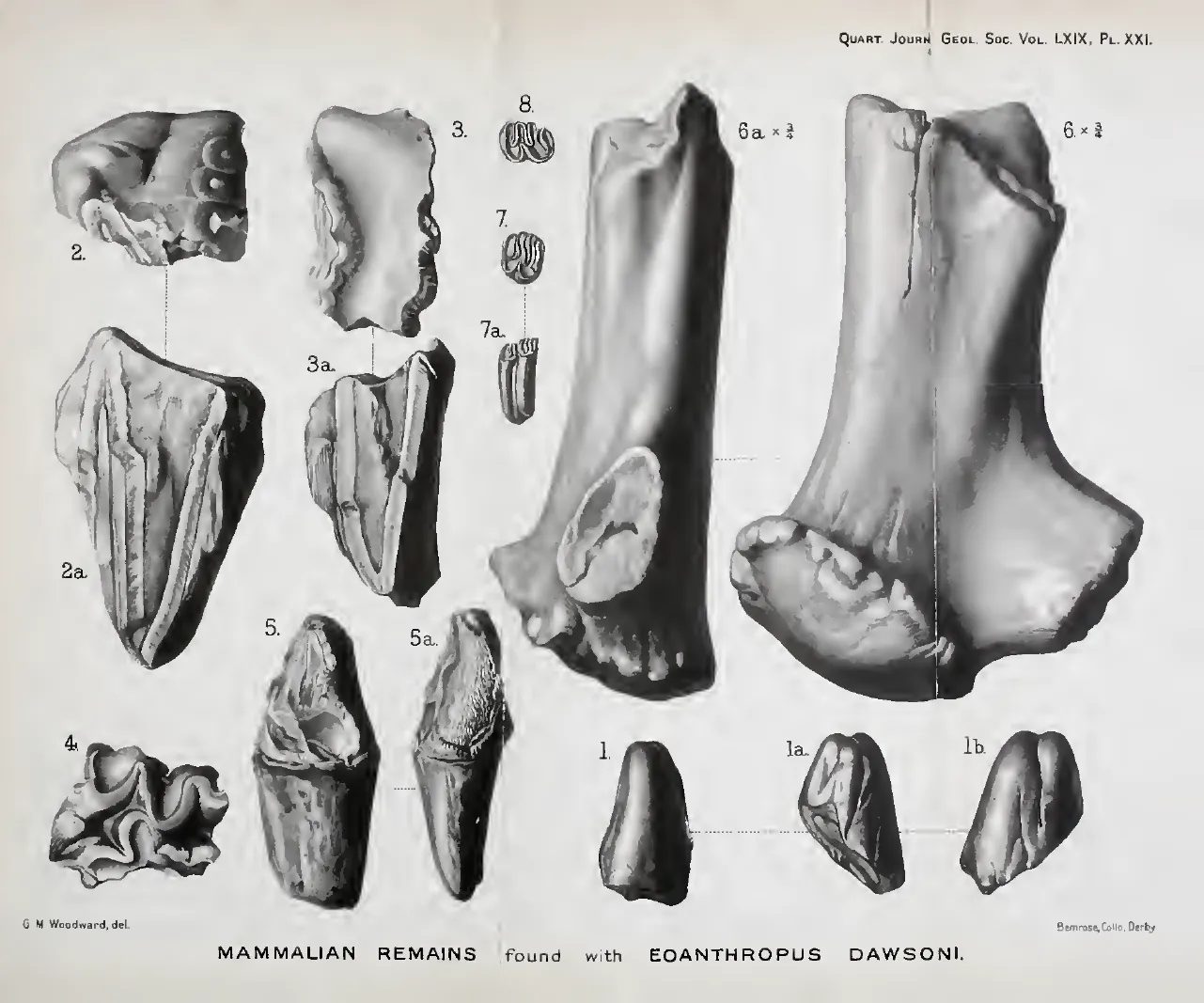
The mammal teeth and antler reported with the skull, drawn by G. M. Woodward for the 1913 paper. The paper used them to date the gravel; the 1955 report concluded they had been planted.
Findspot: reported from the Piltdown gravel and an adjacent field; planted, per the 1955 report
"Mammalian remains found with Eoanthropus dawsoni, Plate XXI, Quarterly Journal of the Geological Society 69 (1913)" by G. M. Woodward. Public domain.
Full image credit
"Mammalian remains found with Eoanthropus dawsoni, Plate XXI, Quarterly Journal of the Geological Society 69 (1913)" by G. M. Woodward — https://commons.wikimedia.org/w/index.php?title=File:The_Quarterly_journal_of_the_Geological_Society_of_London_(IA_quarterlyjourna691913geol).pdf&page=225 — Public domain (draughtsman G. M. Woodward, who signed the plate, died in 1939 (Wikidata Q23603371): public domain in the EU; published in London in 1913: public domain in the US); modified: page 225 of the Commons PDF rendered at 300 dpi, 24 px scan edge cropped at left
Smith Woodward's argument ran through that company. The mammals tended to place the gravel in the Pleistocene. If the gravel had formed early in that epoch, he wrote, "the age of the human remains is also decided." His reason was that the skull and jaw "would not have occurred in close association" if they had traveled far.
The printed discussion shows how loose that date was from the first evening. Keith argued that the skull "must be assigned to the same age as the mammalian remains, which were admittedly Pliocene," which was older still. Clement Reid, speaking about the geology of the Sussex coast, judged the deposits "not pre-Glacial or even early Pleistocene." All three positions came from the same gravel.
Ray Lankester raised the deeper problem. He was not certain that the jaw and skull belonged to one individual, he said, "and hence no convincing argument as to their age could be drawn from their juxtaposition in the gravel." In this site's terms, that is an objection about the proof radius: the gravel could date the gravel, and it could date the bones only if they had lain in it since it formed.
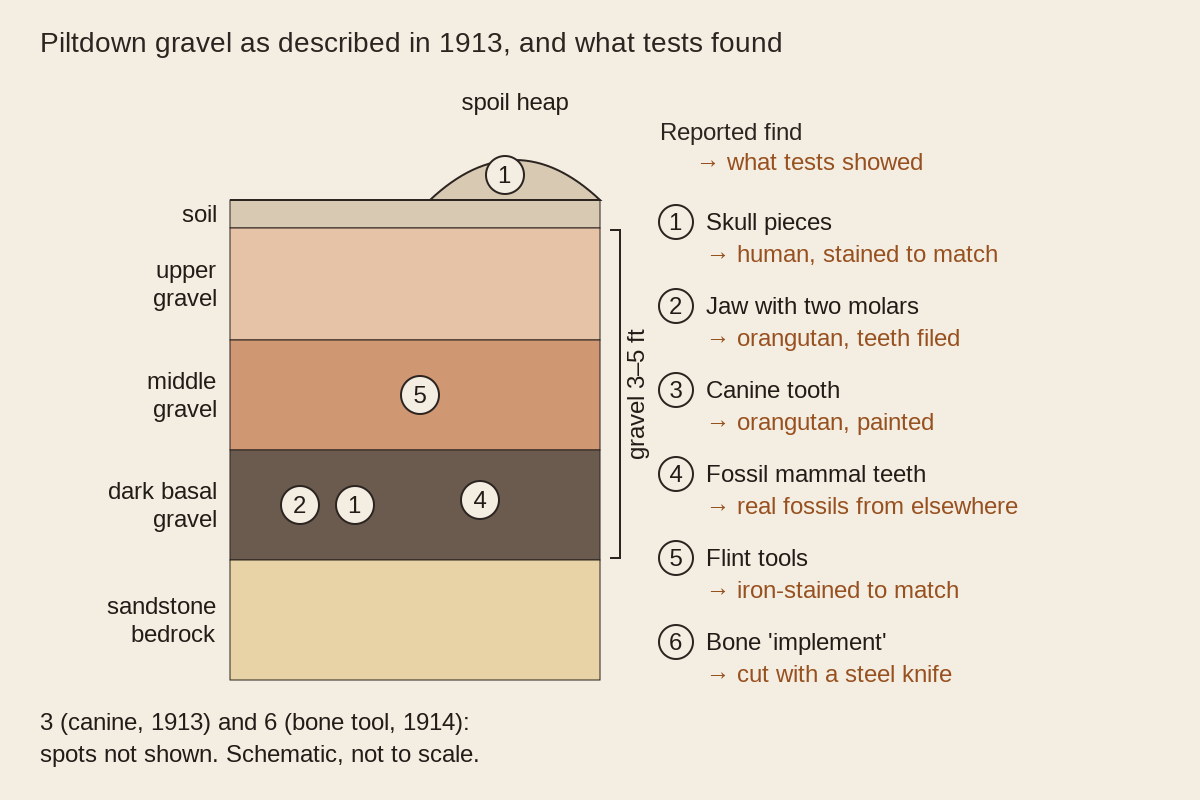
Scroll sideways to read every label, or open the full drawing.
The gravel as the 1913 paper describes it, with what later tests found for each kind of find. Layer depths are schematic; the paper gives the whole bed as 3–5 ft.
"Piltdown gravel as described in 1913, and what tests found" by Sherd and Script, https://sherdandscript.com/evidence/piltdown-man/, licensed under CC BY 4.0 (https://creativecommons.org/licenses/by/4.0/)Data used under CC BY: Isabelle De Groote et al., Royal Society Open Science 3: 160328 (2016), doi:10.1098/rsos.160328, CC BY 4.0 (https://creativecommons.org/licenses/by/4.0/)
Data sources for this figure
Data: C. Dawson and A. S. Woodward, Quarterly Journal of the Geological Society 69 (1913): 117-144 and discussion, public domain, archive.org item quarterlyjourna691913geol; Isabelle De Groote et al., Royal Society Open Science 3: 160328 (2016), doi:10.1098/rsos.160328, CC BY 4.0 (https://creativecommons.org/licenses/by/4.0/); J. S. Weiner, K. P. Oakley and W. E. Le Gros Clark, Bulletin of the British Museum (Natural History), Geology 2(3) (1953): 139-146, archive.org item biostor-265698: single dated facts, cited; J. S. Weiner et al., Bulletin of the British Museum (Natural History), Geology 2(6) (1955), archive.org item biostor-265700: single published values and dated facts, cited
Who doubted Piltdown Man before any test?
Doubts began that same evening. The anatomist David Waterston told the meeting that the braincase was human "in practically all its essential characters." The jaw, he said, resembled a chimpanzee's in all its details, so it was "very difficult to believe" that the two came from one individual. In November 1913 · documentary he pressed the point in Nature with outline tracings made from published radiographs.
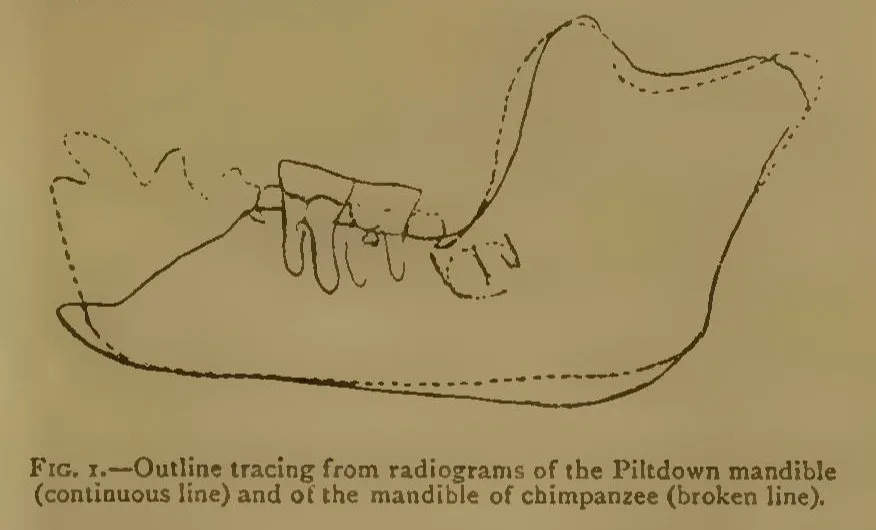
Waterston's 1913 tracing from radiographs: the Piltdown jaw as a solid line, a chimpanzee jaw as a broken line. He found the outlines "practically identical."
Museum no. PA E 594 · Findspot: gravel pit near Piltdown, East Sussex; planted there
"The Piltdown Mandible, fig. 1, Nature 92 (1913): 319" by David Waterston — https://commons.wikimedia.org/wiki/File:Waterston_1913_Figure_1_Piltdown_Mandible.jpg — Public domain (tracing by David Waterston, who says in the letter that he made it and who died in 1942 (Wikidata Q62858387): public domain in the EU; published in Nature on 13 November 1913: public domain in the US)

The jaw was broken at the chin. Smith Woodward's restoration added a modeled canine, and Keith ridiculed that restoration at the International Medical Congress on 11 August 1913 · documentary. Eighteen days later, on 30 August, a canine "remarkably similar" to the modeled one was found. De Groote and colleagues write that its timely discovery silenced many of the critics.
Dawson then reported more. Two postcards in 1915 · documentary told Smith Woodward of further finds at a second site, Piltdown II, including skull pieces and a molar. According to the 2016 study, this second find won over some of the dissenters. Dawson died in August 1916 · documentary and never revealed exactly where that second site was.
Through the 1920s and 1930s, finds of ancient human relatives in China, Indonesia and Africa pushed Piltdown to the margins. None of them combined an ape-like jaw with a human-like braincase (De Groote et al. 2016). By then Piltdown had become an anomaly that no test had yet touched.
How did fluorine test the bones themselves?
Fluorine dating compares bones; it does not count years. Buried bone slowly absorbs fluorine, and the amount grows with the time it stays in the ground, so bones that have lain in one deposit equally long should hold similar amounts. Kenneth Oakley of the British Museum (Natural History) described the method in 1948 · documentary, according to a 1959 account by the dental surgeon Hanbury Hazell.
A fluorine figure carries no date on its own. The rate varies from place to place. At Piltdown, the 1953 report notes, the rate was probably too slow to separate Upper Pleistocene bone from early post-glacial bone. What the test can show is order within one deposit: whether a jaw and a skull found together had been in the ground for the same length of time.
Oakley's first test, made in 1949 · documentary and published with Hoskins in 1950 · documentary, showed that neither the skull nor the jaw was Lower Pleistocene. It could not separate the two. The 1955 report gives the figures: about 0.2% fluorine in the jaw bone and under 0.1% in the teeth, against 0.1–0.4% in the skull, with a probable error of about ±0.2% on samples that small.
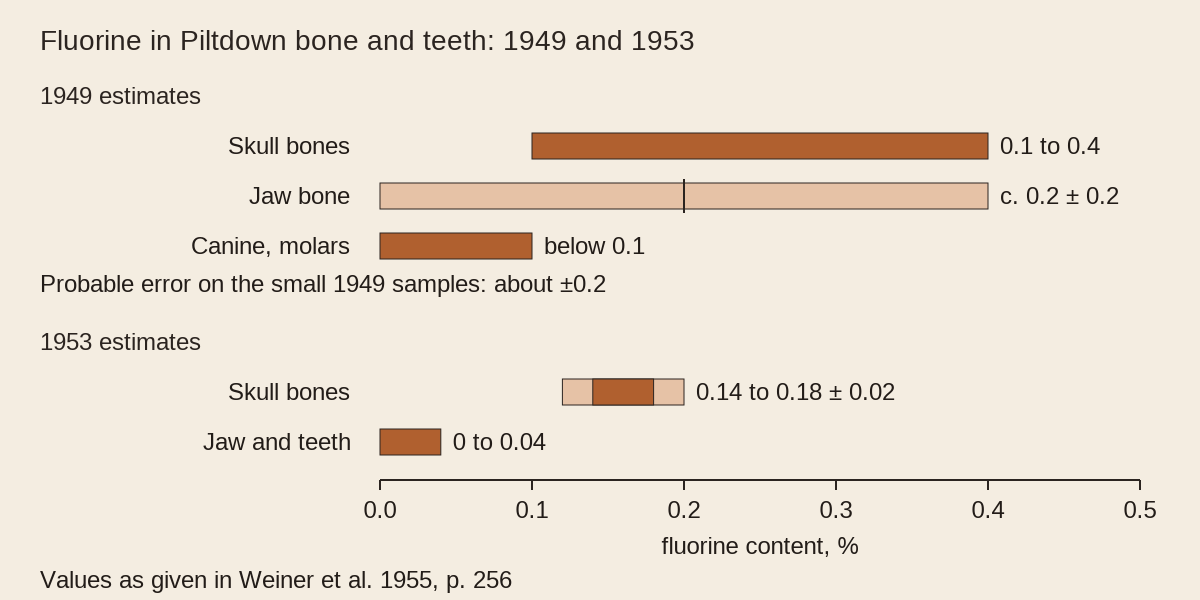
Scroll sideways to read every label, or open the full drawing.
Fluorine estimates as the 1955 report gives them. In 1949 the jaw and skull overlapped within the error; in 1953 the jaw and teeth fell well below the skull bones.
"Fluorine in Piltdown bone and teeth: 1949 and 1953 estimates" by Sherd and Script, https://sherdandscript.com/evidence/piltdown-man/, licensed under CC BY 4.0 (https://creativecommons.org/licenses/by/4.0/)Data: J. S. Weiner et al., Bulletin of the British Museum (Natural History), Geology 2(6) (1955), archive.org item biostor-265700: single published values and dated facts, cited
In 1953 · documentary, C. F. M. Fryd measured larger samples with a finer method. The skull bones held 0.14–0.18% fluorine, ±0.02%, while every result for the jaw and teeth fell between 0.04% and zero. The 1955 report concluded that the skull bones "were probably prehistoric," while "the canine tooth, the mandible and the isolated molar were modern." Nitrogen from bone protein, which is lost slowly after burial, pointed the same way (1953 report; Hazell 1959).
What did the 1953 report find?
The report by Joseph Weiner, Oakley and Wilfrid Le Gros Clark was issued on 21 November 1953 · documentary. Weiner had shown that filing a chimpanzee's teeth and staining them produced "an appearance astonishingly similar" to the Piltdown molars and canine. The team then looked for the marks that such work would leave:
- The molars were planed to a flatness "much more even than that normally produced by natural wear," with sharp, unbeveled edges, and the flat faces of the two molars did not meet in one plane.
- The canine was worn through to its pulp cavity, the opening appeared to have been plugged, and fine scratches marked the worn face.
- The canine's black coating was not an iron crust but "a tough, flexible paint-like substance."
- The skull pieces were stained with iron all the way through, up to 8%, while the jaw's stain was a surface layer: 7% iron at the surface and 2–3% deeper in.
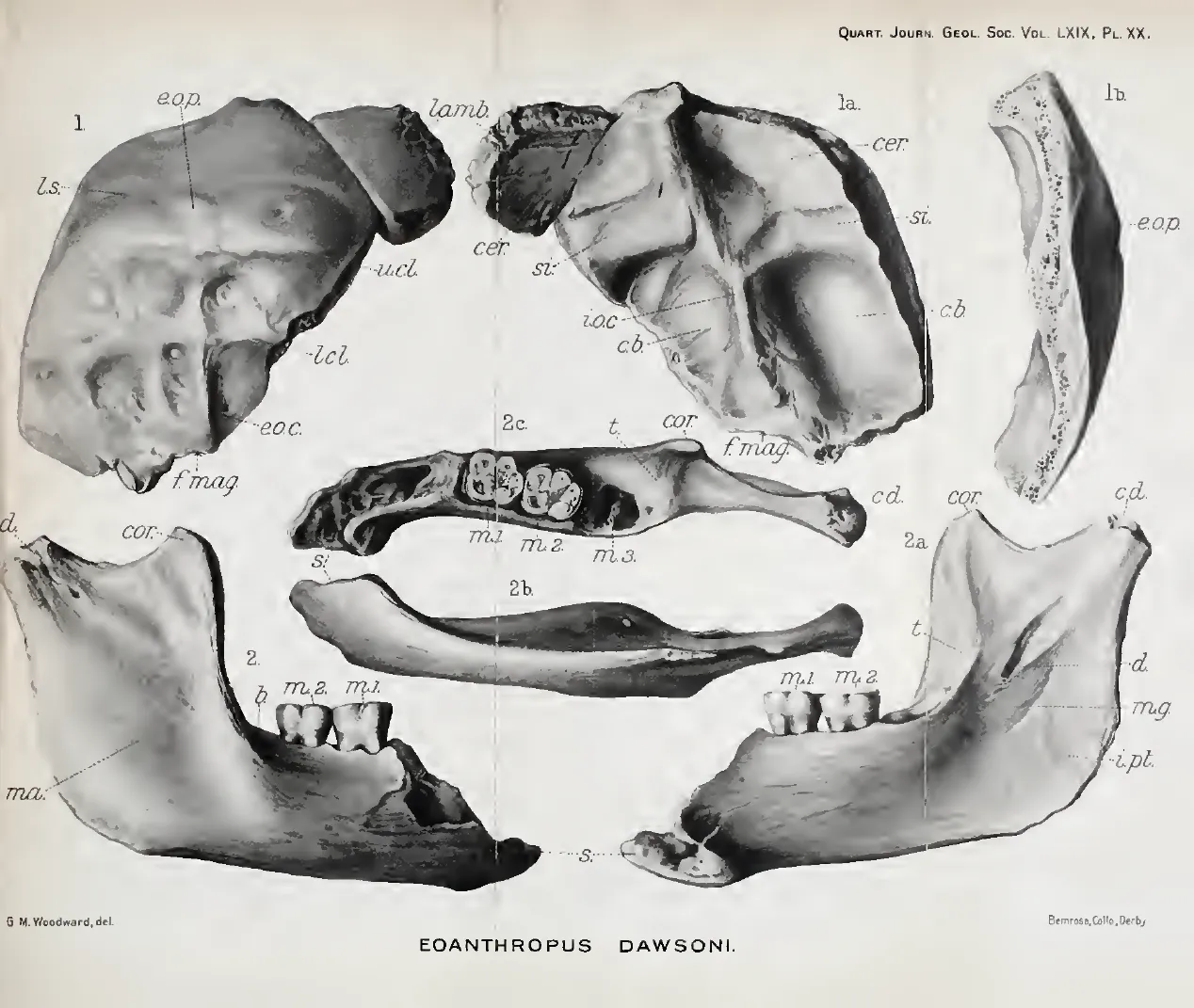
The jaw and an occipital piece as G. M. Woodward drew them in 1913. The two molars, m.1 and m.2, are the teeth the 1953 report found filed flat.
Museum no. PA E 594, PA E 593 · Findspot: gravel pit near Piltdown, East Sussex; planted there
"Eoanthropus dawsoni, Plate XX, Quarterly Journal of the Geological Society 69 (1913)" by G. M. Woodward. Public domain.
Full image credit
"Eoanthropus dawsoni, Plate XX, Quarterly Journal of the Geological Society 69 (1913)" by G. M. Woodward — https://commons.wikimedia.org/w/index.php?title=File:The_Quarterly_journal_of_the_Geological_Society_of_London_(IA_quarterlyjourna691913geol).pdf&page=217 — Public domain (draughtsman G. M. Woodward, who signed the plate, died in 1939 (Wikidata Q23603371): public domain in the EU; published in London in 1913: public domain in the US); modified: page 217 of the Commons PDF rendered at 300 dpi, 24 px scan edge cropped at left
A chemical test closed the gap. Smith Woodward had recorded that Dawson dipped the first skull pieces in potassium bichromate to harden them, and pieces collected later carried no chromate. Yet the jaw, which Smith Woodward recorded as dug up later and in his presence, did. The authors found this "explicable only as a necessary part of the deliberate matching of the jaw of a modern ape with the mineralized cranial fragments."
What did the 1955 report add?
The 1955 report extended the finding to everything in the gravel. The flints had been iron-stained, and the bone "implement" was shaped with a steel knife. The fossil mammals had been brought in, some from abroad; the radioactivity of one elephant tooth closely matched that of a fossil from Ichkeul, in Tunisia. The introduction, signed by the museum's director, Gavin de Beer, put it in one line: "Not one of the Piltdown finds genuinely came from Piltdown."
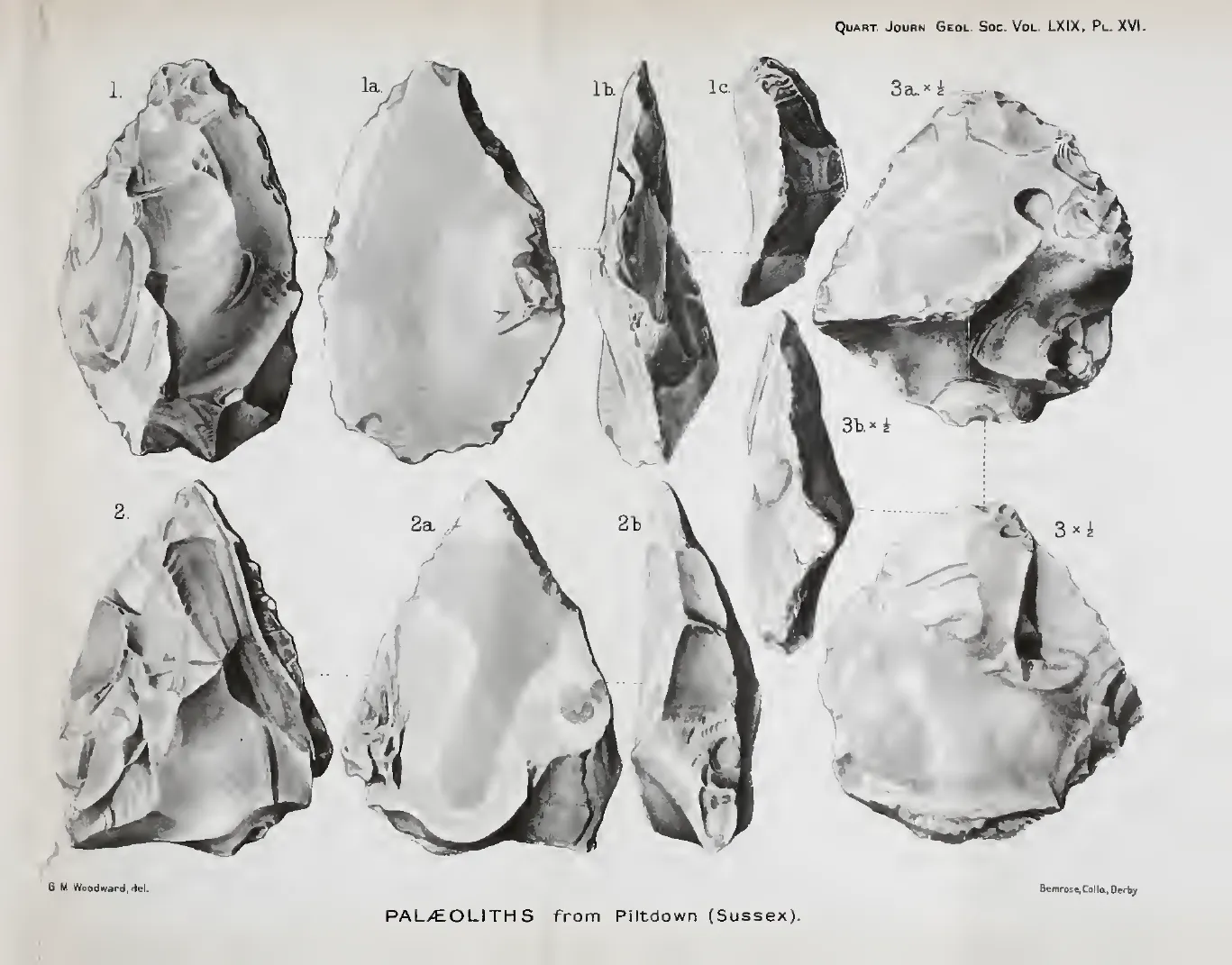
Flints from the Piltdown gravel that the 1913 paper called implements, drawn by G. M. Woodward. The 1955 report found that their stain washed off in dilute acid.
Museum no. E.605–E.607, as numbered in the 1955 report · Findspot: reported from the Piltdown gravel and spoil heaps; planted, per the 1955 report
"Palaeoliths from Piltdown (Sussex), Plate XVI, Quarterly Journal of the Geological Society 69 (1913)" by G. M. Woodward. Public domain.
Full image credit
"Palaeoliths from Piltdown (Sussex), Plate XVI, Quarterly Journal of the Geological Society 69 (1913)" by G. M. Woodward — https://commons.wikimedia.org/w/index.php?title=File:The_Quarterly_journal_of_the_Geological_Society_of_London_(IA_quarterlyjourna691913geol).pdf&page=183 — Public domain (draughtsman G. M. Woodward, who signed the plate, died in 1939 (Wikidata Q23603371): public domain in the EU; published in London in 1913: public domain in the US); modified: page 183 of the Commons PDF rendered at 300 dpi; no crop (this page has no gutter shadow)
Think of the Piltdown gravel as a sentence pasted together from words cut out of other books. Each word was real (an ape's jaw, a person's skull, a genuine fossil tooth), but the sentence that made them one early human had never been written in the ground.
What did radiocarbon add?
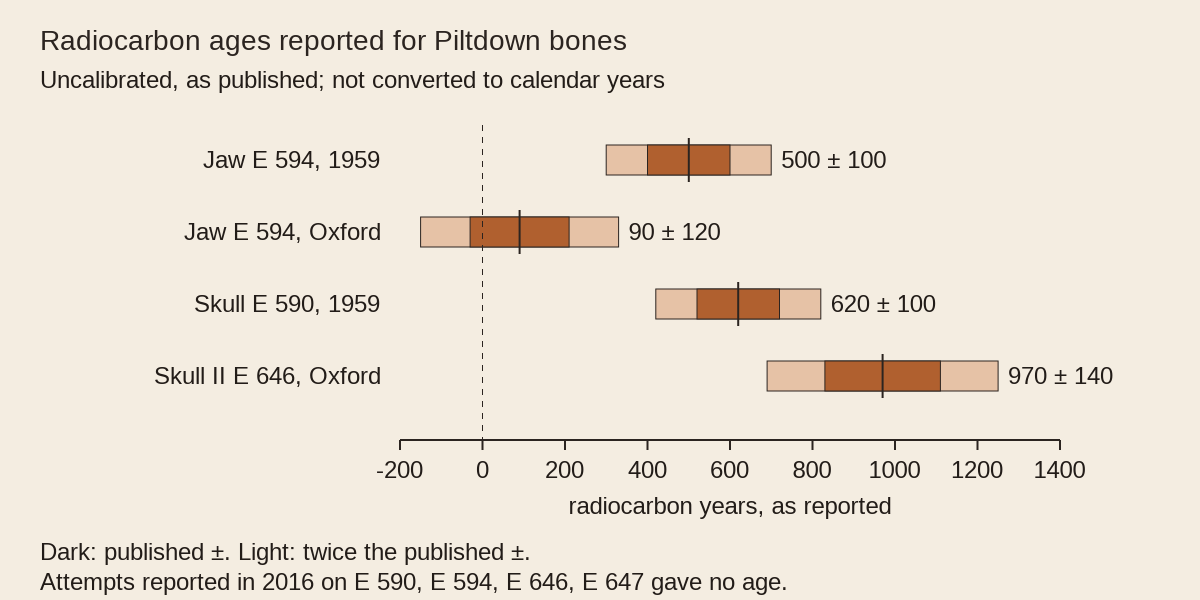
Radiocarbon dates the moment a plant or animal stopped taking in carbon, as the carbon dating page explains. At Piltdown it could date the deaths of the ape and the person, not the day their bones entered the gravel. In 1959 · documentary, de Vries and Oakley reported 500 ± 100 years · radiocarbon, uncalibrated for the jaw, PA E 594, and 620 ± 100 years · radiocarbon, uncalibrated for a braincase piece, PA E 590. Those figures come from the 2016 study; the 1959 paper was not read.
These are radiocarbon ages, not calendar years, and this page reports them as published, without calibrating or converting them. Later accelerator measurements at Oxford gave other figures. The 2016 study cites them from Spencer's 1990 book: 90 ± 120 years · radiocarbon, uncalibrated for the jaw and 970 ± 140 years · radiocarbon, uncalibrated for a Piltdown II frontal bone, PA E 646.
Scroll sideways to read every label, or open the full drawing.
The four reported radiocarbon ages, uncalibrated. Dark bands show the published ±, light bands twice that, by this page's calculation; the two skull results overlap only in the light bands.
"Radiocarbon ages reported for the Piltdown bones, uncalibrated" by Sherd and Script, https://sherdandscript.com/evidence/piltdown-man/, licensed under CC BY 4.0 (https://creativecommons.org/licenses/by/4.0/)Data: Isabelle De Groote et al., Royal Society Open Science 3: 160328 (2016), doi:10.1098/rsos.160328, CC BY 4.0 (https://creativecommons.org/licenses/by/4.0/)
The two sets do not agree. The 1959 jaw result had raised the idea of a curated ethnographic specimen, while the Oxford figure fits, in the 2016 study's words, "a Victorian- or Edwardian-age collection." The two skull results overlap only at two standard deviations, so the dates cannot show whether Piltdown I and II came from one skull.
The 2016 team tried again and got nothing usable. The frontal failed chemical pretesting. The jaw and the braincase piece showed "significant contaminant issues," and a Piltdown II occipital gave no datable material, so the earlier results, the authors concluded, "must be viewed with great caution."
Download: radiocarbon results and failed attempts (CSV) (Data: Isabelle De Groote et al., Royal Society Open Science 3: 160328 (2016), doi:10.1098/rsos.160328, CC BY 4.0 (https://creativecommons.org/licenses/by/4.0/); Crossref metadata (CC0), https://api.crossref.org/works/10.1038/184224a0 and https://api.crossref.org/works/10.1038/165379a0) (sources and license, JSON).
What did the 2016 restudy of the specimens show?
Isabelle De Groote and 15 colleagues reexamined the Piltdown specimens held at the Natural History Museum, London. They used tools the 1950s team did not have: ancient DNA, micro-CT scans, 3D shape analysis inside the teeth and X-ray fluorescence. Their paper appeared in Royal Society Open Science in August 2016 · documentary.
The ape parts are "highly likely" from a single orangutan, they conclude. Tooth shape links the jaw to the Piltdown II molar, root form links it to the canine, and the canine and that molar share one type of mitochondrial DNA. The DNA is from a Bornean orangutan, most closely related to populations now in southwest Sarawak. The human parts come from at least two people, "possibly medieval."
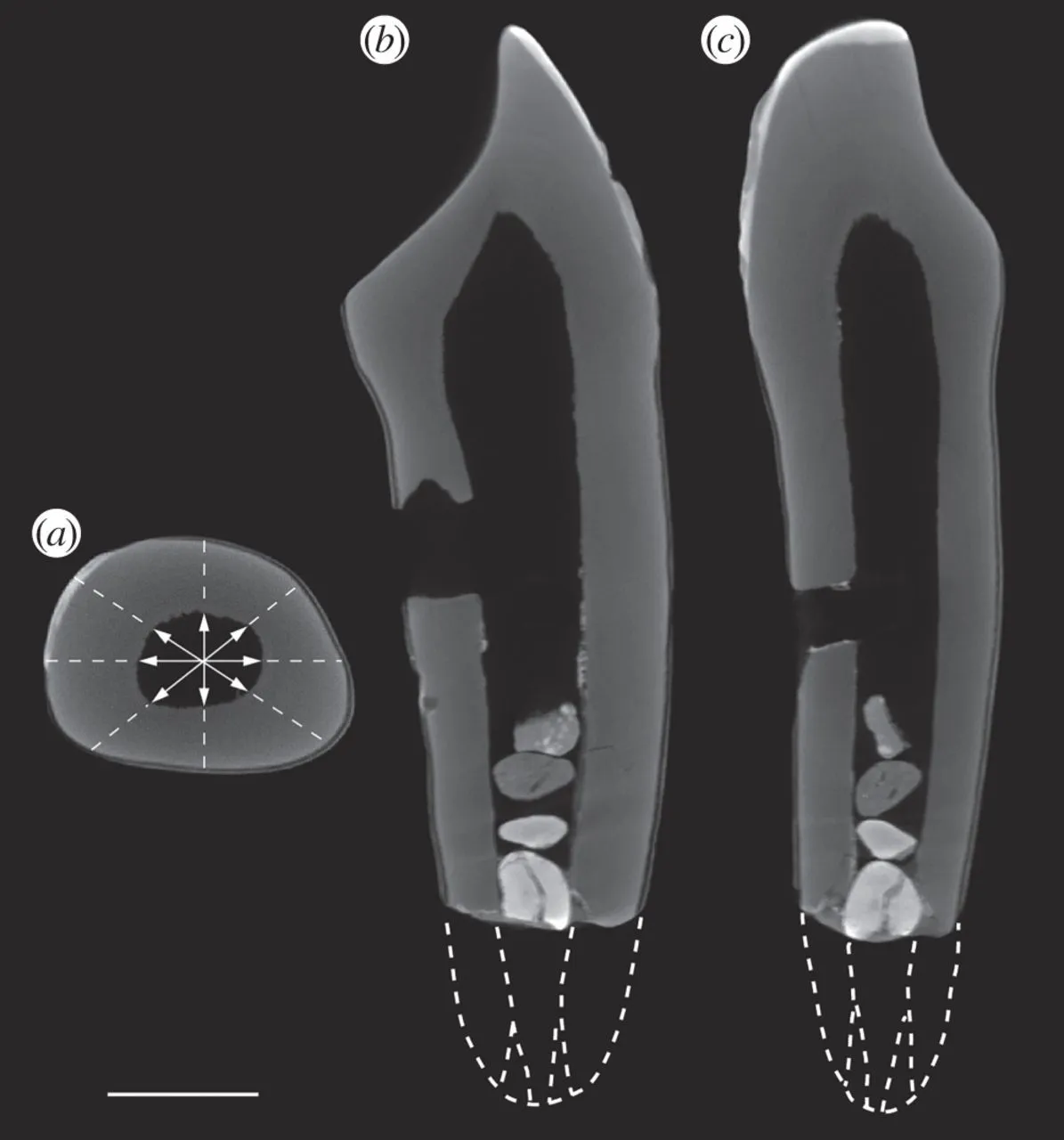
Micro-CT sections of the Piltdown canine, PA E 611, from the 2016 study. The tip has lost its enamel, and grains sit in the root cavity, where the study reports packed gravel.
Museum no. PA E 611 · Findspot: reported from the Piltdown gravel in 1913; planted there
"Three CT scans of the Piltdown canine (figure 3)" by Isabelle De Groote et al., Royal Society Open Science (2016) — https://commons.wikimedia.org/wiki/File:CT_scan_Piltdown_Man.jpg — CC BY 4.0 (https://creativecommons.org/licenses/by/4.0/)

The same working methods run through both sites. The bones carry a dark reddish-brown stain rich in iron, and cavities were packed with gravel held in by small pebble plugs. A putty rich in zinc and zirconium restored skull bone and reseated the molars in the jaw. The canine alone once held about 15 grains of gravel in its pulp chamber.
Most of that work was laboratory analysis of stored specimens. Its reading of letters in the museum's archive and the British Library comes closer to what this site calls an archive dig. The Sutton Hoo case file draws the same line between rereading records and running new tests.
Who made Piltdown Man?
The 2016 study names four main suspects from earlier work: Dawson, Smith Woodward, the Jesuit priest Teilhard de Chardin, who found the canine, and Martin Hinton. Hinton was a volunteer in Smith Woodward's department, and his bone-staining experiments turned up after his death. Citing a published bibliography, the study counts at least 20 others who have been accused over the years, many of them alongside Dawson.
The authors argue from the method. A small number of specimens supplied both sites, and the same stain, gravel and putty run through all of them, which they read as the work of "a single forger," most likely Dawson. The record they cite points the same way: nothing was found at the site when Dawson was absent, he alone was linked to Piltdown II, and no significant finds came after his death in 1916.
Scroll sideways to read every label, or open the full drawing.
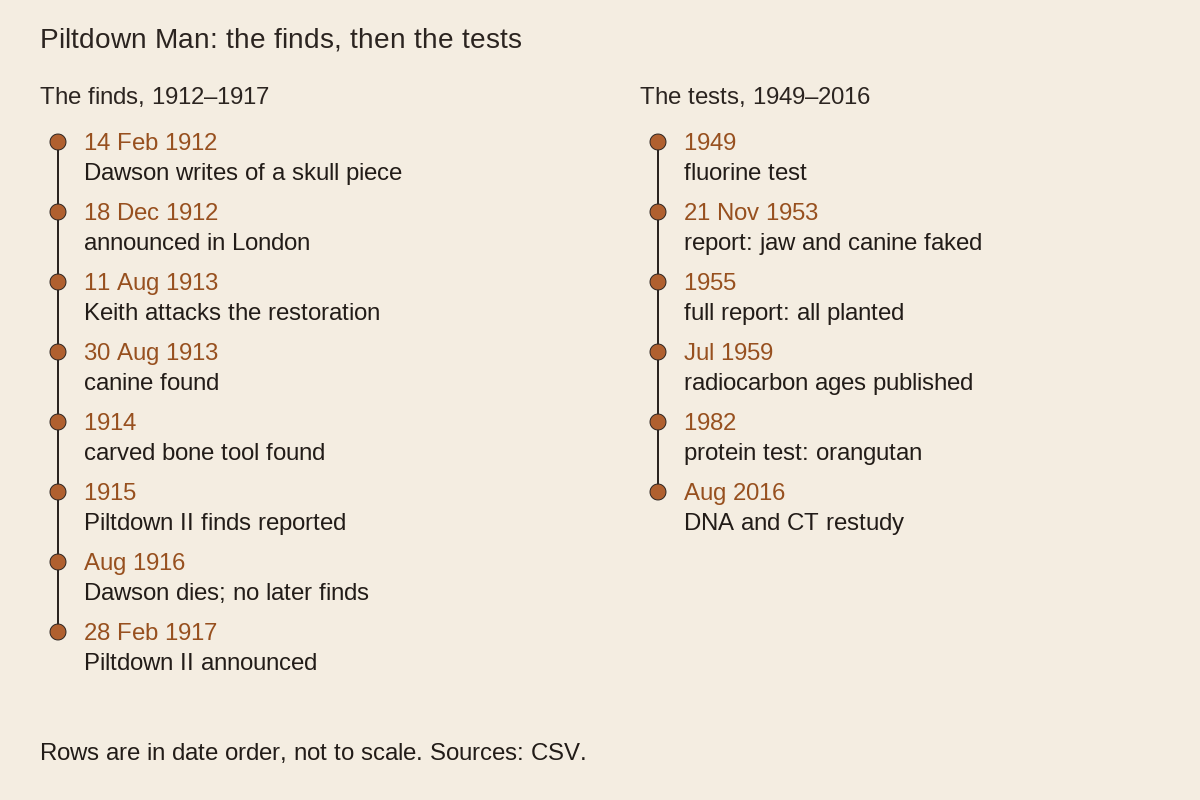
The finds and the tests in date order; rows are not spaced to scale. Dates and sources (CSV) (sources and license, JSON).
"Piltdown Man timeline: the finds, then the tests" by Sherd and Script, https://sherdandscript.com/evidence/piltdown-man/, licensed under CC BY 4.0 (https://creativecommons.org/licenses/by/4.0/)Data used under CC BY: Isabelle De Groote et al., Royal Society Open Science 3: 160328 (2016), doi:10.1098/rsos.160328, CC BY 4.0 (https://creativecommons.org/licenses/by/4.0/)
Data sources for this figure and its CSV
Data: C. Dawson and A. S. Woodward, Quarterly Journal of the Geological Society 69 (1913): 117-144 and discussion, public domain, archive.org item quarterlyjourna691913geol; Isabelle De Groote et al., Royal Society Open Science 3: 160328 (2016), doi:10.1098/rsos.160328, CC BY 4.0 (https://creativecommons.org/licenses/by/4.0/); J. S. Weiner, K. P. Oakley and W. E. Le Gros Clark, Bulletin of the British Museum (Natural History), Geology 2(3) (1953): 139-146, archive.org item biostor-265698: single dated facts, cited; J. S. Weiner et al., Bulletin of the British Museum (Natural History), Geology 2(6) (1955), archive.org item biostor-265700: single published values and dated facts, cited; Crossref metadata (CC0), https://api.crossref.org/works/10.1038/184224a0 and https://api.crossref.org/works/10.1038/165379a0; A. S. Woodward, Quarterly Journal of the Geological Society 73 (1917): 1-10, public domain, archive.org item quarterlyjourna731917geol
On motive they are more careful. They report a suggestion from Spencer's 1990 book that Dawson wanted recognition, above all election to the Royal Society. They also quote a letter he wrote to Smith Woodward in 1909 · documentary: "I have been waiting for the big 'find' which never seems to come along…" Whether Dawson acted alone, their abstract says, is uncertain.
Two questions stay open as of 2026. The 2016 team's search of the Natural History Museum and Hunterian Museum collections did not find the small Bornean orangutan that supplied the jaw. The human bones still have no reliable date either: the attempts reported in 2016 failed on every human bone sampled.
Proof radius
What this box is for: the proof radius.
Proves: The Piltdown jaw is a recent orangutan's with filed teeth, the skull pieces are human bone stained to match the gravel, and the fossils and flints beside them were brought in, so the gravel never dated the bones.
Doesn't prove: That Dawson worked alone, or how old the human bones are. The 2016 study names him as the most likely single forger and leaves the first question open.
Read next: Carbon dating: what a radiocarbon age measures, and why it dates a death, not a burial. Maya Long Count: a doomsday claim built on one calendar date, checked against the inscriptions.
Sources
Primary sources first.
- 1Charles Dawson and Arthur Smith Woodward, "On the Discovery of a Palaeolithic Human Skull and Mandible in a Flint-Bearing Gravel Overlying the Wealden (Hastings Beds) at Piltdown, Fletching (Sussex)," with an appendix by G. Elliot Smith and the discussion at the meeting, Quarterly Journal of the Geological Society of London 69 (1913): 117–150 (read 18 December 1912; plates XV–XXI drawn by G. M. Woodward). https://archive.org/details/quarterlyjourna691913geol Read: full text of pp. 117–150 (Biodiversity Heritage Library scan on archive.org; public domain); plates XVIII, XX and XXI viewed in the Wikimedia Commons copy of the same PDF. The scanned copy ends mid-discussion at p. 150.
- 2Arthur Keith, The Antiquity of Man (London: Williams and Norgate, 1915), pp. 315–316. https://archive.org/details/antiquityofman00keitrich Read: pp. 315–316 (archive.org scan, marked not in copyright)
- 3David Waterston, "The Piltdown Mandible," Nature 92, no. 2298 (13 November 1913): 319, doi:10.1038/092319a0. https://archive.org/details/waterston-1913-nature-9219131914lock Read: full text of the letter (archive.org public-domain scan); nature.com not read
- 4Arthur Smith Woodward, "Fourth Note on the Piltdown Gravel, with Evidence of a Second Skull of Eoanthropus dawsoni," with an appendix by G. Elliot Smith and the discussion at the meeting, Quarterly Journal of the Geological Society of London 73 (1917): 1–10 (read 28 February 1917). https://archive.org/details/quarterlyjourna731917geol Read: title block and pp. 1 and 10 (Biodiversity Heritage Library scan on archive.org; public domain)
- 5J. S. Weiner, K. P. Oakley and W. E. Le Gros Clark, "The Solution of the Piltdown Problem," Bulletin of the British Museum (Natural History), Geology 2, no. 3 (1953): 139–146 (issued 21 November 1953). https://archive.org/details/biostor-265698 Read: full text (BioStor/Biodiversity Heritage Library copy on archive.org, declared CC BY-NC 3.0, so used for single facts and short quotations only)
- 6J. S. Weiner, W. E. Le Gros Clark, K. P. Oakley, et al., "Further Contributions to the Solution of the Piltdown Problem," Bulletin of the British Museum (Natural History), Geology 2, no. 6 (1955): 225–287, with an introduction by Gavin de Beer (issued 21 January 1955). https://archive.org/details/biostor-265700 Read: introduction and sections on the flint implements, the fauna, the bone implement and fluorine (BioStor/BHL copy on archive.org, declared CC BY-NC 3.0, so used for single facts and short quotations only)
- 7Isabelle De Groote et al., "New Genetic and Morphological Evidence Suggests a Single Hoaxer Created 'Piltdown Man'," Royal Society Open Science 3, no. 8 (2016): 160328, doi:10.1098/rsos.160328; author name corrected in Royal Society Open Science 3 (2016): 160679. https://doi.org/10.1098/rsos.160328 Read: full text (PubMed Central PMC5108962), with table 1 (image), figure 1, figure 3 and the supplement; correction PMC5099009; CC BY 4.0
- 8Hanbury Hazell, "The Elimination of Piltdown Man," Medical Journal of the South-West 74, no. 1 (1959): 1–5. https://pubmed.ncbi.nlm.nih.gov/28907952/ Read: full text and page scans (PubMed Central PMC5088895; CC BY 4.0). No DOI exists; the link given is the PubMed record for PMID 28907952; the PubMed page itself was not read
- 9Crossref metadata for doi:10.1038/184224a0 (H. de Vries and K. P. Oakley, "Radiocarbon Dating of the Piltdown Skull and Jaw," Nature 184 (July 1959): 224–226) and doi:10.1038/165379a0 (Kenneth P. Oakley and C. Randall Hoskins, "New Evidence on the Antiquity of Piltdown Man," Nature 165 (March 1950): 379–382). https://api.crossref.org/works/10.1038/184224a0 Read: metadata records only (CC0); the two Nature papers were not read
Cite this page
Sherd and Script. “Piltdown Man: Its Age Came From the Gravel, Not the Bones.” Sherd and Script. Published 13 October 2026. https://sherdandscript.com/evidence/piltdown-man/ (accessed ).
Corrections
None yet.